Moving beyond the pilot
Promising proofs of concept can stall without a clear path for integration, evaluation, security, and scale.
Generative AI development services
AppsChopper is a US-based generative AI engineering firm that designs, builds, and supports secure AI agents, retrieval-augmented generation (RAG) systems, and large language model (LLM) applications. We develop AI solutions around your existing technology environment and business objectives, with a focus on scalability, security, and measurable business outcomes.
Trusted by Fortune 500 innovators, high-growth startups, and the teams building what’s next







The enterprise AI gap
Many organizations can demonstrate what generative AI can do. The harder challenge is turning those capabilities into reliable, secure systems that work with real data, integrate with existing technology, and meet enterprise requirements. Common challenges include:
Promising proofs of concept can stall without a clear path for integration, evaluation, security, and scale.
AI-generated responses need reliable sources, validation, and appropriate human oversight before they can support customer-facing or regulated workflows.
Security, legal, and compliance requirements need to be considered throughout development so AI systems can be evaluated, monitored, and governed.
Model selection, usage patterns, and architecture all affect the cost of operating generative AI at scale.
Where GenAI pilots stall
Each stage fewer projects survive. Hover a problem to see where it bites.
Our GenAI engineering principles
We approach generative AI as an engineered capability, not simply a feature. Our systems are designed to be measurable, auditable, secure, and ready to scale with your business.
01Ship
Every system is designed with long-term operation in mind, including evaluation, observability, cost controls, and appropriate failure handling from the start. We integrate AI with the systems your business already relies on, including enterprise resource planning (ERP), customer relationship management (CRM), data warehouses, and identity platforms.
02Verify
Our retrieval-augmented generation (RAG) pipelines can provide source attribution, while AI agents can log actions and system activity. Evaluation frameworks assess factors such as accuracy, groundedness, and safety before systems are deployed. This gives your teams greater visibility into how AI produces and supports its outputs.
03Govern
We incorporate governance and risk considerations throughout the AI development lifecycle, aligning controls with established frameworks such as the National Institute of Standards and Technology (NIST) AI Risk Management Framework and ISO/IEC 42001. We test for risks such as prompt injection and data leakage and design data handling around your security and privacy requirements.
Our approach
Moving generative AI into production requires more than a working model. Data privacy, response quality, system performance, integration, and operating costs all need to be addressed as part of the engineering process. AppsChopper applies practical AI engineering and governance practices to build systems that can operate reliably within your existing technology environment.
Generic large language models can struggle with specialized business knowledge and domain-specific logic. We use techniques such as hybrid search, contextual retrieval, and knowledge graph integration to connect AI responses to your trusted data and provide source attribution where appropriate.
We design AI environments around your data privacy, security, and compliance requirements, including private deployments and controlled model environments across AWS, Azure, and Google Cloud. Role-based access, data controls, auditability, and appropriate retention policies can be incorporated into the architecture based on your requirements.
AI operating costs can increase as usage grows. We evaluate model selection, routing, caching, quantization, distillation, and other optimization techniques to balance performance, accuracy, latency, and cost for your specific workloads.
Enterprise generative AI solutions
Custom generative AI capabilities designed around your industry, workflows, and technology environment. Start with the use case that offers the clearest opportunity to improve efficiency, decision-making, customer experience, or business performance.
We identify where GenAI creates measurable value in your business, rank use cases by ROI and feasibility, and build the business case your CFO will sign.
How it works
Works with
Autonomous agents that plan, reason, call your APIs, and complete multi-step work across systems, with human approval where it counts.
How it works
Works in
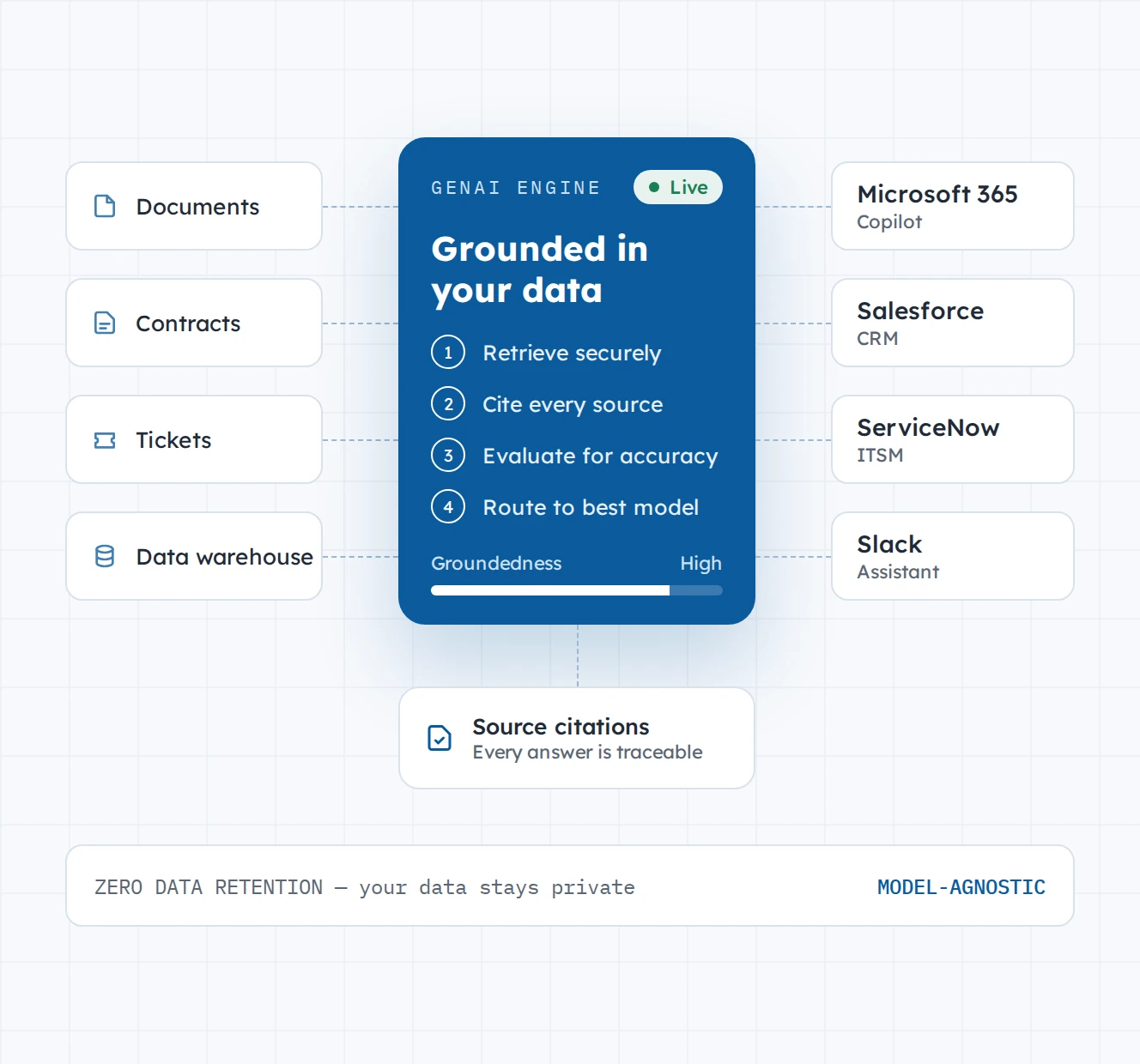
Give every employee an expert that has read everything your company knows, and cites it. We build retrieval-augmented generation on your documents, tickets, contracts, and data.
How it works
Works in
When off-the-shelf models don’t speak your domain, we adapt them: fine-tuning, distillation, and small language models tuned for accuracy, latency, and cost.
How it works
Works in
Copilots embedded where your teams already work: sales, support, engineering, finance, and operations.
How it works
Works in
We embed GenAI into the products and platforms you already run, and modernize legacy systems so they can support it.
How it works
Works in
Production AI needs production operations. We continuously monitor, evaluate, and optimize your models.
How it works
Works in
Stress-test your AI before attackers and auditors do.
How it works
Aligned to
Talk with our AI engineering team about your goals, workflows, data, and existing technology. We can help identify practical opportunities for generative AI and determine the right approach for implementation.
Why AppsChopper
Generative AI requires more than selecting a model or building a proof of concept. AppsChopper combines consulting, product engineering, AI expertise, and ongoing support to help organizations move from opportunity identification through implementation and continued optimization. Our teams work alongside your organization to build AI capabilities around your data, systems, workflows, and business objectives.
| Evaluation criteria |  | Consultancies | Dev Partners | Off-the-shelf GenAI SaaS |
|---|---|---|---|---|
| Path to production | Defined implementation roadmap | Strategy and implementation models vary | Development-focused | Typically ready to use within product constraints |
| Who does the work | Senior architects and engineers | Varies by engagement | Varies by provider and project | Primarily configured by your team |
| Model strategy | Model-agnostic and selected for the use case | May depend on engagement and technology partners | Varies by technical approach | Typically tied to the platform |
| IP and data ownership | Defined around your engagement and architecture | Contract dependent | Contract dependent | Governed by platform terms |
| Governance and evaluations | Considered throughout development | May be a separate workstream | Varies by project | Governed primarily by the platform |
| Ongoing accountability | Implementation, optimization, and ongoing support | Varies by engagement | Varies by engagement | Primarily the platform provider |
Tech stack we use
We work across leading foundation models, AI frameworks, cloud platforms, and enterprise technologies to select the right components for each use case. Our model-agnostic approach allows your AI architecture to evolve as models, capabilities, performance requirements, and business needs change.
A model router sends each task to the best-fit model
Illustrative routing: the right model per task is chosen by benchmarking on your data.
Foundation models
Orchestration & agents
Retrieval & data
Cloud & serving
Evaluation & LLMOps
Guardrails & security
Governance & compliance
We incorporate governance, testing, security, and transparency throughout the AI development lifecycle. Our approach helps your technical, security, legal, and compliance teams understand how AI systems are designed, evaluated, monitored, and operated within your organization.
Our AI lifecycle management follows the NIST AI Risk Management Framework and ISO/IEC 42001, with full auditability, risk mitigation, and continuous performance tracking.
Real-time guardrails block jailbreaks, PII leakage, and toxic outputs before they reach users, and automated red-teaming tests resilience against prompt injection.
Lineage tracking and explainability frameworks let risk and compliance teams inspect the reasoning behind every generated output.
How we deliver
Our four-stage process is designed to take an AI solution from initial use case to production in as little as six months, so your risk never outruns your results.
Approval gate · typical range shown for each stage
Rank use cases, assess data readiness, and set the baseline metrics you’ll use to judge us.
Gate: Business case approved
Build on your real data in a controlled environment. Measure accuracy, adoption, and projected ROI.
Gate: Success criteria met
Integrate, secure, evaluate, and roll out in phases.
Gate: Go-live readiness sign-off
LLMOps, cost tuning, new use cases, and quarterly value reviews.
Gate: Expansion roadmap approved
Security
Security is considered throughout the AI development lifecycle, from architecture and data flows through access controls, testing, monitoring, and deployment. We provide the technical documentation and security information your teams need to evaluate an AI implementation.
Talk With Our Team About SecurityWe can provide relevant architecture documentation, security questionnaires, data-flow information, and other materials required during technical, legal, and procurement reviews.
Where appropriate, AI solutions can be deployed within your AWS, Azure, or Google Cloud environment, with encryption and key-management practices aligned with your organization's requirements.
We design access controls around the principle of least privilege, using capabilities such as single sign-on (SSO), role-based permissions, and permission-aware retrieval where appropriate.
AI systems can incorporate logging and monitoring for relevant prompts, responses, system events, and agent actions, with retention and access policies defined according to your security and privacy requirements.
Data handling and retention are designed around the selected AI models, infrastructure, contractual requirements, and your organization's security policies. Where supported, we can use model and deployment configurations that prevent customer data from being used for provider model training.
Security documentation may include
FAQs
Straight answers on cost, timelines, data security, and IP ownership.
Talk to an AI architectThey cover strategy, use-case selection, data preparation, model selection, application and agent development, integration, evaluation, security, and ongoing operations. AppsChopper delivers all of it with one accountable team.
Most enterprise generative AI programs run from $15K for a strategy sprint to $350K+ for a full production build. Typical ranges by stage:
| AI Opportunity Sprint | $15K–$30K |
|---|---|
| Proof of Value | $30K–$90K |
| Production Build | $90K–$250K |
| Scale and Optimize | Monthly retainer |
Final cost depends on integrations, data complexity, and compliance needs. You get a fixed quote after a scoping call.
Most clients see a working proof of value in 4–8 weeks and a production release in 10–16 weeks.
No. We use enterprise endpoints with zero data retention or deploy models inside your own cloud tenant. Your data stays yours.
You do. Code, prompts, fine-tuned model weights, evaluation sets, and documentation transfer to you in full.
It depends on accuracy, latency, cost, and data-residency needs. We benchmark candidate models on your real tasks and recommend the best fit, often a mix of models routed by task.
RAG connects a model to your current knowledge at query time, with citations. Fine-tuning changes how the model behaves or writes. Most enterprise systems start with RAG and add fine-tuning only where it measurably improves results.
Agentic AI can plan and take actions across your systems. It’s safe when it runs with scoped permissions, human approval for high-impact steps, and full audit logs. That’s how we build it.
We ground answers in approved sources, require citations, automatically score groundedness, and block responses that fall below your accuracy threshold.
Yes. We often co-build with internal teams, fill specific skill gaps, and leave your people fully able to run what we deliver.
Talk to an AI expert
Have a generative AI use case you are exploring? Talk with our team about your business goals, existing technology, data, and implementation needs. We can help you evaluate the opportunity and discuss a practical path forward.
Tell us what you want to build. An AI expert will reply within one business day.