
Unclear business value
Agents need a defined business objective and measurable outcomes from the start, whether that means reducing manual effort, resolving more requests, accelerating operations, or improving revenue recovery.
Enterprise AI Agents · Built for Production
AppsChopper trains and develops AI agents that work within your existing systems, workflows, and business rules. From handling requests and retrieving information to making decisions and triggering actions, our agents are built to support real business processes with the controls, security, and human oversight enterprise environments require.
Trusted by Fortune 500 innovators and high-growth startups







The problem
Proving that an AI agent can work is only the first step. Production deployment requires a clear business case, reliable integration with enterprise systems, and the controls needed to operate safely at scale.
Agents need a defined business objective and measurable outcomes from the start, whether that means reducing manual effort, resolving more requests, accelerating operations, or improving revenue recovery.
Production agents must work reliably across the systems your teams already use, including customer platforms, ERP systems, service management tools, data sources, and internal applications, while respecting existing permissions and workflows.
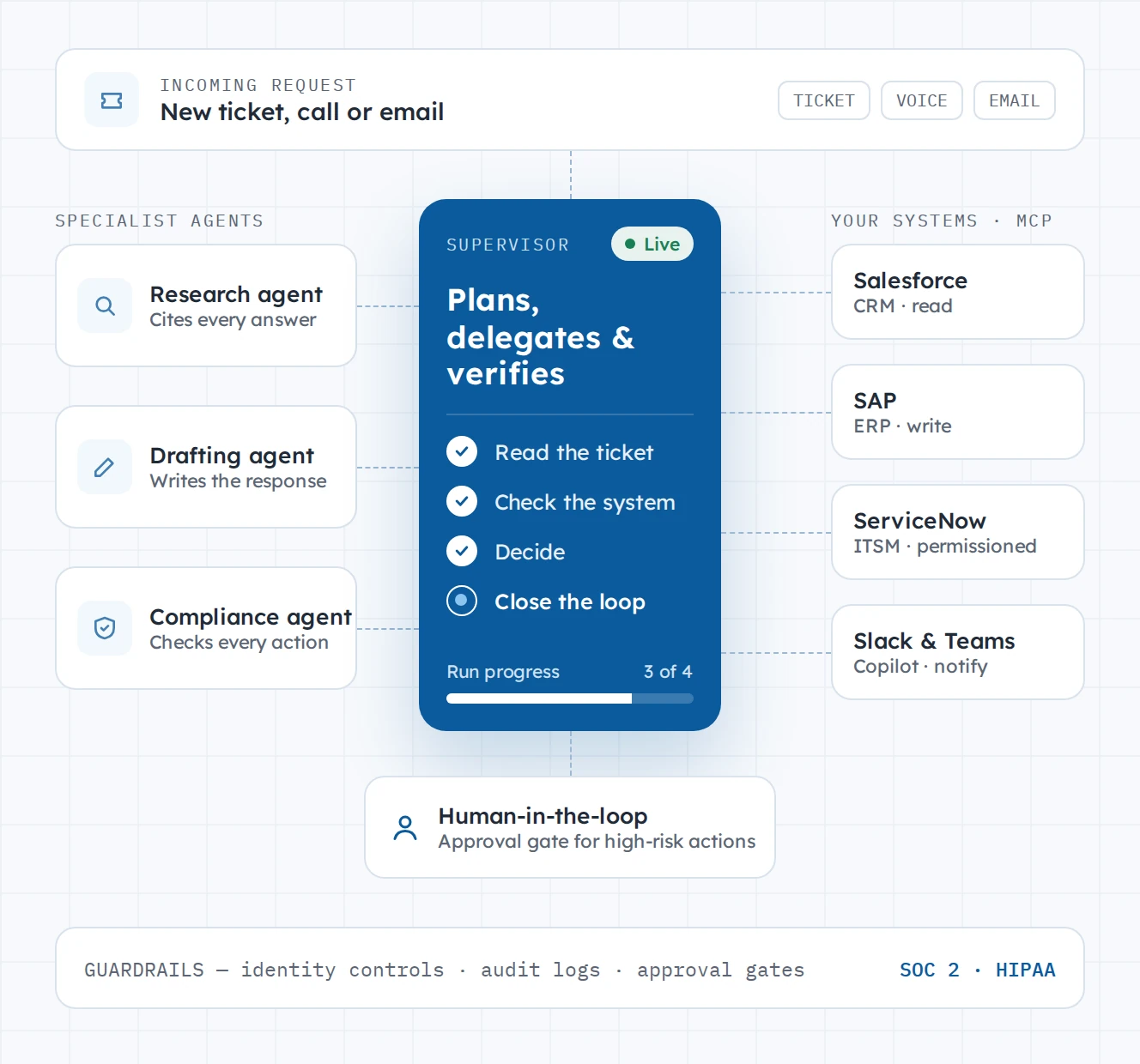
Enterprise agents require identity and access controls, auditability, approval workflows, monitoring, and human oversight to ensure actions remain within defined business and security policies.
Our services
AppsChopper designs, develops, integrates, and supports AI agents across enterprise workflows. We bring strategy, architecture, engineering, security, integration, and ongoing optimization together to move AI agents from an initial use case into production.
We assess workflows, evaluate use cases for business value, feasibility, and risk, and establish a prioritized roadmap for AI agent implementation.
Purpose-built agents designed around your data, systems, business rules, and operational requirements, with the functionality and controls needed for your specific environment.
Coordinated agent systems that assign specialized tasks, validate outputs, and manage complex workflows through defined orchestration and oversight.
Voice agents that handle customer and employee interactions, including inquiries, qualification, scheduling, and service requests, with escalation to human teams when needed.
AI agents grounded in enterprise documents, knowledge bases, and data sources to retrieve relevant information, provide traceable responses, and support knowledge-intensive workflows.
AI assistants embedded within collaboration tools, business applications, and internal portals to help employees retrieve information, summarize content, generate work, and complete tasks.
Secure integration with enterprise applications, APIs, data platforms, and internal systems, enabling agents to access information and take authorized actions within existing workflows.
Ongoing evaluation, monitoring, performance optimization, cost management, and model refinement to maintain agent reliability as business requirements and AI technologies evolve.
Identify Your Highest-Value AI Agent Opportunity
Book a free 30-minute session with an AI agent engineer to assess your workflows and identify where agentic AI can deliver the greatest business value. You’ll leave with up to three priority use cases, an initial ROI assessment, and a practical path from use case to production.
AI Agents for Enterprise Workflows
From healthcare operations and customer service to sales, IT, HR, and finance, we build AI agents that integrate with your existing systems and execute defined workflows with the appropriate controls and human oversight.
Automate patient intake, prior authorization, clinical documentation, trial recruitment, pharmacovigilance, and regulatory workflows while supporting applicable healthcare and life sciences compliance requirements.
How it works
Works in
Resolve routine service requests, process returns, update orders, and escalate complex cases with the relevant customer and interaction context.
How it works
Works in
Research accounts, enrich leads, prepare personalized outreach, update CRM records, and support meeting scheduling across the sales workflow.
How it works
Works in
Triage incidents, manage access requests, provision accounts, and execute approved operational runbooks across IT environments.
How it works
Works in
Support employee questions, onboarding, PTO, benefits, and other HR workflows using approved policies and employee data.
How it works
Works in
Automate invoice matching, exception handling, reconciliation, and financial reporting while maintaining the records and audit trails required for review.
How it works
Works in
Not sure which AI agent to build first?
Share your workflow, goals, and current systems with our team. We’ll help identify where an AI agent can create the most value and outline the next steps.
Benefits you get
AI agents operating in enterprise environments need more than capable models. They need defined permissions, human oversight, auditability, security controls, and deployment options that align with your existing environment.
Agents operate within defined roles and permissions through single sign-on (SSO) and role-based access control (RBAC), limiting access to the information and actions each user is authorized to access.
High-impact actions like refunds, payments, and record changes can be routed to authorized users for review before execution.
Agent interactions, tool calls, actions, and decisions can be logged and made available for monitoring, review, and audit requirements.
Agents are designed with controls for prompt injection, sensitive data exposure, inappropriate outputs, and unauthorized actions, with testing performed before production deployment.
Deploy within your preferred environment, including AWS, Microsoft Azure, Google Cloud, private infrastructure, or on-premises environments, with model options based on your requirements.
Solutions can be designed to support applicable requirements and frameworks.
Voice agents
AI voice agents can handle inbound and outbound conversations, connect with your business systems, and execute defined workflows at scale. AppsChopper builds voice experiences around your business logic, with escalation to human teams when conversations require additional support.
Technology stack we use
We’re platform-agnostic. We select the models, frameworks, platforms, and supporting technologies that align with your security requirements, existing systems, business needs, and budget.
Foundation models
Agent frameworks
Enterprise platforms
Tool connectivity
Memory and retrieval
Voice
Observability and evals
Process
From discovery to deployment, a proven six-step path that takes your AI agent from idea to production in weeks.
Workflow mapping, data assessment, use case validation, feasibility analysis, and KPI definition establish the business case and requirements.
Agent architecture, system integrations, tool access, guardrails, human-in-the-loop points, security requirements, and deployment architecture are defined.
Agile development sprints build the agent, integrations, workflows, and supporting interfaces, with regular demonstrations and stakeholder reviews.
Accuracy benchmarks and performance testing, security testing and red-teaming, load testing, evaluation against defined scenarios, and user acceptance validate the agent before production.
Production deployment includes phased rollout, system integration, monitoring, documentation, and training for teams working with the agent.
Post-production monitoring, performance and cost optimization, model and workflow refinement, and expansion to additional use cases.
Why AppsChopper
Agencies hand over code. We stay accountable for results. Here’s the difference between a typical AI agent development agency and an AI agent development partner.
| Criteria | AppsChopper |
|---|---|
| Starting point | Business objectives, workflow requirements, and measurable KPIs |
| Integrations | Enterprise application, API, data, and tool integrations across existing environments |
| Security | Security and governance requirements incorporated into architecture and development |
| Model choice | Model-agnostic approach based on use case, performance, security, cost, and deployment requirements |
| Post-launch | Monitoring, evaluation, optimization, and expansion to additional workflows |
| Pricing | Defined phases and milestones with clear scope, deliverables, and review points |
Engagement models
Choose an engagement model based on the scope of your use case, number of workflows, and long-term AI agent requirements.
One high-value use case developed to production standards, with the integrations, controls, evaluation, and business-value assessment needed to determine the next step.
Talk to usA coordinated portfolio of AI agents across departments, supported by shared architecture, integrations, orchestration, governance, and a roadmap for continued expansion.
Talk to usA cross-functional team of AI engineers, architects, and AgentOps specialists working alongside your organization to develop, operate, optimize, and expand AI agent capabilities.
Talk to usFAQs
Scope, timelines, cost, and integrations, answered.
Discuss Your AI Agent OpportunityAI agent development services cover the strategy, design, engineering, integration, and ongoing management of AI agents: software that can reason through a goal, use tools and systems, and take action with minimal human input. Unlike chatbots, agents complete tasks, not just conversations.
A chatbot primarily responds to questions. Robotic Process Automation (RPA) follows predefined rules and workflows. An AI agent can interpret a request, determine the appropriate next step, use connected tools and systems, and adapt its workflow based on the context, while operating within defined business rules and controls.
Our AI agent development company services include use case discovery, custom agent and multi-agent development, voice agents, system integration, security and governance, evaluation, deployment, and post-launch AgentOps.
A focused agent pilot can typically be delivered in 6–8 weeks. A medium-complexity production agent typically takes 8–12 weeks, depending on integrations, data, security requirements, and workflow complexity. Larger multi-agent programs can run 3–6 months, delivered in phases.
Cost depends on complexity, integrations, and compliance scope. Focused pilots and enterprise programs are both scoped in fixed phases. We share a detailed estimate after a free discovery session.
We’re model-agnostic and work with OpenAI, Anthropic, Google, Meta, and Mistral models, plus platforms like Microsoft Copilot Studio, Amazon Bedrock, Vertex AI, and Salesforce Agentforce.
Yes. We integrate AI agents with enterprise applications such as Salesforce, SAP, Oracle, Workday, ServiceNow, Epic, and Microsoft 365, as well as custom applications and APIs. We can also use the Model Context Protocol (MCP) where appropriate to provide controlled access to connected tools and systems.
Get started
Book a 30-minute strategy session with an AppsChopper AI agent expert. No obligation.
An AppsChopper AI agent expert will reply within one business day. No obligation.