
Unstructured Data
Business-critical information sits in emails, PDFs, contracts, and conversations that traditional rule-based automation cannot reliably interpret.
Intelligent automation
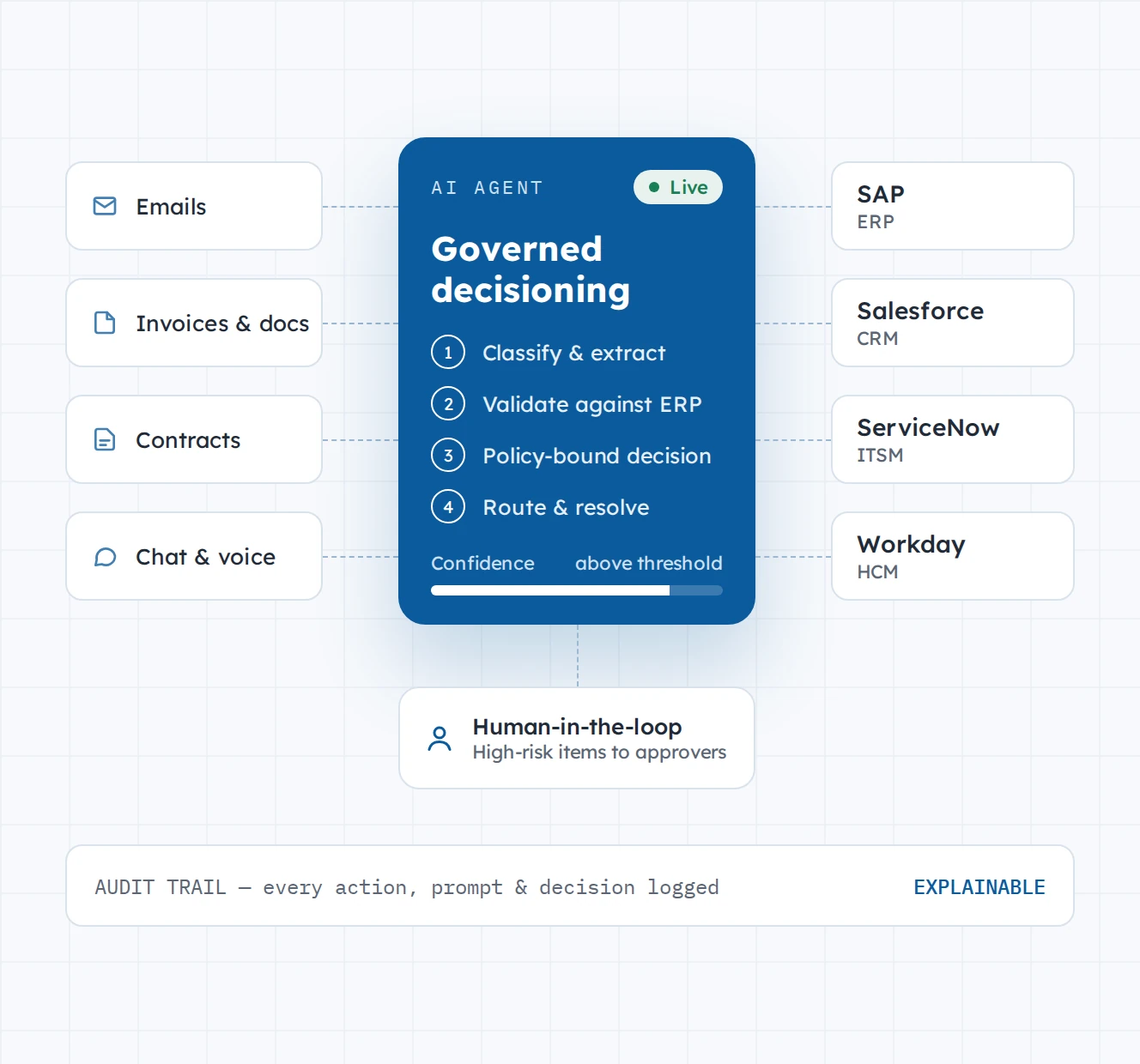
AppsChopper designs, builds, and operates AI-powered automation that executes complex workflows across enterprise systems. Combining AI agents, governed decision-making, and system integration, we automate document processing, operational decisions, and cross-platform tasks with the controls, reliability, and oversight business operations require.
Trusted by Fortune 500 innovators and high-growth startups







Why enterprise workflows break down
Fragmented workflows, manual data handling, and disconnected systems limit operational efficiency as businesses scale. Repetitive tasks consume skilled resources, exceptions create processing delays, and inconsistent handoffs increase error rates and compliance exposure.
Business-critical information sits in emails, PDFs, contracts, and conversations that traditional rule-based automation cannot reliably interpret.
Rule-based automation handles predefined scenarios but struggles with exceptions, leaving complex cases dependent on manual review and intervention.
ERP, CRM, IT service management, human resources platforms, and legacy applications operate in silos, creating data gaps and manual handoffs across workflows.
Manual documentation, fragmented records, and inconsistent audit trails make compliance oversight more resource-intensive and difficult to maintain at scale.
What changes
AppsChopper builds AI automation that combines large language models (LLMs), document intelligence, machine learning, and workflow orchestration to execute complex business processes. AI agents interpret business context, process exceptions, and coordinate actions across systems, with defined policies, human oversight, and auditability.
| Capability | Traditional RPA | AppsChopper Agentic AI Automation |
|---|---|---|
| Input types | Primarily structured data and predefined formats | Documents, emails, images, conversations, and structured data |
| Exception handling | Stops or escalates when rules fail | Interprets context to resolve, route, or escalate exceptions within defined boundaries |
| Change tolerance | Breaks when screens or formats change | Uses AI to interpret variations in layouts, formats, and inputs |
| Decision-making | Hard-coded if/then rules | Policy-bound AI decisions with confidence scoring |
| Scope | Single tasks and defined sequences | Coordinates multi-step workflows across connected systems |
| Process Improvement | Manual reprogramming and configuration | Continuous learning from human feedback through controlled evaluation and updates |
| Governance | Bot logs and rule-based controls | Full audit trail, explainability, policy enforcement, and human-in-the-loop checkpoints |
Services we offer
AppsChopper supports the full automation lifecycle, from identifying high-value opportunities and designing workflows to engineering integrations, deploying AI agents, and maintaining production operations.
We map your processes, score each by ROI and feasibility, risk, and deliver a prioritized automation opportunities roadmap unique to your business impact needs.
Analyze process data, workflow dependencies, bottlenecks, and exception patterns to identify inefficiencies and determine where automation can deliver measurable value.
Purpose-built AI process automation services engineered around your data, systems, policies, and business processes.
We provide secure, event-driven integration with ERP, CRM, HCM, ITSM, data platforms, and legacy mainframe systems.
Move from aging schedulers and scripted bots to AI-native orchestration with zero disruption to live operations.
Establish governance controls for AI-driven workflows, including access permissions, human review, auditability, and risk management aligned with applicable frameworks such as the NIST AI Risk Management Framework and ISO/IEC 42001.
Support deployed automation through scalable monitoring, incident resolution, performance tracking, and ongoing workflow optimization based on agreed service levels.
Training, playbooks, and adoption programs that turn skeptics into power users and build an internal Center of Excellence.
Where Is Manual Work Costing You the Most?
We map your processes. We rank them by ROI. You get a roadmap in weeks.
Our solutions
AppsChopper delivers AI-powered automation across business processes, document-intensive workflows, operational decision-making, and existing automation environments. Each solution is designed around your systems, business rules, governance requirements, and operational objectives.
Solution 01
We deploy agents that own an entire workflow, from intake to resolution. Our AI agents for business process automation triage requests, pull context from your systems of record, make policy-bound decisions, and hand off to people only when judgment is required.
What you get
Solution 02
Turn invoices, contracts, claims, Know Your Customer (KYC) files and other identity documentation, and purchase orders into clean, validated data. Our IDP pipelines classify, extract, and cross-check information against your ERP and master data, then route exceptions with the reason attached.
What you get
Solution 03
Embed machine learning and LLM reasoning directly into approvals, routing, pricing, and risk checks. Combine AI-generated recommendations with deterministic business rules and workflow orchestration to support consistent execution, traceability, and oversight across connected environments.
What you get
Solution 04
Extend existing robotic process automation (RPA) investments by identifying fragile workflows, addressing maintenance bottlenecks, and introducing AI capabilities where traditional scripts struggle with unstructured inputs or exceptions. Modernize existing automation incrementally while preserving useful components and integrations.
What you get
Capabilities
AppsChopper builds AI automation around enterprise systems, operational controls, and measurable business outcomes. Our approach combines system integration, workflow orchestration, performance monitoring, and governance to support reliable deployment and ongoing optimization.
End-to-end process visibility
Monitor workflow execution, agent activity, processing status, and exceptions across integrated enterprise systems.
Enterprise Systems Integration
Connect automation to ERP, CRM, IT service management, human resources, data platforms, and legacy applications through APIs, connectors, and custom integration layers.
Model-agnostic architecture
Integrate models from OpenAI, Anthropic, Google, Meta, and private model deployments, swappable as the market moves, based on performance, security, cost, and business requirements.
Predictive exception management
Spot bottlenecks and service-level agreement (SLA) risks using workflow data and operational analytics.
Performance analytics
Track cycle time, automation rates, exception volumes, touchless rate, cost per transaction, and realized operational savings against defined performance metrics.
Low-code workflow studio
Business teams adjust rules and prompts without waiting on a sprint.
Human-in-the-loop controls
Apply approval gates, confidence thresholds, escalation rules, and human overrides to keep automated actions within defined operational boundaries.
Continuous performance optimization
Monitor model accuracy, workflow reliability, latency, and operating costs to identify performance degradation and prioritize controlled improvements.
Governance and security
AppsChopper designs AI automation with security controls, human oversight, and traceability built into the solution architecture. Our approach supports enterprise security reviews, risk management, and alignment with applicable regulatory requirements and governance frameworks.
Human-in-the-loop by design
Define approval requirements, escalation paths, and human review checkpoints for high-impact or sensitive automated actions.
Private, zero-retention AI
Models run in your cloud tenant or through zero-retention enterprise endpoints. Your data never trains third-party models.
Full auditability and decision tracing
Capture configured workflow events, agent actions, decision records, and supporting context to support operational reviews, investigations, and audits.
AI Guardrails and evaluation
Hallucination checks, policy filters, and red-team/adversarial testing before and after go-live.
Access, Identity, and Data Security
Integrate single sign-on (SSO), role-based access controls, and encryption in transit and at rest, based on solution requirements and the client's security architecture.
Compliance aligned implementation
Controls designed to meet HIPAA, SOC 2, GDPR, CCPA, and SOX requirements.
How we deliver
AppsChopper follows a four-stage delivery process with defined milestones, measurable success criteria, and stakeholder approvals at each gate. Each stage establishes the requirements for the next, from use-case prioritization through deployment and ongoing optimization.
Process mining, stakeholder interviews, and an ROI-ranked use-case backlog.
Gate: Business case approved
A production-grade pilot on your real data, measured against agreed baselines.
Gate: Success metrics met
Enterprise integration, security review, UAT, and phased rollout.
Gate: Go-live sign-off
New workflows, model tuning, and managed operations that compound returns quarter over quarter.
Gate: Quarterly ROI review
Case studies
Tres Health · Health insurance platform
Automated broker and member onboarding cut onboarding time, sped up claims resolution, and removed most broker admin work.
NeuCup · Diagnostics provider
AI-driven home urinalysis, nicotine testing, and streamlined clinic workflows while removing most manual coordination between teams.
Which Workflow Is Quietly Draining Your Margins?
Rework and handoffs hide in plain sight. We find them. You fix the costliest first.
Why AppsChopper
AppsChopper brings strategy, software engineering, AI integration, and implementation together under one team. We build automation around your workflows, systems, and governance requirements, with clear delivery milestones and ownership terms defined from the outset.
| Criteria | AppsChopper | Tool resellers | Big-four consultancies |
|---|---|---|---|
| Technology choice | Platform-agnostic selection informed by your technologies, workflow requirements, and existing systems | Primarily centered on its own platform and ecosystem | Often works within established technology partnerships and enterprise architectures |
| Delivery | Direct software engineering, AI implementation, and integration | Platform implementation and configuration | Strategy, transformation programs, and implementation services |
| Implementation Approach | Phased delivery tied to defined use cases and success criteria | Typically structured around platform capabilities | Often structured around broader transformation scope and program milestones |
| Ownership | Code, integrations, prompts, and IP ownership defined in the project agreement | May depend on platform licensing and contract terms | Depends on engagement terms, deliverables, and IP agreements |
| Accountability | Outcome-based metrics agreed operational delivery milestones | Platform usage, adoption, and automation metrics | Program deliverables and agreed engagement outcomes |
It uses large language models, machine learning, and orchestration to run complete business processes across systems. It reads unstructured inputs, makes governed decisions, handles exceptions, and routes high-risk items to people.
Robotic process automation (RPA) follows fixed scripts and breaks when inputs change. Agentic AI automation understands context, reasons through exceptions, and adapts to new formats. Most enterprises get the best results by pairing their existing RPA with an AI layer.
If you’re deciding how to automate workflows with AI, start with high-volume, rules-heavy processes that involve documents or handoffs, such as invoice processing, onboarding, ticket triage, and claims intake. Our assessment ranks candidates by ROI and feasibility.
A first workflow typically reaches production in 10 to 16 weeks, including a 4- to 6-week pilot. Later workflows move faster because integrations and governance are already in place.
Most enterprise engagements range from $40,000 to $350,000+. A focused pilot typically runs $40,000–$90,000, while a production-grade, multi-system rollout costs $120,000–$350,000+. Final pricing depends on workflow complexity, integrations, and compliance needs. Assessments start at $15,000.
Yes. We integrate with SAP, Oracle, Salesforce, ServiceNow, Workday, Microsoft 365, and custom or legacy applications through APIs, event streams, and, where needed, UI automation.
Models run in your cloud tenant or through zero-retention enterprise endpoints. Data is encrypted, access is role-based, and every action is logged for audit.
No. We extend what you have. We rationalize fragile bots and add AI where scripts fail, so you protect your existing investment.
Discuss Your Automation Needs
Tell us where manual work, process delays, or disconnected systems are affecting operations. Our team will review your requirements and discuss where AI-powered automation may fit your workflows, systems, and business objectives.
Share a few details about your business and automation needs. Our team will review your request and respond within one business day.