
Alert fatigue
When alerts are duplicated, noisy, or irrelevant, critical incidents can be buried in the volume. The result is slower response and increased pressure on on-call teams.
AI for IT operations
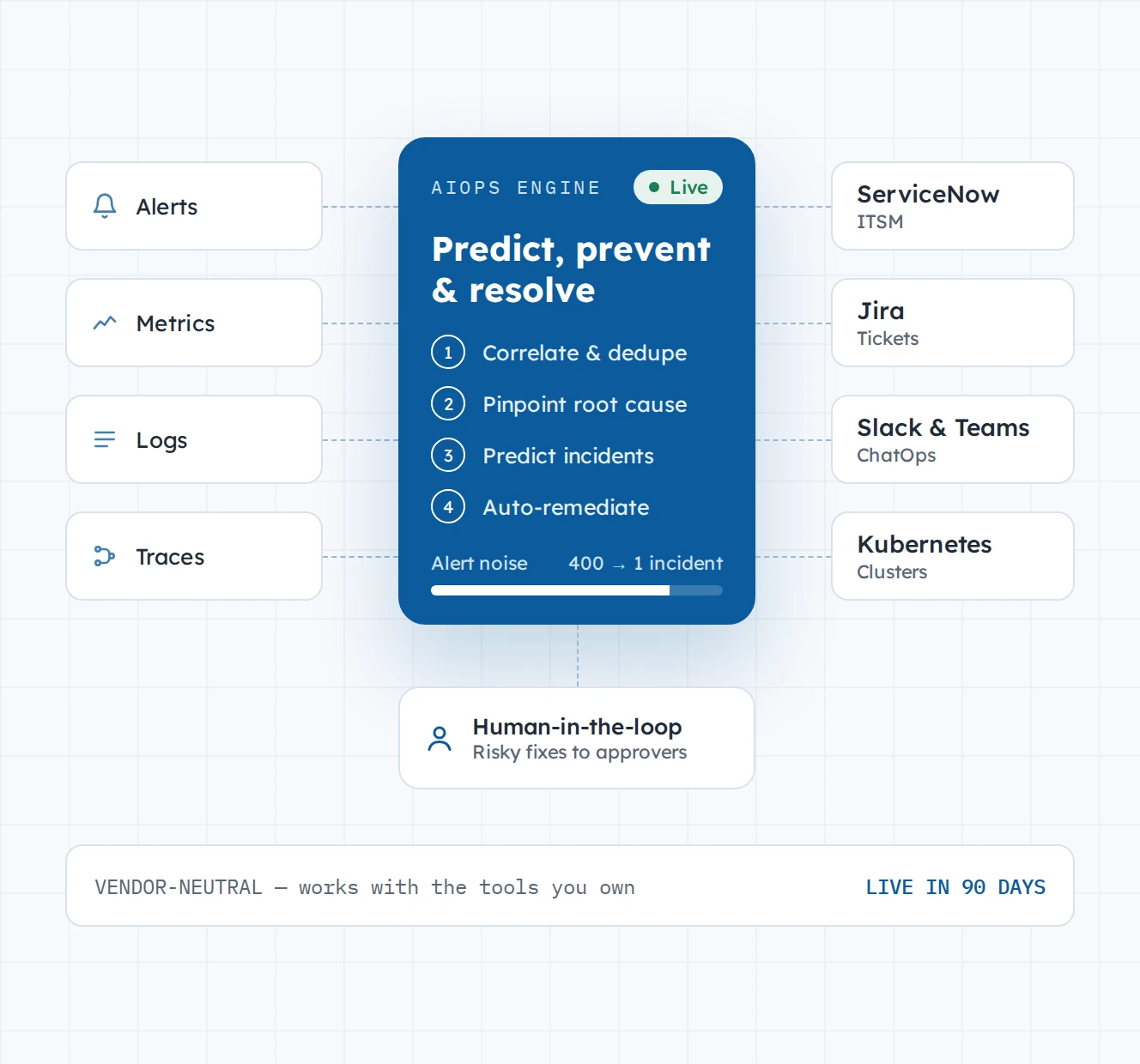
Your IT environment generates millions of signals across applications, infrastructure, cloud services, and security systems. AppsChopper builds enterprise AIOps solutions that correlate those signals, identify the issues that matter, pinpoint root causes, and automate routine remediation. The result is faster incident resolution, fewer disruptions, and more efficient IT operations.
Trusted by renowned industry leaders







Revenue at risk
Every minute an order system, patient portal, or insurance platform is unavailable can mean lost revenue, SLA credits, operational disruption, and reduced customer trust. Yet many IT teams still manage incidents across disconnected monitoring tools, duplicate alerts, and manual investigation. AIOps correlates signals across the environment to identify what matters, isolate root causes, and accelerate resolution.
One real incident, buried in an alert storm
alerts per minuteWhen alerts are duplicated, noisy, or irrelevant, critical incidents can be buried in the volume. The result is slower response and increased pressure on on-call teams.
Metrics, logs, traces, tickets, and infrastructure data often sit across separate platforms. Without correlation, teams lack a unified view of the incident and its business impact.
Microservices, Kubernetes, cloud infrastructure, and distributed applications create complex dependencies that are difficult to track manually. Engineers spend valuable time connecting signals and identifying the source of an incident instead of resolving it.
What changes
Dashboards and telemetry give IT teams visibility into what is happening across their environment. AppsChopper adds the intelligence layer that correlates signals, prioritizes incidents by business impact, identifies likely root causes, and automates remediation for known issues.
| What matters | Traditional monitoring | Telemetry platforms | AppsChopper AIOps |
|---|---|---|---|
| Core question | Is it up? | What is happening inside? | What will break, why, and what’s the fix? |
| Alerts | Static thresholds, high noise | Richer data, same noise | Correlated, deduplicated, ranked by business impact |
| Finding the cause | Manual investigation | Faster manual search | AI identifies likely root cause with supporting evidence |
| Response | Human-driven | Human-driven | Automated for known issues, guided for new ones |
| Timing | Reactive | Reactive | Predictive and proactive |
The platform
AppsChopper AIOps can be implemented pillar by pillar or as a closed-loop operating model, connecting detection, diagnosis, prevention, and remediation from the first signal through verified resolution.
Pillar 01
We ingest alerts, metrics, logs, traces, and change events across your existing IT environment. Machine learning and topology mapping correlate related signals and reduce thousands of alerts to a focused set of actionable incidents.
What you get
Pillar 02
AI analyzes service dependencies, system behavior, and recent changes to identify the most probable cause of an incident. Supporting evidence gives engineers the context they need to validate the diagnosis and route it to the right team.
What you get
Pillar 03
Forecasting and anomaly detection identify capacity constraints, performance degradation, unusual system behavior, and other leading indicators before they become critical incidents.
What you get
Pillar 04
AI agents execute approved runbooks when known issues occur, handling routine remediation without waiting for manual intervention. New or high-risk actions can be routed to an engineer for approval before execution.
What you get
Benefits we provide
A governed, vendor-neutral intelligence layer that gives IT teams the visibility, context, and automation needed to detect, understand, and resolve incidents across complex environments.
Full-stack visibility
Applications, infrastructure, networks, cloud environments, and end-user experience in one operational view.
Unified data layer
Metrics, events, logs, traces, and topology data normalized for correlation and AI analysis.
Natural-language queries
Ask questions like “why is checkout slow in us-east?” and receive an evidence-backed analysis.
Executive dashboards
Translate uptime, incidents, service levels, and operational performance into business impact and risk.
Hybrid and multi-cloud
Connect AWS, Microsoft Azure, Google Cloud, and on-premises environments through one operational model.
Continuous learning
Improve detection, diagnosis, and remediation as the system learns from validated incident outcomes.
Security built in
Role-based access controls, encryption in transit and at rest, audit logging, and governed access to operational data.
Open APIs
Connect custom applications, legacy systems, and existing IT tools without waiting for a vendor roadmap.
Tech integration
No rip-and-replace. AppsChopper connects AIOps capabilities to your existing monitoring, observability, IT service management, cloud, and collaboration tools, along with custom and legacy systems through open APIs.
Monitoring & observability
ITSM
ChatOps
Open standards
Governance
Automation should reduce operational risk, not introduce new risk. AppsChopper gives your teams control over which actions can run automatically, which require approval, and which always remain human-led.
See how approvals workAutomate approved, low-risk actions while requiring human approval for higher-risk remediation.
For new or high-risk incidents, AI provides evidence, recommended actions, and supporting context while people make the final decision.
Reverse automated changes quickly when an action produces an unexpected result.
Correlations, diagnoses, recommendations, and remediation actions include supporting evidence.
Track what changed, when it changed, and whether the action was initiated by an AI agent or a human.
Role-based access, encryption in transit and at rest, audit controls, and architecture designed to support SOC 2 and HIPAA requirements.
Our process
Each phase ends with a go/no-go review against agreed KPIs, so investment decisions are tied to measurable operational outcomes.
Go/no-go review against agreed KPIs
Audit your tools, data, dependencies, and incident history. Establish baselines for alert volume, incident resolution time, and other agreed KPIs.
Gate: KPI baseline approved
Integrate priority data sources and deploy event correlation and anomaly detection. Validate measurable reductions in alert noise using live operational data.
Gate: alert-noise reduction target met
Deploy AI-assisted diagnosis and governed automation for the highest-value recurring incidents. Validate the first automated runbooks in production.
Gate: first approved runbooks in production
Expand coverage, improve models and automation, and introduce additional predictive use cases based on operational priorities and performance against established KPIs.
Monthly value report
Why AppsChopper
No vendor lock-in, no big-bang rollout, and no black-box automation. AppsChopper delivers measurable improvements through phased implementation, governed automation, and technology ownership aligned to your requirements.
| What you need | What AppsChopper delivers |
|---|---|
| No vendor lock-in | Vendor-neutral architecture that works with your existing monitoring, observability, ITSM, cloud, and infrastructure tools |
| Proof before scale | Phased delivery with go/no-go gates tied to real operational KPIs |
| AI depth, not just integration | Custom AI engineering across machine learning, GenAI, agents, correlation, prediction, and automation |
| Enterprise security | Governance and security controls including access controls, audit trails, encryption, and compliance-aligned architecture |
| Full ownership | Ownership of the solution and deliverables structured around your requirements and engagement agreement |
Engagement models
Choose the level of engagement that fits your current environment, priorities, and AIOps maturity.
A roadmap you can act on, with or without us.
Talk to usA dedicated squad delivering all four phases, from assessment to the first automated fixes.
Talk to usWe operate, retrain, and report monthly on the value delivered.
Talk to usFAQs
Tools, timelines, ROI, safety, and governance, answered.
Discuss Your AIOps NeedsAIOps (artificial intelligence for IT operations) applies machine learning and automation to IT data to detect, diagnose, and resolve incidents faster than people can manually. It correlates signals across tools, identifies the cause, predicts failures, and automates routine fixes.
No. We integrate with Datadog, Dynatrace, Splunk, New Relic, ServiceNow, and others through APIs and OpenTelemetry. Most clients consolidate some tools over time, but nothing is ripped out on day one.
Most clients see measurable noise cuts within 8 weeks and governed automated fixes within 90 days. Timelines depend on data quality and the number of sources.
We baseline alert volume, resolution time, incident count, engineering hours, and tool spend in the assessment, then report against those numbers at every phase gate.
Yes, when it’s governed. Low-risk fixes run automatically; anything else needs human approval. Every action is logged and reversible.
Yes. We design deployments for HIPAA, SOC 2, and PCI DSS environments, with built-in data residency, access controls, and audit trails.
Talk to Our AIOps Team
Tell us where your alerts, incidents, and operational bottlenecks are today. Our team will discuss your environment, priorities, and where AIOps can deliver the greatest operational impact.
Tell us about your environment and priorities. A member of our team will follow up within one business day.