Table of Contents
The driver of the manufacturing industry has always been focused on efficiency. And to be fair, to take this into consideration, from the earliest assembly lines to today’s connected factories, the industry’s success has depended on producing more products just in time. Not only that, but it has also depended on maintaining quality while using fewer resources.
However, when times change and the industry demands transformation, the modern manufacturers face a new set of challenges. Volatile customer demand, supply chain disruptions, and labor shortages require manufacturers to adapt quickly. While the expertise and precision remain central, process automation is needed at an alarming speed.
And in those circumstances, AI in manufacturing is becoming a practical solution to these challenges, making its implementation imperative. Over the past few years, AI has transformed manufacturing workflows and operational processes. The market size has reached $5.32 billion in 2024 and is estimated to reach $47.9 billion in 2030.
Keeping the above in mind, it is significant to overcome the doubts regarding the change and how leading manufacturers have transformed. Since the ones who have already made a change in terms of AI in manufacturing processes have observed a linear and smooth supply chain system and built revenue streams worth billions.
With that as a focus, let’s take a dive into this bifurcation for understanding the use of AI and subsets in the manufacturing industry and how to build AI apps for the same.
What is AI in Manufacturing?
In simple terms, AI in manufacturing refers to the application of AI technologies to augment the overall industrial processes and automate repetitive tasks. The implementation has also assisted in building support for data-driven decision-making throughout the manufacturing lifecycle.
To be fair, traditional automation systems operate on predefined rules, whereas AI systems continuously learn from data. The technology has enabled the manufacturing businesses to recognize market trends, detect system and equipment anomalies, and forecast future outcomes based on changing conditions. This has enabled business leaders to make data-driven decisions that are aligned with the customers and bring in revenue, predicated on the investment.
What are The Benefits of AI in Manufacturing?
So far, we have explored that businesses are bringing in the application of AI and agentic AI in the manufacturing industry. However, the reasoning behind it has been a little lacking for the decision-makers. Well, in that case, we must understand that business productivity, operational efficiency, and ROI have a huge role in it.
To better comprehend the benefits, let’s take a look at the role of AI in manufacturing.
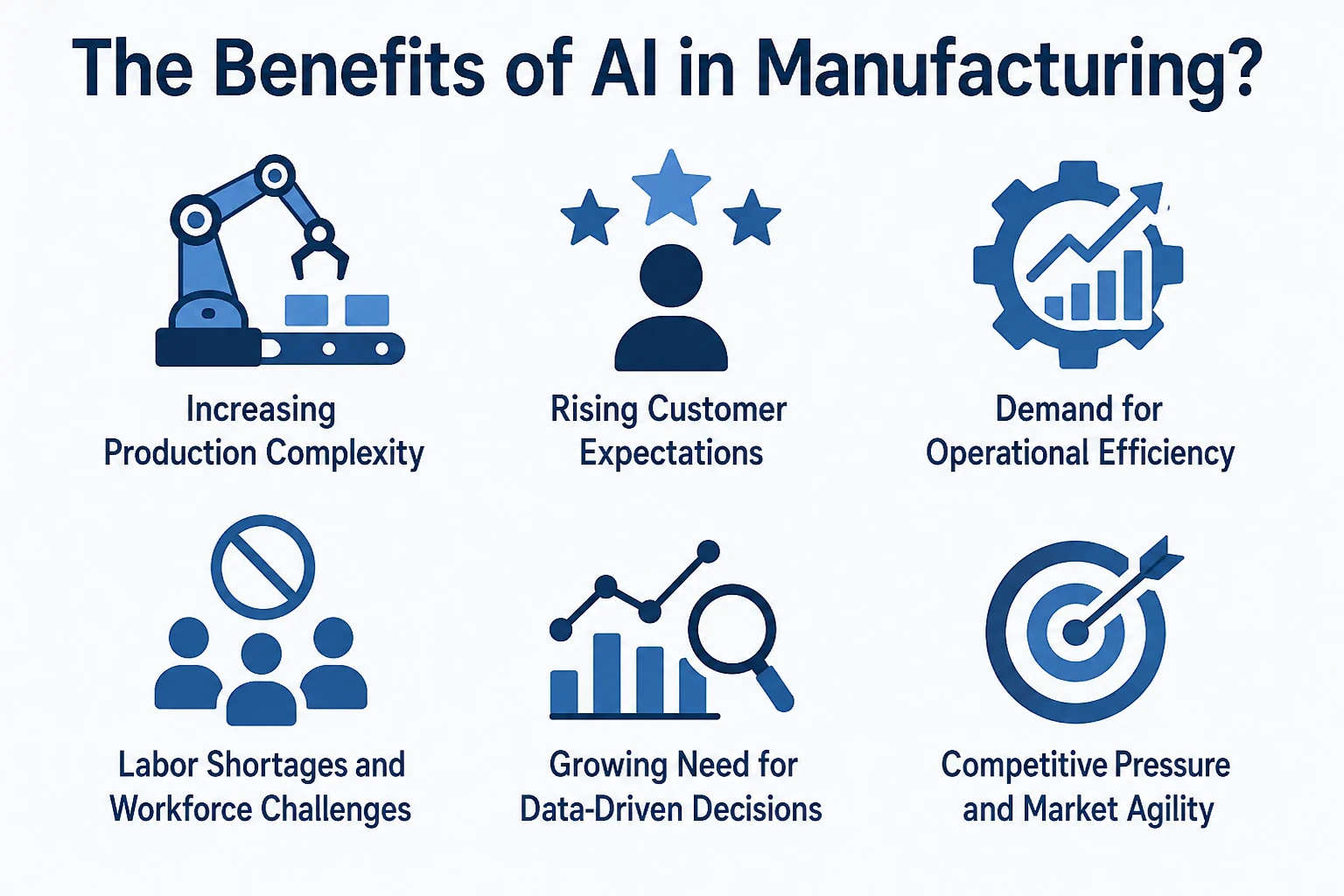
 Increasing Production Complexity
Manufacturing processes have become increasingly sophisticated. Companies often manage multiple production lines, global supplier networks, customized product configurations, and stringent quality standards simultaneously.
Traditional systems struggle to process the volume and complexity of data generated within these environments. AI helps manufacturers uncover hidden relationships between variables and optimize production activities more effectively.
Rising Customer Expectations
Customers today expect faster delivery, higher product quality, and personalized offerings without increased costs.
AI enables manufacturers to respond to these expectations by improving demand forecasting, minimizing defects, and supporting flexible production capabilities that adapt to changing customer requirements.
Demand for Operational Efficiency
Operational inefficiencies can significantly impact profitability. Unexpected equipment failures, production bottlenecks, and excessive resource consumption increase costs and reduce competitiveness.
AI provides continuous visibility into manufacturing processes, allowing organizations to identify inefficiencies and implement improvements before they affect output.
Labor Shortages and Workforce Challenges
Many manufacturing sectors face persistent shortages of skilled workers. At the same time, experienced employees are approaching retirement, creating knowledge gaps within organizations.
AI-powered automation can support workers by handling repetitive tasks, assisting with decision-making, and improving productivity without compromising safety or quality.
Growing Need for Data-Driven Decisions
Manufacturers generate enormous volumes of operational data every day. However, data alone does not create value.
AI transforms raw information into meaningful insights, helping organizations make informed decisions related to maintenance, production planning, inventory management, and quality assurance.
Competitive Pressure and Market Agility
Markets are evolving rapidly, requiring manufacturers to adapt quickly to disruptions and changing customer demands.
Organizations that effectively leverage AI can improve responsiveness, reduce operational risks, and maintain a stronger competitive position within their industries.
How AI Works in Manufacturing Environments?
Now that we have understood the benefits of AI in manufacturing, it is time to take the functioning into consideration. Understanding how AI functions within a manufacturing environment is critical to successful implementation. The effectiveness of AI depends largely on its ability to collect, process, and learn from manufacturing data.
Data Collection
AI systems require access to reliable and diverse data sources to generate meaningful outcomes.
IoT sensors
Industrial IoT sensors continuously monitor variables such as temperature, vibration, pressure, humidity, and machine performance. These real-time inputs help ML models detect abnormal conditions and identify opportunities for optimization.
Smart devices
Connected devices deployed across manufacturing facilities provide additional operational insights that contribute to predictive and analytical capabilities.
Production equipment
Modern machinery often includes embedded systems capable of transmitting performance data that can be analyzed for maintenance and efficiency improvements.
ERP and MES systems
Enterprise Resource Planning (ERP) and Manufacturing Execution Systems (MES) contain valuable information related to inventory levels, production schedules, procurement activities, and operational workflows.
Integrating these systems with AI creates a more comprehensive view of manufacturing performance.
Data Processing and Analysis
Once data is collected, AI algorithms clean, organize, and analyze it to uncover patterns that may not be immediately visible to human operators.
Pattern Recognition
The AI softwares uses historical and real-time data, and can forecast future events such as machine failures, demand fluctuations, or supply chain disruptions.
Predictive Modeling
AI systems can process information continuously and generate recommendations that support immediate operational decisions.
Real-Time Decision-Making
AI systems can process information continuously and generate recommendations that support immediate operational decisions.
Continuous Learning and Optimization
Unlike static systems, AI models improve over time as they are exposed to additional data, increasing accuracy and effectiveness across manufacturing operations.
What are the Most Common AI Use Cases in Manufacturing?
Coming to significant applications of AI, let us understand how they can be used in the industry to ensure workflow efficacy and precision functioning.
1. Predictive Maintenance
Traditional maintenance strategies often rely on fixed schedules or reactive repairs after failures occur. AI introduces a predictive approach by analyzing equipment data to identify early indicators of malfunction. This enables maintenance teams to intervene before unexpected breakdowns disrupt production. Predictive maintenance reduces downtime, extends asset lifespan, and lowers maintenance expenses.
2. Quality Inspection and Defect Detection
Maintaining consistent quality is critical in manufacturing. Computer vision systems powered by AI can inspect products at high speed, detecting surface defects, dimensional inconsistencies, or assembly errors with remarkable precision. This minimizes reliance on manual inspections while improving overall product quality.
3. Production Process Optimization
Manufacturing operations involve countless variables that influence efficiency. AI analyzes production data to identify bottlenecks, optimize workflows, improve resource allocation, and recommend adjustments that enhance throughput without compromising quality.
4. Demand Forecasting
Inaccurate forecasting often leads to overproduction or stock shortages. AI models evaluate historical sales data, seasonal trends, market conditions, and external factors to generate more accurate demand predictions. Improved forecasting supports better production planning and inventory management.
5. Supply Chain Optimization
Global supply chains remain vulnerable to disruptions caused by geopolitical events, transportation delays, and supplier instability. AI enhances supply chain resilience by improving inventory visibility, assessing supplier risks, optimizing procurement decisions, and predicting potential disruptions before they escalate.
6. Smart Robotics and Automation
Industrial robots have long supported manufacturing activities. AI expands its capabilities by enabling adaptive behavior and intelligent decision-making. AI-powered robotic systems can handle repetitive tasks, perform precision operations, and collaborate safely alongside human workers in dynamic environments.
7. Energy Consumption Optimization
Energy costs represent a significant portion of manufacturing expenditures. AI analyzes energy usage patterns across facilities to identify inefficiencies and recommend adjustments that reduce consumption without affecting productivity. These improvements contribute to both financial savings and sustainability objectives.
How to Get Started With AI in Smart Manufacturing?
As we have covered the section about use cases, it is time to take a look at the ways to implement agentic AI in manufacturing solutions with app development services. Successful AI adoption requires careful planning across technology, processes, data, and workforce readiness.
Take a look at the steps mentioned below on how to get started and enable AI-driven cost reduction in manufacturing.
- Define Clear Business Objectives: Establish specific goals for AI adoption by focusing on measurable outcomes such as reducing downtime, improving product quality, or increasing production efficiency.
- Identify High-Impact Use Cases: Prioritize manufacturing challenges where AI can deliver immediate value, including predictive maintenance, defect detection, demand forecasting, or energy optimization.
- Assess Data Readiness: Evaluate the availability, quality, and accessibility of data from IoT devices, production equipment, ERP platforms, and MES systems to ensure a strong foundation for AI initiatives.
- Start with Pilot Projects: Implement AI within a limited scope to validate feasibility, measure performance improvements, and demonstrate return on investment before scaling organization-wide.
- Integrate AI With Existing Systems: Ensure seamless connectivity between AI solutions and current manufacturing infrastructure to maximize operational effectiveness and minimize disruptions.
- Partner With Experienced AI Providers: Collaborate with technology experts who can guide strategy, development, deployment, and integration based on industry best practices.
- Invest in Workforce Training: Equip employees with the knowledge and skills required to work alongside AI-powered systems and leverage insights effectively.
- Establish Change Management Practices: Promote organizational alignment, encourage stakeholder buy-in, and address resistance to facilitate smooth AI adoption.
- Monitor Performance and Optimize Continuously: Track key performance indicators (KPIs) regularly and refine AI models over time to improve accuracy, efficiency, and business outcomes.
- Scale Successful Implementations: Expand proven AI initiatives across production lines, facilities, and business functions to maximize enterprise-wide value.
Why Choose AppsChopper to Implement Generative AI in Manufacturing Businesses?
At AppsChopper, we approach AI app development with a clear focus on solving real operational challenges rather than introducing technology without purpose. Our expertise spans AI strategy, custom solution development, system integration, and workflow optimization, enabling manufacturers to modernize operations with minimal disruption.
Whether the objective is reducing equipment downtime, improving product quality, optimizing energy consumption, or strengthening demand forecasting, we build tailored AI solutions that align with specific manufacturing goals. By integrating AI capabilities with existing ERP, MES, and IoT ecosystems, we help businesses unlock the full value of their operational data while creating a foundation for long-term scalability and innovation.
Our track record of delivering complex AI and digital transformation projects helps manufacturers accelerate adoption while reducing implementation risks. These capabilities position AppsChopper as a trusted technology partner for manufacturers and the future of AI in manufacturing, looking to accelerate their digital transformation journey.
Frequently Asked Questions
1. What are the challenges of implementing AI in manufacturing?
Common challenges include poor data quality, legacy system integration, high implementation costs, workforce skill gaps, and cybersecurity concerns.
2. What industries can benefit from AI in manufacturing?
Industries such as automotive, aerospace, electronics, pharmaceuticals, food and beverage, and consumer goods can use AI to improve efficiency, quality, and productivity.
3. How long does it take to develop an AI solution for manufacturing?
AI development timelines vary by complexity. Pilot projects typically take 8–12 weeks, while full-scale implementations can take 3–9 months.
4. What KPIs can AI improve in manufacturing?
AI can improve KPIs such as OEE, downtime, defect rates, production output, inventory turnover, maintenance costs, energy consumption, and forecast accuracy.