Table of Contents
A logistics company managing hundreds of shipments every day. Orders keep coming in, drivers need directions, customers want live updates, and managers need to know where every vehicle is. Yet, much of the work still happens through spreadsheets, phone calls, messages, and disconnected systems.
This is where transportation management application development can make a real difference. A well-built application can bring trip planning, route optimization, vehicle tracking, shipment management, driver coordination, and reporting into one place.
The need is growing. According to Grand View Research, the global transportation management system market was valued at $18.6 billion in 2025 and is expected to expand from $21.8 billion in 2026 to $68.4 billion by 2033, climbing at a steady annual rate of 17.9%. So, what happens when transportation operations outgrow manual processes?
Costs start increasing. Routes may not be planned efficiently. Vehicles can return empty. Deliveries get delayed. Customers call for updates because they cannot see where their shipments are.
For transportation and logistics businesses, the goal is to create a centralized digital system that makes everyday transportation operations easier to plan, monitor, and control. This guide explores how to build a system with must-have features, reduce avoidable manual work, improve visibility, make better decisions, and prepare operations for growth.
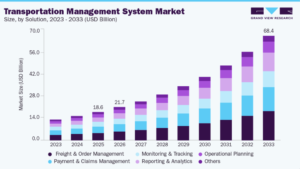
Image Source: Grand View Research
What Is a Transportation Management System?
A transportation management system is software that helps businesses plan, execute, monitor, and optimize the movement of goods.
Depending on the business model, a TMS can support activities such as:
- Shipment and order management
- Carrier selection
- Freight rate management
- Load planning
- Route optimization
- Dispatch management
- Real-time shipment tracking
- Delivery management
- Freight billing and settlement
- Reporting and analytics
- Exception management
Oracle describes TMS as a system that helps businesses plan, execute, and optimize the physical movement of goods while providing visibility, documentation, and compliance support.
These systems can work together rather than operating as isolated applications. For example, TMS can work alongside ERP and warehouse management systems to manage freight, carrier, and route optimization. At the same time, ERP handles accounting and orders, and WMS handles warehouse functions.
The Growing Strategic Importance of Transportation Management App Development
As transportation networks grow more complex, businesses face increasing challenges in managing freight efficiently, controlling costs, and maintaining visibility across operations. A few key factors are driving the need for more advanced transportation management solutions:
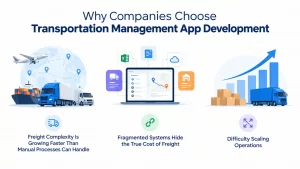
Freight Complexity Is Growing Faster Than Manual Processes Can Handle
Customers expect faster delivery, precise arrival windows, and proactive updates. Carriers change rates and capacity constantly. Regulations add documentation and driver-hour rules. A dispatcher who once managed 40 loads a day now manages 200, across more lanes, more carriers, and more exceptions.
Every manual step adds risk. Someone rekeys an order, someone forgets to confirm a pickup, someone accepts an invoice without checking it against the rate agreement. Each error looks small. Across thousands of shipments, the errors erode margin and customer trust.
Fragmented Systems Hide the True Cost of Freight
Most enterprises do not lack data. They lack connected data. Orders live in the ERP, inventory sits in the warehouse system, driver locations come from telematics, and rates arrive in PDFs and emails. When leaders ask a basic question, such as “What did we really pay to move product on this lane last quarter?”, the answer takes days to assemble, and nobody fully trusts it.
Transportation management application development solves this problem by creating one operational layer that plans, executes, and measures freight from order to settlement. When leaders see the full picture, they negotiate better, plan better, and promise customers only what operations can deliver.
Difficulty Scaling Operations
A transportation workflow that works for 100 shipments may become difficult to manage when shipment volumes increase significantly. Automation, centralized data, role-based workflows, and scalable infrastructure can help businesses support growing operations without simply adding more manual work.
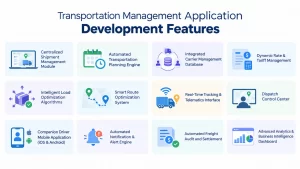
Core Features to Engineer in Custom Transportation Management Application Development
The exact features you build depend on your logistics model, but you should engineer the following core transport software solutions.
1. Centralized Shipment Management Module
Build a single, intuitive dashboard to create, modify, assign, and monitor shipments. Custom development ensures seamless data flow across delivery requirements, locations, assigned carriers, and digital documents without switching systems.
2. Automated Transportation Planning Engine
Design automated workflows that generate optimal shipment plans. Engineers program custom business rules into this module, factoring in resource availability, strict delivery windows, vehicle capacity, and target transportation costs.
3. Integrated Carrier Management Database
Build a central repository for carrier profiles, active contracts, negotiated rates, service lanes, and performance history. This gives your operational teams instant access to verified carrier data across your entire supply chain network.
4. Dynamic Rate & Tariff Management
Engineer custom pricing logic to store, calculate, and compare complex rate structures:
- Base carrier tariffs and contract rates
- Dynamic fuel surcharges and accessorial fees
- Lane-based and distance-dependent pricing models
This module automates cost evaluations when coordinating multi-carrier networks.
5. Intelligent Load Optimization Algorithms
Implement smart consolidation logic that groups shipments based on physical and operational constraints:
- Cargo weight and cubic volume
- Destination clusters and delivery windows
- Specific vehicle axle and volume limits
Custom algorithms maximize load factors and eliminate underutilized freight runs.
6. Smart Route Optimization System
Develop advanced routing engines that integrate mapping APIs to calculate optimal delivery paths. Custom route optimization factors in real-time traffic, height/weight road restrictions, multi-stop schedules, and fuel conservation, making it one of the highest-ROI components in application development.
7. Real-Time Tracking & Telematics Interface
Build map-based dashboards and status tracking tools powered by cellular GPS, IoT sensors, and carrier API integrations. This provides full visibility into transit progress, reducing manual check-in calls to zero.
8. Dispatch Control Center
Design a high-efficiency interface for dispatchers to assign loads, push real-time route changes, monitor field execution, and dynamically manage operational exceptions.
9. Companion Driver Mobile Application (iOS & Android)
Hire a dedicated mobile app development company to build a customized transportation app to match your needs. Custom app features include:
- Trip assignments and turn-by-turn navigation
- Digital status updates and direct dispatcher messaging
- Photo document uploads and Electronic Proof of Delivery (ePOD) via digital signatures
10. Automated Notification & Alert Engine
Program real-time web, push, and SMS alerting mechanisms that trigger automatically during critical transit events:
- Order pickups, completed deliveries, and failed attempts
- Route deviations, traffic delays, and revised ETAs
- Maintenance flags and vehicle emergency alerts
11. Automated Freight Audit and Settlement
Build automated billing verification workflows that cross-check carrier invoices against agreed contract rates, fuel surcharges, and proof of delivery. Custom settlement software automatically flags billing errors to ensure accurate freight payments.
12. Advanced Analytics & Business Intelligence Dashboard
Convert raw operational logs into actionable business intelligence. Develop customizable BI dashboards that visualize critical KPIs:
- Total transportation spend and cost-per-mile/cost-per-shipment
- Carrier contract compliance and on-time delivery percentages
- Route efficiency metrics, vehicle capacity utilization, and exception rates
Advanced Features to Include in a Modern Custom Transportation Software
Once the core workflow works, businesses can add more advanced capabilities.
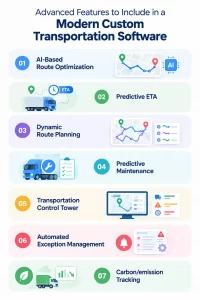
AI-Based Route Optimization
AI and machine learning development models can analyze historical and real-time data to improve routing and transportation planning.
Oracle notes that machine learning can support transit-time prediction, capacity planning, and identification of shipments at risk of delay.
Predictive ETA
Instead of showing an ETA based only on the original route, predictive models can use historical patterns and live transportation data to identify potential changes.
Dynamic Route Planning
Routes can be recalculated when conditions change, such as traffic, weather, vehicle problems, or delivery-window changes.
Predictive Maintenance
When connected with vehicle and telematics data, the system can identify patterns that may indicate potential vehicle maintenance requirements.
Transportation Control Tower
A control tower provides a centralized operational view across shipments, carriers, routes, locations, and exceptions.
Automated Exception Management
Instead of only showing that a shipment is delayed, the system can trigger predefined workflows.
For example:
| Delay detected → Identify affected orders → Notify dispatcher → Recalculate ETA → Notify customer |
This turns visibility into action.
Carbon/emission Tracking
Businesses can also use transportation data to monitor fuel consumption, emissions, route efficiency, and vehicle utilization.
How to Develop a Transportation Management Application?
Developing a transportation management application is not simply a matter of putting shipment tracking, GPS, and route planning into one dashboard. A useful application must reflect how transportation works inside a business, from receiving an order and planning a load to assigning a carrier, tracking a vehicle, handling delivery exceptions, and reconciling transportation costs.
A typical transportation management application development process includes the following steps:
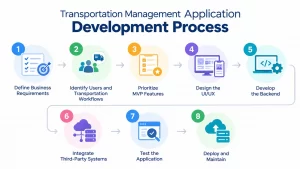
1. Define Business Requirements
The first step is to understand what the application needs to solve.
Start by documenting the current transportation process and identifying where the business loses time, money, or visibility. For example, a company may struggle with manual dispatching, disconnected carrier information, inaccurate ETAs, poor fleet utilization, or repetitive freight-billing work.
It can also help reduce manual dispatch work, improve shipment visibility, reduce billing discrepancies, or shorten the time required to assign loads.
This requirements stage lays the foundation for the application scope and prevents businesses from paying for features that don’t solve an operational problem.
2. Identify Users and Transportation Workflows
A transportation management application usually serves multiple stakeholders, and each one interacts with the system differently.
For example:
- Administrators manage users, permissions, configurations, and system settings.
- Dispatchers plan loads, assign vehicles or carriers, monitor trips, and handle exceptions.
- Drivers receive assignments, navigate routes, update shipment status, and submit proof of delivery.
- Carriers accept loads, provide status updates, and manage transportation documents.
- Customers track shipments, view ETAs, receive notifications, and access delivery information.
- Finance teams manage freight rates, invoices, settlements, and reconciliation.
Map the workflow for each role before designing the application.
3. Prioritize MVP Features
One of the most common mistakes in transportation application development is trying to build the entire platform at once. Instead, separate the requirements into must-have MVP capabilities, second-phase improvements, and advanced functionality.
Once the core workflow is stable, later releases can introduce AI-powered optimization, predictive ETA, advanced analytics, dynamic pricing, automated freight auditing, control towers, or predictive maintenance.
4. Design the UI/UX
Design the UI/UX around the decisions each user needs to make.
For example, a dispatcher may need to see:
- Active shipments
- Available vehicles
- Driver status
- Route progress
- Delays
- Unassigned loads
- Exceptions
A driver may need a much simpler interface focused on:
- Assigned trips
- Pickup and delivery information
- Navigation
- Status updates
- Documents
- Proof of delivery
The design process normally includes wireframes, user flows, interactive prototypes, and usability validation before full development. Map-based interfaces, color-coded shipment statuses, actionable alerts, and role-specific dashboards can help users find important information without navigating through multiple screens.
5. Develop the Backend
The backend development supports much of the application’s operational intelligence. It handles business rules, authentication, user permissions, shipment records, transportation workflows, notifications, integrations, tracking data, billing logic, and analytics data.
Transportation software developers also need to process information coming from external systems. For example, a GPS provider may send location updates while a carrier API sends shipment-status events.
The application needs a consistent way to receive, validate, store, and process these events.
For larger systems, developers may also use event-driven architecture, caching, message queues, or separate services for high-volume workloads.
6. Integrate Third-Party Systems
Integrations are often the most technically demanding part of transportation and logistics software development.
A TMS rarely works in isolation. It needs to exchange information with systems that already manage orders, inventory, vehicles, financial transactions, maps, and customers.
Integration planning should happen early because the number, quality, and complexity of integrations can significantly affect both project cost and timeline. TMS development specifically identifies ERP, WMS, telematics, carrier APIs, EDI, and financial systems as major parts of the implementation effort.
7. Test the Application
Transportation software needs more than basic functional testing. Testing should verify that the application continues to work when real-world transportation conditions become complicated.
Important testing areas include:
Functional testing: Ensures every module performs according to its requirements.
Integration testing: Verifies that ERP, WMS, carrier, GPS, payment, and other connected systems exchange data correctly.
Real-time testing: Checks whether location and shipment-status updates arrive correctly and within the expected timeframe.
Performance testing: Determines whether the system can handle expected shipment, user, vehicle, and tracking-event volumes.
Security testing: Evaluates authentication, authorization, API security, encryption, access controls, and vulnerabilities.
Mobile testing: Ensures driver applications work across supported devices, operating systems, network conditions, and GPS states.
Exception testing: Simulates situations such as delayed shipments, failed deliveries, rejected loads, missing GPS signals, and canceled orders.
This last category is particularly important. Test a transportation application not only when everything goes according to plan, but also when operations become unpredictable.
8. Deploy and Maintain
Once the application passes testing, you can deploy it to production. A transportation application depends on external APIs, mobile operating systems, cloud infrastructure, maps, GPS devices, carrier systems, and changing business requirements. Ongoing maintenance is therefore necessary.
Post-launch activities may include:
- Performance monitoring
- Security updates
- Bug fixes
- API maintenance
- Cloud optimization
- Database management
- Mobile OS compatibility updates
- User support
- Analytics monitoring
- New feature releases
A phased rollout can also reduce operational risk. Instead of replacing every transportation process on day one, a business can launch a core workflow, validate it with users, and gradually introduce additional modules.
Technology Stack for Transportation Management Application Development
No single technology stack fits every transportation management application. The right combination depends on the expected scale, real-time requirements, integrations, security needs, and product scope.
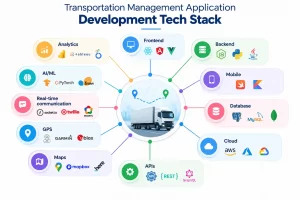
| Technology Category | Common Options | Why It Matters for a Transportation Management Software |
| Frontend | React, Angular, Vue | Builds dashboards used by dispatchers, administrators, operations teams, and customers |
| Backend | Node.js, Java, .NET, Python | Handles business logic, workflows, APIs, authentication, tracking, and integrations |
| Mobile | Flutter, React Native, Swift, Kotlin | Supports driver and field applications for trip updates, GPS, navigation, and ePOD |
| Database | PostgreSQL, MySQL, MongoDB | Stores shipment, carrier, driver, vehicle, route, transaction, and user data |
| Cloud | AWS, Microsoft Azure, Google Cloud | Provides scalable infrastructure for applications, databases, storage, APIs, and monitoring |
| APIs | REST, GraphQL, webhooks | Allow the TMS to exchange data with ERP, WMS, carriers, GPS providers, and other systems |
| Maps | Google Maps, Mapbox, HERE | Supports geocoding, distance calculations, route planning, navigation, and location visualization |
| GPS | Device GPS, telematics APIs, GPS providers | Provides vehicle and driver location data for real-time tracking |
| Real-time communication | WebSockets, MQTT, message queues | Helps transmit live location, shipment events, alerts, and status changes |
| AI/ML | Python, TensorFlow, PyTorch, cloud AI services | Supports predictive ETA, route optimization, demand forecasting, anomaly detection, and predictive maintenance |
| Analytics | Power BI, Tableau, custom dashboards | Converts transportation data into insights about cost, delivery performance, carriers, routes, and fleet utilization |
How Much Does Transportation Management Application Development Cost?
The cost of developing a transportation management application can vary widely because a basic dispatch and tracking application differs greatly from an enterprise platform supporting multiple carriers, real-time telematics, complex routing, financial workflows, and AI.
For planning purposes, a basic transportation management application may cost around $35,000–$75,000, a medium-complexity solution around $75,000–$175,000, and an advanced platform around $175,000–$25,000+.
| Application Complexity | Estimated Cost | Estimated Timeline |
| Basic | $35,000–$75,000 | 4–6 months |
| Medium | $75,000–$175,000 | 6–9 months |
| Advanced | $175,000–$250,000+ | 9–15+ months |
Prepare a detailed estimate only after you define the workflows, platforms, integrations, user roles, and technical requirements.
Factors Affecting Cost
The number of features matters, but it is not the only factor that determines the budget.
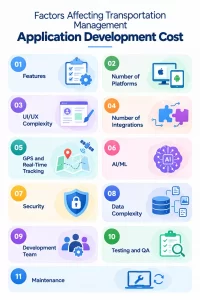
Features
A basic application with shipment management and tracking requires less development than one containing route optimization, freight auditing, automated tendering, analytics, and AI.
Number of Platforms
A web-only application generally requires less development effort than a solution with web dashboards, iOS and Android driver apps, carrier portals, and customer portals.
UI/UX Complexity
Multiple user types mean multiple workflows and interfaces. A dispatcher dashboard, driver application, customer portal, and admin console each require a different experience.
Number of Integrations
Every external integration adds development, authentication, data mapping, testing, error handling, and ongoing maintenance.
That is why integrations can affect cost more than simply adding more screens. Recent TMS cost analyses consistently identify integrations as a major cost driver.
GPS and Real-Time Tracking
Cost to develop a location tracking app like Life360 requires more than displaying a map. The application needs to receive location events, process them, store relevant data, calculate or update ETAs, and display changes reliably.
AI/ML
AI features introduce additional requirements for data preparation, model development, testing, monitoring, and ongoing improvement.
Security
Authentication, role-based access, encryption, secure APIs, audit logs, vulnerability testing, and monitoring all contribute to development effort.
Data Complexity
A TMS can process large volumes of shipment, location, event, vehicle, carrier, and transaction data. More complex data models and higher event volumes require more careful architecture.
Development Team
The project may require a combination of:
- Business analysts
- UI/UX designers
- Frontend developers
- Backend developers
- Mobile developers
- QA engineers
- DevOps engineers
- Solution architects
- Data/AI specialists
The required team size and expertise affect the overall budget.
Testing and QA
Testing a simple CRUD application is different from testing a system that processes real-time GPS events, external APIs, route calculations, financial transactions, and multiple user roles.
Maintenance
Post-launch costs should be included in the budget for:
- Cloud hosting
- Monitoring
- Security updates
- Third-party API changes
- Mobile OS updates
- Bug fixes
- Performance optimization
- New functionality
How to Choose a Transportation Software Development Company
The development partner you choose can strongly affect whether the final application reflects real transportation operations or becomes another generic logistics dashboard.
Consider these areas before selecting a company.
Transportation and Logistics Domain Experience
Look for experience with transportation workflows such as shipment planning, dispatching, carrier management, fleet tracking, freight billing, route optimization, and delivery management.
A transportation software development services provider that understands the domain can identify requirements that technical planning might otherwise miss.
Custom Software Expertise
The partner should be able to design software around your specific processes rather than simply configuring a standard template.
API Integration Experience
Ask about previous experience integrating:
- ERP systems
- WMS platforms
- GPS providers
- Telematics
- Carrier APIs
- Mapping services
- Payment systems
- Accounting platforms
Mobile Development Capabilities
If drivers will interact with the system, the partner should have experience developing mobile applications that work with GPS, cameras, notifications, offline conditions, and device permissions.
Cloud Expertise
The team should understand how to design infrastructure that can support increasing users, shipments, tracking events, storage requirements, and integrations.
Security Practices
Ask how the company handles authentication, authorization, encryption, API security, data protection, vulnerability testing, and access controls.
Testing Methodology
A transportation application needs comprehensive testing across web, mobile, APIs, integrations, real-time data, performance, and exception scenarios.
Post-Launch Support
Find out what happens after deployment.
A reliable partner should support bug fixes, monitoring, API changes, security updates, performance improvements, and future feature development.
Ability to Scale the Application
The development partner should consider where the platform needs to be in two or three years, not just what it needs to do on launch day.
Ask how the architecture will accommodate:
- More users
- More vehicles
- More shipments
- More locations
- Additional carriers
- New integrations
- New transportation modes
- Advanced analytics and AI
How AppsChopper Helps With Transportation Management Application Development
A transportation management application should be built around the business’s operational needs, not a fixed set of features.
AppsChopper can support businesses through the development lifecycle, including requirements analysis, UI/UX design, web and mobile development, backend engineering, API integration, testing, deployment, and ongoing maintenance.
The process can begin by understanding the existing transportation workflow and identifying where manual processes, disconnected systems, poor visibility, or operational bottlenecks are creating problems.
From there, the development scope can be organized into an MVP and future releases. This helps businesses focus the first version on the workflows that matter most while keeping the architecture ready for additional capabilities such as real-time tracking, advanced analytics, AI-powered optimization, and additional integrations.
Transportation software developers can also build role-specific experiences for administrators, dispatchers, drivers, carriers, and customers so each user has access to the information and actions relevant to their responsibilities.
The goal is to create a transportation management application that fits into the existing technology ecosystem and evolves as the business grows.
Conclusion
Transportation management application development is ultimately about connecting transportation workflows, people, vehicles, data, and business systems in one digital environment.
The strongest applications do not begin with a long feature list. They begin by understanding how transportation currently works, where the business loses time or money, which users need to interact with the system, and which existing platforms need to exchange data.
From there, businesses can define an MVP, select an appropriate technology stack, design role-specific interfaces, build the backend, integrate external systems, test real-world scenarios, and gradually introduce advanced capabilities.
Whether the goal is better shipment visibility, faster dispatching, improved fleet utilization, automated freight processes, or smarter route planning, the development strategy should remain tied to measurable business needs.
The objective is not to build another transportation app. It is to build a transportation management application that makes the company’s actual transportation operation easier to plan, execute, monitor, and improve.
FAQs
What data should a transportation management application capture?
Depending on the business model, the application may need to capture shipment details, pickup and delivery locations, vehicle and driver information, carrier data, rates, route information, GPS events, delivery milestones, documents, invoices, and customer information.
How should a transportation management application handle offline situations?
Driver applications may encounter poor connectivity in warehouses, rural areas, or during transit. An offline-capable mobile experience can temporarily store essential actions on the device and synchronize them with the backend when connectivity returns.
Can a transportation management application support multiple transportation modes?
Yes. The application can support road, rail, air, ocean, or multimodal transportation. However, each mode introduces different planning rules, documents, milestones, pricing models, and integrations, so consider multimodal support during requirements and architecture planning.
How can a TMS application support multi-tenant operations?
If the application will serve multiple companies or customers from the same platform, the architecture needs tenant isolation, organization-level permissions, separate configurations, data segregation, billing rules, and potentially tenant-specific workflows.
What should businesses prepare before starting TMS application development?
Businesses should ideally prepare their current workflows, user roles, shipment volumes, carrier information, existing software, integration requirements, transportation rules, reporting needs, security requirements, and future growth plans. This gives the development team enough information to create a realistic scope and estimate.