Table of Contents
The classroom of tomorrow is being shaped today by AI in education, a revolutionary force that’s fundamentally changing how students learn and how educators teach. From personalized learning experiences to intelligent tutoring systems, artificial intelligence is no longer a futuristic concept but a present-day reality transforming educational institutions worldwide.
What is AI in Education and How is it Reshaping Learning?
At its core, AI in education is the integration of machine learning algorithms, natural language processing, and data analytics into educational settings to enhance teaching effectiveness and improve learning outcomes. This technology encompasses everything from adaptive learning platforms that adjust to individual student needs to automated grading systems that free up valuable teacher time.
The application of AI technology in classrooms goes beyond simple automation. AI in the education system creates intelligent environments where every student interaction generates data that helps refine and personalize the learning experience. Virtual teaching assistants can answer student questions 24/7, while predictive analytics identify struggling students before they fall behind.
Understanding the Benefits of AI in Education
The transformation powered by artificial intelligence offers remarkable advantages for both students and educators. One of the most significant benefits of AI in education is personalization at scale. Traditional classrooms often struggle to meet the diverse needs of 30+ students with different learning speeds, styles, and backgrounds. AI addresses this by creating customized learning paths for each student.
Intelligent tutoring systems can give instant feedback, lightening the load for teachers managing large class sizes. Students get immediate insights without waiting days for graded work, which quickens learning and engagement. AI can automate administrative tasks, assignment grading and give teachers more opportunities to meaningfully connect with students. Data insights show which concepts students struggle with, helping teachers refine instruction.
The importance of artificial intelligence in education extends to accessibility. AI-powered tools provide real-time translation for students learning in non-native languages, text-to-speech for visually impaired learners, and speech-to-text for students with physical disabilities. Technology is democratizing education in ways previously unimaginable.
Examining the Cost of AI in Education
While the benefits are compelling, institutions must carefully consider the cost of AI in education. Implementation expenses include software licensing, hardware upgrades, professional development for staff, and ongoing technical support. Initial investments can range from thousands to millions of dollars, depending on the scale and sophistication of the system.
However, the total cost equation includes long-term savings. AI reduces administrative overhead, optimizes resource allocation, and can even decrease the need for remedial courses by catching learning gaps earlier. Many schools find that strategic AI implementation in education pays for itself within 3-5 years through improved efficiency and outcomes.
Open-source AI tools and cloud-based solutions have made entry points more accessible for budget-conscious institutions. Schools don’t need to build everything from scratch; they can leverage existing platforms and scale as they grow. Partnership with AI chatbot development specialists can provide cost-effective implementation paths.
Current AI in Education Trends Shaping the Industry
The landscape of the trends in educational AI reveals several dominant patterns. Adaptive learning platforms lead the market, using algorithms to adjust difficulty and content based on student performance. These systems analyze thousands of data points per student to optimize their learning journey.
Gamification powered by AI creates engaging learning experiences that feel more like play than work. Students earn points, badges, and rewards while AI algorithms ensure they’re being appropriately challenged. This approach significantly boosts engagement, especially among younger learners.
Natural language processing enables conversational AI tutors that students can query in plain language. Rather than navigating complex menus, learners simply ask questions as they would to a human tutor. The AI understands context, remembers previous interactions, and provides increasingly relevant responses.
Predictive analytics identify at-risk students early. By analyzing attendance patterns, assignment completion rates, and assessment scores, AI flags students who may need intervention. Early warning systems allow schools to provide support before students fail or drop out.
What is the Use of AI in Education Across Different Contexts?
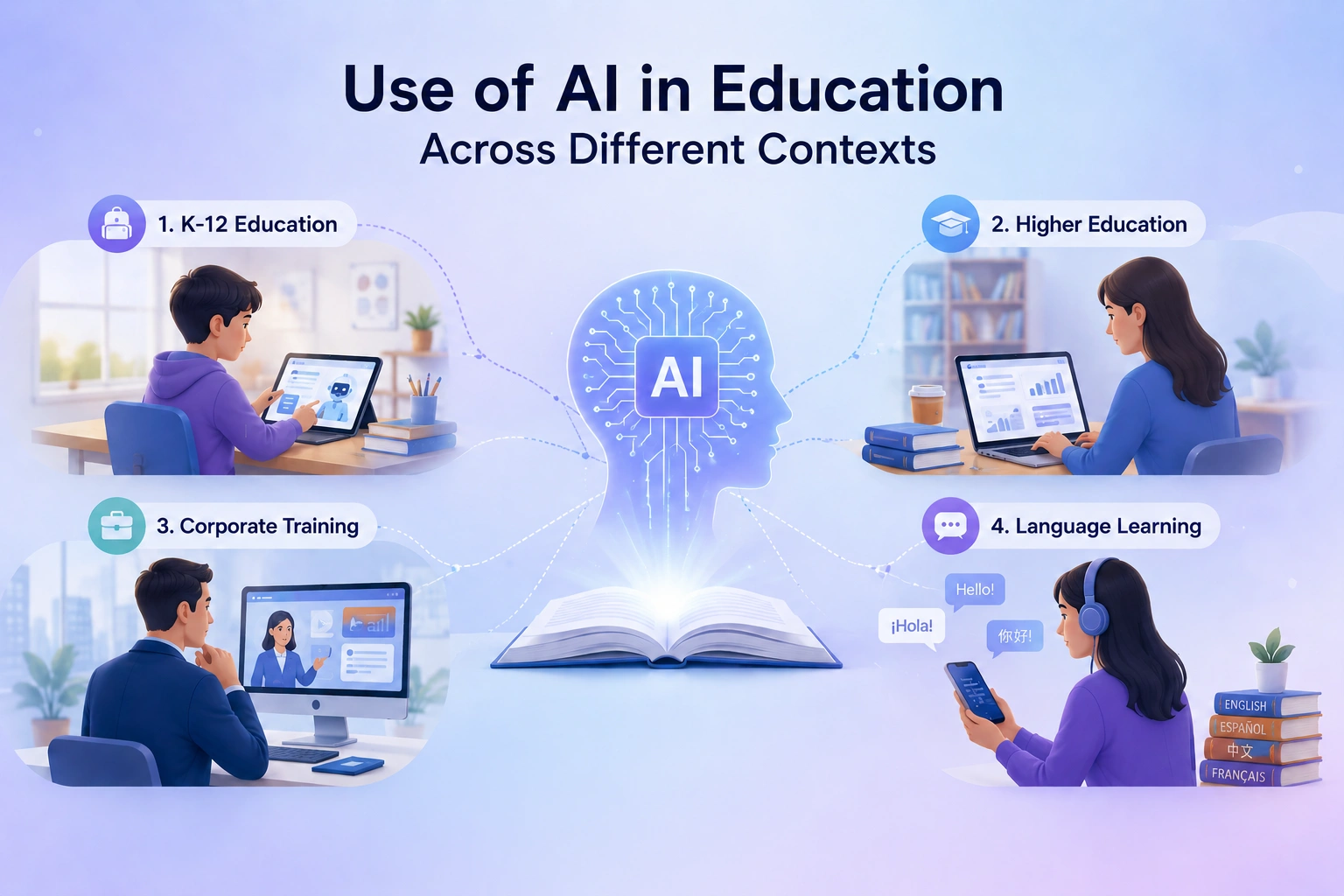
The use of AI in education varies significantly across educational levels and subjects. In K-12 education, AI primarily supports foundational skill development. Math and reading programs adapt to student proficiency, ensuring neither boredom from material that’s too easy nor frustration from content that’s too difficult.
 1. K-12 Education: Building Strong Foundations
In K-12 education, AI primarily supports foundational skill development. Math and reading programs adapt to students’ proficiency, ensuring neither boredom from material that’s too easy nor frustration from content that’s too difficult. Young learners benefit from gamified experiences that make skill-building feel like play, while teachers receive detailed analytics on each student’s progress and learning patterns.
2. Higher Education: Advanced Learning and Research
Higher education leverages AI for research assistance, plagiarism detection, and course recommendation systems. Universities use algorithms to recommend courses based on student interests, career goals, and past performance. This guidance helps students navigate increasingly complex degree requirements and ensures they’re building skills aligned with their career aspirations.
3. Corporate Training: Learning in the Workplace
Corporate training is another major application area. Companies use AI to deliver just-in-time training, ensuring employees learn exactly what they need, when they need it. AI-powered microlearning modules maximize retention while minimizing time away from work, creating more productive and knowledgeable workforces.
4. Language Learning: Breaking Down Communication Barriers
Language learning has been revolutionized by AI. Speech recognition provides pronunciation feedback, and conversational bots offer learners unlimited practice opportunities. These tools make language acquisition more accessible and effective than traditional classroom-only approaches, enabling learners to practice anytime, anywhere, without the pressure of speaking in front of others.
For organizations looking to develop custom solutions, partnering with education application development specialists can create tailored AI tools that address specific institutional needs.
The Ethical Use of AI in Education and Critical Considerations
As schools adopt AI tools, ethical use becomes crucial. Data privacy is the top concern; AI systems collect sensitive student data, requiring strong security and transparency. Algorithmic bias is another issue; biased data can perpetuate inequalities, such as favoring affluent schools. Regular audits and diverse data help reduce this risk.
The question of AI replacing teachers requires in-depth and nuanced discussion. AI excels at some tasks but cannot replace human connection, emotional support, and mentorship that teachers offer. The goal should be to use AI for routine tasks so teachers can focus on human aspects. Transparency is key; students and parents deserve to know when AI is used. Black-box algorithms making important decisions without explanation undermine trust. ML solutions must consider ethical issues to ensure technology benefits all students fairly.
Looking Toward the Future of AI in Education
The future of AI in education promises even more transformative changes. Emotion recognition technology may soon detect student frustration, boredom, or confusion in real-time, prompting interventions before students disengage. These systems could read facial expressions and voice tone to gauge emotional states and adjust accordingly.
AI-powered virtual and augmented reality will create immersive learning experiences, like history students exploring ancient Rome with an AI guide or biology students exploring the human body. These make concepts tangible and memorable. Lifelong learning platforms will offer personalized career paths, helping individuals identify skill gaps and access learning resources to stay competitive.
Collaborative AI will facilitate global learning communities. Language barriers will disappear as real-time translation enables students from different countries to work together effortlessly. AI will match learners with complementary skills and interests, fostering international collaboration. The development of these advanced systems will require expertise from app development services and mobile app development cost considerations will factor into institutional planning.
Implementing AI Successfully in Your Institution
For schools adopting this technology, success depends on key principles. Start with clear goals: what problems are you solving? Better student outcomes? Less admin work? More engagement? Clear objectives guide choices, making it easier to measure success.
Tip 1: Involve Stakeholders from the Beginning
Teachers, students, parents, and administrators all have valuable perspectives. Their input ensures the chosen solutions address real needs rather than imagined ones. Resistance to change decreases when people feel heard and included.
Tip 2: Professional Development is Non-Negotiable
Even the best AI tools fail if users don’t understand them. Invest in comprehensive training that goes beyond basic functionality to help educators understand pedagogical applications and best practices.
Tip 3: Start Small and Scale Gradually
Pilot programs allow institutions to test technologies, identify issues, and refine approaches before full deployment. Early successes build momentum and support for broader implementation.
Tip 4: Choose Partners Wisely
Whether working with established education technology companies, custom developers, or artificial intelligence development services providers, vet vendors carefully. Look for proven track records, strong support systems, and alignment with your institutional values.
Conclusion
Artificial intelligence is not merely enhancing education; it’s fundamentally reimagining what’s possible in teaching and learning. From personalized learning paths that adapt to individual student needs to predictive systems that identify struggling learners before they fail, AI offers tools that were science fiction just a decade ago. The journey toward AI-enhanced education requires balancing innovation and enthusiasm with ethics and caution. Institutions must thoughtfully consider costs, carefully implement systems, and constantly evaluate impact on student outcomes and equity.
Those who successfully navigate this transformation will create learning environments that are more engaging, effective, and inclusive than ever before. The rise of artificial intelligence in education is revolutionizing how we understand education itself. Now, the question is how to implement it thoughtfully, ethically, and effectively to serve all learners. The future of education is here, powered by artificial intelligence and unlimited by human potential.