Table of Contents
Automation initiatives in the healthcare industry can be difficult, and many hit the same wall. There are many tasks in the healthcare industry that, if automated, can have a very positive impact on healthcare businesses. These tasks include patient access, supply chain, credentialing, claims, scheduling, and clinical documentation. The problem is that many leaders simply do not know where to begin because everything feels like a priority.
The good news is that technology can settle the debate. Structured, high-volume tasks should come first because they are ready for automation. Unstructured, judgment-heavy tasks can benefit from AI. All of this depends on how well your systems integrate. That three-part logic is a more reliable prioritization framework than any internal negotiation.
Start With Work That Is Structured and High-Volume
The best way to determine which task to automate first is to identify tasks with predictable inputs and sufficient volume. Michael Dell, the CEO of Dell Software, stated, “AI that augments people gives companies many more options, and a lot of flexibility. It makes the world better, increases opportunities, and expands economies.” The tasks that can be easily automated include eligibility verification, claim status checks, prior authorization submissions, charge reconciliation, appointment reminders, and data entry between systems. By automating these tasks first, you will create space for small efficiencies to compound over time.
These workflows can be prioritized because they follow defined rules and can be handled by robotic process automation and workflow orchestration with high accuracy. Automations also have measurable aspects. You will know the current cycle time, error rates, and the cost per transaction. So, the ROI can be measured clearly.
Leaders should prioritize these considerations. Though the tasks are not glamorous, they fund everything that follows. Overall, the early wins reflected in the numbers build credibility with finance, clinical leadership, and the board.
Reserve AI for Work That Requires No Human
For tasks that don’t fit a rules-based approach, AI is the best way to automate them. For example, denial management often involves interpreting payer behavior across thousands of variables. To document properly, there needs to be an understanding of context, nuance, and intent.
Machine learning models, natural language processing, and generative tools can interpret unstructured data, flag exceptions, and support decisions without human review. Automating these tasks can allow healthcare employees to focus their skills and energy on tasks that require human insight and judgment. However, AI can deliver these improvements only when the underlying systems are connected and able to exchange information seamlessly.
Integration Is the Dependency Behind Everything
Automation works best when underlying systems can communicate with each other. Healthcare environments tend to be fragmented. EHR billing platforms, payer portals, legacy databases, and point solutions are sometimes built so they cannot work together. When automation is layered on top of disconnected systems, manual handoffs persist instead of eliminating the old ones.
Prior to finalizing a roadmap, leaders should assess which systems hold the data each workflow depends on, and whether those systems expose APIs or rely on screen-level workarounds. It is also important to determine how data quality and standards are handled today, and where governance and security requirements constrain data movement.
Consider the ROI
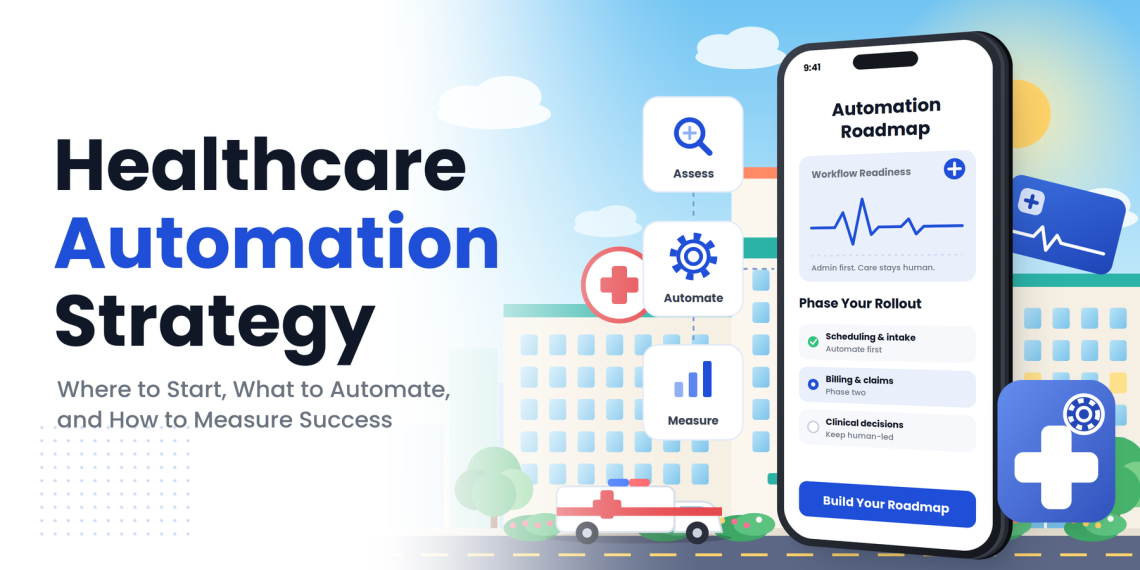
The best way to approach automation in the healthcare industry is to start with structured, high-volume workflows that don’t require constant human oversight. ROI from this approach can fund the next phase. Then, AI can be integrated into judgment-heavy workflows once the data foundation is reliable and the team has built confidence in automation governance. Since each connected system expands what the next phase can accomplish, continuous investment in integration will be essential.
Rather than viewing automation as a one-time effort, this approach allows healthcare automation to be a cumulative process. Each step generates measurable returns, whether in reduced collection costs, faster turnaround, lower denial rates, or recovered clinician time.
From Priorities to a Plan
When every department has a legitimate claim on automation, the answer is not to pick favorites or spread resources thin. It is to let the nature of the work, the readiness of the data, and the proof of return determine the path.
At AppsChopper, we work with healthcare organizations to turn ideas into practical plans. Our team reviews your workflows, finds the best places for automation and AI, fixes integration issues, and creates solutions that show real value at every step.
If your organization is unsure where to start or wants to improve a program that hasn’t met your expectations, contact AppsChopper today. We can help you organize your priorities in a way that makes sense.