Table of Contents
How do you verify that a person is really who they claim to be without adding another password or creating friction? Modern enterprise organizations face a compounding identity crisis. Legacy authentication relies on passwords that users forget and bad actors steal, manual identity checks that stall onboarding, and escalating fraud tactics like synthetic identity creation.
Investing in biometric software development lets businesses replace vulnerable credentials with mathematical models based on physical or behavioral human traits. Beyond eliminating password reset costs, this technology transforms organizational efficiency. Modern biometric systems evaluate facial geometry, fingerprints, iris patterns, or behavioral interactions within milliseconds to establish high-assurance verification.
This guide explores how biometric software works, the technologies behind modern authentication systems, key features and use cases, the development process, implementation challenges, and the factors that influence the cost of building a secure and scalable biometric solution.
Executive Summary
| Developing custom biometric software requires balancing modality selection, AI/ML infrastructure, zero-trust security, and compliance (GDPR, BIPA). Planning estimates range from $30,000 for basic integrations to $250,000+ for multimodal enterprise platforms. Deciding between building a custom engine or integrating third-party SDKs directly impacts time-to-market, long-term operational costs, data ownership, and system scalability. |
What Is Biometric Software Development?
Biometric software development involves designing and building software applications that capture, process, analyze, and match unique physical or behavioral human characteristics to automatically verify or identify an individual. It bridges raw hardware sensor inputs with AI-driven matching algorithms to deliver secure, automated identity validation.
How Biometric Software Works
Biometric platforms transform unstructured biological data into encrypted digital representations called templates. The underlying software pipeline follows a precise sequence:

Verification vs. Identification: 1:1 vs. 1:N
Understanding the mathematical distinction between verification and identification is foundational when selecting a custom software development company.
| Method | How It Works | Typical Use |
| 1:1 Verification | Compares one captured biometric sample against a single pre-enrolled template belonging to a claimed identity. | Mobile app login, step-up authentication, digital onboarding KYC. |
| 1:N Identification | Compares one captured biometric sample against a database of $N$ enrolled records to determine an identity without a claimed username. | High-security access control, law enforcement matching, duplicate account prevention. |
How Biometric Authentication Works in 8 Steps
- Enrollment: The system captures initial biometric data from a user via a camera, microphone, or fingerprint scanner.
- Biometric Capture: Raw sensor inputs generate visual, acoustic, or tactile data points.
- Data Preprocessing: Software normalizes the raw data, filtering out background noise, poor lighting, or sensor artifacts.
- Feature Extraction: Deep learning algorithms isolate key vector points, such as facial landmark coordinates or fingerprint minutiae.
- Template Generation: Extracted features undergo cryptographic transformation into a non-reversible mathematical vector (the template).
- Liveness Detection: Presentation Attack Detection (PAD) algorithms analyze the input to confirm the presence of a real, living human rather than a photograph, screen playback, or mask.
- Template Matching: Algorithms calculate similarity scores comparing newly generated templates with stored reference vectors.
- Authentication Decision: The risk engine compares the similarity score against predefined confidence thresholds to grant or deny access.
The exact workflow varies by chosen biometric modality, security requirements, and whether processing occurs on-device, in the cloud, or through a hybrid architecture.
How to Develop Biometric Software: Step-by-Step
Successful biometric software development starts with defining the business use case and risk model, not immediately selecting an AI model or biometric SDK. The engineering process then moves through architecture design, biometric technology selection, user experience optimization, enterprise integration, security hardening, rigorous accuracy testing, deployment, and continuous model monitoring.
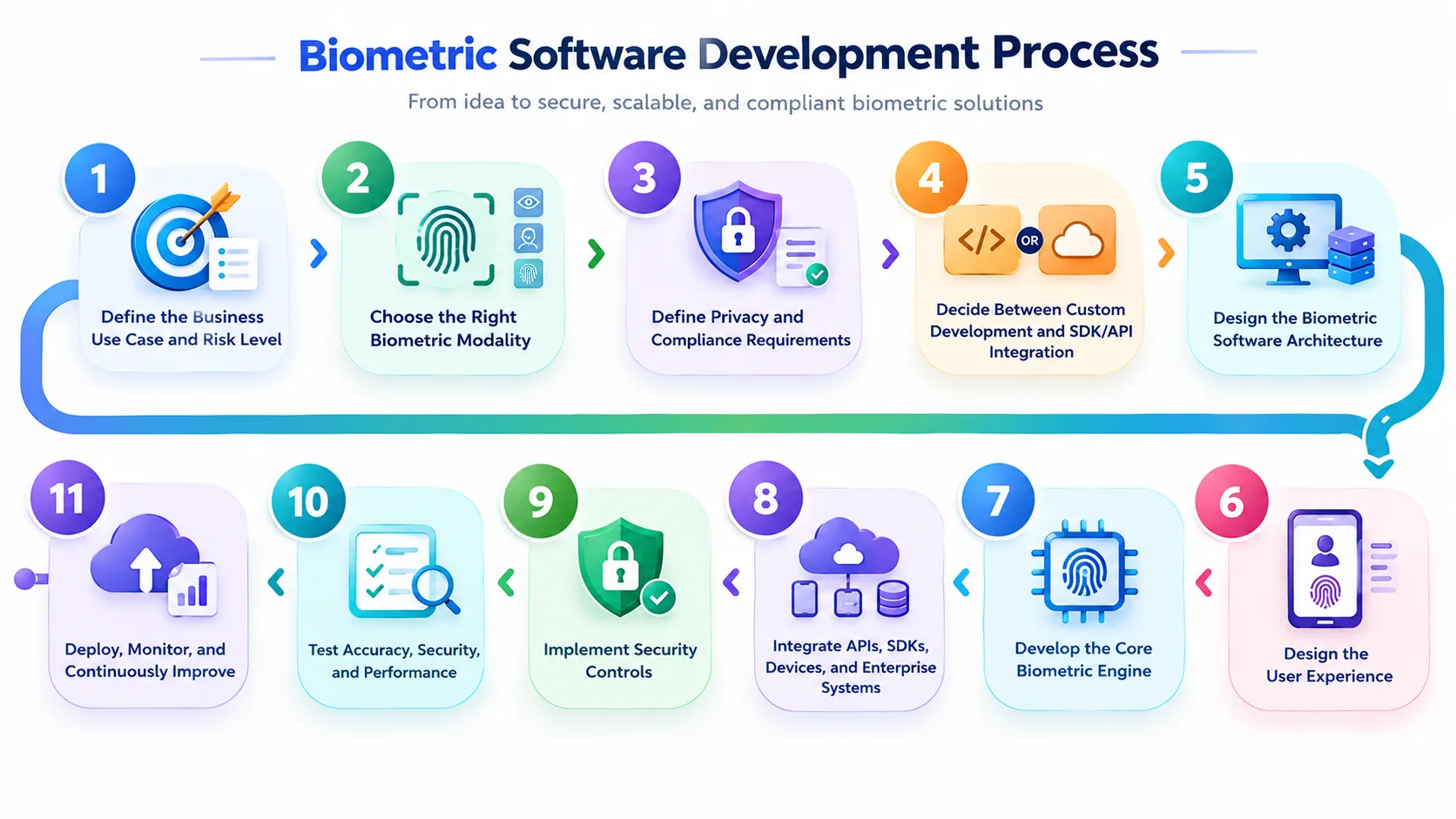
Step 1: Define the Business Use Case and Risk Level
Every project begins by scoping operational boundaries:
- Decide between 1:1 verification or 1:N identification.
- Map expected transaction volumes and target user demographics.
- Determine acceptable error tolerances based on business risk (e.g., higher security thresholds for money transfers vs. low-friction thresholds for daily app logins).
Step 2: Choose the Right Biometric Modality
Select hardware and sensor modalities aligned with hardware availability and user context:
- Fingerprint: Fast and familiar, but dependent on hardware sensors.
- Facial Recognition: Universal via standard RGB or infrared cameras.
- Iris Recognition: Unmatched accuracy for extreme-security environments.
- Voice Recognition: Ideal for phone-based customer service or smart devices.
- Behavioral Biometrics: Passive, continuous protection based on typing cadence or swipe pressure.
- Multimodal Systems: Combines two or more modalities to maximize security.
Step 3: Define Privacy and Compliance Requirements
Establish legal compliance before writing code:
- Map user consent collection workflows.
- Establish strict data retention and deletion schedules.
- Select processing jurisdictions to fulfill data residency laws.
- Partner with an experienced biometric software development company to ensure alignment with regional privacy mandates.
Step 4: Decide Between Custom Development and SDK/API Integration
Evaluate whether your core value relies on proprietary algorithm ownership (Build) or rapid speed-to-market using established vendors (Buy). Many teams adopt a hybrid structure, pairing commercial engines with tailored workflows.
Step 5: Design the Biometric Software Architecture
A resilient architecture structures data flow securely across isolated components:
- Client applications (mobile/web UI).
- Edge/Cloud biometric capture and quality evaluation layers.
- Core AI/ML extraction and matching services.
- Authentication policy engines linked to existing databases and monitoring dashboards.
Step 6: Design the User Experience
Biometric interactions must remain intuitive:
- Provide real-time visual and audio feedback during data capture (e.g., “Move closer,” “Increase lighting”).
- Create clear permission requests explaining why biometrics are used.
- Implement accessible fallback mechanisms (PIN, fallback OTP) for capture failures.
Step 7: Develop the Core Biometric Engine
Construct the mathematical backbone:
- Build image and signal preprocessing pipelines.
- Fine-tune neural networks to convert biometric inputs into lightweight, high-dimensional embeddings.
- Build high-speed distance-matching logic (e.g., Euclidean or Cosine distance evaluation) paired with real-time confidence scoring.
Step 8: Integrate APIs, SDKs, Devices, and Enterprise Systems
Connect the biometric service into broader operational systems:
- Identity and Access Management (IAM) tools (Okta, Ping Identity).
- Core banking systems, EHR/EMR platforms, or ERP backends.
- External document verification and government database lookup services.
Step 9: Implement Security Controls
Protect biometric pipelines against advanced threats:
- Encrypt data at rest with AES-256 and in transit with TLS 1.3 and certificate pinning.
- Store cryptographic keys inside Hardware Security Modules (HSMs) or secure enclaves (Apple Secure Enclave, Android Keystore).
- Apply zero-knowledge architectures so raw biometric images are discarded immediately after template extraction.
Step 10: Test Accuracy, Security, and Performance
Subject the platform to rigorous QA, assessing critical biometric metrics:
- False Match Rate (FMR) / False Acceptance Rate (FAR): Frequency of granting access to an unauthorized user.
- False Non-Match Rate (FNMR) / False Rejection Rate (FRR): Frequency of rejecting an authorized user.
- Presentation Attack Detection (PAD): Testing resilience against photos, 3D masks, and generative deepfake injection attacks.
Step 11: Deploy, Monitor, and Continuously Improve
Roll out via controlled phased releases while tracking real-world model health:
- Monitor hardware sensor variations across newly released mobile devices.
- Track statistical drift in false rejection trends.
- Apply regular patch management to update detection engines as spoofing techniques evolve.
Biometric software is not finished at launch. Models, devices, threats, regulations, and user behavior change continuously, making ongoing monitoring and maintenance essential to the development lifecycle.
How Much Does Biometric Software Development Cost?
Biometric software development costs vary by biometric modality, AI/ML complexity, custom vs. third-party technology, supported platforms, enterprise integrations, regulatory requirements, and expected operational scale.
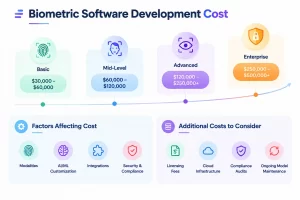
Biometric Software Development Cost by Complexity
| Solution Level | Estimated Cost | Typical Timeline | Scope |
| Basic | $30,000–$60,000 | 3–4 months |
|
| Mid-Level | $60,000–$120,000 | 4–7 months |
|
| Advanced | $120,000–$250,000+ | 7–10 months |
|
| Enterprise | $250,000–$500,000+ | 10–18+ months |
|
Note: These figures serve as general planning ranges rather than fixed quotes.
Factors Affecting Biometric Software Development Cost
- Modalities: Supporting multiple biometric traits requires separate extraction models, increasing engineering effort.
- AI/ML Customization: Training proprietary deep learning models demands specialized data collection, labeling, and computational resources compared to using pre-trained vendor models.
- Integrations: Connecting legacy ERPs, banking backends, or specialized hardware sensors increases interface complexity.
- Security & Compliance: Healthcare (HIPAA), financial (SOC 2 Type II), and regional privacy mandates demand rigorous penetration testing and audit documentation.
Additional Costs to Consider
- Licensing Fees: Per-user or per-check commercial fees when relying on third-party SDKs.
- Cloud Infrastructure: High-performance GPU computing costs for cloud-based AI inference.
- Compliance Audits: Third-party security assessments and certifications.
- Ongoing Model Maintenance: Routine retraining to adapt to new operating systems, hardware sensors, and emerging threat vectors.
How to Reduce Biometric Software Development Costs
Businesses can control biometric development costs by narrowing the first release to a high-value use case, reusing proven biometric technologies, selecting the right architecture, and avoiding unnecessary custom AI development.
- Start With One High-Value Use Case: Scope initial releases around high-friction workflows, such as mobile app login or new user onboarding, before expanding across all corporate channels.
- Build an MVP: Partner with an experienced MVP development services provider to validate core workflows, usability, and matching accuracy with real users before committing to large-scale infrastructure.
- Use Existing SDKs/APIs Where Appropriate: Avoid reinventing core mathematical matching algorithms if an established, certified third-party vendor satisfies your security model.
- Avoid Unnecessary Custom AI Models: Standard computer vision tasks rarely warrant building neural networks from scratch; leverage transfer learning or pre-trained base models.
- Choose On-Device Processing: Processing biometric data locally using built-in smartphone enclaves lowers cloud GPU consumption and server hosting expenses.
- Adopt Modular Architecture: Decouple biometric extraction logic from the application UI to allow future SDK or engine upgrades without rebuilding the core app.
- Plan Compliance Early: Incorporate privacy controls from the start to avoid costly architectural rework late in the development cycle.
- Automate Testing: Utilize automated UI and regression testing frameworks via comprehensive mobile app testing services to catch edge-case device incompatibilities early.
- Monitor Infrastructure Usage: Optimize API query frequencies and cloud instances to align server capacity with peak operational hours.
Cost optimization becomes counterproductive when it compromises core security controls, liveness detection quality, testing rigor, or privacy compliance. Skipping essential validation checks increases long-term exposure to identity fraud and regulatory fines.
Biometric SDK and API Integration: Build or Buy?
Choosing between a proprietary biometric engine, third-party SDKs, or a hybrid solution is a key strategic decision in custom biometric software development.
Option 1: Build a Custom Biometric Engine
Building a proprietary engine means writing custom algorithms for feature extraction, matching, and liveness detection.
- Advantages: Full control over algorithms, complete IP ownership, no vendor licensing fees, and tailored performance tuning.
- Considerations: Requires high upfront R&D investment, specialized computer vision PhD talent, long development cycles, and full liability for algorithm accuracy and bias.
Option 2: Integrate a Biometric SDK/API
Integrating market-proven vendor engines (e.g., FaceTec, Onfido, Innovatrics) via SDKs and RESTful APIs.
- Pros: Faster time-to-market, lower initial engineering overhead, pre-certified compliance, and battle-tested accuracy across millions of daily checks.
- Considerations: Recurring volume-based licensing fees, potential vendor lock-in, reliance on external product roa
Option 3: Use a Hybrid Approach
Many enterprise applications pair off-the-shelf biometric SDKs for sensor capture and liveness detection with a custom cloud backend that governs authentication policies, enterprise risk scoring, and unified identity management.
Build vs. Buy Comparison
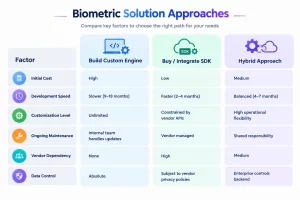
Building a custom engine suits large organizations or defense contractors that need proprietary IP and full data isolation. Conversely, integrating proven SDKs or adopting a hybrid architecture suits commercial enterprises that need high accuracy, budget control, and fast deployment.
Types of Biometric Software You Can Develop
Biometric platforms can be designed around a single physical trait or multiple modalities depending on the target use case, operational environment, and available hardware sensors.
Modality Deep Dive
- Fingerprint Recognition Software: Analyzes ridge endings, bifurcations, and minutiae patterns. Highly effective for hardware-integrated physical access control and workforce timekeeping.
- Facial Recognition Software: Maps spatial distances between key facial landmarks (eyes, nose, jawline). Used broadly in digital onboarding, airport border checks, and mobile application authentication.
- Iris Recognition Software: Evaluates the intricate, random patterns within the iris. Provides exceptional matching accuracy unaffected by aging and is widely deployed in high-security facilities and government databases.
- Voice Recognition Software: Measures vocal tract shape, pitch, and acoustic cadence. Functions effectively across phone-based banking channels and hands-free voice-assisted systems.
- Behavioral Biometrics Software: Passively measures interaction dynamics, including typing cadence, touchscreen pressure, device grip angle, and navigation speed. Ideal for continuous session monitoring without impacting user experience.
- Multimodal Biometric Software: Combines two or more distinct modalities (e.g., Face + Voice) within a single authentication decision, preventing single-vector spoofing attacks.
Modality Selection Matrix
| Modality | Common Applications | Key Strategic Consideration |
| Fingerprint | Device login, workforce attendance, ATM access | Requires clean physical sensors and touch contact. |
| Facial Recognition | Remote KYC onboarding, mobile access, surveillance | Requires adequate lighting and effective liveness protection. |
| Iris | High-assurance access, national identity, border control | Requires specialized optical cameras and higher hardware costs. |
| Voice | Telephone banking, call center validation | Sensitive to ambient background noise and audio compression. |
| Behavioral | Continuous session fraud prevention, anti-bot protection | Requires time to establish an initial user behavioral baseline. |
| Multimodal | High-value wire transfers, privileged admin access | Increases user verification time and processing overhead. |
Key Features of Biometric Software
Production-ready platforms require robust system governance, data privacy controls, and audit trails alongside biometric matching capabilities.
Core Capabilities
- Biometric Enrollment: Guided onboarding workflows with real-time image-quality feedback.
- Liveness Detection: Detects whether a real person is present rather than a photo, video, or fake biometric input by analyzing facial depth, skin texture, movements, or challenge responses, with ISO/IEC 30107 providing a framework for presentation-attack detection.
- Risk-Based Authentication: Dynamic policy routing that enforces step-up biometric checks when detecting suspicious IP addresses or abnormal transaction amounts.
- Secure Template Storage: Irreversibly convert biometric samples into encrypted mathematical vectors, preventing reconstruction of raw photos or voice files.
- Fallback Authentication: Alternative authentication paths (e.g., hardware tokens, push notifications) when biometrics fail, or hardware sensors are impaired.
- Administrative Dashboard: Real-time metrics tracking authentication volume, system latency, false rejection trends, and security alerts.
NIST Guidelines Alignment: The National Institute of Standards and Technology (NIST) Special Publication 800-63B emphasizes that biometric authentication must always be paired with an alternative primary authentication mechanism. Systems must provide a fallback path when biometric capture fails due to physical injury, environmental limitations, or sensor errors.
Security and Privacy Challenges in Biometric Software
Biometric data requires higher protection standards than traditional credentials. If a password leaks, it can be reset; if a user’s biometric template is compromised, that physical characteristic is compromised permanently.
Major Threat Vectors
- Presentation Attacks (Spoofing): High-resolution photos, 3D-printed masks, or silicon finger overlays presented directly to hardware sensors.
- Deepfakes and Synthetic Media: Real-time AI-generated video or voice cloning injected directly into camera pipelines to bypass identity checks.
- Template Reconstruction Attacks: Reverse-engineering stored feature vectors back into recognizable visual or auditory representations of the user.
- Device and Interception Attacks: Man-in-the-middle attacks capturing raw biometric payloads in transit between client apps and verification backends.
Engineering Mitigations
To mitigate these risks, secure architectures isolate hardware capture within secure device enclaves (e.g., Apple Secure Enclave). They also encrypt vectors with non-reversible algorithms (cancelable biometrics) and enforce end-to-end TLS 1.3 communication with strict certificate pinning.
Biometric Software Compliance Requirements
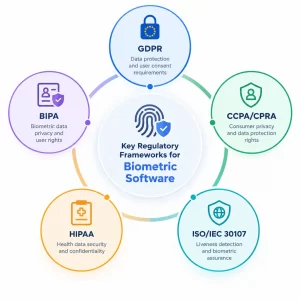
Regulatory frameworks require treating biometric data as highly sensitive personal identification information (PII). Compliance considerations must guide software architecture from inception.
Key Regulatory Frameworks
GDPR: If your biometric software serves people in the EU, treat biometric data used for unique identification as highly protected personal data. This means having a valid legal basis, clearly explaining why you collect data, limiting collection to what is necessary, and supporting applicable user rights.
BIPA: If your business collects biometric identifiers in Illinois, BIPA requires clear written notice and consent before collection, a publicly available retention and destruction policy, and restrictions on how biometric information is handled and disclosed. This is particularly important for employee authentication, customer verification, and access-control systems.
CCPA/CPRA: If your business falls under California’s privacy laws, biometric information may qualify as sensitive personal information. Your software should therefore support applicable consumer rights and give businesses appropriate controls over how this information is collected, used, retained, and disclosed.
HIPAA: For healthcare organizations, HIPAA becomes relevant when biometric systems handle protected health information. The software should incorporate appropriate safeguards such as access controls, authentication, audit controls, and secure data transmission.
ISO/IEC 30107: If your biometric system verifies people remotely or through automated devices, presentation-attack detection is important. This standard provides a framework for evaluating whether the system can detect attempts to fool biometric verification using artifacts such as photographs or other presentation attacks.
Impact on Software Design
Compliance influences key architectural choices:
- Consent Management: Developing intuitive UI prompts to capture clear, explicit opt-in records.
- Data Retention Automation: Building background jobs that purge biometric vectors automatically upon user account termination.
- Data Processing Governance: Restricting cross-border cloud processing to comply with local data sovereignty mandates.
Biometric Software Architecture and Tech Stack
Modern biometric platforms rely on modular, microservices-driven architectures. Decoupling computational tasks into distinct layers prevents hardware dependencies from locking down the entire software ecosystem.
Recommended Tech Stack
| Layer | Recommended Technologies |
| Mobile Platforms | Swift, SwiftUI, Kotlin, React Native, Flutter |
| Web Platforms | React, Angular, Vue.js, WebAssembly (WASM) |
| AI / ML & Vision | Python, C++, TensorFlow, PyTorch, OpenCV, CUDA |
| Backend Services | Node.js, Go, Python (FastAPI/Django), Java Spring Boot |
| Vector Database / Matching | Milvus, Pinecone, Faiss, PostgreSQL (pgvector) |
| Cloud Infrastructure | AWS (SageMaker, ECS), Azure ML, Google Cloud AI, Docker, Kubernetes |
| Security & IAM | HashiCorp Vault, AWS KMS, OAuth 2.0 / OIDC, PKI |
Architecture Models: On-Device vs. Cloud vs. Hybrid
| Dimension | On-Device (Edge) | Cloud Processing | Hybrid Architecture |
| Privacy Assurance | Highest (Data remains local) | Moderate (Transmits vectors) | High (Edge liveness + Cloud token) |
| Verification Latency | Ultra-low (<100ms) | Dependent on network (200-800ms) | Low (<200ms) |
| Scalability (1:N) | Not feasible for broad databases | Unlimited cloud scaling | Edge 1:1 matching; Cloud 1:N fraud check |
| Offline Operation | Supported | Not supported | Partial functionality |
| Compute Cost | Offloaded to client hardware | Higher cloud GPU infrastructure | Balanced resource utilization |
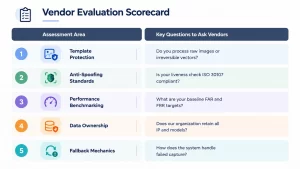
How to Choose a Biometric Software Development Company
Selecting a development partner requires assessing their specialized experience in computer vision, deep learning, regulatory compliance, and secure system architecture.
- Proven Biometric & AI Capabilities: Verify past experience implementing liveness detection models, feature extraction pipelines, and high-speed vector matching.
- Security & Compliance Standards: Ensure the agency demonstrates ISO 27001, SOC 2 Type II, or HIPAA compliance capabilities.
- Architecture Expertise: Confirm experience designing scalable, secure app development projects that isolate biometric payloads from application backends.
- Vendor-Agnostic Perspective: A quality partner evaluates custom engines versus commercial SDKs objectively based on project ROI rather than pushing a single pre-selected vendor.
Top 5 Biometric Software Use Cases
Biometric platforms streamline operations and mitigate identity risk across major global industries.
- Banking and FinTech: Securing remote mobile onboarding via automated document photo matching paired with passive liveness detection.
- Healthcare: Utilizing secure biometric identity tools to link patients accurately with Electronic Health Records (EHR) while enforcing strict access controls for staff accessing controlled substance dispensaries.
- Retail and eCommerce: Eliminating password friction during mobile checkout while blocking bot-driven automated account takeover attempts.
- Workforce Management: Modernizing facility clock-in workflows via facial or fingerprint recognition to eliminate buddy punching and manual log tracking.
- Travel and Aviation: Accelerating passenger check-in and passport validation via automated biometric gates.
Common Challenges in Biometric Software Development
Developing custom biometric software involves balancing competing performance metrics, hardware constraints, and evolving security threats.
- Balancing Accuracy and User Friction: Setting confidence thresholds too high increases false rejections (frustrating users), while setting them too low increases false acceptances (compromising security).
- Sensor and Device Heterogeneity: Managing varied camera resolutions, low-end mobile processors, and inconsistent lighting conditions across diverse user devices.
- Presentation Attack Evolution: Countering increasingly sophisticated deepfake video streams, synthetic voice clones, and high-definition printed overlays.
- Scaling 1:N Identification: Maintaining low matching latency when querying a candidate template against millions of stored database vectors.
Engineers address these challenges by implementing client-side image quality checks, using efficient vector search indexing algorithms (such as HNSW), and applying dynamic risk-adjusted confidence scoring.
Why Businesses Invest in Biometric Software
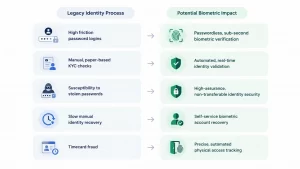
Organizations deploy biometric identity platforms to eliminate security vulnerabilities, improve operational efficiency, and drive measurable ROI.
- Strengthened Identity Assurance: Replaces static credentials with non-transferable physical traits, protecting sensitive applications against breach vectors.
- Reduced Password Costs: Eliminates credential reset support tickets, which cost large enterprises significant IT overhead annually.
- Faster Customer Onboarding: Converts manual ID inspection into an automated digital workflow completed in under 60 seconds.
- Non-Repudiation Audit Logs: Creates verifiable access trails for compliance reporting across regulated financial, healthcare, and government systems.
Business Impact Summary
Biometric Software vs. Facial Recognition
Confusion often arises between the terms “biometric software” and “facial recognition.” Biometric software is the overarching category for solutions that measure human biological traits, while facial recognition is one specific modality within that umbrella.
| Metric / Dimension | Biometric Software (Category) | Facial Recognition (Specific Modality) |
| System Scope | Broad framework covering all human traits | Single modality focused exclusively on face features |
| Input Signals | Face, fingerprint, iris, voice, keystroke, touch | 2D/3D facial images, video streams, infrared |
| Hardware Required | Varies by modality (Microphones, sensors, cameras) | Optical camera (RGB, IR, or Depth sensor) |
| Primary Use Cases | Enterprise identity, physical access, KYC, IAM | Mobile device unlock, remote onboarding, access gates |
| Key Threat Vectors | Varies widely by selected modality | Photos, video playbacks, 3D masks, deepfakes |
Biometric Software Development Trends to Watch in 2026
Advanced engineering practices are transforming biometric architecture, shifting systems toward decentralized edge computing and deepfake-resistant AI detection.
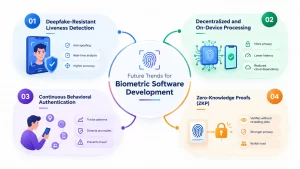
- Deepfake-Resistant Liveness Detection: AI models designed to detect subtle pixel anomalies, frame inconsistencies, and synthetic media artifacts generated by advanced generative AI tools.
- Decentralized and On-Device Processing: Shifting processing to client hardware enclaves, enabling local identity verification without transmitting sensitive templates over the web.
- Continuous Behavioral Authentication: Moving beyond one-time login checks to continuously evaluate session validity via typing cadence, scroll velocity, and touchscreen interactions.
- Zero-Knowledge Proofs (ZKP): Applying advanced cryptography so applications can verify user identity without storing or exposing underlying biometric templates.
Develop Scalable Biometric Solutions With AppsChopper
Selecting the right partner is vital when building high-performance, secure biometric applications. AppsChopper delivers end-to-end engineering services tailored to enterprise goals, connecting advanced machine learning with scalable cloud architectures.
Our custom biometric capabilities span the entire product development lifecycle:
- Business and Technical Discovery: Mapping identity risks, regulatory compliance mandates, and architectural prerequisites before writing code.
- Custom Biometric Application Development: Building native and cross-platform mobile apps, using robust mobile development practices to deliver seamless user experiences across devices.
- Biometric SDK/API Integration: Integrating certified commercial SDKs for rapid time-to-market while building custom orchestration backends.
- Advanced AI/ML Engineering: Leveraging deep AI development expertise to train, integrate, and deploy computer vision and liveness detection models tailored to challenging operational environments.
- Secure Backend Architecture: Designing resilient cloud backends using modern backend development services to power secure vector matching, access control policies, and real-time fraud scoring.
- Enterprise Identity Integrations: Connecting biometric authentication workflows directly into enterprise IAM, ERP, and legacy databases.
- Security & QA Testing: Subjecting systems to rigorous penetration testing, presentation attack simulation, and vulnerability analysis to deliver certified secure app development standards.
- Post-Launch Maintenance: Delivering long-term mobile app maintenance and support to monitor AI model accuracy, update SDKs, and preserve system resilience as operating systems evolve.
To see these capabilities in practice, explore our work on NeuCup. An AI-powered diagnostic platform engineered by AppsChopper, combining mobile image capture, machine learning, and cloud infrastructure to securely process complex health data.
FAQs About Biometric Software Development
1. How long does it take to develop biometric software?
Development timelines typically range between 3 and 12 months. Simple SDK integrations can launch within 3 to 4 months, whereas complex enterprise engines require longer development and testing phases.
2. What programming languages are used for biometric software?
Python and C++ dominate AI/ML model training, feature extraction, and computer vision tasks. Swift and Kotlin power native mobile applications, while Go, Node.js, and Java backends manage API routing, cloud storage, and database matching.
3. Is biometric software secure?
Biometric software is secure when built using strong architectural safeguards, including non-reversible template generation, active presentation attack detection (liveness checks), TLS 1.3 encryption, and Hardware Security Modules (HSMs).
4. Can biometric software work without storing raw biometric data?
Yes. Secure systems process raw images or voice inputs temporarily in memory to extract mathematical feature vectors (templates). The system discards the raw files, and the resulting mathematical vector cannot be reverse-engineered back into the original image.
5. Can biometric software integrate with an existing application?
Yes. Developers integrate biometric capabilities into web and mobile apps via native device SDKs, RESTful APIs, WebAssembly modules, and standard OAuth 2.0/OIDC authentication protocols.