Table of Contents
The digital marketplace has never moved faster. Customer expectations are rising, competition is intensifying, and the margin between a thriving online store and a struggling one is thinner than ever. At the center of this shift is AI in ecommerce, a force that is no longer a novelty but a competitive necessity.
As of 2026, the global AI in ecommerce market size is USD 11.12 billion. Overall, AI enhances business and shopping, from personalized recommendations to support. Whether small or large, knowing AI’s capabilities is key to staying ahead.
In this blog, we will explore what AI in ecommerce is, core benefits and examples, and trends that are shaping the future of AI in ecommerce.
What Is AI in Ecommerce, and Why Does It Matter Now?
At its core, AI in ecommerce refers to the use of machine learning, natural language processing, computer vision, and predictive analytics to automate decisions, personalize experiences, and optimize operations across online retail.
A few years ago, this technology was largely out of reach for most businesses. Today, it is embedded in platforms, plugins, and tools that any merchant can access. The result is a more level playing field where smaller brands can deliver the kind of personalized, intelligent experiences that once required enterprise-scale resources.
What makes AI particularly valuable in ecommerce is its ability to process enormous volumes of data in real time. Every click, scroll, search query, and purchase generates information that AI can learn from, act on, and use to make the next interaction smarter.
The Core Benefits of AI in Ecommerce
Understanding the benefits of AI in ecommerce goes beyond surface-level efficiency gains. The impact touches every layer of the business.
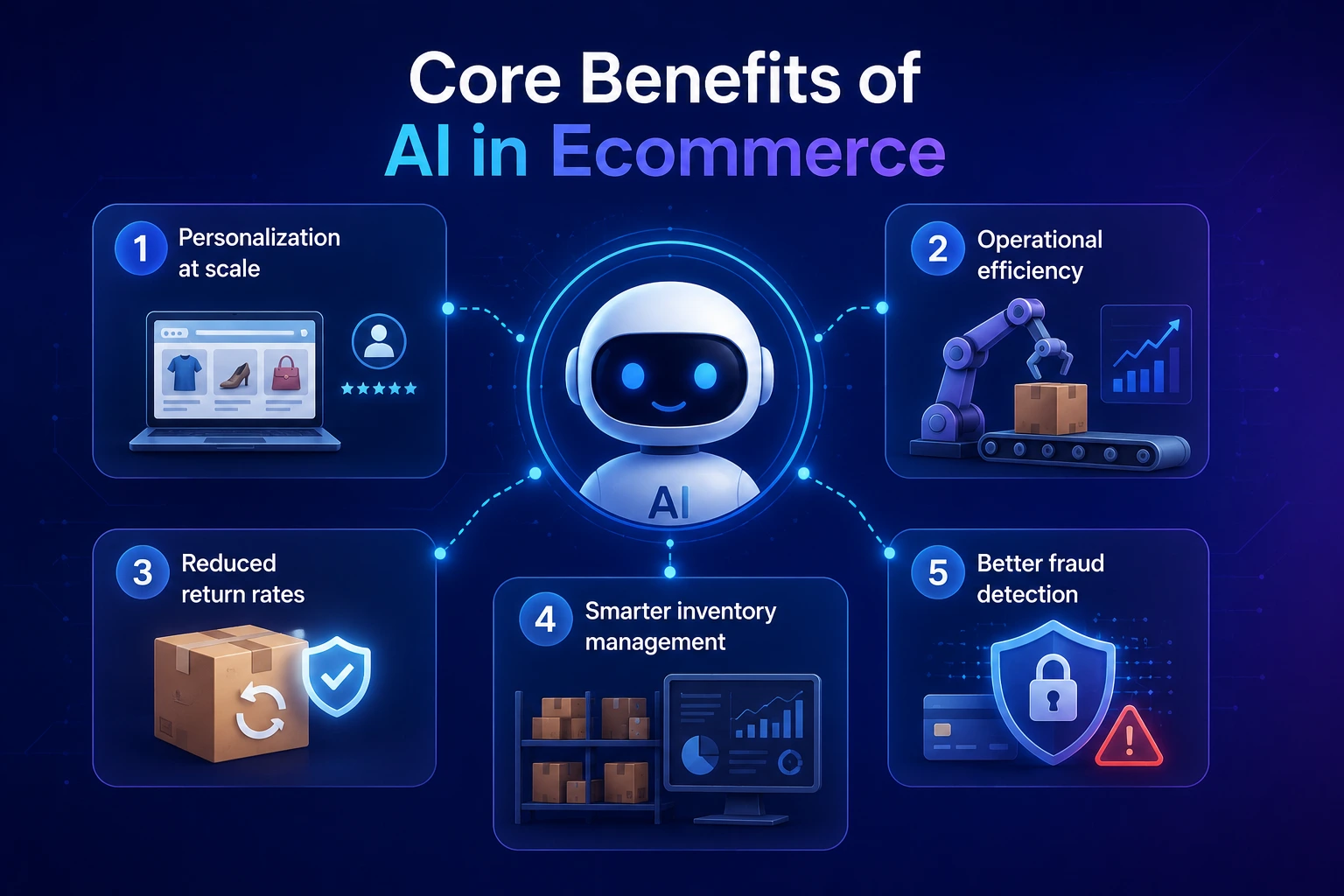 1. Personalization at scale is perhaps the most visible benefit. AI analyzes browsing patterns, purchase history, and contextual signals to serve each shopper a uniquely relevant experience. This leads to higher conversion rates, larger average order values, and stronger long-term loyalty.
2. Operational efficiency is another major advantage. Tasks that once required significant manual effort, such as writing product descriptions, responding to common customer enquiries, flagging fraudulent transactions, and managing ad bids, can now be automated, freeing teams to focus on higher-value work.
3. Reduced return rates are a benefit that often goes underappreciated. AI-powered size recommendation tools, detailed fit predictions, and augmented reality try-on features help customers make more confident purchase decisions, which means fewer returns and lower associated costs.
4. Smarter inventory management reduces both overstock and stockouts. Predictive models factor in seasonality, trends, supplier lead times, and promotional calendars to keep inventory levels precisely calibrated.
5. Better fraud detection protects both merchants and customers. AI systems can identify suspicious patterns in real time and flag potentially fraudulent orders before they are processed.
Examples of AI in Ecommerce You Might Already Be Using
The examples of AI in ecommerce that exist today span the entire customer journey. Here are some of the most impactful applications currently in use.
1. Product recommendation engines
Among the oldest and most refined uses of AI in retail, these systems analyze what a customer is viewing, what similar customers have bought, and what items are trending to surface relevant products at exactly the right moment.
2. Conversational chatbots
A significant share of customer service interactions – answering FAQs, tracking orders, processing simple returns, and escalating more complex issues to human agents – are now handled automatically. These systems have improved dramatically in recent years and can handle nuanced conversations that once required a human touch.
3. Dynamic pricing
Retailers can automatically adjust prices based on demand, competitor pricing, inventory levels, and customer segments. This maximizes revenue without requiring manual intervention.
The AI Trends in Ecommerce Shaping Strategy Today
Staying current on AI trends in ecommerce is essential for any business planning its technology roadmap. Several developments deserve particular attention right now.
1. Generative AI in ecommerce
Content production has been completely transformed. Merchants are using large language models to draft product descriptions, generate ad copy, create blog content, and even design promotional images. What once took a team of writers and designers hours can now be prototyped in minutes, dramatically accelerating go-to-market timelines.
2. Voice commerce
Smart speakers and voice-enabled devices are becoming more common in households, and shopping behavior is following. AI voice agents for ecommerce have advanced to the point where shoppers can complete purchases, check order status, or get product recommendations through spoken commands alone.
3. Agentic AI
This represents a broader shift in how AI is used. Rather than responding to individual queries, agentic systems can take sequences of actions autonomously, browsing for the best price, applying coupon codes, or managing a subscription on behalf of the user.
4. AI-driven customer service for ecommerce
Support is moving beyond simple chatbots toward more sophisticated systems that can handle complex, multi-step interactions while maintaining continuity across channels. Customers increasingly expect immediate, intelligent responses at any hour, and AI makes this possible without proportionally scaling support headcount.
5. Predictive analytics
Its role in merchandising, marketing, and logistics continues to deepen, helping businesses move from reactive decision-making to proactive strategy.
AI Tools for Ecommerce Businesses: A Practical Overview
For merchants looking to get started or expand their use of technology, the landscape of AI tools for ecommerce businesses is broad and accessible.
- Customer experience platforms like Dynamic Yield, Bloomreach, and Nosto offer sophisticated personalization and recommendation capabilities that integrate with most major ecommerce platforms.
- Chatbot and conversational AI tools such as Tidio, Gorgias, and Intercom help merchants automate support interactions without sacrificing quality.
- Marketing automation platforms including Klaviyo and Omnisend use AI to optimize email and SMS campaigns based on behavioral data and predictive models.
- Inventory and demand forecasting tools like Inventory Planner and Blue Yonder help merchants reduce carrying costs and avoid stockouts by predicting future demand with greater accuracy.
- Generative AI writing assistants help content teams produce product descriptions, ad copy, and other materials at scale.
The right combination of tools depends on the size, category, and specific goals of the business, but there has never been a better time to explore what is available.
How AI in B2B Ecommerce Differs from B2C?
AI in B2B ecommerce operates under a distinct set of dynamics compared to consumer-facing retail. The sales cycles are longer, the purchase decisions involve multiple stakeholders, the order volumes are larger, and the relationships between buyer and seller are often more complex and enduring.
In this context, AI serves different but equally powerful functions. Personalization in B2B often means surfacing the right contract pricing, recommending reorder quantities based on usage patterns, or alerting account managers when a key customer’s purchasing behavior signals a risk of churn.
AI also plays a major role in streamlining procurement workflows for B2B buyers. Intelligent punch-out catalogs, automated quote generation, and smart approval routing reduce friction in what are often cumbersome purchasing processes.
On the marketing side, AI helps B2B brands identify their most valuable accounts, score leads with greater precision, and deliver personalized content that speaks to the specific needs and pain points of each buyer segment.
The Future of AI in Ecommerce Is Already Here
When people talk about the future of AI in ecommerce, many assume they are discussing something five or ten years away. Many of those capabilities are already deployed and improving year over year.
Hyper-personalization at scale, dynamic pricing engines that respond to real-time market signals, visual search that lets customers shop by uploading a photo, and predictive inventory systems that anticipate demand before it spikes — these are not experimental features. They live in production environments across the industry.
Looking ahead, the next wave will likely focus on multimodal AI, where systems can simultaneously understand text, images, and voice inputs, enabling far more natural and intuitive shopping experiences. AI agents that can autonomously complete purchases, negotiate deals, or manage returns on a customer’s behalf are also emerging. The question is not whether this transformation will happen but how quickly businesses will adapt to it.
Tailored AI Solutions for Ecommerce: Finding the Right Fit
Not every business needs the same technology. Finding tailored AI solutions for ecommerce that match the specific needs, scale, and goals of a given business is far more valuable than implementing AI for its own sake.
A small fashion boutique might begin with an AI-based size tool and a basic chatbot. A mid-market electronics retailer could focus on dynamic pricing and fraud detection. A large omnichannel brand might develop a comprehensive personalization engine across web, mobile, email, and in-store channels.
The key is to target high-impact AI opportunities that improve customer experience or efficiency first. Starting with clear goals, measurable KPIs, and flexibility is more crucial than using the most advanced tech. Success in AI for ecommerce businesses is ultimately not about having the most tools. It is about deploying the right capabilities in ways that align with your customers’ needs and your business model.
Final Thoughts
Artificial intelligence has moved from the edges of ecommerce to its center. The businesses seeing the strongest results are the ones using AI thoughtfully, strategically, and in direct service of a better customer experience.
Whether you are just beginning to explore what is possible or looking to deepen an existing AI strategy, the opportunity is significant. The tools are accessible, the use cases are proven, and the competitive advantages are real. Business owners should think about how quickly they can make it work.
Ready to integrate AI into your ecommerce business? Reach out to AppsChopper today.
Frequently Asked Questions
1. What industries benefit the most from AI in ecommerce?
Fashion, electronics, and consumer goods see the highest impact due to large catalogs, frequent purchases, and personalization. Any online industry can benefit from AI by applying it to relevant use cases for customer behavior.
2. How does AI reduce return rates in ecommerce?
AI-powered tools like size recommenders, fit predictors, and augmented reality try-ons help shoppers make more confident decisions before purchasing, which means fewer items come back. Better product descriptions and more accurate search results also reduce the likelihood of customers receiving something different from what they expected.
3. How does AI improve customer engagement in ecommerce apps?
AI enables apps to deliver personalized feeds, timely push notifications, and relevant product suggestions based on each user’s behavior, making the experience feel tailored rather than generic. This increases the likelihood that customers return to the app, browse longer, and ultimately convert.
4. What AI technologies are commonly used in ecommerce?
The most widely deployed include machine learning for recommendations and fraud detection, natural language processing for chatbots and search, computer vision for visual search and try-on features, and generative AI for content creation. Most ecommerce platforms today have some combination of these built in or available as integrations.
5. Does implementing AI in ecommerce require a large technical team?
Not necessarily. Many AI tools are plug-and-play, working with platforms like Shopify, Magento, or BigCommerce without custom development. Businesses can start with accessible tools and scale as needed.
6. Can AI help ecommerce businesses compete with larger retailers?
Yes, and this is one of the more underappreciated advantages. AI levels the playing field by giving small merchants access to the same personalization, automation, and analytics as large retailers, enabling small brands to deliver customer experiences that rival bigger competitors.