
Table of Contents
Access to capital has always been the biggest bottleneck for launching innovative businesses and products. However, traditional lenders want collateral, and venture capital firms want proven market traction. Crowdfunding removed both barriers by allowing businesses and creators with a compelling idea to raise money directly from people who believe in it.
The global crowdfunding market was valued at roughly $20.34 billion in 2025 and is projected to grow to $23.82 billion in 2026 at a 17.1% CAGR through 2030, according to Research and Markets. For business leaders, crowdfunding has moved past its origins as a niche tool for independent creators. Plus, it has become a mainstream channel for financing and customer validation.
Founders, retail brands, real estate developers, and nonprofit organizations now include crowdfunding application development as a part of their digital strategy. Every fundraising campaign requires a secure and scalable digital platform. Enterprises that own infrastructure that captures recurring transaction revenue have direct access to a highly engaged audience and a profitable position in a market still being defined.
This complete guide explores the crowdfunding app, including its meaning, why it matters, how to build it, costs, and more, so that your business can create a scalable crowdfunding app development company.
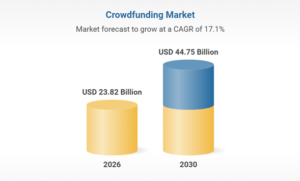 Image Source: Research and Markets
What Is Crowdfunding?
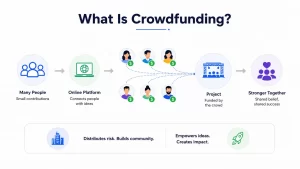
Crowdfunding is a method of raising capital by collecting small contributions from a large number of people. It is usually through an online platform, rather than relying on a single lender or investor. Plus, it replaces one large financial intermediary with thousands of smaller decision-makers, each backing an idea they believe in.
Consider an example. There is a group of people, each contributing five dollars to fund a concert, rather than asking one wealthy sponsor to cover the entire cost. Here, crowdfunding distributes the financial risk across thousands of backers while giving the project creator direct access to a ready-made audience.
Enterprises that understand this structure are well positioned to either launch their own campaigns or build a platform that serves an entire industry.
 How Do Crowdfunding Apps Work?
Every successful crowdfunding campaign follows a structured workflow that the platform manages automatically. Understanding this flow is useful for any enterprise evaluating where the real development effort goes.
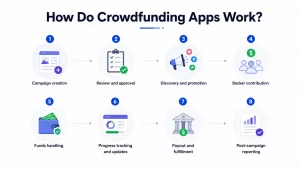
1. Campaign creation
The creator signs up, verifies their identity, and builds a campaign page with a funding goal, deadline, project description, and media such as photos or a pitch video.
2. Review and approval
Many platforms run a moderation check before a campaign goes live, screening for prohibited categories, unrealistic claims, or missing compliance documentation.
3. Discovery and promotion
Once live, the app surfaces the campaign through search, category browsing, curated collections, and often personalized recommendations driven by backer behavior.
4. Backer contribution
A backer selects a reward tier or contribution amount and completes checkout through the app’s integrated payment gateway, which authorizes and holds the funds.
5. Funds handling
Depending on the platform’s model, funds are either held in escrow until the deadline (all-or-nothing funding) or released to the creator as contributions arrive (flexible funding).
6. Progress tracking and updates
The UI/UX app design displays real-time funding progress, backer counts, and time remaining, while giving creators tools to post updates that keep the audience engaged.
7. Payout and fulfillment
Once the campaign closes successfully, the platform deducts its fee and processing costs and releases the remaining funds to the creator, who is now responsible for delivering the promised reward, equity, or outcome.
8. Post-campaign reporting
The app generates tax documentation, transaction records, and compliance reports for both the creator and the platform operator, which are most relevant to equity- and debt-based models.
This workflow manages payments, identity verification, and regulatory compliance within a unified platform, which is exactly why crowdfunding apps require more design standards than a typical e-commerce storefront.
Types of Crowdfunding Platforms
Not every crowdfunding platform serves the same purpose, and choosing the right model is one of the most important decisions a business or platform owner will make. Here is how the four core types compare.
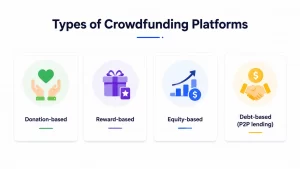
| Type | How it works | Who uses it | Example use case |
| Donation-based | Backers give money with no expectation of a reward. | Nonprofits, medical fundraisers, and disaster relief. | A hospital is raising funds for a children’s ward. |
| Reward-based | Backers receive a product, perk, or experience in return. | Product startups, indie creators, and game studios. | A smartwatch startup pre-selling its first production run. |
| Equity-based | Backers receive shares or an ownership stake in the company. | Early-stage startups and SMEs. | A fintech startup raising a seed round from retail investors. |
| Debt-based (P2P lending) | Backers lend money and earn interest over time. | Small businesses and real estate developers. | A property developer is asking for a short-term bridge loan. |
According to Mordor Intelligence, cloud-based platform architecture already accounts for more than 72% of crowdfunding deployments. This trend highlights that the market has firmly moved away from on-premise, custom-built systems.
Some newer platforms also support hybrid models that combine rewards and benefits with equity participation. This structure is gaining traction among consumer hardware and clean-energy startups that want both early customers and early investors in the same funding period.
What Are the Popular Crowdfunding Platforms
If any organization is developing a crowdfunding application, understanding the platforms already leading the market and what makes each one successful is crucial.
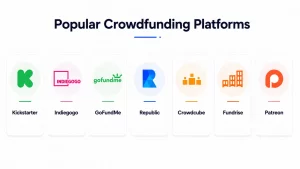
 Kickstarter: The leading reward-based crowdfunding platform is best known for funding creative and hardware projects with an all-or-nothing funding model.
- Indiegogo: It is similar to Kickstarter but with more flexible funding options, including the ability to keep funds even if the goal is not fully met.
- GoFundMe: The go-to platform for donation-based, personal, and cause-driven campaigns such as medical bills or community relief efforts.
- Republic: A leading equity crowdfunding platform that lets everyday investors buy stakes in early-stage startups, not just accredited investors.
- Crowdcube: A major UK-based equity crowdfunding platform connecting startups with retail investors across Europe.
- Fundrise: A real estate crowdfunding platform that allows individuals to invest in property portfolios without buying a building outright.
- Patreon: Technically a recurring membership platform rather than a single-campaign model, but it operates on the same crowdfunding principle.
Each of these crowdfunding app development platforms has built its brand around a specific niche rather than attempting to serve every use case at once. It should focus on the enterprise rather than a startup alone. The most successful crowdfunding platforms own a category rather than competing directly with Kickstarter or GoFundMe on their core platforms.
Features of Crowdfunding Application
When designing a crowdfunding model, companies should consider distinct functionalities for different roles, such as sponsors, admins, and even applicants for financing. Features are listed below.
- Profile Creation and Sign-Up: Users’ sign-up and profile creation can be set up to build trust and streamline engagement on a crowdfunding application.
- Verification of financial solvency: Financial verification tools help validate users, reduce transaction risk, and support regulatory compliance.
- Generating reports for tax authorities: The automated generation and submission of financial reports to regulatory bodies to mitigate fiscal and full legal compliance risks for all contracting parties.
- Effective account management: It allows admins to promptly access campaign reports and statistics, along with a well-organized list of their financial data and involved parties.
- Secure and rapid transaction processing: Secure payment processing is a core requirement for every crowdfunding platform. However, it includes the ability to calculate interest, schedule payments, make multi-currency transfers, choose different payment methods, and more.
Crowdfunding vs Crowdsourcing: Key Differences
These two terms are often misinterpreted while developing a plan. Understanding their differences matters for strategic clarity.
| Aspect | Crowdfunding | Crowdsourcing |
| Primary goal | Raise money | Gather ideas, labor, or data |
| What the crowd contributes | Financial capital | Skills, opinions, content, or effort |
| Typical outcome | A funded project or business | A completed task, dataset, or solution |
| Common examples | Kickstarter campaigns, equity rounds | Wikipedia edits, Waze traffic data, open innovation contests |
| Business use case | Product launches, real estate, or startups. | Market research, product design feedback, or distributed problem-solving. |
In short, crowdfunding asks the crowd to pay for a product, while crowdsourcing asks the crowd to gather insights or track trends. Some modern platforms blend both models, such as product development communities that crowdsource design feedback and then crowdfund the manufacturing run.
Crowdfunding Advantages and Disadvantages
Before investing in crowdfunding application development, organizations should evaluate the advantages and potential challenges.
Pros:
- Market Validation: Organizations will get instant feedback when a product launches, prevent financial waste, and use live campaign data to optimize the development.
- Keep Your Equity: Crowdfunding enables businesses to raise capital while retaining greater ownership and decision-making control.
- Access to Capital: Crowdfunding bypasses traditional barriers to business. It provides early-stage enterprises with rapid liquidity and smooth, consumer-facing technology.
- Marketing & Visibility: Crowdfunding platforms are ideal marketing channels, as they leverage community networks to drive global brand visibility without incurring traditional advertising costs.
Cons:
- Security and Fraud Prevention: It requires continuous investment in encryption, fraud detection, and compliance technologies.
- Payment Gateway Integration: Supporting numerous payment gateways and currencies requires ongoing maintenance fees, complex programming, and strict regulatory compliance for each region.
- Compliance with Regulations: Operating a platform where people buy shares in startups needs strict compliance with applicable laws and regulations. Because financial crimes, such as money laundering, pose a persistent risk, your application must be legally designed to verify the identities of all users and trace the source of funds.
- Scalability: Once your app is fully designed, its main aim should be to scale without encountering performance issues, such as slowdowns or crashes. It requires cloud hosting solutions like Google Cloud or AWS and an efficient backend architecture to handle high traffic volumes.
Crowdfunding Application Development Examples
Here are a few widely used crowdfunding examples across different crowdfunding types.
- Pebble Time: The smartwatch company raised over 20 million dollars on Kickstarter. It became one of the most-funded hardware campaigns in Kickstarter’s history, proving there was consumer demand for wearables before Apple entered the category.
- BrewDog: The UK craft brewery built a loyal shareholder community through its “Equity for Punks” campaigns. It raises tens of millions of pounds while turning customers into literal co-owners of the brand.
- Fundrise real estate portfolios: Everyday investors can now invest as little as $10 in diversified property portfolios that were once reserved for institutional buyers.
- Local disaster relief campaigns: GoFundMe has processed hundreds of millions of dollars for community and medical causes, demonstrating how donation crowdfunding fills gaps that insurance and government aid often miss.
These examples show that crowdfunding is not limited to gadgets and Silicon Valley startups. It works for beverage companies, property investors, nonprofits, and community organizations alike, which is precisely why enterprise platform owners see an opportunity to serve specific verticals with purpose-built tools.
How to Create a Crowdfunding Platform
Crowdfunding application development is a high-level product initiative. Here is the realistic strategy most enterprises follow.
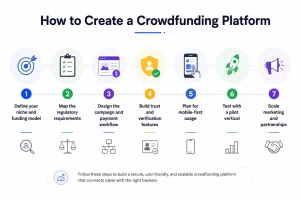
1. Define your niche and funding model
Decide whether you are building for donations, rewards, equity, debt, or a hybrid. Trying to support all four from day one usually slows down launch and dilutes focus.
2. Map the regulatory requirements
Equity and debt crowdfunding are regulated in most countries. In the US, this typically involves SEC Regulation Crowdfunding rules, while the EU operates under the European Crowdfunding Service Providers Regulation. Ignoring regulatory requirements can expose platforms to significant legal and compliance risks.
3. Design the campaign and payment workflow
This includes campaign creation tools, secure payment processing, escrow handling for all-or-nothing models, and automated payout logic.
4. Build trust and verification features
KYC and AML checks, identity verification, and fraud detection are non-negotiable for any platform handling real money at scale.
5. Plan for mobile-first usage
A large share of backers discover and fund campaigns through mobile apps, so responsive design and a native app experience directly affect conversion rates.
6. Test with a pilot vertical
Launch with one campaign category, gather feedback, and expand once the core workflow is proven.
7. Scale marketing and partnerships
Even the best platform fails without a strategy to bring creators and backers together, since crowdfunding is fundamentally a two-sided marketplace.
Enterprises that treat this as a marketplace product, rather than a simple donation form, consistently outperform platforms built quickly and cheaply without long-term scalability in mind.
How Do Crowdfunding Apps Make Money?
After building a crowdfunding application, businesses should understand how to earn money.
Most platforms layer several revenue streams on top of one another, turning a simple campaign tool into a sustainable business.
- The platform fee is the foundation, typically 5% to 8% of every successfully funded campaign, deducted automatically before the payout reaches the creator.
- Payment processing fees add a second layer, usually a 3% to 5% transaction fee that often includes a small margin above the gateway’s base cost. From there, most platforms build additional revenue through premium or featured campaign placements, subscription tiers for repeat creators, and optional value-added services such as video production or marketing support.
- Debt and equity platforms add one more layer specific to their model: an interest spread or a management fee on funds raised. This means their revenue scales directly with how well their creators perform.
Cost of Running a Campaign on a Crowdfunding App
| Cost Item | Typical Range |
| Platform fee | 5% to 8% of funds raised |
| Payment processing fee | 3% to 5% of each transaction |
| Marketing and advertising | 10% to 30% of the funding goal |
| Reward fulfillment and shipping | Varies widely by product type |
| Video production and campaign design | 2,000 to 15,000 USD |
Core Technical Components of Crowdfunding Application Development
Crowdfunding software development determines whether the platform can actually scale. Several architectural decisions have a significant impact on scalability and long-term performance.
Every high-end platform build needs to account for the following core components:
- A campaign management system is needed to create, edit, and track fundraising pages.
- Secure payment gateway integration supports cards, digital wallets, and, increasingly, stablecoin or crypto platforms for cross-border backers.
- User and role management separates creators, backers, and platform administrators.
- Compliance and KYC modules to meet regional financial regulations.
- Analytics dashboards give creators and platform owners visibility into funding efficiency and backer behavior.
- Notification and communication tools to keep backers engaged throughout the campaign lifecycle.
Technology Stack for Crowdfunding App Development
The specific tools matter, but enterprise teams still need a clear starting point when designing a build. Here is a realistic technology stack for a modern crowdfunding app.
| Layer | Common Technology Choices | Why It Matters |
| Frontend (web) | React, Next.js, Angular | Delivers a fast, responsive campaign browsing and checkout experience. |
| Mobile app | React Native, Flutter, native Swift/Kotlin | Reaches backers who discover and fund campaigns on mobile devices. |
| Backend | Node.js, Python (Django/FastAPI), Java (Spring Boot) | Handles campaign logic, business rules, and API traffic at scale. |
| Database | PostgreSQL, MongoDB | Stores campaign, user, and transaction data reliably. |
| Payment processing | Stripe, PayPal, Braintree, regional gateways | Handles card payments, payouts, and multi-currency support. |
| Cloud infrastructure | AWS, Google Cloud, Microsoft Azure | Absorbs traffic spikes during high-profile campaign launches. |
| Identity and compliance | Onfido, Jumio, Persona | Powers KYC, AML, and identity verification workflows. |
| Analytics | Mixpanel, Segment, custom dashboards | Tracks funding velocity, conversion rates, and backer behavior. |
Cloud-native, API-first architecture allows this stack to scale from a single-country reward platform to a multi-region equity marketplace without a full rebuild. Enterprises that use this foundation early avoid the costly re-architecture. Many early crowdfunding platforms had to be rebuilt once their traffic outgrew their original build.
How Much Does Crowdfunding Cost
Cost shows up in two very different places. They are running a crowdfunding campaign, and the second is for developing the crowdfunding application for their own platform. Enterprise buyers need clarity on both.
| Development Approach | Estimated Cost Range | Typical Timeline |
| White-label solution | 10,000 to 40,000 USD | 4 to 8 weeks |
| Custom MVP build | 40,000 to 100,000 USD | 3 to 5 months |
| Full enterprise-grade platform | 100,000 to 300,000+ USD | 6 to 12 months |
These mobile app development cost ranges vary based on the number of supported payment methods, regional compliance requirements, and whether the platform requires native mobile apps in addition to the web.
Conclusion
Crowdfunding has matured from a novelty into a legitimate, fast-growing financing channel that touches product launches, real estate, nonprofits, and early-stage startups alike. For enterprise leaders, the opportunity extends well beyond running a single campaign. Investing in crowdfunding application development delivers a recurring revenue model, direct access to a highly engaged niche audience, and a defensible market position that generic tools cannot easily replicate.
Successful crowdfunding platforms consistently follow three strategic principles. First, they choose a single funding model and niche rather than trying to serve everyone. Second, they invest early in compliance and trust features. Third, they build on cloud-native, AI-ready infrastructure that can handle traffic spikes without breaking.
If your organization is ready to move from strategy to execution, AppsChopper helps founders and enterprises design, develop, and scale secure crowdfunding platforms. We are enterprise app development partners who cover the full build lifecycle, even if budget planning is your next step. Schedule a consultation with our experts to discuss your crowdfunding platform requirements and business goals.
FAQs
Q1. How long does it take to develop a crowdfunding app?
Ans. A white-label solution can launch in four to 8 weeks, while a fully custom, enterprise-grade platform with compliance and multi-currency support typically takes 6 to 12 months.
Q2. Are crowdfunding apps secure?
Ans. Yes. Crowdfunding apps are secure and safeguard your confidential data and manage payments, as these platforms use PCI-compliant systems and advanced encryption protocols.
Q3. Who should invest in crowdfunding platform development?
Ans. Financial institutions, fintech companies, startups, enterprises, and investment firms should invest in developing crowdfunding platforms to profit from the rapidly growing alternative finance market.
Q4. Why choose custom crowdfunding app development?
Ans. Choosing custom crowdfunding application development lets you align your platform with your preferred fundraising model, whether reward-based, equity-based, or donation-based.