
Table of Contents
Over the past decade, it has been observed that mobile apps have modernized industries. Healthcare saw a change in functioning with doctor appointment apps, the real estate sector introduced modern buying and selling apps with 3D tours, and going cashless became possible with P2P apps.
One way or another, new ideas revolutionized the overall outlook of functioning, socializing, shopping, patient care, and more that you can mention. To add to the growing nature of the app, the downloads by users are reaching a peak. With 102.4 billion app downloads on the Google Play Store and 35.4 billion on the Apple App Store, expectations are rising.
Such a market motivates people to come up with new ideas, welcoming convenience into the user’s lives. That being said, it is known that having an idea and building it are two different stories. You may have an idea that can change the conventions, but to build it as per expectations, that is the job of a mobile app development company.
In that case, people with ideas, or even those planning to modernize their existing apps, look for service providers with in-depth knowledge and experience assisting others in creating them. Keeping this in mind, decision-makers need assistance to locate such a company.
To assist with this and locate an app development firm, here we bring a comprehensive guide that helps you understand the process, red flags, and benefits, and how to overcome challenges.
What Does a Mobile App Development Company Actually Do?
When decision-makers hire mobile app development companies, they don’t get their assistance for a technical perspective only. These future-ready companies work as a strategic mobile app development agency and offer suggestions, keeping scalability in mind.
Their focus is on end-to-end services that span ideation and validation through post-launch support. Let’s clear a common misconception.
If a company is only talking about coding, tech stack, and timelines, you’re already looking at a limited partner. A strong mobile app development company operates more like a product mobile app development team extension.
Here’s what that actually looks like:
1. They challenge your idea (in a good way)
Not every feature belongs in version 1. Good teams help you prioritize what actually drives value.
2. They think in user journeys, not screens
Instead of “we’ll build 10 screens,” they focus on how users move, where they drop off, and what keeps them engaged.
3. They plan for scale from day one
Even if you’re building an MVP, the architecture should not collapse at 10,000 users.
4. They stay involved after launch
Because launch isn’t the finish line but where real learning begins.
If a company only “builds what you ask,” they’re vendors. If they help you build what works, they’re mobile app development experts.
Why the Right Development Partner Matters for Long-Term Success?
Think of your custom app development company not as a vendor, but as the co-architect of your digital future. The right one doesn’t just build what you ask but helps you imagine what’s next, and make sure you’re ready for it.
Enables Continuous Innovation
A great app development consultant brings ideas to the table before you even ask for them. They experiment, prototype, and iterate, turning emerging trends into real features that keep your product fresh. Instead of playing catch-up, your business becomes a trendsetter.
Improves User Retention
The right partner obsesses over micro-experiences: faster load times, smoother journeys, smarter interactions. They translate user behavior into meaningful upgrades, creating a product users don’t just use, but prefer.
Reduces Technical Debt
Behind every great product is clean, future-ready code. The right partner builds by laying strong foundations that don’t crack under pressure. This means fewer breakdowns, faster updates, and more room to grow without costly rebuilds.
Supports Scaling and Expansion
Growth shouldn’t break your product but should fuel it. The right partner designs systems that expand effortlessly, whether you’re onboarding 1,000 or 1 million users. From new markets to new features, they ensure your tech evolves as fast as your ambition.
The right development partner doesn’t just deliver a product but future-proofs your business. They turn your vision into a living, evolving ecosystem that adapts, scales, and thrives over time.
Benefits of Hiring a Mobile App Development Firm
The benefits of having a mobile app development company are worth discussing. From getting access to expertise to reduced cost, all matters. For better understanding, let’s take a look at it.
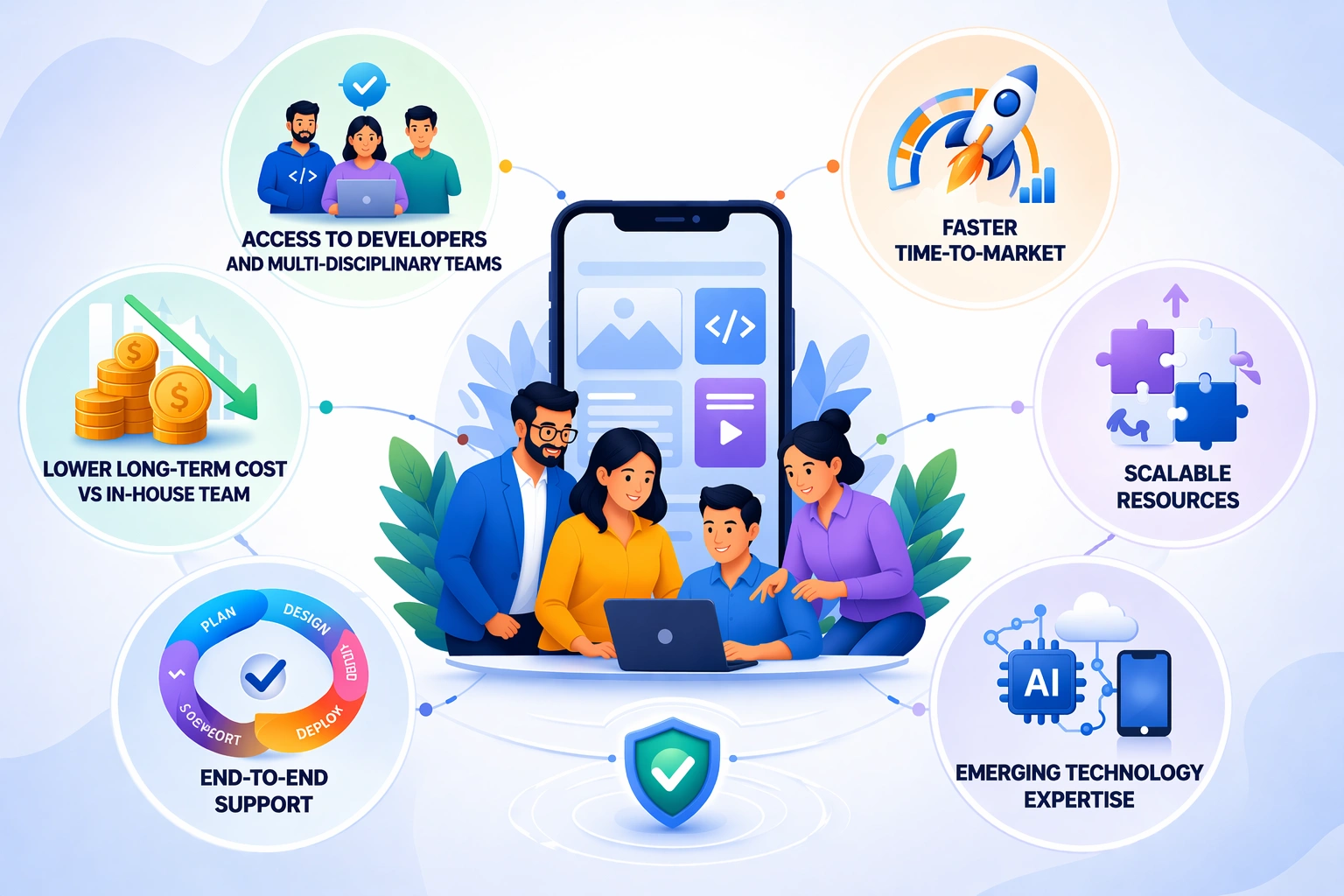
1. Access to Developers and Multidisciplinary Teams
You’re not just hiring developers. You are unlocking a coordinated ecosystem of specialists. From product thinkers to UI/UX designers and quality analysts, each role contributes to building a well-rounded, high-performing app that aligns with both user expectations and business objectives.
2. Faster Time-to-Market
Development firms operate with refined workflows and pre-built accelerators that reduce development cycles. This efficiency helps you validate ideas quickly, launch at the right time, and stay ahead in competitive markets.
3. Lower Long-Term Cost vs In-House Team
Beyond salaries, in-house teams come with hidden costs, such as recruitment, infrastructure, training, and retention. A development firm converts these fixed expenses into a more predictable, project-based investment with optimized output.
4. Scalable Resources
Whether you’re building an MVP or expanding an existing product, firms can instantly adjust team size and skill sets. This adaptability ensures you’re never overstaffed or under-resourced at any stage of development.
5. End-to-End Support
A single partner manages the entire lifecycle, planning, execution, launch, and ongoing improvements. This continuity minimizes miscommunication, keeps timelines on track, and ensures a cohesive product vision throughout.
6. Emerging Technology Expertise
With exposure to multiple industries and projects, development firms bring practical knowledge of integrating advanced technologies with the assistance of top mobile app developers in USA. They help you adopt the right innovations, not just the latest ones, so your app remains relevant and competitive.
Future Trends & Technologies to Keep in Mind When Locating an App Development Firm
The right development partner should not only meet your current needs but also prepare your product for what’s next. Technology is evolving rapidly, and selecting a firm that understands and implements future-ready solutions can give your business a significant edge.
Artificial Intelligence
AI is transforming how apps interact with users through personalization, chatbots, predictive analytics, and automation. A forward-thinking firm leverages AI to create smarter, more intuitive experiences that adapt to user behavior.
Machine Learning
ML enables apps to learn and improve over time. Whether it’s recommendation engines, fraud detection, or user insights, a capable development partner can integrate ML models that continuously enhance performance and decision-making.
AR/VR
Immersive technologies are redefining user engagement across industries like retail, real estate, gaming, and education. A firm experienced in AR/VR can help you create interactive, experience-driven applications that stand out in the market.
Internet of Things
IoT connects apps with smart devices, from wearables to home automation systems. Choosing a firm with IoT expertise ensures seamless integration, real-time data exchange, and enhanced user control across connected ecosystems.
Cloud
Cloud-based development ensures flexibility, scalability, and cost efficiency. A strong partner builds cloud-native apps that support real-time updates, remote access, and secure data storage, essential for modern digital products.
Blockchain
For applications requiring high security and transparency, such as fintech or supply chain, blockchain offers decentralized solutions. A knowledgeable firm can implement blockchain for secure transactions, data integrity, and trust-building.
Microservices
Instead of building monolithic apps, modern development relies on microservices, small, independent modules that work together. This approach improves scalability, speeds up updates, and reduces system downtime.
5G-Enabled Experiences
With the rollout of 5G, apps can deliver faster speeds, lower latency, and richer experiences like real-time streaming, gaming, and AR features. A future-ready firm designs apps that can fully leverage these capabilities.
Step-by-Step Process to Hire a Mobile App Development Company
Now that you understand what to look for, the next step is following a structured approach to find the right development partner. A clear process helps you avoid costly mistakes and ensures you choose a team that aligns with your vision and goals.
Step 1: Define Your Mobile App Requirements
Start by outlining what you want to build. Identify your target audience, core features, platform (iOS, Android, or cross-platform), and business objectives. The clearer your requirements, the easier it is to communicate your expectations and evaluate potential partners effectively.
Step 2: Research and Shortlist the Best Mobile App Development Companies
Explore agencies through platforms like Clutch, GoodFirms, LinkedIn, and Google. Create a shortlist based on their expertise, industry focus, and past work. Look for companies that have experience building apps similar to your idea or within your domain.
Step 3: Evaluate Portfolio and Experience
Dive deep into their previous projects. Assess the quality of design, functionality, and overall user experience. A strong portfolio reflects their ability to solve real-world problems and deliver polished, user-friendly applications.
Step 4: Look for Previous Client Feedback
Client reviews and testimonials provide insights into how the company works. Pay attention to feedback around communication, timelines, problem-solving, and post-launch support. Consistent positive feedback is a strong indicator of reliability.
Step 5: Assess Technical Expertise With Interview Rounds
Schedule discussions with their development team. Ask about the technologies they use, development methodologies, and how they handle challenges. This step helps you gauge their depth of knowledge and whether they can handle your project’s complexity.
Step 6: Check Communication and Process
Smooth collaboration is key to a successful project. Understand how they manage communication, provide updates, and handle feedback. A transparent and structured process ensures fewer misunderstandings and better alignment throughout development.
Step 7: Review the Pricing Models and Ranges
Understand their pricing structure, fixed cost, hourly rate, or dedicated team model. Make sure there are no hidden costs and that the pricing aligns with your budget. Focus on value rather than just the lowest cost.
Step 8: Start With a Pilot Project
Before committing long-term, begin with a small project or MVP. This allows you to evaluate their performance, quality of work, and collaboration style in a real-world scenario before scaling the partnership.
Red Flags to Look for During the Hiring Process
Not every development partner is the right fit, and spotting early warning signs can save you time, money, and frustration down the line. Here are some key red flags to watch out for when evaluating a mobile app development company:
Vague Answers to Technical Questions
If a team struggles to clearly explain their tech stack, architecture decisions, or development approach, it’s a sign of shallow expertise. A reliable partner should be able to break down complex concepts in a way that’s easy to understand and backed by real examples.
No Clear Development Roadmap
A lack of structured planning often leads to delays and confusion. If they can’t outline timelines, milestones, or delivery phases, it indicates poor project management and a reactive approach to development.
Unrealistic Delivery Timelines
Be cautious of promises that sound too good to be true. Extremely short timelines often mean corners will be cut, either in quality, testing, or scalability, leading to bigger issues later.
Lack of Documentation
Proper documentation is essential for maintenance, scalability, and knowledge transfer. If a company doesn’t prioritize documentation, it can create long-term dependency and make future updates difficult.
No Ownership of Post-Launch Issues
Development doesn’t end at launch. If a company avoids responsibility for bug fixes, updates, or ongoing support, you are left handling critical issues on your own.
Overpromising “Everything”
A trustworthy partner sets realistic expectations. If a company claims they can do everything, faster, cheaper, and better than everyone else, it’s often a red flag for overcommitment and underdelivery.
Why is AppsChopper Considered the Best Mobile App Development Company in USA?
AppsChopper has established itself as a reliable mobile app development company with over a decade of experience (since 2011) and a portfolio of 400+ mobile applications successfully delivered across industries such as healthcare, fintech, eCommerce, and on-demand services. This breadth of experience demonstrates its ability to handle diverse business requirements and complex project scopes.
The company is also recognized on platforms like Clutch and other B2B review directories, where client feedback highlights its strengths in project management, communication, and quality delivery. Consistent ratings and verified reviews provide an added layer of trust for businesses evaluating development partners.
From a technology standpoint, AppsChopper has worked extensively with AI, Blockchain, IoT, and cloud-based solutions, enabling businesses to build future-ready applications. Its use of agile methodologies ensures faster iterations, transparency, and adaptability throughout the development lifecycle.
In addition to technical expertise, AppsChopper focuses on user-centric design and scalable architecture, ensuring apps not only perform efficiently at launch but also support long-term growth. Backed by end-to-end services and ongoing support, the company positions itself as a long-term technology partner rather than just a service provider.
Frequently Asked Questions
1. How do I choose the right mobile app development company?
Start by defining your requirements, then evaluate companies based on their portfolio, technical expertise, client reviews, and communication process. A reliable partner should align with your business goals and offer scalable solutions.
2. What factors should I consider before hiring an app development firm?
Key factors include experience, technology stack, development methodology, pricing model, post-launch support, and their ability to understand your industry and target audience.
3. How much does it cost to develop a mobile app?
The cost depends on app complexity, features, platform (iOS, Android, or both), and development time. Basic apps may cost less, while feature-rich or enterprise apps require a higher investment.
4. How long does it take to develop a mobile app?
Timelines vary based on the scope of the project. A simple app may take a few months, while complex applications with advanced features can take 6–12 months or more.
5. Should I hire an in-house team or choose outsource app development?
Outsourcing to a development firm is often more cost-effective and gives you access to a wider range of expertise, whereas in-house teams require long-term investment and management.
6. What are the latest trends in mobile app development?
Some key trends include AI, Machine Learning, AR/VR, IoT, blockchain, 5G-enabled apps, and low-code/no-code development platforms.
7. Why is post-launch support important?
Post-launch support ensures your app remains updated, secure, and optimized. It helps fix bugs, improve performance, and introduce new features based on user feedback.
8. What are common mistakes to avoid when hiring an app development company?
Avoid choosing based solely on price, ignoring client reviews, overlooking technical expertise, and not discussing post-launch support or scalability.
9. Can a development company help with app scalability?
Yes, a good development partner builds apps with scalable architecture, allowing your app to handle growth, increased users, and future feature expansions.