
Table of Contents
The global AI in healthcare market is projected to exceed $180 billion by 2030, highlighting the rapid adoption and investment in these technologies across the industry. Because of generative AI, the healthcare industry now stands at the precipice of a technological revolution. Generative AI in healthcare is transforming how medical professionals diagnose diseases, develop treatment plans, and interact with patients. From accelerating drug discovery to personalizing patient care, this groundbreaking technology is reshaping the medical landscape in ways previously confined to science fiction.
As hospitals and clinics worldwide integrate artificial intelligence into their workflows, understanding the practical applications and implications of this technology has become essential for healthcare providers, administrators, and patients alike. To fully grasp the scope of this transformation, we must first distinguish the technology’s impact. By dividing our focus between clinical advancements, such as diagnostic accuracy and drug synthesis, and operational optimizations, such as automated documentation and resource management, we can better analyze how these two paths converge to redefine modern medicine.
What is Generative AI in Healthcare and How Does It Work?
Generative AI in healthcare refers to artificial intelligence systems that can create new content, predictions, and insights based on vast amounts of medical data. Generative AI models can produce novel outputs such as synthetic medical images, personalized treatment recommendations, drug molecule designs, and clinical documentation.
These systems learn from millions of patient records, research papers, medical images, and clinical trials to identify patterns in healthcare data. When presented with a new case or query, they generate relevant responses by drawing on this comprehensive knowledge base. This technology powers everything from chatbots that answer patient questions to sophisticated systems that predict disease progression and recommend intervention strategies.
The foundation of generative AI in medicine lies in advanced machine learning architectures, particularly large language models and generative adversarial networks. These systems continuously improve as they process more data, making them increasingly valuable tools for modern healthcare delivery.
Key Generative AI Use Cases in Healthcare That Are Changing Medicine
The practical applications of generative AI in healthcare span nearly every aspect of medical practice. These use cases demonstrate the technology’s versatility and transformative potential across clinical, administrative, and research domains.
1. Clinical Documentation and Administrative Efficiency
One of the most immediate impacts comes from automating clinical documentation. Physicians spend countless hours writing notes, updating records, and managing paperwork. Gen AI in healthcare can transcribe patient conversations, generate clinical summaries, and automatically populate electronic health records. This reduces the administrative burden and allows doctors to focus more time on patient care.
2. Drug Discovery and Development
Pharmaceutical companies are leveraging generative AI use cases to dramatically accelerate drug development timelines. The technology can design new molecular structures, predict how compounds will interact with biological targets, and identify promising drug candidates in a fraction of the time traditional methods require. What once took years of laboratory work can now be simulated and tested virtually within weeks.
3. Medical Imaging and Diagnostics
Gen AI use cases in radiology include generating synthetic training data for rare conditions, enhancing image quality, and identifying subtle abnormalities that human eyes might miss. The technology can also create complete 3D reconstructions from 2D scans, providing physicians with more comprehensive views of patient anatomy.
4. Personalized Treatment Planning
Every patient responds differently to treatments based on their unique genetic makeup, lifestyle, and medical history. Generative AI analyzes these individual factors to recommend personalized treatment protocols. The systems can predict which therapies are most likely to succeed for specific patients, reducing trial-and-error approaches and improving outcomes.
5. Virtual Health Assistants
AI chatbots in healthcare powered by generative technology provide 24/7 patient support, answer medical questions, schedule appointments, and triage symptoms. These virtual assistants improve access to healthcare information while reducing the workload on human staff.
Practical Generative AI in Healthcare Examples Already in Use
Real-world implementations demonstrate how theory translates into tangible benefits. Several pioneering organizations have successfully deployed generative AI solutions that are already improving patient outcomes and operational efficiency.
1. Personalized Nutrition and Wellness Platforms
Healthcare app development companies have created AI-powered platforms that generate personalized nutrition plans based on patient health data, dietary restrictions, and fitness goals. These applications use generative models to create meal plans, recipes, and shopping lists tailored to individual needs.
2. AI-Powered Cancer Treatment Planning
In oncology, AI systems analyze tumor genetics and medical literature to generate comprehensive treatment recommendations for cancer patients. These platforms consider the latest research, clinical trial results, and patient-specific factors to suggest optimal therapy combinations.
3. Mental Health Support Applications
Healthcare mobile app developers have built mental health applications where generative AI creates personalized therapy exercises, meditation scripts, and coping strategies based on user interactions and emotional states. These tools provide accessible mental health support between clinical appointments.
4. Synthetic Medical Images for Training
Radiology departments use generative AI to create synthetic medical images for training purposes, addressing the shortage of labeled data for rare conditions. This improves diagnostic accuracy by ensuring radiologists have exposure to a wider variety of cases during their education.
5. Multilingual Patient Education Systems
Artificial Intelligence Development Services providers have created systems for hospitals that generate discharge instructions, medication guides, and follow-up care plans in multiple languages, ensuring patients understand their post-treatment requirements regardless of language barriers.
Major Benefits of Generative AI in Healthcare for Providers and Patients
The advantages extend far beyond simple efficiency gains. Generative AI in healthcare delivers meaningful improvements to care quality, accessibility, and outcomes.
1. Enhanced Diagnostic Accuracy
By analyzing patterns across millions of cases, generative AI can identify disease markers that might escape human notice. This leads to earlier detection and intervention, particularly for conditions like cancer where early diagnosis significantly improves survival rates.
2. Reduced Healthcare Costs
Automation of administrative tasks, more efficient drug development, and prevention of medical errors all contribute to substantial cost savings. These savings can be redirected toward patient care and expanding access to underserved populations.
3. Improved Patient Engagement
AI chatbot development for healthcare creates conversational interfaces that make medical information more accessible and understandable. Patients can get answers to questions immediately rather than waiting for appointments, leading to better adherence to treatment plans and healthier behaviors.
4. Accelerated Research and Innovation
ML solutions powered by generative AI compress research timelines from years to months. Researchers can test hypotheses, analyze data, and discover new insights at unprecedented speeds, accelerating the pace of medical breakthroughs.
5. Better Work-Life Balance for Healthcare Providers
By handling routine documentation and administrative tasks, generative AI allows physicians and nurses to reclaim time for patient interaction and personal well-being. This reduces burnout and improves job satisfaction among healthcare professionals.
6. Democratized Access to Expertise
Generative AI can bring specialist-level knowledge to rural or underserved areas through app development services that provide decision support to general practitioners. This helps reduce healthcare disparities and ensures more patients receive high-quality care regardless of location.
Understanding the Challenges of Generative AI in Healthcare
Despite its promise, implementing generative AI in medical settings presents significant hurdles that organizations must address thoughtfully.
1. Data Privacy and HIPAA Compliance
Healthcare generative AI systems require vast amounts of patient data for training, raising serious privacy concerns. Organizations must ensure their HIPAA compliance strategies protect sensitive health information while still enabling AI development. This requires robust data governance frameworks, encryption protocols, and careful vendor selection.
2. Regulatory Uncertainty
The regulatory landscape for AI in healthcare remains in flux. Approval processes for AI-powered medical devices and diagnostic tools are still evolving, creating uncertainty for developers and healthcare organizations considering adoption.
3. Algorithmic Bias and Health Equity
If training data doesn’t adequately represent diverse populations, generative AI systems may perform poorly for certain demographic groups. This could exacerbate existing healthcare disparities rather than reducing them. Ensuring diverse, representative datasets is crucial for equitable outcomes.
4. Integration with Legacy Systems
Many healthcare facilities operate on outdated technology infrastructure. Integrating cutting-edge AI in healthcare solutions with legacy systems requires significant technical expertise and investment, creating barriers to adoption.
5. Clinical Validation and Trust
Healthcare providers understandably require rigorous evidence before trusting AI-generated recommendations for patient care. Building this trust requires extensive clinical validation, transparency about how systems reach conclusions, and clear communication about appropriate use cases and limitations.
Mobile App Development Cost and Resource Constraints
For many healthcare organizations, particularly smaller practices and rural hospitals, the mobile app development cost and ongoing maintenance expenses for AI systems represent significant financial challenges. Finding sustainable funding models remains an obstacle to widespread adoption.
Emerging Generative AI in Healthcare Trends Shaping the Future
The field continues to evolve rapidly, with several trends pointing toward even more transformative applications in the coming years. 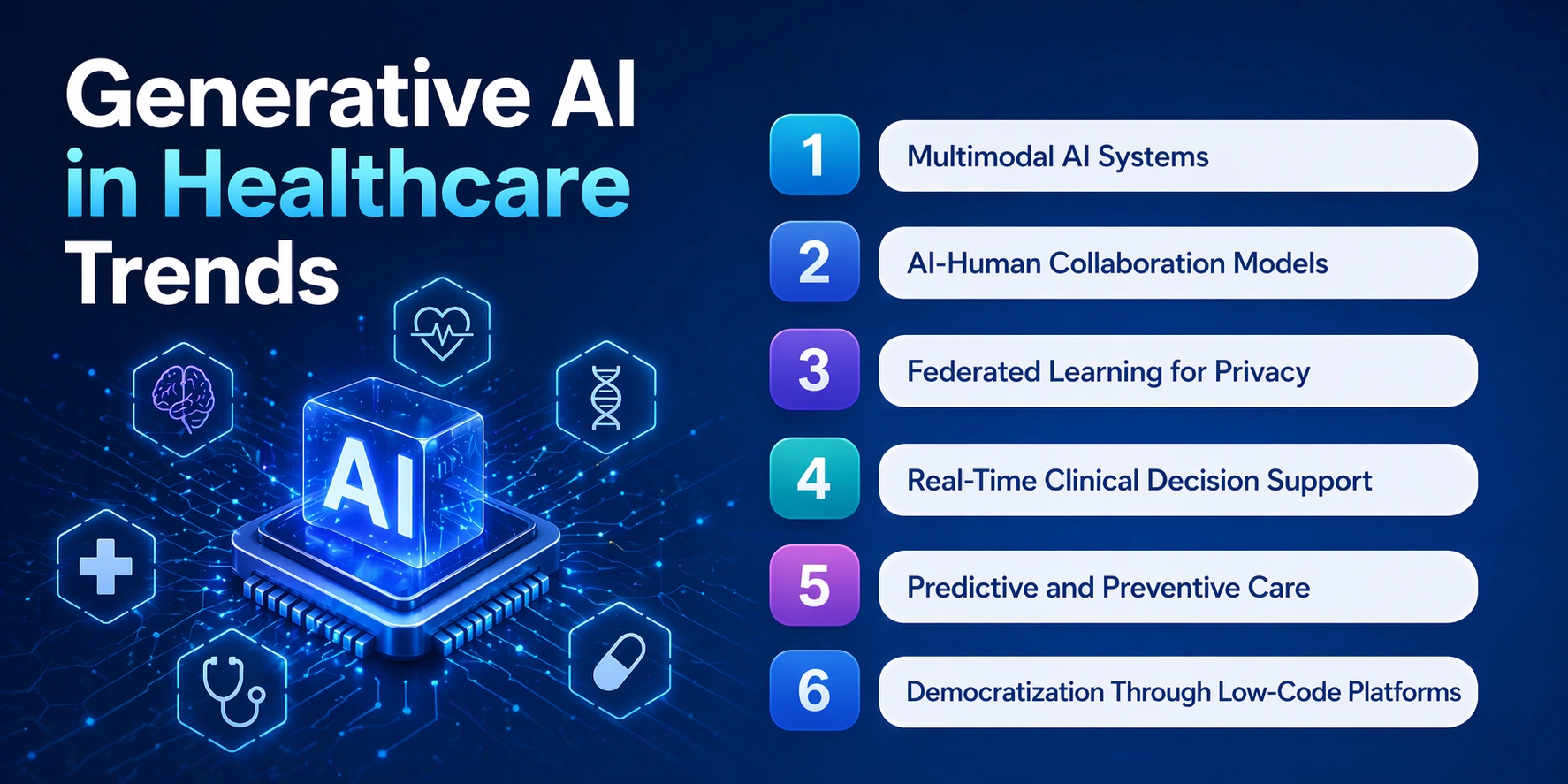
1. Multimodal AI Systems
The next generation of healthcare generative AI will integrate multiple data types simultaneously, analyzing medical images, genetic data, clinical notes, and patient-reported outcomes together. This holistic approach will enable more accurate diagnoses and better personalized treatments.
2. AI-Human Collaboration Models
Rather than replacing healthcare professionals, emerging trends focus on augmenting human capabilities. Future systems will function as intelligent assistants that handle routine tasks while amplifying the expertise and judgment of medical practitioners.
3. Federated Learning for Privacy
New training approaches allow generative AI models to learn from data across multiple institutions without that data ever leaving its original location. This federated learning approach addresses privacy concerns while still enabling systems to benefit from diverse datasets.
4. Real-Time Clinical Decision Support
Generative AI in medicine Generative AI in Healthcare Trendsis moving toward real-time assistance during patient encounters. Systems will analyze conversations, vital signs, and medical histories as consultations happen, providing immediate suggestions and alerts to clinicians.
5. Predictive and Preventive Care
Future applications will shift focus from reactive treatment to proactive prevention. Gen AI in healthcare will identify at-risk individuals years before symptoms appear, enabling early interventions that prevent disease development entirely.
6. Democratization Through Low-Code Platforms
Healthcare app development is becoming more accessible through low-code and no-code platforms that allow medical professionals to create custom AI tools without extensive programming knowledge. This empowers clinicians to develop solutions tailored to their specific practice needs.
Getting Started with Generative AI in Healthcare Implementation
For healthcare organizations ready to explore generative AI, a strategic approach ensures successful adoption and meaningful results. Begin by evaluating your current technology infrastructure, data quality, and staff capabilities to identify specific pain points where AI could deliver the greatest impact, whether that’s reducing documentation time, improving diagnostic accuracy, or enhancing patient engagement.
Initial projects should demonstrate clear value without risking patient safety. Good starGenerative AI in Healthcareting points include administrative automation, patient communication tools, and clinical decision support for well-established protocols. Combining app development service providers with healthcare expertise to ensure your AI systems meet regulatory requirements and integrate properly with existing workflows. Look for partners who understand both the technical and clinical aspects of implementation.
Technology alone won’t drive transformation. Healthcare professionals need training to use AI tools effectively and to understand their capabilities and limitations through ongoing education programs that build confidence and competency with new systems. Develop clear policies for AI use, including oversight mechanisms, accountability structures, and procedures for handling system errors or unexpected outputs to build trust and ensure responsible deployment. Track key performance indicators to assess whether AI implementations are delivering expected benefits and be prepared to adjust approaches based on real-world feedback from clinicians and patients.
The Transformative Promise of Generative AI in Healthcare
The integration of generative AI in healthcare represents one of the most significant advances in medical technology this century. From streamlining administrative burdens to discovering breakthrough treatments, this technology offers solutions to some of healthcare’s most persistent challenges.
While obstacles around privacy, regulation, and equitable access remain, the trajectory is clear. Organizations that thoughtfully adopt generative AI today will be better positioned to deliver superior care tomorrow. The question is no longer whether AI will transform healthcare, but how quickly and comprehensively that transformation will occur.
For healthcare providers, administrators, and technology partners, now is the time to engage with these powerful tools. Whether through healthcare app development initiatives, clinical decision support systems, or patient engagement platforms, the opportunities to improve outcomes and efficiency have never been greater.
The future of medicine is being written by the combination of human expertise and artificial intelligence working in harmony. Those who embrace this partnership will lead healthcare into a new era of precision, accessibility, and innovation that benefits providers and patients alike.
FAQs
1. How is generative AI different from traditional AI in healthcare?
Generative AI creates new outputs like treatment plans or medical images, while traditional AI mainly analyzes existing data to identify patterns or support decision-making.
2. Is generative AI safe to use in healthcare settings?
Generative AI can be safe when properly validated, regulated, and monitored, but it still requires human oversight to ensure accuracy and patient safety.
3. What are the biggest risks of generative AI in healthcare?
Key risks include data privacy concerns, algorithmic bias, inaccurate outputs, and challenges with regulatory compliance and clinical validation.
4. Can generative AI replace doctors or healthcare professionals?
No, generative AI is designed to assist, not replace, healthcare professionals by automating tasks and enhancing clinical decision-making.
5. How does generative AI improve patient outcomes?
It enables earlier diagnosis, personalized treatments, faster drug discovery, and better patient engagement, all of which contribute to improved health outcomes.
6. What types of healthcare organizations benefit most from generative AI?
Hospitals, clinics, pharmaceutical companies, and digital health startups can all benefit, especially those looking to improve efficiency, innovation, and patient care.