Table of Contents
Healthcare is rapidly evolving, with remote patient monitoring at its core. Hospitals, clinics, and health tech startups are competing to develop smarter, more connected care solutions, which is essential. The global remote patient monitoring market size is 31 million USD as of 2026. Patients seek convenience, while providers need access to data. Today’s technology makes it possible to deliver exactly that to both parties from anywhere in the world.
But before a single line of code is written, one question always comes up: how much is this going to cost? The answer is not a flat number. The cost of remote patient monitoring software depends on a wide range of factors, from the features you need to the development team you hire and the regulatory requirements you have to meet. This guide breaks it all down so you can plan with confidence.
What Is Remote Patient Monitoring, and Why Does It Matter?
At its core, remote patient monitoring is a method of healthcare delivery that uses digital technology to collect patient health data outside of a clinical setting and transmit that data to providers for review and response. Think of a patient recovering from cardiac surgery at home. Instead of making multiple hospital visits per week, they wear a device that continuously tracks their heart rate, blood oxygen levels, and activity. That data flows in real time to their care team, who can flag any anomalies and intervene before a small issue becomes a crisis.
This kind of connected care is not just a convenience, it is a clinically significant development. Studies consistently show that patients enrolled in monitoring programs have lower hospital readmission rates, better medication adherence, and stronger overall health outcomes. For providers, it means fewer emergency visits, more efficient use of staff time, and a broader ability to manage larger patient populations. The technology makes all of this possible, but only if the software behind it is built well.
How Does Remote Patient Monitoring Work?
The remote patient monitoring system has interconnected layers that must work reliably. It begins with a data collection device, such as wearable, diagnostic tool, or smart home device, that captures biometric data and transmits it to a cloud platform. The platform processes and stores the data, using rules or machine learning to check if values are normal for the patient. If not, it alerts the care team. Care teams review data via their dashboard, responding by messaging, scheduling telehealth, or dispatching emergency services if needed. This process occurs continuously, ensuring a seamless experience for the patient, supported by a sophisticated system that comes at a cost.
The Real Benefits of Remote Patient Monitoring
Understanding the benefits of remote patient monitoring is essential before committing to a software build. Your feature set should be driven by the outcomes you are trying to achieve. The most impactful benefits include: 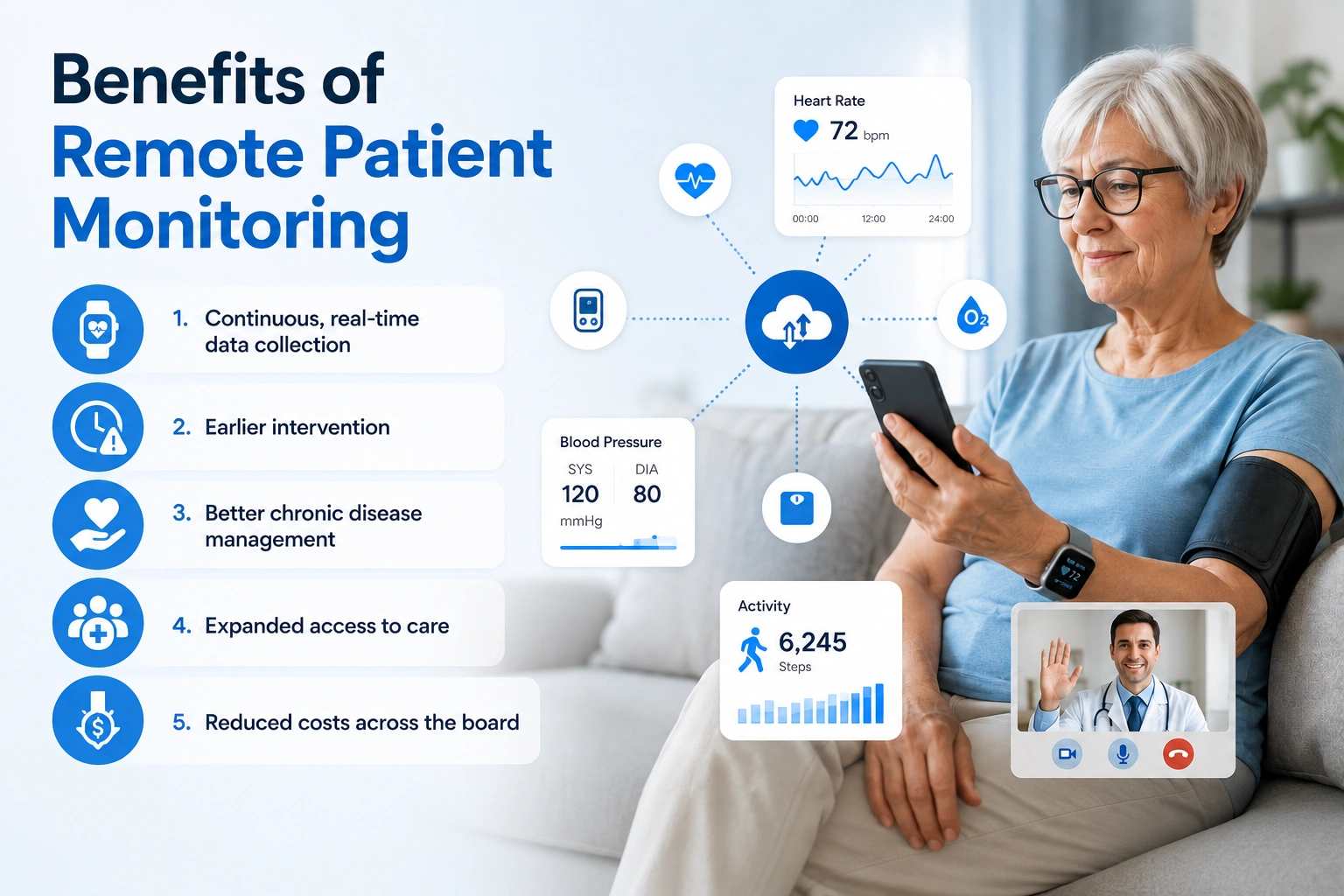
1. Continuous, real-time data collection
Unlike a 15-minute in-office visit, RPM captures health metrics over days, weeks, and months. This longitudinal view gives clinicians far more accurate insight into a patient’s condition.
2. Earlier intervention
When vital signs cross a threshold, automated alerts notify care teams immediately. This allows providers to act before a patient’s condition deteriorates to the point of requiring hospitalization.
3. Better chronic disease management
Conditions like diabetes, hypertension, COPD, and heart failure require consistent monitoring. RPM gives patients and providers the tools to track these conditions daily without the burden of constant in-person visits.
4. Expanded access to care
Patients in rural or underserved areas gain access to quality healthcare that geography would otherwise make difficult. A specialist in one city can effectively monitor a patient hundreds of miles away.
5. Reduced costs across the board
Fewer emergency admissions, shorter hospital stays, and more efficient provider workflows all translate into meaningful cost savings for health systems and patients alike.
These are the benefits that are driving real investment, and they are the reason remote patient monitoring software development has become one of the most in-demand segments in health tech. If you are exploring what a build like this involves end to end, our app development services team works with health tech companies at every stage of that process.
Examples of Remote Patient Monitoring in Action
Looking at real-world examples of remote patient monitoring helps clarify what kind of software you need to build and the complexity involved. Remote patient monitoring can be used in many ways, so understanding each can help businesses determine the one best suited to their needs.
1. Cardiac monitoring
Wearable ECG patches and connected heart monitors transmit rhythm data continuously. Software platforms receive, analyze, and flag arrhythmias for cardiologist review.
2. Diabetes management
Continuous glucose monitors (CGMs) paired with mobile apps allow patients to track blood sugar in real time. Integrated software sends alerts when levels move outside of target ranges and can even sync with insulin pump data.
3. Post-surgical recovery
Patients discharged after joint replacements or major surgeries wear devices that track movement, temperature, and pain indicators. Care teams monitor recovery milestones remotely and can schedule follow-ups only when needed.
4. Pulmonary care
Patients with COPD or asthma use connected spirometers and oxygen monitors. Software logs daily lung function and alerts providers to downward trends before they escalate.
5. Maternal health
Expectant mothers use home monitoring kits to track blood pressure and fetal heart rate. Software platforms flag concerning readings and route them to OB care teams for review.
Each of these use cases requires a different combination of device integrations, data pipelines, alert logic, and user interfaces. The more complex the use case, the more custom your software needs to be, and the more that influences cost.
Key Features of Remote Patient Monitoring Software
Before we get into numbers, it helps to understand what goes into a fully functional RPM platform. The remote patient monitoring tools and features that make up the system are the primary cost drivers.
1. Patient-facing mobile or web application:
This interface allows patients to view data, receive alerts, communicate with care teams, and manage health plans. It must be intuitive for all ages and tech skills.
2. Clinician dashboard:
Providers need a centralized view of monitored patients, including real-time vitals, historical trends, alerts, and communication logs. This is often the most complex part of building the platform.
3. Device integration layer:
The software must connect with wearables, biosensors, and medical devices via Bluetooth, cellular, or Wi-Fi. The complexity depends on the device ecosystem targeted.
4. Automated alerting and escalation:
Rules-based or AI-powered systems trigger notifications when patient data crosses thresholds, configurable by condition, patient, and care protocol.
5. Data storage and analytics:
Secure, compliant storage for large volumes of health data, along with analytics tools that help providers identify trends, measure outcomes, and generate reports.
6. Telehealth integration:
Many RPM platforms incorporate video consultation functionality, so providers can conduct follow-ups without requiring in-person visits.
7. EHR connectivity:
Integration with EHR systems like Epic, Cerner, or athenahealth is often needed for monitoring data to flow directly into the patient’s record.
8. Billing and reimbursement tools:
Especially for US platforms, as CMS has specific billing codes (CPT 99453, 99454, 99457, and 99458) for RPM services. Automated software for time tracking and billing reduces administrative burden and overhead.
What Does It Actually Cost to Build Remote Patient Monitoring Software?
Now for the number everyone wants to know. The cost of remote patient monitoring software development can range from roughly $50,000 for a basic MVP to well over $500,000 for a fully featured, enterprise-grade platform. Here is how that range breaks down.
1. MVP or Proof of Concept: $50,000 to $100,000
An MVP typically includes a basic patient app, a simplified provider dashboard, integration with one or two devices, and foundational compliance infrastructure. It is enough to validate the concept, attract early customers, or secure funding for a full build.
2. Mid-Tier Platform: $100,000 to $250,000
This tier adds more robust device integrations, a more polished user experience, automated alerting, telehealth functionality, and initial EHR connectivity. Most early-stage health tech companies targeting a specific clinical use case fall into this range.
3. Full-Featured Enterprise Platform: $250,000 to $500,000+
A platform at this level includes comprehensive device support, advanced analytics, full EHR integration with major systems, custom alerting and escalation workflows, billing automation, and the security architecture required to pass enterprise health system procurement reviews. A remote patient monitoring platform built to these standards opens doors to health system contracts that smaller products cannot access.
The geographic location of the development team also plays a major role. US-based teams typically charge $150 to $250 per hour. Eastern European teams range from $50 to $100 per hour. South Asian teams often fall between $25 and $75 per hour. The tradeoff is not just cost but communication overhead, time zone alignment, and familiarity with US healthcare regulatory requirements. For a broader look at how these variables affect budgets across health tech products, our mobile app development cost guide breaks it down in detail.
The Future of Remote Patient Monitoring
The future of remote patient monitoring is being shaped by several converging trends that will significantly influence which software gets built and which features become table stakes.
1. AI Remote Patient Monitoring
Remote patient monitoring with AI revolutionizes healthcare by using machine learning to detect early deterioration. An advanced model trained on millions of records can identify patients with “normal” vitals who exhibit patterns like past adverse events. AI-driven remote patient monitoring is moving from experimental to operational in many health systems today. For a closer look at what this means in practice, our piece on the benefits of integrating ML into mobile apps covers the key use cases and implementation considerations.
2. Ambient Sensing and Passive Monitoring
Future RPM will rely less on patients actively wearing or using devices and more on ambient technologies that collect data passively, through smart home sensors, cameras with computer vision, and even acoustic monitoring. This reduces friction and dramatically improves adherence.
3. Deeper EHR Integration and Interoperability
As FHIR standards mature and health systems modernize their infrastructure, RPM platforms will be able to exchange data more seamlessly with clinical systems, enabling richer, more contextual care decisions.
4. Expanded Payer Coverage
As evidence for RPM’s clinical and economic value continues to accumulate, more payers are expanding coverage. This creates a stronger business model for RPM companies and more incentives for health systems to deploy the technology broadly.
Choosing the Right Development Partner?
Building remote patient monitoring software is not a generic software project. It requires a team that understands both the technical complexity of health data systems and the regulatory landscape of healthcare technology. Cutting corners on compliance or security to save money in the short term almost always costs more in the long run, whether through rework, failed audits, or reputational damage.
Seek a development partner experienced in HIPAA-compliant systems, device integration, and healthcare interoperability. Review their portfolio for similar remote patient monitoring use cases. Ask about their FDA regulatory strategy and security architecture approach.
If your roadmap includes predictive analytics or intelligent alerting, our ML solutions are built to integrate cleanly into RPM platforms from the ground up. And if AI-driven triage, predictive modeling, or natural language processing for clinical documentation is part of your vision, our artificial intelligence development services can help you scope and build those capabilities in a way that is clinically validated and production-ready.
Final Thoughts
Remote patient monitoring is one of the most consequential categories in health technology today. When done well, it improves patient outcomes, reduces costs, and expands access to care. When done poorly, it wastes resources and erodes trust in digital health more broadly. The investment required to build great RPM software is real, but so is the return. Whether you are a health system looking to deploy monitoring at scale, a startup building a condition-specific platform, or a device manufacturer looking to add software value to your hardware, the path forward starts with an honest understanding of what it takes to build something that works.
If you are ready to have that conversation, the AppsChopper team is ready to help you scope, plan, and build.
Frequently Asked Questions
1. Do I need FDA approval to launch remote patient monitoring software?
Whether FDA clearance is needed depends on software classification. Wellness apps usually aren’t regulated, but clinical diagnosis or treatment software may be classified as SaMD and need 510(k) clearance. Consulting a regulatory specialist early is advisable.
2. Who owns the patient data collected through an RPM platform?
Patients have legal rights to their health data under HIPAA and CCPA, with providers as custodians. Software vendors must follow a signed BAA. Ownership and access rights must be clearly stated in your platform’s terms and privacy policy.
3. Can a small or independent medical practice afford to implement RPM?
Yes, the model differs from large health systems. Many small practices use white-label RPM platforms or third-party providers instead of custom software, lowering entry barriers. Medicare and private payer reimbursements can offset operational costs.
4. How long does it typically take to build an RPM platform from scratch?
A basic MVP typically takes 4 to 6 months from kickoff to launch. A mid-tier platform with broader device support and EHR integration typically takes 9 to 14 months. Enterprise-grade builds with full compliance infrastructure and custom workflows can take 18 months or more, depending on scope and team size.
5. What happens if a patient’s device loses connectivity or stops transmitting data?
A well-designed RPM platform should have gap detection built in, meaning it flags
when expected data stops arriving and alerts the care team. Protocols for handling connectivity loss, whether through automated patient notifications, fallback check-in methods, or escalation workflows, should be defined during the product design phase, not after launch.
6. Is it better to build an RPM platform in-house or partner with an existing vendor?
Choosing between custom and platform depends on your goals. Custom offers full control over features, data, and differentiation, but needs more time and investment. Platforms speed up market entry and cost less upfront but limit flexibility and create dependency. Companies with unique clinical needs benefit from custom builds, while those using standard protocols often prefer vendors.