
Table of Contents
A forward-thinking healthcare company sees a huge opportunity to expand its reach. The global telemedicine market was valued at $130.5 billion in 2025 and is expected to grow to $157.9 billion in 2026, then reach $514.2 billion by 2033, according to Grand View Research. The projected CAGR is 18.4% from 2026 to 2033. Patients increasingly expect convenient virtual care at their fingertips. So, the executives make a bold decision: “Let’s build our own virtual care app.”
But within months, reality hits. Video consultations, live chat, e-prescriptions, security, HIPAA compliance, bugs, and ongoing maintenance demand far more time and money than expected. Instead of focusing on patient care, the team finds itself running a software operation.
That’s where a white label telemedicine platform can change the equation. Rather than building everything from scratch, healthcare businesses can customize a ready-made platform with their own branding and launch a virtual care solution much faster.
If your expertise is healthcare, why spend years becoming a software company when you can launch your own branded virtual clinic?
This guide explores the strategic steps, key features, why businesses need to invest in this platform, and development costs to stand out in this competitive market.

Image Source: Grand View Research
What Is a White Label Telemedicine Platform?
A white-label telemedicine platform is a pre-built or reusable telehealth solution that businesses can customize with their own branding, workflows, and selected features and offer as their own digital healthcare service.
Instead of building appointment scheduling, virtual consultations, patient management, notifications, payments, and other core capabilities from scratch, a business can start with an existing platform and configure it to its requirements.
The key distinction is that white-labeling doesn’t mean simply changing a logo or color scheme. A useful platform should give businesses enough flexibility to configure the patient and provider experience, integrate required healthcare systems, and support the services they actually plan to offer.
For example, a clinic may use the platform to provide online consultations, while a healthcare startup may use the same underlying solution to operate a multi-provider virtual care marketplace. The underlying platform can remain reusable while the customer-facing experience is adapted to each business.
White-Label vs. Custom Telemedicine Software: What Is the Difference?
The main difference is how much software already exists before your project begins.
| Factor | White-Label Telemedicine Platform | Custom Telemedicine Software |
| Development approach | Starts with existing core functionality | Built around specific business requirements |
| Launch time | Generally faster | Generally longer |
| Initial development effort | Lower | Higher |
| Branding | Customizable | Fully controlled |
| Feature flexibility | Depends on the platform | Broadly customizable |
| Integrations | Depends on available APIs and vendor support | Can be developed around required systems |
| Maintenance | Often handled partly by the platform provider | Organization or development partner manages it |
| Ownership | Depends on licensing agreement | Typically greater control over the developed product |
The choice should therefore be based on the business model, not development speed alone.
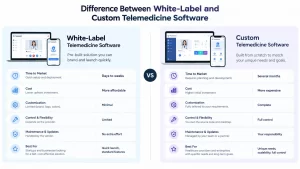
A white-label approach can make sense when the goal is to launch a proven set of telemedicine capabilities quickly and validate demand. On the other hand, custom development becomes more relevant when a company’s workflows, integrations, user experience, or product functionality need to differentiate from what existing platforms provide.
Why Businesses Invest in White Label Telemedicine Platform Development
To understand why so many industry leaders are making this shift, let’s explore the core business advantages driving the investment in white-label telemedicine solutions.
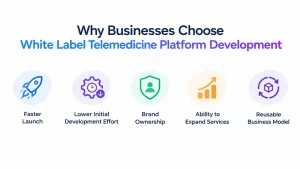
Faster Launch
Building a complete telemedicine product from zero requires significant work across scheduling, consultation, patient management, payments, notifications, security, testing, and administration.
A white-label mobile app development agency can reduce this initial workload because the core functionality is already available to configure and deploy.
Lower Initial Development Effort
Businesses do not necessarily need to fund the development of every standard telemedicine capability independently.
The investment can instead focus on branding, required customization, integrations, compliance-related work, testing, deployment, and ongoing improvements.
Brand Ownership
Patients can interact with a platform under the healthcare company’s own brand rather than being redirected to a third-party telemedicine service.
This gives the business greater control over how patients experience registration, consultation, communication, and follow-up services.
Ability to Expand Services
A well-designed white-label platform can support adding services such as specialist consultations, remote monitoring, digital prescriptions, payment services, and other virtual care workflows.
The exact expansion possibilities depend on the platform’s available features, integrations, and customization capabilities.
Reusable Business Model
Businesses can also use white-label telemedicine software as the foundation for a B2B healthcare technology product.
For example, a company could provide branded virtual care solutions to clinics, hospitals, employers, or specialist healthcare organizations instead of operating the platform only for its own patients.
Essential Features of a White Label Telemedicine Platform
The right features depend on the type of healthcare service being delivered. However, several capabilities are important for most platforms.
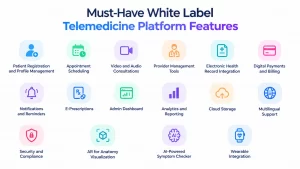
Patient Registration and Profile Management
Patients should be able to create accounts, manage personal information, upload relevant documents, and maintain their healthcare profiles without unnecessary steps.
A simple onboarding process reduces friction before the first consultation.
Appointment Scheduling
Patients and providers should be able to view availability, schedule appointments, reschedule when necessary, and receive reminders.
Calendar synchronization can also reduce scheduling conflicts and missed appointments.
Video and Audio Consultations
Secure video and audio consultations form the foundation of many telemedicine services.
The experience should support reliable communication, waiting rooms, session controls, and appropriate privacy safeguards so providers can conduct consultations without relying on disconnected third-party workflows.
Provider Management Tools
Healthcare providers need tools to manage availability, appointments, patient information, consultation history, and clinical workflows.
An effective provider dashboard should reduce administrative work rather than simply provide another interface to maintain.
Electronic Health Record Integration
Integration with EHR or EMR systems lets relevant patient information move between systems, so healthcare professionals don’t have to re-enter the same information repeatedly.
For businesses operating at scale, interoperability should be evaluated early because integration limitations can become a major barrier to expansion.
Digital Payments and Billing
Payment functionality lets patients pay for consultations and lets businesses manage transactions within the same service ecosystem.
Depending on the business model, the platform may also need refunds, invoices, subscriptions, insurance-related workflows, or multiple payment methods.
Notifications and Reminders
Automated notifications can remind patients about appointments, payments, prescriptions, follow-ups, and other important events.
This reduces the need for manual communication and helps keep patients informed throughout the care journey.
E-Prescriptions
Where legally and operationally applicable, digital prescription functionality can connect the consultation with the next stage of care.
The implementation must account for the applicable prescribing rules and healthcare requirements in the markets where the platform operates.
Admin Dashboard
Administrators need centralized visibility into users, providers, appointments, transactions, reports, platform settings, and operational activity.
For a white-label product, the administrative layer becomes particularly important when multiple healthcare organizations or business clients use the same platform.
Analytics and Reporting
Analytics can help businesses monitor appointment volume, provider utilization, patient engagement, cancellations, revenue, and other operational metrics.
Cloud Storage
Cloud storage allows healthcare businesses to securely manage relevant digital information and support access to data across approved devices and locations. The storage approach should include appropriate access controls, encryption, backup, and data-retention practices for the markets in which the platform operates.
Multilingual Support
Multilingual functionality allows businesses to serve patients and providers who speak different languages. This can expand the platform’s addressable market while making registration, appointment booking, consultations, and other workflows easier for a wider user base.
Security and Compliance
Security must be built into every layer of a telemedicine platform because it handles highly sensitive medical and personal data. Key features like role-based access control, multi-factor authentication, end-to-end encryption, secure APIs, audit logs, and access monitoring safeguard information while ensuring full compliance with strict global rules like HIPAA and HITECH in the US and GDPR in Europe.
AR for Anatomy Visualization
AR-based anatomy visualization can help healthcare professionals explain certain medical concepts or procedures through interactive visual representations. However, it isn’t necessary for every telemedicine business. It can add value to specialized healthcare services where visual explanations improve patient understanding or provider communication.
AI-Powered Symptom Checker
An AI-powered symptom checker can collect information about a patient’s reported symptoms and help guide them toward an appropriate next step, such as scheduling a consultation or seeking urgent care. It should support professional medical judgment and should be designed with appropriate safety, clinical, privacy, and regulatory considerations.
Wearable Integration
Integration with wearable technology in healthcare can incorporate relevant health data, such as heart rate, activity, sleep, or other supported measurements, into the patient’s digital healthcare experience. This gives providers additional information for remote monitoring and helps businesses expand beyond one-time virtual consultations.
How to Develop a White Label Telemedicine Platform
Now that we’ve covered the strategic advantages of investing and the essential features, let’s look at a step-by-step roadmap for developing a white-label telemedicine platform efficiently.
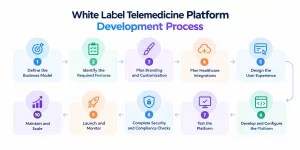
1. Define the Business Model
Start by identifying who will use the platform and how the business will generate revenue. A clinic serving its own patients will have different requirements than a company selling a telemedicine platform to multiple healthcare organizations.
2. Identify the Required Features
Then, separate must-have features from optional nice-to-haves. Focus on core capabilities, like secure video calls and basic scheduling, to keep the initial build from getting too complex so your team can launch faster without blowing the budget on nonessential tech.
3. Plan Branding and Customization
Define which parts of the platform each business can customize. This can include logos, colors, content, notifications, user journeys, feature availability, provider settings, and other customer-facing elements.
4. Plan Healthcare Integrations
Identify the external systems the platform must communicate with before white-label telemedicine app development begins. These may include EHR/EMR systems, payment gateways, pharmacies, laboratories, identity verification services, calendars, communication tools, and wearable devices.
Integration requirements can significantly affect both development effort and overall cost.
5. Design the User Experience
Create separate experiences for patients, healthcare providers, administrators, and, where applicable, business clients.
The goal should be to make each workflow straightforward. For example, allowing a patient to book and attend a consultation without unnecessary steps while giving providers quick access to the information needed for the appointment.
6. Develop and Configure the Platform
The development team can configure the existing white-label capabilities and build the custom elements that the business requires. This is where branding, workflows, integrations, payment functionality, dashboards, and other business-specific requirements are brought together.
7. Test the Platform
Healthcare application testing should cover functional workflows, integrations, security, performance, usability, accessibility, and different user roles. These platforms need particular attention to data handling and failure scenarios because a technical issue can affect both business operations and patient experiences.
8. Complete Security and Compliance Checks
Build compliance and data security directly into your architecture from day one. HIPAA, PHI, or GDPR requirements right before launch can cause major redesign delays, unexpected costs, and critical security vulnerabilities.
Specific obligations depend on the countries, users, healthcare services, and types of health information the platform handles.
9. Launch and Monitor
After deployment, monitor system performance, appointment completion, user activity, failed transactions, support requests, and other meaningful operational metrics.
These insights can show which parts of the platform require improvement after real users begin interacting with it.
10. Maintain and Scale
A telemedicine platform needs continuous maintenance as integrations, operating systems, security requirements, healthcare workflows, and business needs change.
A development agreement should therefore define what happens after launch, including updates, bug fixes, monitoring, support, security improvements, and future customization.
How Much Does White-Label Telemedicine Platform Development Cost?
There is no single development price because the total investment depends on how much customization and integration the business requires.
One development agency estimates the cost to develop a telemedicine app like Amwell at roughly $35,000 to $250,000 or more, with timelines from four months to a year or longer. Treat that as a planning guide, not a quote. Other vendors price differently, and regional labor rates change the calculation.
| App Complexity | Average Cost | Average Timeline |
| Simple solution with basic features | $35,000 – $75,000 | 4 – 6 months |
| Medium complex platform with moderate features | $75,000 – $185,000 | 4 – 9 months |
| Highly complex system with advanced features | $185,000 – $250,000+ | 9 – 12+ months |
The Costs Beyond the Build
The development quote is only the first bill. Budget for these recurring items as well:
- Cloud hosting that scales with visit volume
- Security monitoring, audits, and penetration testing
- Regulatory updates as privacy rules change
- Bug fixes, feature updates, and platform upgrades
- Customer support and clinician training
Skipping these line items creates false savings. A breach, for example, costs far more than most build budgets. A single data breach costs healthcare companies an average of $10.93 million, more than any other field. By comparison, the financial sector takes the second-biggest hit, averaging $5.9 million per incident, according to IBM’s Cost of a Data Breach report.
Common Factors Drive Costs
The major cost factors include:

- Customization: More business-specific workflows require more development work.
- Integrations: EHR, payment, laboratory, pharmacy, identity, and other integrations increase project complexity.
- Number of platforms: Supporting web, iOS, and Android can increase development and testing requirements.
- Security requirements: Advanced authentication, access controls, monitoring, and security testing add to the investment.
- Compliance requirements: Operating across multiple regions can introduce additional legal, technical, and operational requirements.
- UI/UX customization: A highly customized patient and provider experience requires more design and development effort.
- Third-party services: Video, messaging, payment, analytics, and other external services may introduce recurring costs.
- Maintenance: Hosting, updates, monitoring, support, and future development add to long-term costs.
Therefore, businesses should evaluate total cost of ownership, not only the initial setup price. A low entry cost can become less attractive if you later add required integrations, customization, support, or recurring platform fees.
How to Keep Costs Under Control
Start with a focused first release. Launch with the features your clinicians and patients need on day one, then add advanced tools once real usage shows what matters.
- Choose a vendor with a well-documented API so future integrations cost less.
- Ask for a full cost schedule that covers implementation, hosting, support, and renewal terms.
- Pilot before you scale, because fixing a problem with 50 users costs far less than fixing it with 50,000.
The right question is not “What is the cheapest option?” It is “Which option delivers the fastest, safest return on our investment?”
How to Monetize a White Label Telemedicine Platform
If you’re developing the platform as a commercial product, businesses can use several revenue models.
Subscription Plans
Healthcare organizations can pay a recurring monthly or annual fee for access to the platform. Different plans can provide different feature limits, provider counts, storage capacity, or administrative capabilities.
Per-Provider Pricing
The business can charge based on the number of healthcare professionals using the platform. This model can work when platform usage grows primarily with the size of the provider network.
Per-Consultation Fees
A platform owner can charge a fee for each completed virtual consultation. This aligns revenue with platform activity but requires careful consideration of transaction economics and provider expectations.
Enterprise Licensing
Hospitals, healthcare networks, and larger organizations may require customized deployments and additional integrations. Enterprise licensing can therefore combine platform access with implementation, customization, support, and service agreements.
Premium Features
Advanced capabilities such as analytics, AI-assisted workflows, remote monitoring, or additional integrations can be offered as paid upgrades when they provide clear operational value.
Security and Compliance Considerations
Security in telemedicine underpins patient trust and protects your brand. Because virtual care platforms handle sensitive medical records, compliance goes far beyond slapping a “HIPAA-compliant” badge on your site.
One of the biggest advantages of a white-label platform is that the vendor has already built these complex, enterprise-grade safeguards into the core system:
- Zero-Trust Data Protection: End-to-end encryption, multi-factor authentication, and role-based access mean only authorized personnel ever see sensitive records.
- Automatic Regulatory Alignment: Pre-built compliance with strict international standards like HIPAA (US), GDPR (Europe), and PIPEDA (Canada) saves you months of legal review.
- Built-in Resilience: Automated audit logs, secure API connections, and continuous disaster recovery keep your operations running safely 24/7.
Instead of spending hundreds of thousands of dollars engineering these safeguards from scratch, a white-label platform gives you instant, audit-ready security from day one.
Challenges to Consider Before Developing a White-Label Telemedicine Platform
While a white-label telemedicine platform offers a fast, cost-effective route to market, it comes with strategic trade-offs every healthcare leader must evaluate before signing a contract:
- Customization Boundaries: White-label platforms offer configurable themes and layout adjustments, but core codebase changes are off-limits.
- Key Check: Clarify which clinical workflows are flexible out-of-the-box versus features that require paid custom development.
- Vendor Dependency & Lock-In: Outsourcing technology means relying on your vendor for system uptime, bug fixes, regulatory patches, and server hosting.
- Key Check: Establish strict Service Level Agreements (SLAs) and clear data migration clauses in your contract in case you switch providers later.
- EHR & System Integration Limits: A feature-rich platform still creates operational bottlenecks if it cannot sync with your existing Electronic Health Records (EHR) or billing systems.
- Key Check: Request open API documentation and test integration capabilities with your tech stack before committing.
- Scalability & Performance Limits: A platform built for a small practice may lag, drop video, or load slowly as patient volume scales.
- Key Check: Verify how the platform handles concurrent consultations, heavy media bandwidth, and database scaling.
- Hidden Long-Term Costs: Beyond the initial setup fee, recurring costs like per-consultation fees, server hosting, third-party API usage (SMS/video), and support tiers add up over time.
- Key Check: Request a transparent total cost of ownership (TCO) breakdown covering 3–5 years.
How to Choose the Right White-Label Telemedicine Development Partner
Evaluate the development partner on more than the number of features shown in a product demo.
Healthcare Experience
Look for experience with healthcare workflows, telemedicine, EHR/EMR integration, patient-facing applications, and healthcare data requirements.
Customization Capabilities
Ask exactly what can be customized without rebuilding the platform from scratch.
Integration Experience
Confirm whether the partner has experience connecting healthcare platforms with EHRs, payment systems, laboratories, pharmacies, identity services, and other required systems.
Security and Compliance Knowledge
Ask how security is handled throughout development and what documentation, controls, testing, and operational processes are included.
Support and Maintenance
Understand what happens after launch, including response times, updates, bug fixes, monitoring, security patches, and future development.
Data Ownership and Exit Terms
Before choosing the healthcare app development company, clarify who owns the data, how you can export it, what happens if the contract ends, and whether another technology team can take over the product.
Scalability
Ask for clear information about supported users, integrations, deployment options, infrastructure, and how the platform can accommodate future growth.
How AppsChopper Can Help You Build a White-Label Telemedicine Platform
Building a white label telemedicine platform requires more than assembling standard app features. You need a solution that supports your brand, healthcare workflows, integrations, security requirements, and future expansion without adding unnecessary complexity.
AppsChopper provides healthcare app development services covering telemedicine, EHR/EMR solutions, hospital management systems, healthcare CRM, and other digital healthcare products. Its telemedicine development offering includes patient and doctor dashboards, appointment management, and remote video, audio, and text consultations.
With AppsChopper, you can get support across the development lifecycle, including:
- Product discovery and planning: Define your target users, business model, required features, integrations, and development roadmap before implementation begins.
- Custom healthcare development: Adapt the telemedicine experience to your business requirements instead of relying only on a fixed template.
- Telemedicine functionality: Build capabilities such as virtual consultations, appointment management, patient/provider dashboards, and secure communication.
- Healthcare integrations: Connect the platform with EHR/EMR systems and other healthcare ecosystem components to reduce disconnected workflows.
- Security and compliance: Incorporate security controls and compliance considerations into the development process for healthcare applications. AppsChopper states that its healthcare development services focus on secure, compliant applications and data privacy.
- AI, IoT, and wearable capabilities: Add advanced technologies when they address a specific business or healthcare use case, such as remote monitoring, intelligent analysis, or connected devices.
- Testing and deployment: AppsChopper describes a healthcare development process covering discovery, planning, design, development, testing, deployment, and post-launch support.
- Post-launch maintenance: Continue improving the platform through updates, optimization, security maintenance, and support as requirements evolve.
The objective is to build a white-label telemedicine solution that is launch-ready and adaptable as your patient base, provider network, services, and business requirements grow.
White-Label Telemedicine Platform: Is It Right for Your Business?
A white-label telemedicine platform can reduce the effort required to enter the virtual care market because businesses can begin with established functionality rather than developing every component from scratch.
However, the right platform is not necessarily the one with the longest feature list or the lowest initial price.
Businesses should evaluate whether the solution supports their specific healthcare workflows, required integrations, security obligations, branding requirements, business model, and long-term growth plans.
If standard functionality is enough to launch the service and validate demand, white-label software can provide a practical starting point. If the business depends on highly differentiated workflows, complex integrations, or product capabilities existing platforms cannot support, consider custom development.
The most important decision is to evaluate the platform against the healthcare business’s actual requirements.
FAQs
What is white-label telemedicine software?
White-label telemedicine software is a reusable virtual care platform that another healthcare business or organization can brand and configure.
How long does it take to launch a white-label telemedicine platform?
The timeline depends on customization, integrations, testing, compliance requirements, and deployment scope. Standard implementations can be much faster than building a telemedicine platform from scratch, while complex healthcare integrations can extend the timeline. Recent industry sources describe white-label implementations in ranges from several weeks for standard deployments to longer periods for complex projects.
How much does a white-label telemedicine platform cost?
The cost depends on customization, integrations, platforms, security requirements, compliance needs, and ongoing services. Businesses should calculate both implementation expenses and recurring operating costs before selecting a solution.
Can a white-label telemedicine platform be customized?
Yes, depending on the provider. Branding, workflows, features, user roles, notifications, integrations, and other elements may be configurable, but the level of customization varies by platform.
Is white-label telemedicine software secure?
Security depends on the platform’s technical controls, implementation, infrastructure, third-party services, and operational practices. Businesses should evaluate authentication, encryption, access controls, audit logging, security testing, data handling, and compliance responsibilities before deployment.
Can white-label telemedicine software integrate with EHR systems?
It can, provided the platform supports the required integration methods and the target EHR provides the necessary interfaces. Assess EHR interoperability before selecting a platform because integration requirements can materially affect implementation complexity and cost.
Can businesses make money from a white-label telemedicine platform?
Yes. Potential models include subscriptions, per-provider pricing, per-consultation fees, enterprise licensing, implementation charges, and premium feature packages. The best model depends on the target customers and the platform’s economics.