Table of Contents
A telehealth platform crashes for ten minutes during peak enrollment season. A hospital’s patient portal sends the wrong appointment time to thousands of users. A remote monitoring app fails to flag an abnormal reading before a nurse ever sees it. None of these are hypothetical. They happen every year, and each one traces back to the same root cause: testing that treated healthcare software like ordinary business software.
For executives building or buying healthcare technology, this is not a technical footnote. It is a business risk with a price tag. According to the HIPAA Journal, from January 1, 2026, to April 30, 2026, 252 extensive healthcare data breaches have been reported to OCR, 9.5% fewer data breaches than the previous period in 2025.
Meanwhile, the market keeps moving. Patients expect digital-first care. Providers expect systems that talk to each other without manual workarounds. Investors expect products that pass enterprise due diligence on the first try.
Healthcare application testing sits at the center of all three expectations. Done right, it protects patients, protects revenue, and protects your position in a market where trust decides which vendors survive procurement. Done as an afterthought, it becomes the reason a promising product never makes it past a hospital’s security review.
This guide breaks down what makes application testing different from standard QA, why it matters more than ever heading into next year, and what a well-run testing program actually looks like inside a healthcare business.
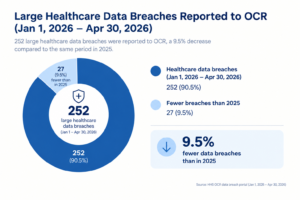
Image Source: HIPAA Journal
What Is Healthcare Application Testing?
Healthcare application testing is the process of evaluating healthcare software to verify that it works correctly, protects sensitive information, handles healthcare data accurately, and performs reliably across its intended environments.
It applies to products such as:
- Electronic health record (EHR) and electronic medical record (EMR) systems
- Patient portals
- Telemedicine platforms
- Healthcare mobile applications
- Remote patient monitoring applications
- Hospital management software
- Pharmacy and laboratory systems
- Healthcare billing and claims applications
- Medical device software
- Digital health and clinical applications
The testing scope depends on the application’s purpose.
For example, a patient portal needs strong authentication, privacy, accessibility, and appointment testing. A clinical application may require additional validation of medical workflows and data accuracy. Software connected to a medical device may also fall under FDA requirements.
The goal is not simply to determine whether a feature works. It is to determine whether the application behaves safely, accurately, securely, and reliably within a healthcare environment.
What Makes Healthcare Application Testing Different From Regular Software Testing?
Most software testing answers one question: does the feature work as designed? Healthcare application testing answers that question too, but it adds three more, and none of them are optional.
Is it safe for a patient? Is it defensible to a regulator? Does it stay accurate when connected to a dozen other systems that were never built to work together cleanly?
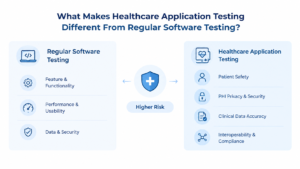
That difference shows up the moment something breaks. Look at what the same category of bug costs in two different industries.
| Bug Type | Cost in a Typical Business App | Cost in a Healthcare App |
| Form validation error | A support ticket and a reissued order | A wrong dosage or unit recorded in a patient’s file |
| API timeout | A delayed confirmation email | A lab result that never reaches the doctor who ordered it |
| Login vulnerability | A stolen payment card | Exposed medical records, a breach notification, and a regulatory investigation |
| Data mismatch | A package sent to the wrong address | The wrong patient linked to the wrong procedure |
A bug in a healthcare app is a patient safety problem, a legal problem, and a financial problem, often all three at the same time. That single fact changes how a business should think about testing. It is not a cost center to minimize. It is a control that protects the value of everything else the business has built.
Three other differences matter for anyone running a healthcare technology business.
Dynamic Regulatory Compliance
Unlike standard SaaS applications governed by general privacy laws, health tech platforms must comply with strict national and international frameworks. A single software release must simultaneously respect HIPAA, HITECH, GDPR, FDA Software as a Medical Device (SaMD) directives, and regional data residency rules. Testing must validate both functionality and ongoing compliance across all active jurisdictions.
Data Sensitivity
Protected health information carries legal protections that ordinary customer data does not. Testing must prove, not just assume, that this data stays encrypted, access-controlled, and logged correctly at every step, including in test environments that never touch a live patient.
Connection Complexity
A typical business application might connect to two or three outside services. A hospital-facing platform often connects to electronic health record systems, pharmacies, insurance networks, labs, and medical devices, each speaking its own version of standards like HL7 and FHIR. Testing must confirm that patient information keeps its meaning intact across every connection, not just that a message technically arrived.
Why Healthcare Application Testing Is Critical
Healthcare applications support patient care, sensitive health information, clinical workflows, and complex technology ecosystems. As a result, testing must go beyond verifying whether individual features work and focus on whether data, workflows, integrations, and security controls behave correctly under real-world conditions.
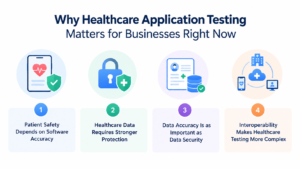
Patient Safety Depends on Software Accuracy
Healthcare apps often manage information that clinicians and patients depend on.
This includes:
- Medication information
- Laboratory results
- Patient histories
- Allergies
- Appointment information
- Diagnostic information
- Treatment-related data
A software defect that changes, hides, delays, or misroutes this information may have consequences beyond the application itself.
Testing should therefore prioritize workflows where an error could affect patient care. This includes validating expected transactions as well as edge cases, invalid inputs, unexpected conditions, and failure scenarios.
Healthcare Data Requires Stronger Protection
Protecting healthcare applications requires more than ensuring they function correctly. When HIPAA applies, organizations must implement safeguards to protect electronic protected health information (ePHI). As a result, security testing becomes essential to application quality.
Depending on the application, security testing may cover:
- Authentication
- Multi-factor authentication
- Authorization
- Role-based access
- API security
- Session management
- Encryption
- Input validation
- Audit logging
- Data exposure
- Vulnerability management
- Third-party integrations
- Backup and recovery
HHS continues to enforce the HIPAA Privacy, Security, and Breach Notification Rules. In April 2026, HHS announced four ransomware-related settlements involving breaches affecting more than 427,000 individuals.
HHS also announced another ransomware settlement with OSF Healthcare System in July 2026, describing an accurate and thorough HIPAA risk analysis as an important requirement for identifying threats and vulnerabilities affecting ePHI.
This reinforces why organizations should test security throughout the application lifecycle to identify weaknesses earlier. They can also validate security controls as applications change and reduce the risk of exposing sensitive healthcare information.
Data Accuracy Is as Important as Data Security
Secure healthcare data is not enough if the information is inaccurate, incomplete, or altered during processing. Data integrity testing verifies that information remains correct as it moves through the application and connected systems.
Testing should consider:
- Patient identification
- Data mapping
- Duplicate records
- Missing information
- Incorrect values
- Data transformation
- Data migration
- Synchronization
- Failed transactions
- Recovery after integration errors
For example, when a laboratory result moves between healthcare systems, testing should verify more than a successful API response. QA should confirm that the result reaches the correct patient, field, format, and clinical context without unintended changes.
Interoperability Makes Healthcare Testing More Complex
Healthcare apps rarely work as standalone systems. A single application may exchange data with EHRs, laboratories, pharmacies, insurance systems, medical devices, payment platforms, identity providers, patient engagement systems, and external APIs.
Depending on the use case, these integrations may rely on standards such as HL7, FHIR, DICOM, or X12. This creates a testing challenge because an integration can be technically successful, but the overall data exchange can still be incorrect.
A successful API response does not confirm that the patient’s information was transmitted, mapped, stored, and displayed correctly throughout that journey.
This matters because an interoperability defect can extend beyond a technical integration issue. It can affect clinical workflows, patient records, billing, or downstream systems. For healthcare apps that depend on multiple platforms, interoperability testing is therefore essential to validating the application’s reliability and data integrity.
What Core Types of Healthcare Applications Require Strict Testing?
Testing strategies must adapt to the specific clinical and operational risks of the software under evaluation. The most common digital health solutions requiring dedicated QA workflows include:
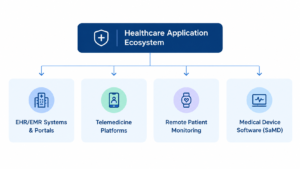
Electronic Health and Medical Record Systems (EHR/EMR)
EHR/EMR solutions act as the digital nervous system of healthcare institutions. Application testing for healthcare EHR solutions focuses heavily on data integrity, role-based record access, multi-facility record synchronization, and audit logging for every view, edit, or export of patient records.
Telemedicine and Virtual Care Platforms
Telehealth platforms combine real-time audio/video streaming, patient triage, digital consent management, and integrated payment processing. QA efforts focus on maintaining secure session tokens, validating low-latency video streaming over poor cellular networks, and protecting video session metadata from unauthorized interception.
Remote Patient Monitoring (RPM) and Medical IoT
RPM apps collect telemetry data from blood glucose monitors, smart pulse oximeters, wearable ECGs, and continuous cardiac monitors. QA must validate real-time data ingestion, offline data caching during connectivity drops, packet loss recovery, and automated threshold alerts that notify care teams when vital signs cross critical limits.
Medical Device Software
Medical Device solutions contain standalone software used for diagnostic or therapeutic purposes (e.g., AI-driven radiology image analyzers, radiation dose calculators). Testing here requires strict compliance with FDA guidelines and international software lifecycle standards (IEC 62304), demanding rigorous verification and validation (V&V) procedures.
Which Regulatory Standards Govern Healthcare Application QA?
To achieve compliance, healthcare application testing companies align testing activities directly with key global standards:
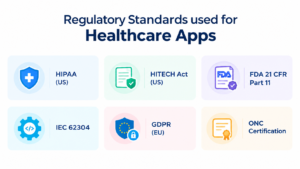
Regulatory Standard | Primary Focus Area | Testing Requirement |
| HIPAA (US) | Protection of ePHI privacy and technical security. | Audit trail validation, access control verification, data encryption checks, and transmission security testing. |
| HITECH Act (US) | Expansion of HIPAA enforcement and breach notification rules. | Validation of breach notification mechanisms, expanded audit logs, and vendor business associate compliance checks. |
| FDA 21 CFR Part 11 | Electronic records and electronic signatures in medical software. | Automated audit trail verification, non-repudiation of digital signatures, and validation of system access logs. |
| IEC 62304 | Global lifecycle software requirements for medical devices. | Rigorous software verification and validation (V&V), risk analysis integration, and complete traceability matrix generation. |
| GDPR (EU) | Data protection and user privacy rights. | Explicit consent management testing, right-to-be-forgotten data-purging validation, and cross-border data-transfer checks. |
| ONC Certification | Health IT interoperability and patient data access. | Verify standardized FHIR API endpoints, secure data-sharing capabilities, and patient portal access requirements. |
The Core Components of a Strong Healthcare Application Testing Program
A mature testing program blends functional testing, which confirms the software works, with non-functional testing, which confirms it keeps working safely under pressure. Below are the components that matter most, and why each one protects business value, not just code quality.
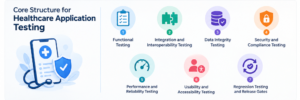
Functional Testing
This confirms that everyday workflows, such as patient registration, appointment booking, prescription entry, and billing, behave correctly under both normal and unusual conditions. In healthcare, the unusual conditions carry real weight. A heart rate entered as 300 beats per minute, or a dosage field that accepts 100 milligrams when 10 was intended, needs to be caught before it reaches a patient record.
Integration and Interoperability Testing
This is where most healthcare software failures actually start, not in the interface, but in the connections between systems. A lab feed arrives with an unexpected field. An insurance response does not map cleanly to a billing status. The goal is confirming that no result went missing, no order got duplicated, and the right patient stayed linked to the right record the entire way through.
Data Integrity Testing
Duplicate patient records and mismatched identifiers across systems create real-world harm for experienced teams. Errors that don’t trigger an obvious alert but quietly corrupt care decisions. A clear map connecting every requirement to a test case and result gives a business verifiable proof that every feature was thoroughly tested and works exactly as intended.
Security and Compliance Testing
This is where application security testing for healthcare earns its name. It has to prove that access controls, multi-factor authentication, encryption, and audit logs actually work. Enterprise buyers increasingly ask for proof, not promises, before they sign a contract.
Performance and Reliability Testing
This measures how the system holds up during peak demand and, just as importantly, how it fails when something does go wrong. A four-second delay loading a product page costs a retailer a sale, and a delay in a patient’s chart during an emergency costs that business can’t refund.
Usability and Accessibility Testing
Healthcare software serves an unusually wide range of people under an unusually wide range of conditions, from a clinician moving fast during a shift change to an elderly patient navigating a portal with limited vision. Testing against WCAG 2.2 AA standards is a requirement with real enforcement behind it.
Regression Testing and Release Gates
Automated testing of software updates ensures that improvements don’t accidentally break what already works, protecting patients from dangerous technical glitches.
How Can Healthcare Organizations Address Critical Testing Challenges?
Executing a high-performing QA strategy in healthcare involves overcoming unique technical and operational challenges:
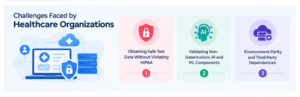
Challenge 1: Obtaining Safe Test Data Without Violating HIPAA
The Risk: Testing with production patient data exposes organizations to massive regulatory fines and privacy breaches. Conversely, using overly simplistic dummy data fails to surface real-world edge cases.
The Solution: Implement automated data masking and synthetic data generation tools (such as Synthea or custom FHIR data generators). These utilities build realistic clinical scenarios, maintaining logical relationships between conditions, medications, and lab results, while completely removing real-world personal identifiers.
Challenge 2: Validating Non-Deterministic AI and ML Components
The Risk: AI-driven diagnostic tools, clinical decision support (CDS) algorithms, and natural language processing (NLP) transcription engines produce variable outputs based on probabilistic models. Moreover, these make simple pass/fail assertions impossible.
The Solution: Establish baseline validation suites using curated, historical clinical datasets. Measure AI outcomes against established precision, recall, and accuracy benchmarks. Incorporate continuous model drift testing to ensure algorithmic performance remains consistent as new clinical data is ingested over time.
Challenge 3: Environment Parity and Third-Party Dependencies
The Risk: Healthcare apps often pass testing in isolated staging environments, only to fail in production because of differences in third-party API response rates, firewall configurations, or endpoint timeouts.
The Solution: Utilize containerized sandbox environments (e.g., Docker/Kubernetes) that mirror production network topologies. Deploy service virtualization tools to mock external EHR, lab, and clearinghouse APIs. This allows QA teams to safely simulate third-party latency, network drops, and malformed payload responses.
Best Practices That Reduce Risk and Protect ROI
Best practices consistently separate businesses that scale safely from businesses that learn these lessons the hard way.
- Prioritize risk: Patient information and medication-related features need more careful testing than small changes to the app’s look or design.
- Bring testing into the design stage, not just before launch: Finding a problem in the requirements early is much cheaper and easier than finding it after the product has already been built.
- Use safe test data: Use fake or anonymized patient data for testing whenever possible. If companies must use real patient data, they get proper approval first.
- Automate the stable layers first: Starting with application programming interfaces before investing heavily in interface-level automation, which tends to be fragile and expensive to maintain.
- Map requirements to tests early: Build a clear requirements-to-tests map early and keep it current, instead of rebuilding it under deadline pressure right before an audit.
- Include a clinical expert during test design: A healthcare professional working with the testing team can spot important risks, such as the wrong medicine dose for a child, that a tester without medical knowledge might miss.
- Make testing part of every release: Run continuous testing inside the release pipeline, with security checks and performance limits acting as hard gates, not optional steps.
What Drives the Cost of Healthcare Application Testing
Cost varies significantly, but it depends on identifiable factors rather than vague complexity.
Integration depth is the single biggest driver. A simple scheduling app with no connection to a hospital system costs far less to test than a platform integrating with three hospital systems, a lab, and an insurance clearinghouse.
Regulatory scope adds real hours. Testing scoped only for HIPAA is narrower than testing that also has to produce evidence for FDA review or GDPR compliance across multiple markets.
Team composition matters as much as team size. A strong healthcare testing program benefits from specialists who understand interoperability standards, security validation, and, for anything patient-facing, a clinical reviewer.
In-house versus outsourced changes the cost structure, not just the total. Building a team in-house means hiring time and filling specialized skill gaps. Outsourcing to a specialized healthcare application testing company trades that for a need to manage the vendor relationship closely and define clear deliverables. Neither option is automatically cheaper. The right choice depends on release frequency and how much of this expertise the business needs to keep long term.
How Can Organizations Choose the Right Strategy for Healthcare App Testing?
Building a search-competitive, reliable, and compliant digital health platform requires moving beyond basic QA practices. By testing, healthcare organizations protect both their business reputation and patient safety.
When structuring your testing strategy, focus on three primary pillars:
- Prioritize Risk-Based Testing: Focus testing resources on high-concurrency workflows, patient safety logic, and ePHI integration points where defects carry severe consequences.
- Automate System Interoperability: Build automated validation suites for FHIR, HL7, and third-party APIs to verify data integrity across every software release.
- Embed Security and Compliance Early: Integrate compliance checks, encryption validation, and vulnerability scanning directly into your healthcare app development lifecycle.
Through structured QA processes, reliable test automation, and expert domain alignment, healthcare technology providers can release applications that earn patient trust, satisfy complex regulatory standards, and deliver consistent clinical value.
How AppsChopper Supports Healthcare Application Testing
At AppsChopper, we build testing into the product design process from day one, not at the end of a release cycle. As a healthcare application testing company, we start with risk mapping. We identify every workflow that could affect patient safety, data accuracy, or compliance before writing a single test case, so testing effort goes where it best protects the business.
Our services cover the full range a growing healthcare business needs: functional and regression testing, such as HL7, FHIR, and DICOM interoperability validation. Our QA testers provide security and compliance testing aligned with HIPAA and relevant regional rules.
Also, we execute performance testing under realistic clinical load and accessibility testing against WCAG 2.2 AA. For businesses building AI-assisted features, we validate model behavior on its own track, separate from standard feature testing, because a model needs different proof than a form field does.
Whether a business needs a full healthcare application testing service for a new product launch or focused support to harden an existing platform before a hospital vendor review, we deliver documented evidence alongside the testing. When a partner or regulator asks how you know the system works, you get a clear answer backed by real evidence, not just a passing test report.
Conclusion
The gap between a bug that annoys a customer and a bug that harms a patient is what makes healthcare application testing a different discipline entirely. It protects patient safety, regulatory standing, and the connections between systems that a healthcare business depends on every single day.
Businesses that build this into their process from the start are not just avoiding fines or breach headlines. They are building the kind of trust that gets a product through a hospital’s procurement process, keeps patients coming back after their first good experience, and gives clinicians confidence in the data they see. In healthcare, mistakes can cost much more than money. Building trust by delivering safe and reliable software can give your business a strong advantage.
FAQs
Q1. How long does a healthcare application testing project usually take?
For a small app with limited connections to outside systems, plan for roughly two to four weeks to complete functional and regression testing. For platforms with multiple integrations, such as hospital records, labs, and insurance claims, along with full security and performance evidence, six to twelve weeks or more is a realistic timeline.
Q2. Does a healthcare business need clinical experts involved in testing?
Yes, especially for features related to medical decisions, medicines, or patient results. Having a healthcare professional review these areas can help find risks that testers without medical knowledge may miss.
Q3. How much of healthcare application testing can be automated?
API testing, integration checks, and regression testing on stable workflows automate well and deliver fast results. Interface-level automation works best when applied selectively, since heavy investment before the underlying system is stable often creates fragile, expensive test suites.
Q4. What does a hospital or enterprise buyer expect to see before signing a contract?
Most enterprise buyers expect a documented evidence package: a test plan, a risk assessment, security findings, performance results, and a clear sign-off process. A vendor who cannot produce this quickly signals risk to a careful buyer.
Q5. Is outsourcing healthcare application testing services a good option for a growing business?
It depends on release frequency and how much specialized expertise the business wants to keep in-house. A specialized healthcare application testing company brings interoperability and compliance experience without the hiring time an in-house team requires, though it does require clear deliverables and close vendor management.