Table of Contents
Your customers don’t wait for banking hours anymore, and they don’t want to. They expect instant payments, real-time account access, biometric security, and uninterrupted service, and they quickly move on when a bank fails to deliver. That is why banks are rethinking mobile banking software development as a long-term technology and business investment rather than simply another digital initiative.
The market is moving in the same direction. According to Fortune Business Insights, the global mobile banking market was valued at USD 1.58 billion in 2025 and is projected to reach USD 4.86 billion by 2034, growing at a CAGR of 13.60%. But capturing this opportunity takes more than launching an app.
Banks must balance customer experience with strong security, regulatory compliance, seamless integration, scalability, and a realistic development budget. So what does it actually take to build mobile banking software that meets these demands?
This guide explores the applications, features, development process, costs, security and compliance requirements, challenges, and trends involved in building a scalable mobile banking solution.
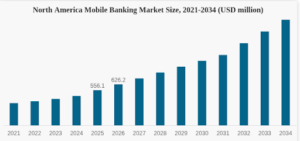
Image Source: Fortune Business Insights
Key Takeaways
|
Overview of Mobile Banking App
A mobile banking app is a software application that lets users access and manage banking services on a smartphone or tablet.
The functionality depends on the type of banking solution and its target users. A basic app may let users check balances, view transactions, transfer money, and pay bills. A more advanced platform may include digital onboarding, card controls, financial analytics, credit services, fraud monitoring, business payments, treasury management, and third-party integrations.
For businesses, mobile banking software can also act as a digital layer between customers and the underlying banking infrastructure.
The mobile interface is only one part of the system. A mobile banking solution involves connecting multiple financial, security, compliance, and operational systems, such as:
- Mobile application interfaces
- Secure backend services
- Core banking integrations
- Payment gateways
- Identity and authentication services
- KYC and AML services
- Fraud monitoring systems
- Notification services
- Analytics systems
- Customer support tools
- Cloud infrastructure
- Administrative and operational dashboards
This makes banking app development different from developing a standard consumer application. Every transaction, login, payment request, and data exchange needs to be designed with security, reliability, and regulatory requirements in mind.
Why There Is a Need to Invest in Mobile Banking Apps
Mobile banking has moved beyond basic transactions. Businesses now invest in banking apps to improve financial visibility, service delivery, customer experience, and operational efficiency.
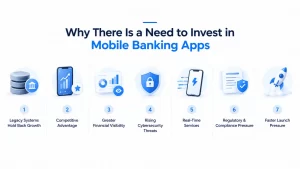
Legacy Banking Systems Are Holding Businesses Back
Legacy systems may not easily support modern apps and digital services. Mobile banking applications can provide a modern interface while connecting existing systems through APIs and middleware.
Competitive Advantage
A well-designed mobile banking app can help banks stand out by making everyday banking faster and easier. According to the American Bankers Association, 54% of bank customers use mobile devices as their top option for managing accounts. This shows why meeting this preference can help banks attract and retain customers.
Need for Greater Financial Visibility
Banking apps give customers and businesses access to balances, transactions, payments, and financial insights in one place, supporting faster decisions.
Rising Cybersecurity Threats
Banking apps require strong authentication, encryption, access controls, fraud monitoring, secure APIs, and continuous testing to protect sensitive data.
Demand for Real-Time Financial Services
Users expect fast transfers, balance updates, and transaction alerts, making real-time infrastructure essential.
Growing Regulatory & Compliance Pressure
Planning must account for KYC, AML, privacy, authentication, and payment security requirements.
Key Applications of Mobile Banking Software Development
Mobile banking software can do much more than provide account access. Businesses can use it to improve financial visibility, automate banking operations, simplify business payments, and deliver digital financial services to customers and employees.
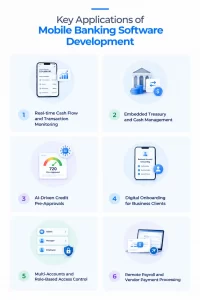
Real-time Cash Flow and Transaction Monitoring
A banking application can provide users with a live view of account activity, incoming payments, outgoing payments, pending transactions, and available balances.
For businesses, this visibility helps finance teams understand their current cash position and detect unusual activity sooner. Instead of waiting for a statement, users can review financial activity directly through the application.
Embedded Treasury and Cash Management
Large businesses often manage multiple accounts, debts, currencies, and cash positions. A mobile banking solution can bring these activities into a single interface.
Treasury users may be able to monitor liquidity, move funds between accounts, review balances, manage payment approvals, and monitor financial exposure.
The exact functionality depends on the organization’s banking relationships and treasury infrastructure.
AI-Driven Credit Pre-Approvals
AI and machine learning can help analyze financial information and identify customers who may qualify for selected credit products.
For example, a banking platform could analyze transaction patterns, account activity, repayment behavior, and other approved data sources to support credit decisioning.
However, AI-driven pre-approvals still require clear decision rules and oversight. Banks must validate the data used for assessments, monitor model performance, document decision rationale, and ensure automated recommendations comply with lending policies and applicable regulations.
Digital Onboarding for Business Clients
Digital onboarding removes much of the manual work involved in opening a business account. Users can submit required information, upload documents, complete identity checks, and move through verification workflows within the application.
A well-designed onboarding process should make requirements clear while maintaining strong identity and fraud controls.
Multi-Accounts and Role-Based Access Control
Business banking often involves multiple accounts and multiple employees. A banking application can let authorized users access different accounts based on their responsibilities.
For example, one employee may prepare a payment while another approves it.
Role-based access controls help businesses separate these responsibilities and maintain better visibility into account activity.
Remote Payroll and Vendor Payment Processing
Businesses regularly make payroll and supplier payments. A mobile banking solution lets authorized users review, schedule, approve, and track these payments remotely.
This reduces dependence on office-based workflows and gives finance teams greater flexibility when urgent payments need attention.
Popular Types of Mobile Banking Apps Companies Can Invest In
Companies can choose from several mobile banking app models based on their target customers, banking needs, and business objectives. These models range from basic account management and digital wallets to full-service, payment-focused, digital-only, and industry-specific business banking solutions.
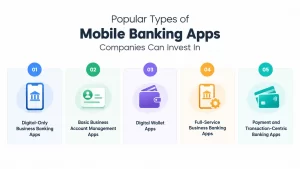
Digital-Only Business Banking Apps
These digital-only business banking applications provide banking services primarily through digital channels. They typically focus on quick onboarding, account management, payments, financial visibility, and digital support.
Such apps suit businesses that want a banking experience without relying heavily on physical branches.
Basic Business Account Management Apps
These basic business account management applications focus on everyday banking needs. Common functions include:
- Account balances and available funds
- Transaction history
- Account statements
- Fund transfers
- Payment management and approvals
- Transaction notifications
- Basic account controls and permissions
This model is suitable when the main objective is to give customers convenient access to existing banking services.
Digital Wallet Apps
Digital wallets focus primarily on storing, sending, receiving, and using digital funds. They may support bank account connections, cards, QR payments, payment requests, transfers, and transaction records.
Wallet applications are especially relevant for businesses involved in retail, marketplaces, digital payments, and high-volume transactions.
Full-Service Business Banking Apps
Full-service business banking apps bring banking, payments, cash management, and financial operations into a single platform. They serve small and medium-sized businesses, as well as larger organizations that need more than basic account and payment services.
They may support:
- Multiple accounts
- Payments
- Payroll
- Cash management
- Credit products
- Card management
- Financial reporting
- User permissions
- Transaction approvals
Payment and Transaction-Centric Banking Apps
These payment and transaction-centric banking applications focus on moving money efficiently. They may support customer payments, vendor payments, payment processing, invoicing, recurring payments, and transaction tracking. The interface is usually designed around speed, visibility, and transaction control.
Industry-Specific Business Banking Apps
Different industries have different financial workflows.
A construction business may need to pay suppliers and subcontractors. A healthcare organization may have different payment and reimbursement workflows. A marketplace may need seller payouts and transaction reconciliation.
Industry-specific banking software combines banking functionality with the workflows that matter most to a particular sector.
Must-Have Features for Every Mobile Banking App
The right mobile banking software features should be selected based on user needs, business objectives, and the services the platform is designed to support. Basic features enable everyday banking tasks, while advanced and emerging capabilities can improve financial management, automation, personalization, and security. The sections below cover the key features businesses can consider when planning a mobile banking solution.
Key Basic Features for Mobile Banking App Development
A mobile banking app should cover the core tasks customers expect to handle digitally, from managing accounts and transferring funds to paying bills, tracking finances, and receiving timely alerts. These basic features form the foundation of the banking experience, while security, third-party integrations, and customer support help ensure the app remains reliable and easy to use.
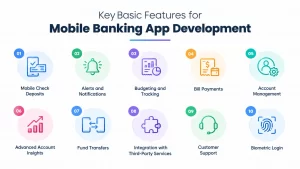
Mobile Check Deposits
Users can deposit eligible checks by capturing images through their mobile device.
This feature reduces the need for branch visits and makes deposits more convenient for eligible users. In addition, it includes appropriate image validation, deposit confirmation, transaction status, and fraud controls.
Alerts and Notifications
Notifications keep users informed about important financial activity and potential security risks. They may include:
- Transaction alerts
- Payment confirmations
- Low-balance alerts
- Login alerts
- Security warnings
- Upcoming payment reminders
Notification preferences let users control which alerts they receive. They also help them focus on important financial and security updates.
Budgeting and Tracking
Budgeting tools help users understand how they are spending money. The application can categorize transactions, track spending over time, identify recurring expenses, and provide a clearer view of financial behavior. For business users, similar tools can help monitor expenses and cash movements.
Bill Payments
Users can manage recurring and one-time bills from the app. Useful capabilities include payment scheduling, reminders, payment status, receipts, and transaction history. The payment flow should clearly display the amount, recipient, and scheduled date before the user confirms the transaction.
Account Management
Account management gives users control over their banking relationships. It may include:
- Balance viewing
- Transaction history
- Statements
- Account details
- Beneficiary management
- Account preferences
- Card controls
Advanced Account Insights
Transaction history tells users what happened. Account insights help them understand what that activity means. The application can identify spending patterns, recurring expenses, cash flow changes, or unusual activity and present these findings in a simple format.
Fund Transfers
Fund transfers are a core function of mobile banking software development. Users should be able to select a recipient, enter the amount, review the transaction, authenticate the request, and receive confirmation. Business banking workflows may also require approval levels, transaction limits, and additional verification.
Integration with Third-Party Services
Banking applications often need to communicate with external systems. These may include payment providers, identity verification services, accounting platforms, credit bureaus, notification services, and financial data providers. Well-designed APIs let these systems communicate without making the mobile app depend on unnecessary internal complexity.
Customer Support
Financial problems often require quick assistance. In-app support can provide access to chat, FAQs, support tickets, or automated assistance. Users should also have a clear way to report suspicious transactions or security issues.
Biometric Login
Biometric login allows users to authenticate through supported device-level biometric capabilities. It improves convenience while adding another security layer when implemented as part of a broader authentication strategy.
Advanced Features to Include in Mobile Banking Software
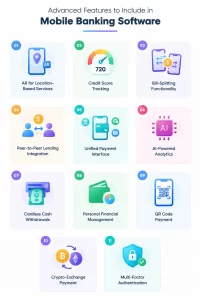
Select advanced mobile banking app features based on target users and the business model, rather than adding them simply to increase the feature count.
AR for Location-Based Services
AR can support location-based banking services such as finding nearby branches or ATMs.
The camera and location capabilities can provide users with a visual way to discover supported banking locations.
Credit Score Tracking
Credit score tracking gives users visibility into available credit information. The application can present credit information, explain relevant factors, and provide financial guidance where appropriate.
Bill-Splitting Functionality
Bill splitting allows users to divide shared expenses and request payments from other participants. This feature is useful for consumer-focused banking products that combine everyday banking with social payment experiences.
Peer-to-Peer Lending Integration
A banking platform can connect users with approved peer-to-peer lending services where the business model and regulations allow it. However, lending introduces additional financial and regulatory requirements, such as eligibility, risk, identity, and compliance controls, that need careful consideration.
Unified Payment Interface
A unified payment interface can simplify supported account-to-account payment experiences.
Implementation depends on the payment infrastructure, banking partners, and regulations in the target market.
AI-Powered Analytics
AI can analyze transaction information to identify patterns, unusual activity, and relevant financial opportunities. The value comes from turning financial data into useful insights, not simply displaying more information.
Cardless Cash Withdrawals
Cardless withdrawal allows users to access supported ATM services without presenting a physical card. Depending on the banking infrastructure, authentication may involve app authorization, codes, QR workflows, or biometrics.
Personal Financial Management
Personal financial management brings several financial activities into one place. Users can monitor spending, savings, financial goals, recurring expenses, and other aspects of their financial position.
QR Code Payment
QR payments provide a quick way to initiate supported transactions. Users can scan a merchant or payment QR code, review transaction details, authenticate the transaction, and receive confirmation.
Crypto-Exchange Payment
Where legally and commercially appropriate, banking platforms may integrate supported digital-asset services. This requires additional controls for identity verification, transaction monitoring, security, custody, and applicable regulations.
Multi-Factor Authentication
Multi-factor authentication requires users to verify their identity through more than one factor.
These may involve knowledge, possession, inherence, and behavioral factors. MFA should form part of a wider risk-based security strategy, particularly for sensitive financial actions.
Emerging Features Driving the Future of Mobile Banking Software
Emerging technologies are changing how banking applications interact with customers.
However, businesses do not need to adopt every new capability. The right choice depends on customer needs, product strategy, infrastructure, and regulatory requirements.
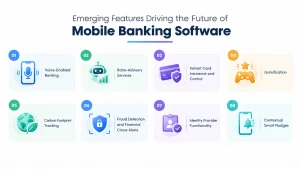
Voice-Enabled Banking
Voice interfaces can help users complete simple banking tasks or retrieve financial information through spoken commands. Sensitive actions should still require appropriate authentication and confirmation.
Robo-Advisory Services
Robo-advisory services use automated models to support selected investment-related recommendations or portfolio management activities. These services require careful consideration of suitability, disclosures, customer data, and applicable regulations.
Instant Card Insurance and Control
Customers increasingly expect immediate control over their cards. An application can provide capabilities such as card locking, transaction controls, spending limits, and selected protection services.
Gamification
Gamification can make financial education and money-management activities more engaging.
It should encourage responsible financial behavior rather than unnecessary spending or risky decisions.
Carbon Footprint Tracking
Financial transaction data can support estimated environmental-impact insights. This gives users another way to understand the broader impact associated with selected spending activities.
Fraud Detection and Financial Crime Alerts
Modern banking platforms need systems that can quickly identify suspicious activity. Fraud controls can analyze transaction patterns, device signals, login behavior, and other approved indicators to flag activity that requires additional verification or investigation.
Identity Provider Functionality
Mobile banking apps are moving beyond financial transactions to support trusted digital identity experiences. Where supported, users may authenticate themselves with external services through their banking app, reducing repeated verification steps and creating a more seamless digital journey.
Contextual Smart Nudges
Smart nudges provide timely financial guidance based on relevant user activity. An application may alert users about an upcoming payment, unusual spending, or another financial event when the information is most useful. The goal is to make financial information actionable without overwhelming users.
Which Is Better for Banking Software Development: Android or iOS?
The right choice depends on target users, geography, device coverage, budget, existing technology, and product strategy.
| Factor | Android | iOS |
| Device coverage | Broad range of devices | More controlled device ecosystem |
| Market reach | Strong reach across many markets | Strong presence in selected markets |
| Hardware variation | Higher | Lower |
| Development considerations | More device and OS combinations | More controlled environment |
| Best fit | Broad market coverage | iOS-focused audiences |
For a banking product serving a broad customer base, supporting both platforms is often the practical long-term approach.
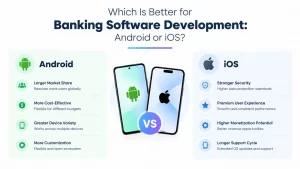 Cross-platform development can allow teams to share parts of the codebase between platforms. However, banking applications still need platform-specific attention for security, biometrics, notifications, device capabilities, and performance.
The platform decision should therefore follow the target customer base rather than simply choosing the lowest-cost option.
How the Mobile Banking App Development Process Works
The structured development process helps reduce costly changes later because banking applications involve financial workflows, security controls, compliance requirements, and multiple integrations.
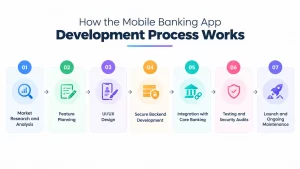
Market Research and Analysis
Start by identifying target users, supported financial services, operating markets, the business model, and applicable banking regulations, such as FDIC and FINRA. This helps define the required features, compliance requirements, integrations, and technical roadmap before development begins.
Feature Planning
Next, map business and banking requirements to core functionality. Prioritize features such as account management, fund transfers, bill payments, card services, transaction tracking, alerts, authentication, and security based on the services offered. Define required banking integrations and plan advanced capabilities for later releases.
UI/UX Design
Banking interfaces need clarity more than visual complexity. Users should quickly understand their balance, any pending transactions, failed payments, or security alerts. The design should also account for accessibility, error handling, secure authentication, transaction confirmation, and account recovery.
Secure Backend Development
The backend manages sensitive operations such as user accounts, authentication, permissions, financial data, notifications, audit logs, and API requests. Security controls should be implemented at the backend level.
Integration with Core Banking
Connect the mobile banking application with core banking systems, payment gateways, and required financial services. Mobile banking software developers configure these connections to exchange account information, initiate transactions, and support the application’s defined services.
Testing and Security Audits
Thorough mobile app testing helps prevent transaction failures and protect customer trust. Test core functionality, authentication, transaction flows, performance, data security, and recovery across devices and network conditions. Security audits and testing help identify vulnerabilities before and after launch.
Launch and Ongoing Maintenance
Prepare the application for production release, monitor its performance after launch, and address issues as they arise. It covers OS compatibility, bug fixes, compliance updates, API maintenance, fraud monitoring, infrastructure scaling, and feature improvements.
Understanding the Mobile Banking Software Development Cost
The cost of developing a mobile banking app depends on factors such as complexity, features, integrations, and security level. A basic application supporting accounts and transfers requires a very different investment from an enterprise banking platform. However, it needs multiple integrations, advanced fraud detection, AI capabilities, complex compliance requirements, and business banking workflows.
| App Complexity | Estimated Cost | Features Included |
| Basic Banking App | $25,000 – $45,000+ |
|
| Mid-Level Banking App | $45,000 – $85,000+ |
|
| Advanced Banking App | $85,000 – $200,000+ |
|
Key Factors that Impact the Cost to Build a Mobile Banking App
The features, integrations, and security requirements all influence the overall cost of a mobile banking app. The key factors that drive development costs include:
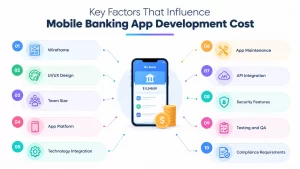
Wireframe
Wireframes define how users move through the application. Complex banking workflows require more screens, states, approval paths, transaction scenarios, and error conditions, increasing design effort.
UI/UX Design
Banking design requires more than attractive screens. The design needs to handle transaction confirmation, authentication, errors, sensitive information, accessibility, and different user roles.
Team Size
A banking project may require:
- Product manager
- Business analyst
- UI/UX designer
- Mobile developers
- Backend developers
- QA engineers
- DevOps engineers
The exact team depends on the project’s scope and regulatory requirements.
App Platform
Building for Android, iOS, or both affects development effort. Native app development generally requires separate platform expertise, while cross-platform approaches may allow teams to share parts of the codebase.
Technology Integration
Integrations with banking infrastructure, payment systems, identity providers, credit services, fraud tools, accounting platforms, and other systems can significantly increase development complexity.
App Maintenance
A banking application needs continuous maintenance after launch. This includes security updates, operating-system compatibility, infrastructure management, bug fixes, monitoring, and feature improvements.
API Integration
Each API introduces development, testing, security, monitoring, and maintenance requirements. Financial APIs may also require additional error handling, transaction reconciliation, and failure recovery.
Security Features
Security affects architecture, development, testing, infrastructure, and monitoring. Advanced authentication, encryption, fraud monitoring, audit logs, and security testing all add to the overall development effort.
Testing and QA
Financial transactions require extensive testing because technical errors can have direct financial consequences. Testing effort increases as the number of platforms, devices, integrations, transaction types, and user roles grows.
Compliance Requirements
Compliance costs depend on the countries served, banking model, payment services, data handled, and regulatory obligations. For this reason, compliance should be estimated according to the actual product and market.
Security and Compliance Considerations in Banking Software Development
Security is the basic foundation of building trust in banking. Users share personal data, sensitive information, and transaction history inside their app. One small data breach can damage the reputation and customer confidence. That is why you should consider strong security during mobile banking platform development.
PCI DSS Compliance
If your mobile banking app handles card payments, it should follow Payment Card Industry Data Security Standards (PCI DSS). These rules safeguard cardholders’ personal data and reduce fraud risks.
End-to-end Encryption
Protect sensitive information while it moves between systems and while it is stored. Encryption should be implemented based on the data’s sensitivity and the overall security architecture.
Key management is equally important because strong encryption does not provide sufficient protection if encryption keys are poorly secured.
KYC and AML Regulations
Know Your Customer processes help verify customer identities. Anti-Money Laundering controls help financial businesses identify and prevent activities associated with financial crime.
The exact requirements vary by jurisdiction and business model.
A banking platform should therefore connect identity verification, transaction monitoring, risk controls, and compliance workflows.
GDPR and Data Privacy
Applications serving users in jurisdictions with applicable privacy regulations need appropriate controls for personal information. These may cover:
- Data collection
- Access controls
- User rights
- Third-party processing
- Data transfers
Privacy requirements should be mapped according to the locations and services covered by the product.
Real-time Fraud Monitoring
Fraud monitoring should identify suspicious activity as quickly as the banking infrastructure allows. The system may analyze transaction behavior, login patterns, device signals, and other approved risk indicators. When the system identifies suspicious activity, it may request additional verification, delay the transaction, alert the customer, or route the activity for investigation.
Two-Factor Authentication (2FA)
Two-factor authentication adds another verification layer beyond a password. Depending on the banking environment, authentication may involve OTPs, biometrics, authentication applications, hardware-backed credentials, or other mechanisms. Higher-risk actions may require stronger authentication than lower-risk activities.
Challenges & Solutions While Developing Mobile Banking Software
Banking software combines financial workflows, user experience, infrastructure, security, and regulation. This creates challenges that standard mobile applications may not face.
User Experience and Accessibility
Challenge: Banking workflows can become complicated when too many steps, warnings, and security checks are placed into a single software development roadmap.
Solution: Design common tasks around clear user flows, readable information, accessibility, understandable confirmation screens, and helpful feedback.
Compliance and Regulatory Limitations
Challenge: Regulations vary by market and may change as financial services evolve.
Solution: Map requirements during discovery and design the architecture so you can manage compliance changes without rebuilding the entire platform.
Security and Data Protection
Challenge: Banking applications are attractive targets for attackers because they handle valuable financial and personal data.
Solution: Use layered security covering authentication, encryption, access control, API protection, monitoring, secure development, vulnerability management, and regular testing.
Integration With Legacy Systems
Challenge: Older banking systems may not support modern interfaces or real-time data exchange.
Solution: Use APIs, middleware, integration layers, adapters, and controlled data flows to connect modern applications with existing financial infrastructure.
The objective is to modernize the customer experience without unnecessarily disrupting critical banking systems.
Maintaining User Trust
Challenge: A failed or unclear financial transaction can quickly affect customer confidence.
Solution: Provide clear transaction status, transparent error messages, visible security controls, responsive support, and reliable recovery processes.
Scalability and Performance
Challenge: Banking applications need to remain responsive as transaction volumes and user numbers increase.
Solution: Build scalable backend services, monitor performance, optimize database operations, use appropriate cloud infrastructure, and design integrations to handle failures and recovery.
Mobile Banking Development Trends Shaping the Fintech Industry
The enterprise mobile banking app industry is evolving rapidly, driven by changing customer demands and technological advancements. Below are some emerging trends shaping the future of mobile banking application development.
Mobile-First and User-Focused Design
Banking products are increasingly designed around mobile journeys. This means reducing unnecessary steps and designing financial tasks around how users actually interact with their financial services.
AI and ML for Personalization
AI and machine learning can help personalize financial insights, improve fraud detection, support customer service, and identify relevant financial products. The focus is shifting from collecting more data to turning financial data into useful actions and decisions.
Open Banking and API Integration
APIs allow banking applications to communicate with external financial systems and services. This supports connected financial experiences and reduces the need to build every financial capability internally.
Blockchain for Security and Transparency
Blockchain can support selected financial workflows where shared records, programmable transactions, or decentralized verification provide a clear business benefit.
Embedded Finance Solutions
Financial services are increasingly being integrated into non-banking products. Businesses can embed payments, accounts, lending, insurance, or other financial capabilities into existing customer experiences.
Instant Transfers and Real-Time Payments
Customers increasingly expect money to move quickly. This makes reliable payment infrastructure, transaction verification, and real-time notifications increasingly important.
Sustainability and Green Banking
Digital banking can reduce dependence on paper-based processes and some physical banking interactions. Applications can also provide users with selected insights into the environmental impact associated with their financial activity.
RegTech Integration for Compliance
RegTech tools help financial organizations automate selected compliance processes. They can support identity verification, transaction monitoring, reporting, screening, and other regulated workflows.
Cloud-Based Solutions for Scalability
Cloud infrastructure can help banking platforms scale computing resources, storage, monitoring, and services as demand changes. However, cloud adoption still requires careful planning for security, access control, data governance, resilience, and compliance.
What to Look for in a Mobile Banking App Development Company
Choosing a development partner requires knowledge of financial workflows, security, integrations, infrastructure, and compliance.
Experience in Fintech
Look for experience with financial workflows, payment systems, banking integrations, financial data, and regulated environments.
Security Expertise
The development partner should understand secure application architecture, API security, authentication, encryption, vulnerability management, and security testing.
Compliance Knowledge
The team should understand that regulatory requirements depend on the product, market, and services offered. They should also work with internal compliance and legal stakeholders.
Scalable Architecture
The architecture should support future growth across users, transactions, integrations, financial products, geographic markets, and business workflows.
Post-Launch Support
Banking software requires continuous support. The fintech app development company should be prepared to handle security updates, infrastructure monitoring, bug fixes, platform updates, integration changes, and future product improvements.
How AppsChopper Delivers Custom Mobile Banking Software Development
AppsChopper develops mobile banking software around the business model, user workflows, security requirements, and existing financial infrastructure.
The objective is to build more than a functional banking interface. The platform should provide a reliable foundation for financial transactions, customer engagement, operational efficiency, and future product expansion.
For organizations modernizing an existing banking experience, the approach can also focus on connecting the new mobile layer with existing systems instead of replacing the entire infrastructure at once.
Many fintech startups, banks, and enterprises trust AppsChopper as their mobile banking software development services provider because we combine scalable architecture and fintech expertise under one umbrella. Our developers handle core banking integrations to build secure apps that grow with your business.
We also build an AI-enabled investment application that helps investment teams reduce manual analysis, identify opportunities faster, and strengthen strategic decision-making through automated recommendations.
Conclusion
Mobile banking software development has moved beyond basic account access. Modern banking platforms need to bring together secure transactions, simple user experiences, real-time information, intelligent insights, third-party services, and existing banking infrastructure.
The right development strategy starts with the business problem.
A basic banking app may focus on accounts, transfers, payments, and notifications. A business banking platform may require treasury management, role-based access, payroll, vendor payments, and financial analytics. A digital-first financial product may require AI, fraud detection, open banking, or embedded financial services.
The technology should follow these requirements. Security and compliance should be built into the foundation. With the right architecture, integrations, development approach, and ongoing maintenance, a mobile banking platform can become a reliable digital channel for delivering financial services and supporting long-term business growth.
FAQs
What Is the Cost of Developing a Mobile Banking App?
The cost depends on features, platforms, integrations, security, compliance, testing, and infrastructure. A basic banking app typically starts at $25,000, while an enterprise platform costs around $85,000–$200,000. Advanced integrations and financial controls will increase the cost.
How Long Does It Take to Build a Mobile Banking App?
A basic application may take 3-5 months, while a full-scale platform with complex integrations, security requirements, and compliance needs may take considerably longer.
What Security Measures Do Mobile Banking Apps Need?
Common measures include strong authentication, encryption, secure APIs, access controls, fraud monitoring, audit logging, vulnerability testing, and applicable regulatory controls.
Can I Build a Banking App Without a Development Company?
Yes, building a banking platform usually requires expertise across mobile development, backend engineering, security, integrations, testing, infrastructure, and compliance.
Can a Banking App Connect With Existing Core Banking Systems?
Yes. Banking applications can connect with existing financial infrastructure through APIs, integration layers, middleware, or other controlled interfaces. The right approach depends on the capabilities and limitations of the existing systems.