
Table of Contents
If you’re a startup founder, you probably already know how tricky it is to turn an app idea into a reality without burning through your runway. You want your product in users’ hands fast, without compromising quality, and, of course, within a budget that makes sense for a lean startup.
Enter React Native, a framework that’s been quietly changing the game for startups around the world. It allows you to build iOS and Android apps using a single codebase, meaning faster development, lower costs, and a smoother path from idea to launch.
In this guide, we’ll break down everything you need to know about React Native app development for startups: the benefits, costs, real-world use cases, challenges, and how you can decide if it’s right for your business. By the end, you’ll have a clear understanding of whether React Native is the right tool to turn your app idea into reality.
What Is React Native App Development?
At its core, React Native is a JavaScript framework developed by Meta (Facebook) that allows you to build mobile apps that feel native on both iOS and Android.
Think of it like this: Instead of writing two entirely separate apps, your developers write one app, and React Native takes care of rendering it on both platforms. The result? Apps that look, feel, and perform like native apps, without the duplicated effort.
Here’s what makes it different from plain React.js (the framework often used for web apps):
- React.js = builds websites
- React Native = builds mobile apps that run natively on phones
When React Native makes sense for startups:
- You need an MVP quickly
- You want to save development costs
- You’re aiming for both iOS and Android users
- You want a scalable foundation for future app growth
In short, React Native gives you the speed of development without compromising too much on performance, a perfect match for the resource-conscious startup.
Why Use React Native for Mobile App Development?
Startups operate in a world where every week counts, and every dollar matters. You’re not just building an app, you’re validating a business idea, attracting your first users, and trying to grow without burning through your runway.
That’s why more and more startups are turning to React Native. It isn’t just a tech trend but a strategic choice that helps startups move faster, spend wisely, and scale confidently. Let’s break down why this framework is becoming a favorite among early-stage companies:
Speed: Launch Your MVP Faster
Imagine you have a brilliant app idea. You want to test it with real users as soon as possible. Traditionally, building separate apps for iOS and Android could take months, or even a year, before your MVP sees the light of day.
With React Native, your developers write a single codebase that works for both platforms. This means you can cut your development timeline in half, get feedback from users quickly, and start iterating on your product without delay. For startups, speed isn’t a luxury but survival.
Cost-Effectiveness: Do More With Less
Hiring two separate teams for iOS and Android? That can quickly blow up your budget. React Native lets you achieve near-native functionality with a smaller team, meaning less money spent on development and maintenance.
Maintaining one codebase is simpler, easier, and faster. That means your startup can reinvest those savings into marketing, user acquisition, or product improvements, exactly where it counts.
A Growing, Supportive Community
React Native is backed by Meta (Facebook) and a huge developer community. That means:
- Pre-built libraries and components ready to use
- Community solutions for common problems
- Continuous improvements and updates
For a startup, this is huge. You don’t want to spend weeks reinventing the wheel. React Native lets your team leverage what’s already out there, keeping development efficient and reducing risk.
Proven Track Record Across Industries
React Native powers apps you probably use every day, like Instagram, Shopify, and Discord. These are products that scale to millions of users, handle complex features, and still perform smoothly.
For startups, knowing that big, trusted companies rely on the same technology provides reassurance. It signals that React Native is not a fad, but a mature, reliable mobile framework that can support both early MVPs and long-term growth.
Flexibility and Scalability
Startups evolve quickly, and so do their app requirements. The React Native new architecture allows you to:
- Add new features rapidly
- Integrate with native modules if needed
- Scale your app as your user base grows
You get the speed and affordability of cross-platform development, without locking yourself out of more advanced capabilities as your startup matures.
React Native isn’t just about writing code faster but about helping startups move quickly, save money, and scale confidently, all while keeping users happy. That’s why it’s becoming the go-to framework for founders who want results without unnecessary risk.
React Native vs Native App Development: What Startups Should Know?
If you’re evaluating React Native, it’s natural to wonder: “Should I go fully native instead?” Let’s break it down.
| Factor | React Native | Native App Development |
| Development Speed | Faster (single codebase) | Slower (two separate apps) |
| Development Cost | Lower | Higher |
| Maintenance | Easier (one codebase) | More complex |
| Performance | Near-native | Fully native, optimal for high-performance apps |
| Scalability | Good for most apps, can integrate native modules | Best for highly complex apps |
React Native App Examples: How Startups Use It in the Real World?
When founders hear “React Native is great for startups,” the next natural question is:
“Okay, but what kind of apps can I actually build with it?”
Instead of abstract use cases, let’s look at real-world React Native app examples and how startups typically use them.
MVP and Early-Stage Startup Apps
Many startups use React Native to build their first version of the app: the MVP. At this stage, the goal isn’t perfection; it’s validation.
With React Native, startups can:
- Launch on both iOS and Android at once
- Test core features quickly
- Collect user feedback early
- Iterate without heavy rework
This approach is especially useful when you’re still figuring out what users truly want, and speed matters more than edge-case optimization.
Marketplace and Platform-Based Apps
React Native works well for marketplace-style apps, think platforms that connect buyers and sellers, service providers and customers, or multiple user roles.
These apps often require:
- User authentication
- Real-time updates
- Payment integrations
- Dashboards for different user types
React Native handles these needs efficiently while keeping development cost-effective and scalable.
On-Demand Service Apps
Startups building on-demand apps, such as delivery, booking, or home services, often choose React Native to ensure feature parity across platforms.
Common features include:
- Location tracking
- Push notifications
- In-app chat
- Scheduling and bookings
With React Native, updates and improvements roll out to both platforms simultaneously, which is a huge advantage when refining the service experience.
Social Networking and Community Apps
Social networking apps focused on communication, engagement, and content sharing are another strong fit. React Native supports:
- Messaging
- News feeds
- Notifications
- User-generated content
Many social apps start with React Native because it offers fast iteration cycles, allowing teams to test engagement features and improve retention without slowing down development.
SaaS, Fintech, and Dashboard-Driven Apps
React Native is also widely used for SaaS and fintech mobile apps, especially those that rely on dashboards and data visualization.
Examples include:
- Expense tracking apps
- Productivity tools
- Analytics dashboards
- Subscription-based platforms
As long as performance requirements are well-defined, React Native provides a stable and scalable foundation for these kinds of applications.
Ecommerce Mobile Apps
Ecommerce startups often use React Native to deliver a consistent shopping experience across devices.
Typical features include:
- Product catalogs
- Secure checkout
- Order tracking
- Personalized recommendations
For startups, ecommerce app development with React Native means faster go-to-market and easier updates during promotions or seasonal campaigns.
React Native isn’t limited to one type of app. It’s flexible enough to support early MVPs, growing platforms, and feature-rich applications, all while keeping development manageable for startups.
If your app idea fits into any of these categories, React Native is likely worth serious consideration.
React Native App Development Cost for Startups
At some point, every founder asks the same question: “How much will React Native cost to build my app?” While there’s no one-size-fits-all answer, the good news is that React Native app development is generally more cost-effective for startups compared to building separate native apps for iOS and Android.
Instead of guessing, let’s break the costs down in a way that actually helps you plan.
App Type | Typical Features Included | Estimated Timeline | Estimated Cost (USD) |
| Basic App / MVP | Login & signup, basic UI screens, simple backend, limited integrations | 3–5 months | $35,000 – $55,000 |
| Mid-Level App | Real-time data, APIs, payment gateway, dashboards, push notifications | 5–8 months | $55,000 – $150,000 |
| Complex App | Advanced workflows, custom UI/UX, multiple integrations, high security | 8–12 months | $150,000 – $240,000+ |
What Factors Influence React Native App Development Cost?
Even apps that look similar on the surface can end up with very different budgets. Some of the biggest cost drivers include:
- Feature complexity: The more logic your app requires, the more development effort it needs
- UI/UX design: Custom designs and animations take more time than standard layouts
- Backend and third-party integrations: Payments, analytics, CRM, or cloud services add scope
- Security requirements: Especially important for fintech, healthcare, or SaaS apps
- Maintenance and updates: Ongoing support after launch is often overlooked but essential
Understanding these factors early helps startups avoid budget overruns and unexpected delays.
React Native App Development Process for Startups
Building a React Native app is often described as “faster” and “simpler” than native development, but that doesn’t mean it’s simple. For startups, the process involves a series of decisions that affect not just how fast you launch, but how well your app performs as your business grows.
Understanding this React Native app development roadmap helps you see where experience really matters.
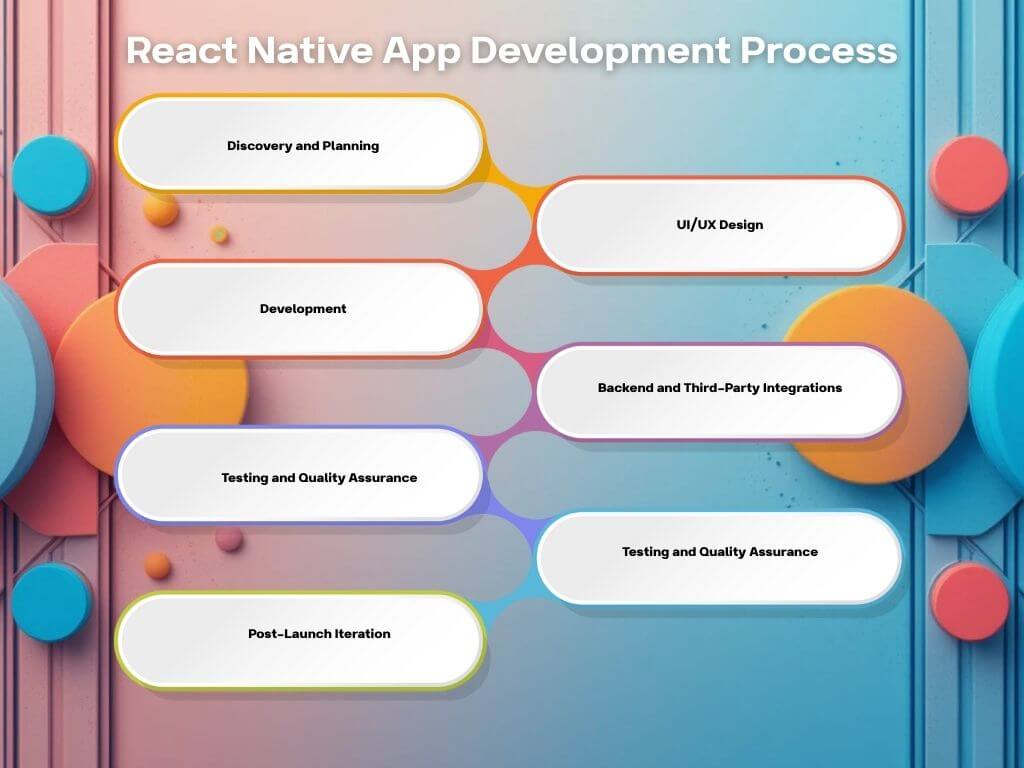
 Discovery and Planning: Avoiding Costly Assumptions
Every startup begins with an idea, but ideas alone aren’t enough. This phase turns your vision into clear, buildable requirements by defining:
- Core features and priorities
- User journeys
- Technical feasibility and constraints
At this stage, small decisions, like what to include in the MVP or how data flows through the app, can significantly affect cost and scalability later. Teams that have worked on multiple React Native projects know where startups typically overbuild and where simplifying early makes the biggest difference.
UI/UX Design: Designing Once, Thinking Twice
React Native allows shared UI logic, but designing for both iOS and Android still requires careful thought. Each platform has its own interaction patterns, performance considerations, and user expectations.
This phase involves:
- Wireframes and prototypes
- Platform-aware design choices
- Usability and accessibility planning
Experience here helps avoid redesigns later, something startups often underestimate when speed is the priority.
Development: Managing a Shared Codebase Without Compromises
Mobile app development is where React Native shows its real strength, and also its complexity.
While a single codebase accelerates development, it also requires:
- Clean architecture decisions
- Thoughtful state management
- Handling platform-specific behaviors
- Knowing when native modules are needed
Without careful planning, React Native performance issues and technical debt can creep in quickly. React Native app developers understand how to balance code reuse with platform-specific optimization from the start.
Backend and Third-Party Integrations: Planning for Growth Early
Most startup apps rely on more than just frontend code. Payments, analytics, notifications, and cloud services all need to work seamlessly with the mobile app.
This stage involves:
- API integration
- Data security considerations
- Scalability planning
Early choices here can either support future growth or limit it. React Native app developers help ensure the backend development evolves smoothly as user demand increases.
Testing and Quality Assurance: Saving Time by Slowing Down
Testing is often where startups feel tempted to cut corners. But React Native apps need to be tested across:
- Multiple devices
- Different OS versions
- Platform-specific behaviors
Thorough mobile app testing reduces the risk of crashes, poor reviews, and emergency fixes after launch, issues that can be costly for early-stage products.
App Store Readiness: More Than Just a Submission
Preparing an app for release involves compliance, performance checks, and platform guidelines. Minor oversights can lead to rejections or delays.
Teams that have navigated multiple launches understand these React Native app deployment requirements well, helping startups move through this stage smoothly without unnecessary back-and-forth.
Post-Launch Iteration: Where Real Product Development Happens
User feedback, analytics, and performance data guide what comes next:
- Feature improvements
- Performance optimization
- Scaling infrastructure
React Native supports rapid iteration, but maintaining quality over time requires consistency and long-term technical thinking.
React Native Challenges and How Startups Solve Them?
React Native is a powerful framework, but like any technology, it comes with trade-offs. For startups, the key isn’t avoiding these React Native challenges and knowing how to handle them early so they don’t slow growth later.
Here are the most common challenges startups face with React Native mobile app development, along with practical ways they’re typically addressed.
Balancing Performance with a Shared Codebase
The challenge:
While React Native delivers near-native performance for most apps, performance can become a concern when:
- Apps grow feature-heavy
- Animations become complex
- Real-time updates increase
How startups address it:
Successful teams design the architecture carefully from day one. They identify performance-critical features early and plan for selective native integrations where needed, without compromising the benefits of a shared codebase.
This balance is less about the framework and more about how it’s implemented.
Managing Third-Party Dependencies Responsibly
The challenge:
React Native’s ecosystem is rich, but relying on too many third-party libraries can introduce:
- Compatibility issues
- Upgrade risks
- Long-term maintenance concerns
How startups address it:
Instead of adding libraries reactively, experienced teams evaluate stability, community support, and long-term viability before integrating them. This reduces technical debt and keeps the app easier to maintain as it scales.
Handling Platform-Specific Differences
The challenge:
Even with a single codebase, iOS and Android behave differently. Subtle differences in UI behavior, permissions, and device handling can cause inconsistencies if overlooked.
How startups address it:
Teams account for platform-specific behavior during mobile app design and development, rather than fixing issues after launch. This proactive approach saves time and prevents user experience issues down the line.
Debugging Across Multiple Layers
The challenge:
React Native apps combine JavaScript, native code, and third-party tools. Debugging across these layers can be complex, especially under tight startup timelines.
How startups address it:
A structured debugging and testing approach helps isolate issues quickly. Clear coding standards and testing workflows prevent small problems from becoming launch-blocking issues.
Planning for Scalability Without Overengineering
The challenge:
Startups often struggle to balance future scalability with present needs. Overengineering wastes budget; underplanning creates bottlenecks.
How startups address it:
A phased approach works best: build a lean MVP, validate usage, and evolve the architecture as demand grows. React Native supports this incremental growth when the foundation is thoughtfully designed.
Why Startups Choose AppsChopper as Your React Native App Development Company?
AppsChopper, a trusted React Native app development company in USA, works with startups that need to launch quickly without compromising long-term scalability. Our app development approach focuses on building lean, practical products that are easy to evolve as user needs and business goals grow.
With experience across the full React Native lifecycle, from MVP planning to cross-platform development and post-launch optimization, we help startups avoid common pitfalls like performance issues or rigid architectures. This allows founders to validate ideas faster while keeping future expansion in mind.
We collaborate closely with startup teams, offering clear communication, realistic timelines, and technical guidance that aligns development decisions with business priorities.
Frequently Asked Questions About React Native App Development
Can React Native be used for iOS?
Yes. React Native was designed to build native iOS applications using JavaScript and React. It compiles to native components, which allows apps to follow iOS design patterns while sharing a large portion of the codebase with Android.
Does React Native work on both iOS and Android?
Absolutely. React Native enables developers to use a single codebase for both iOS and Android, while still supporting platform-specific customization when needed. This is one of the main reasons startups choose React Native for faster cross-platform app development.
How long does it take to develop a React Native app?
The timeline depends on the app’s complexity and features. A basic MVP can take 6–10 weeks, while more feature-rich apps typically require 3–6 months. Planning, design, and testing also play a major role in determining the overall timeline.
How to check the React Native version of an app?
You can check the React Native version by looking at the package.json file in your project and finding the react-native dependency. Alternatively, running npx react-native info in the project directory will display the current version and environment details.
How to hire React Native developers for a startup?
Start by evaluating experience with real-world React Native projects, not just familiarity with the framework. Look for developers who understand performance optimization, cross-platform nuances, and startup constraints. Many startups prefer working with React Native app development companies that offer end-to-end support, clear timelines, and post-launch scalability.
Is React Native suitable for building MVPs?
Yes. React Native is widely used for MVP development because it allows startups to launch faster, validate ideas, and reach both iOS and Android users without building two separate apps.
Can React Native apps scale as the startup grows?
React Native apps can scale effectively when built with the right architecture. Many startups start with React Native and continue to evolve their apps by adding native modules or optimizing performance as user demand increases.
Is React Native a good choice for long-term app development?
For many startups, yes. React Native offers flexibility, strong community support, and continuous improvements. When implemented thoughtfully, it supports both early-stage development and long-term product evolution.