Table of Contents
Insurance has always run on paperwork, phone calls, and middlemen. That is changing fast. Policyholders now expect the same instant, on-demand experience from their insurer that they get from their bank or their food delivery app, and insurance mobile app development has become the fastest way for carriers, agents, and InsurTech startups to meet that expectation. In 2026, the digital insurance platform market is valued at USD 188.45 billion. So,
If you are exploring how to build an insurance app for your business, this guide walks through the different types of apps you can build, the features that matter most, the development process, and what it actually costs to bring an app like this to market.
Why Businesses Are Investing in Insurance App Development?
Every major insurer is currently rethinking how it reaches customers, and insurance app development sits at the center of that shift. A mobile app lets a company communicate directly with policyholders, cut down on manual paperwork, and remove the friction that traditionally slowed down quotes, renewals, and claims.
For the business, that translates into lower operating costs, fewer calls to the support line, and a direct channel for cross-selling new policies. For the customer, it means being able to buy a policy, file a claim, or check coverage without waiting on hold. As more of the industry moves online, companies that delay their insurance app development efforts risk losing customers to competitors who already offer a faster, app-based experience.
Types of Insurance Apps You Can Build
Not every insurance app serves the same purpose, so the first step is to decide which type fits your business model.
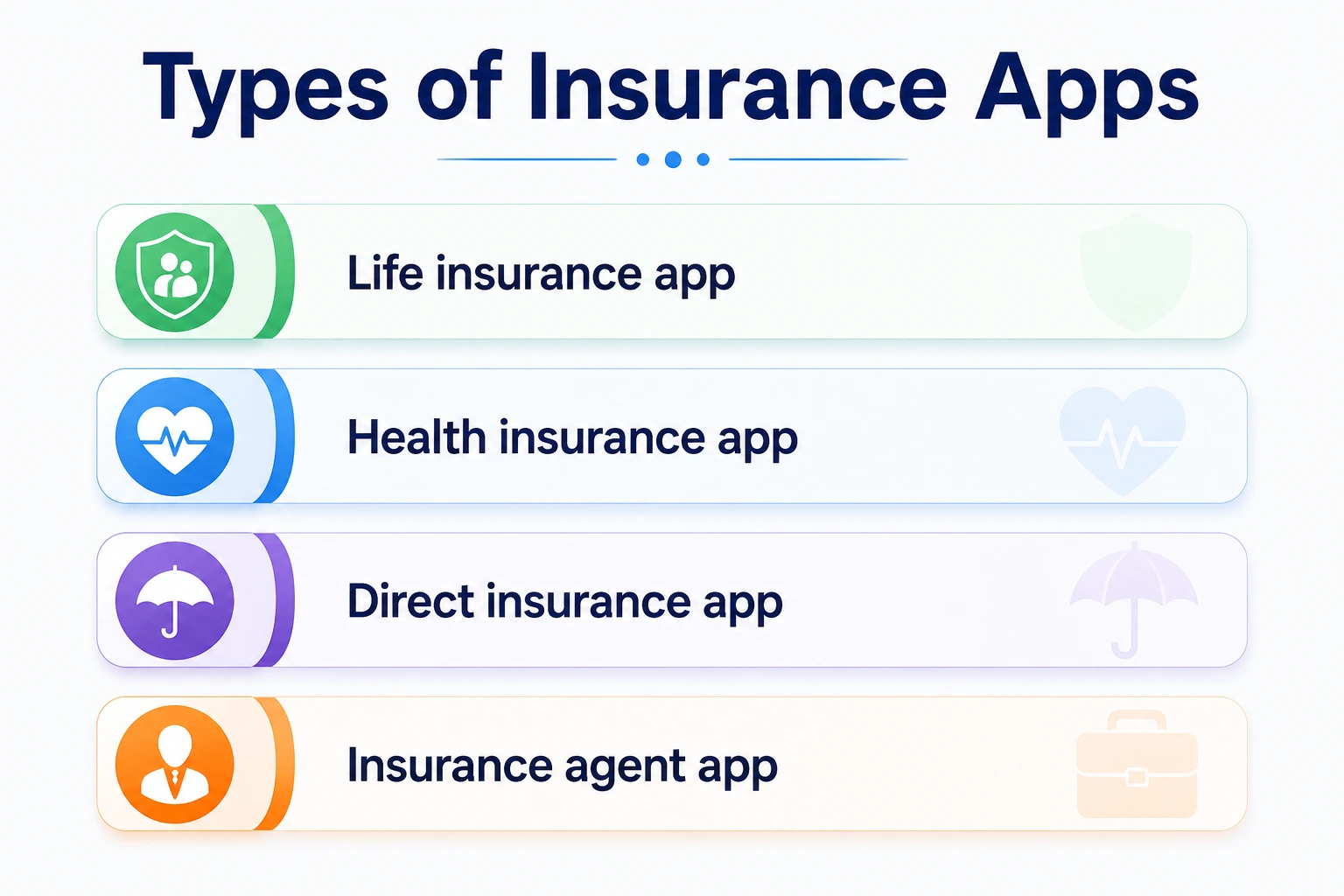
- Life insurance app: Built for long-term policy management, beneficiary updates, premium tracking, and simplified underwriting questionnaires.
- Health insurance app: Focused on plan comparisons, provider search, digital ID cards, and claims tied to medical visits or prescriptions.
- Direct insurance app: Cuts out brokers and agents entirely, letting customers research, buy, and manage a policy end-to-end without ever speaking to a middleman.
- Insurance agent app: Designed for the agents and brokers themselves, giving them a mobile CRM, quoting tools, and real-time access to client policy data while they are in the field.
Many businesses eventually build more than one of these, pairing a customer-facing app with a companion insurance agent app so both sides of the relationship are supported.
Insurance App Design That Builds Trust
Good insurance app design is not just about looking modern. Insurance products are complex, and a well-designed app must translate dense policy language and legal terms into something a first-time user can understand in seconds.
A few principles tend to separate the apps people enjoy using from the ones they abandon after one session:
| Design Principle | Why It Matters |
| Keep the quote and sign-up flow short | Every extra screen is a chance for someone to drop off |
| Use plain language and visual summaries instead of legal blocks of text | Coverage details are easier to trust when they are easy to understand |
| Make the claims button impossible to miss | This is the feature people reach for during a stressful moment, so it should never be buried in a menu |
| Design for accessibility from the start | A meaningful share of policyholders will be older users or people with disabilities |
Strong insurance app design also considers what happens after onboarding. Push notifications for renewal dates, claim status updates, and payment reminders keep users coming back instead of forgetting the app exists until they need it.
Insurance App Development Solutions: The Step-by-Step Process
Most insurance app development solutions follow a similar structure, whether you are developing an app for a startup or an established carrier.
1. Discovery and planning:
This phase maps out your target users, the regulatory requirements in your market, and the core features your MVP actually needs. Skipping this step is the most common reason projects go over budget later.
2. UI/UX design:
Wireframes and prototypes are built and tested before a single line of code is written, so the team can fix usability issues while they are still cheap to fix.
3. Backend and frontend development:
This is where the policy engine, payment gateway, claims workflow, and admin panel come together. Choosing the right tech stack here affects how easily the app scales later. If you want a deeper breakdown of tooling choices at this stage, this mobile app development guide is a useful reference.
4. Insurance app testing:
Thorough insurance app testing covers functionality, security, performance under load, and compliance checks. Because insurance apps handle sensitive financial and health data, this stage typically takes longer than a typical consumer app, and it should never be treated as an afterthought.
5. Deployment and ongoing support:
After launch, the work does not stop. Regular updates, bug fixes, and feature additions, often powered by AI, keep the app competitive. Carriers exploring how automation fits into this stage can look at how an AI-Empowered Agent can support both customers and human agents without replacing the relationship entirely.
Must-Have Features for Insurance Application Development
Whatever type of app you are building, a few features show up in almost every successful insurance application development project:
- Admin panel for managing policies, users, and claims from a central dashboard
- Quote and filter system so users can compare coverage options instantly
- Digital policy management, including documents, renewal dates, and coverage summaries
- Claims filing and tracking, ideally with photo upload for faster processing
- Secure payment gateway for premiums and automatic billing
- In-app messaging or chatbot support for quick questions
- Push notifications for renewals, payment due dates, and claim updates
Health-focused products in particular need to go further, with features like provider directories and telehealth integration. If you are building specifically in that space, this guide to Health Insurance App Development breaks down the additional considerations involved.
Handling Claims, Appeals, and Appraisals
Claims are where an insurance app either earns a customer’s trust or loses it. A smooth claims experience needs three things working together: a fast-filing process, clear status tracking, and a way to resolve disagreements when they happen.
That is where the insurance appeal process comes in. If a claim is denied or underpaid, users need a straightforward, in-app way to contest the decision rather than being forced back to a phone call or a paper form. Building this flow directly into the app reduces frustration and keeps the dispute documented.
On the other side of a claim, many apps now integrate an insurance appraiser feature, using photo and video uploads combined with AI-assisted damage assessment to speed up the valuation process. This shortens the time between filing a claim and receiving a payout, which is consistently one of the biggest drivers of customer satisfaction. For a broader look at how these kinds of automated capabilities are reshaping the industry, see InsurTech’s Biggest Opportunity.
Real-world case studies can also make this concrete. A project like Tres health insurance management shows how these claims, appeal, and appraisal features come together in a live product rather than staying theoretical.
How Much Does Insurance App Development Cost?
Insurance app development cost varies widely depending on complexity, platform choice, and the number of integrations involved. As a general guide:
- Simple MVP apps with basic policy viewing and quote features typically start in the lower tens of thousands of dollars.
- Mid-complexity apps that add claims processing, payment integration, and a companion agent portal cost significantly more.
- Highly complex platforms with AI-driven underwriting, telematics, multi-market compliance, and deep third-party integrations sit at the top end of the range.
Beyond the feature list, cost is also shaped by your development team’s location, the platform you choose (iOS, Android, or both), and how much backend infrastructure needs to be built versus reused. A detailed look at how these variables affect pricing is available in this breakdown of app development cost.
Most businesses find that starting with a lean MVP, then expanding based on real user feedback, keeps the initial insurance app development cost manageable while still validating the product in the market.
Conclusion
Building an insurance app is no longer a nice-to-have. Between rising customer expectations and the operational savings that come from digitizing claims, quotes, and policy management, insurance mobile app development has become one of the clearest paths to staying competitive in this industry. Whatever you end up building, the fundamentals stay the same: solid design, a clear development process, thorough testing, and a cost structure that matches your actual needs rather than an inflated feature list.
Frequently Asked Questions
1. How long does it take to build an insurance app?
A basic MVP can typically be built in a few months, while a full-featured app with claims processing, payment integration, and compliance checks can take six months to a year, depending on scope. A health insurance app with provider directories and telehealth integration tends to fall at the longer end of that range because of the added compliance work involved.
2. Why should businesses invest in insurance app development?
An app reduces reliance on manual processes, gives customers a faster way to buy policies and file claims, and opens a direct communication channel that improves retention and lowers support costs. This matters even for products with long sales cycles, such as a life insurance app, where ongoing digital touchpoints help keep policyholders engaged between renewals.
3. What technologies are used in insurance app development?
Most modern insurance apps rely on frameworks like React Native or Flutter for cross-platform mobile development, cloud infrastructure such as AWS or Azure, and secure APIs for payment processing and third-party data integrations. If you are also building an insurance agent app alongside the customer-facing product, it typically shares this same backend, so policy and claims data stay in sync across both.
4. Is regulatory compliance important in insurance app development?
Yes. Insurance apps handle sensitive financial and personal data, so compliance with regulations like GDPR, HIPAA, or local insurance authority requirements is not optional. Non-compliance can result in legal penalties and loss of customer trust.
5. Can AI improve insurance app development?
AI is already being used to speed up claims assessment, detect fraud, personalize policy recommendations, and power chatbot support, making the overall experience faster and more accurate for both customers and insurers.
6. What is the average cost of insurance app development?
Costs generally range from the low tens of thousands of dollars for a simple MVP to several hundred thousand for a highly complex, AI-integrated platform, with the final number depending on features, platforms, and team location.