
Table of Contents
After a dip in investment following the pandemic, the financial technology industry is making a strong comeback, led by artificial intelligence. Whether you’re a startup founder aiming to disrupt digital banking, a product manager at a traditional financial institution, or a developer exploring this space, 2026 could be the best time in history to build fintech app solutions that scale with artificial intelligence development.
The numbers support this opportunity. The global fintech market is projected to be valued at USD 949.49 billion by 2032, growing at a compound annual rate of 17.5%. The AI-in-fintech segment alone is expected to grow from $30 billion in 2025 to $83 billion by 2030. If you’re considering building a fintech app, the market timing has never been better.
This guide covers everything you need to know and serves as a complete fintech app development guide, such as what a fintech app is, the key features it must have, and how to build one step by step. We will also talk about the design principles that build user trust, the real costs involved, and how to hire the right team to bring it all to life.
What Is a Fintech App and Why Are They Growing in Popularity?
A fintech app is software that digitizes and improves financial services, allowing users to manage money, invest, borrow, and transact entirely from their devices. Many modern fintech mobile apps are built with AI at their core and supported by advanced machine learning solutions to enhance personalization and automation.
Types of Fintech Apps
Below are the leading types of fintech apps in 2026, each designed to solve a specific financial need.
- Neobanks offer fully digital banking experiences without physical branches, providing accounts, debit cards, and money management entirely online.
- Payment apps enable fast peer‑to‑peer transfers and merchant payments, making everyday transactions simple and cash‑free.
- Investment platforms allow users to buy and manage stocks, ETFs, and fractional shares through intuitive digital tools.
- Lending platforms use AI-driven models to evaluate creditworthiness and deliver faster, more accessible loan approvals.
- Personal finance tools help users budget, track expenses, and manage their overall financial health in one place.
- InsurTech apps streamline the process of finding, managing, and claiming insurance policies through fully digital workflows.
- Crypto and DeFi platforms give users access to digital assets, decentralized financial services, and blockchain-based transactions.
Why Fintech Apps Are Growing?
Fintech apps succeed by making financial services faster, more accessible, and cheaper. AI boosts personalization, a key selling point. Companies are investing in and leveraging AI as a foundation, often through mobile app consulting, and are achieving success.
Comprehensive List of Fintech App Features
Modern fintech apps depend on essential features, advanced AI, and strict security to operate safely and stay competitive. These ensure regulatory compliance, real-time utility, and trust. Overall, the pillars of fintech app design and development are often supported by mobile app development services.
The tables below list the core features, AI capabilities for 2026, and security measures to safeguard users and institutions.
Essential Features (Non-Negotiable)
Regardless of the app size, there are several features that must be implemented in all fintech apps to ensure a seamless and secure user experience.
The table below outlines the must-have features that form the foundation of any fintech application, along with why each one is critical to include.
| Feature | Description | Why It Matters |
| KYC/AML Compliance | Identity verification + transaction monitoring | Required by law; prevents fraud and penalties |
| Secure Authentication | Biometrics, 2FA, behavioral authentication | Protects accounts from unauthorized access |
| Real-Time Transactions | Instant payments and balance updates | Matches modern user expectations |
| Push Notifications | Alerts for activity, risks, and milestones | Improves engagement and awareness |
| Account Dashboard | Clear financial overview | Helps users make decisions quickly |
AI-Powered Features (2026 Differentiators)
As AI continues to lead digital transformation across many industries, fintech is no exception. The following capabilities have become key differentiators for modern fintech platforms, enabling greater automation, personalization, and intelligence at scale.
The table below highlights the AI-powered features that set leading fintech apps apart in 2026, and the value each one delivers to users and businesses.
| Feature | Description | Value |
| Personalized Insights | AI-driven spending and savings recommendations | Improves financial outcomes |
| Fraud Detection | Real-time adaptive risk models | Reduces fraud and false positives |
| AI Credit Scoring | Uses alternative data for risk analysis | Expands access to credit |
| Predictive Analytics | Forecasts cash flow and trends | Enables proactive decisions |
| Conversational Interfaces | Chatbots and voice assistants | Simplifies user experience |
| Agentic AI | AI executes transactions and optimizations | Automates financial management |
Compliance & Security Features
Security and regulatory compliance are essential in fintech. AI in software testing is now becoming mainstream, especially in fintech. The following features safeguard user data, prevent financial crimes, and ensure apps meet the legal standards needed to operate across major markets.
| Feature | Description | Purpose |
| End-to-End Encryption | Protects data in transit and at rest | Secures sensitive information |
| PCI-DSS Compliance | Card data security standards | Prevents payment fraud |
| GDPR / CCPA Compliance | Data privacy regulations | Builds trust and ensures legality |
| Audit Trails | Tracks all activity | Enables reporting and investigations |
| Anomaly Detection | Flags suspicious behavior | Prevents fraud in real time |
Fintech App Design Best Practices for Better User Experience
In fintech, design plays a critical role in building user trust and driving long‑term retention, especially for teams focused on app development for fintech. Clear layouts, predictable interactions, and transparent communication help reassure users when dealing with sensitive financial information.
Below are the principles that embody best practices for designing fintech apps. Following these will help ensure that users feel confident when using the app, maximizing ROI.
1. Design for Trust
Trust begins with clarity. Fintech apps should present information using a strong visual hierarchy and easily readable data so users can quickly understand their financial status. Users want transparency, so explaining why recommendations or insights are being offered makes users feel informed, not confused. Small, reassuring micro‑interactions during key actions like payments or transfers further reinforce confidence.
2. Reduce Cognitive Load
Minimizing mental effort helps users navigate financial tasks more comfortably. A minimalist UI with an appropriate amount of white space, clean layouts, and one primary action per screen keeps the experience simple and intuitive. Strong typography and clear visual hierarchy guide users’ attention to what matters most.
3. Personalization with Transparency
Personalization should empower users rather than surprise them. Making AI‑driven features opt‑in gives users control over which insights they receive. Also, clearly explain how recommendations are generated. This approach balances customization with respect for user autonomy and privacy.
4. Continuous and Biometric Security
Fintech apps should feel secure without being intrusive. Continuous behavioral authentication helps verify user identity in the background, while biometrics like Face ID or fingerprints should be the default login method. Avoid frequent or unnecessary password prompts to keep the experience smooth without sacrificing security.
How to Build a Fintech App: A Step-by-Step Process?
Building a fintech app requires balancing innovation, security, and regulatory compliance. A structured approach helps teams validate demand, ensure trust, and deliver a reliable financial product efficiently, something every fintech app expert understands deeply.
The following seven-step process walks through the entire development lifecycle, from initial idea validation to launch and ongoing maintenance.
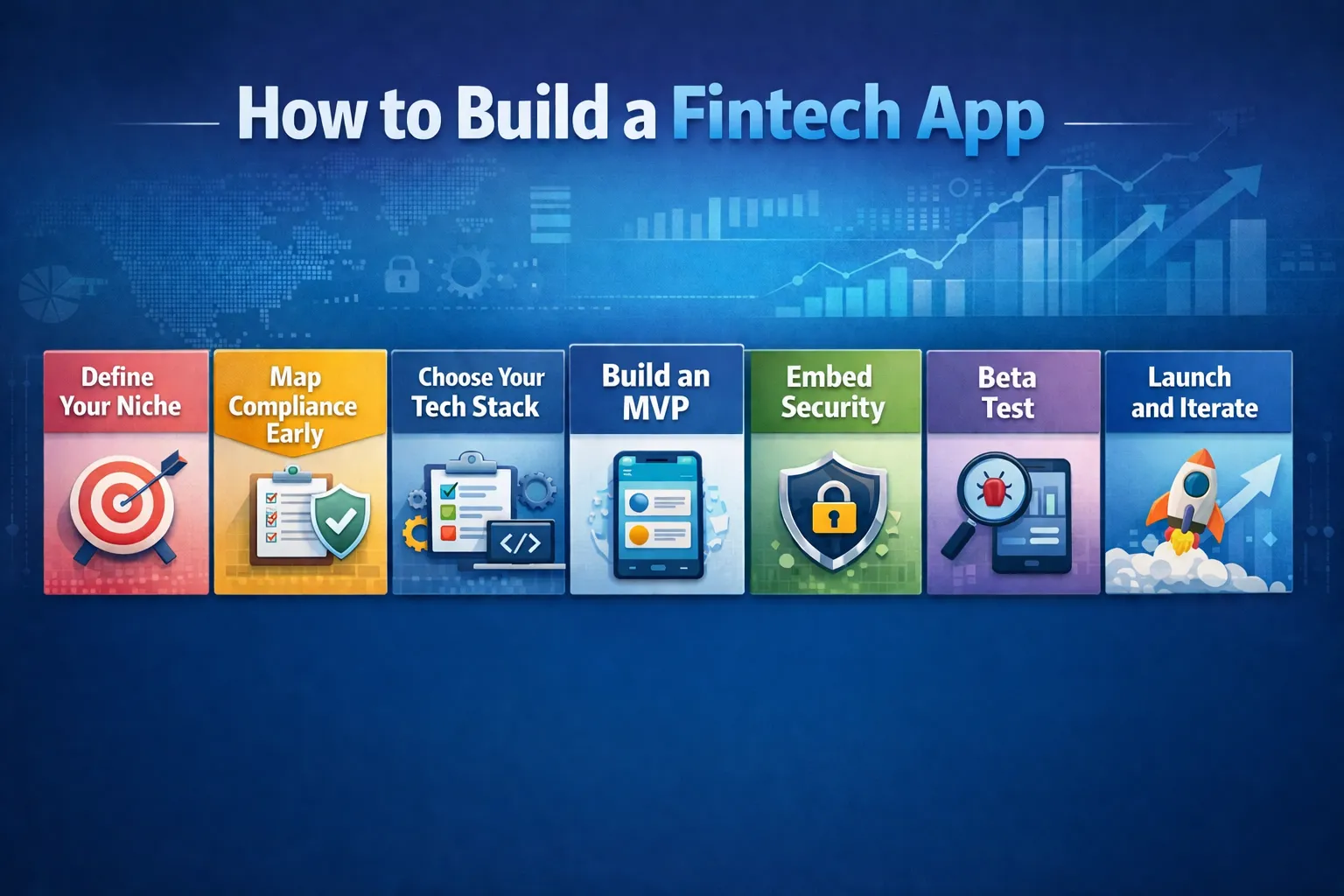
 Step 1: Define Your Niche
Start by selecting a fintech vertical like payments, lending, or investing. After choosing your focus, confirm real user demand through interviews, surveys, or competitor analysis, often supported by a fintech app case study.
Step 2: Map Compliance Early
Fintech apps must comply with strict regulatory standards, so identify all compliance requirements before starting development. This includes KYC/AML rules, PCI-DSS for payment security, GDPR or similar data privacy laws, and any necessary licenses. Tackling compliance early avoids costly redesigns later.
Step 3: Choose Your Tech Stack
Choose a technology stack that supports security, scalability, and a smooth user experience. This is where strong fintech app architecture decisions become critical. Popular options include React Native or Flutter for cross-platform apps, or Swift and Kotlin for more secure native solutions, especially for android app development. Backends usually utilize Node.js, Python, Go, or Java with PostgreSQL and Redis. Cloud services like AWS, Google Cloud, or Azure, along with APIs such as Plaid, Stripe, Twilio, and KYC solutions, help speed up development.
Step 4: Build an MVP
Focus your Minimum Viable Product on the core essentials: secure authentication, basic transactions, and accurate balance information. Many startups begin with MVP app development for fintech to validate ideas quickly and efficiently.
Step 5: Embed Security
Security must be built into every layer of the app. Use end‑to‑end encryption, adopt a zero‑trust architecture, tokenize sensitive data, and monitor activity in real time. Strong security helps protect users and builds trust.
Step 6: Beta Test
Release the app to a small group of users and conduct thorough fintech app testing to identify issues before launch. Use this phase to identify issues like onboarding bottlenecks, where users drop off, and any UX improvements needed. Beta testing provides valuable insights before a full launch.
Step 7: Launch and Iterate
Launch the app in stages rather than all at once. Continue improving features based on user feedback in short, 2–3 week development cycles. Frequent iteration keeps the product evolving and aligned with user needs.
Fintech App Development Challenge: Common Problems and Proven Solutions
Fintech development involves unique technical, regulatory, and operational challenges unlike those traditional app teams face. Companies must meet strict compliance, security, and real-time performance standards within a complex financial API ecosystem and when working to scale fintech mobile app development systems. Recognizing these hurdles early helps teams create stronger, resilient products.
Below is an overview of the five most significant challenges faced by development teams, and why each requires careful planning from the beginning.
1. Regulatory Complexity
Regulatory requirements differ across countries and within financial sectors, making ongoing compliance a challenge. Since regulations change quickly, teams must frequently update systems to meet legal standards. Falling behind can lead to delays, fines, or loss of user trust.
Solution: Designate a dedicated compliance owner and utilize managed platforms like Alloy that automatically push regulatory updates, easing the manual workload on your engineering team. Structure your architecture to be modular so that when a regulation evolves, you only need to update a single compliance layer instead of refactoring core functionality.
2. Security at Scale
Fintech apps are prime targets for cyberattacks because threats like deepfake fraud and automated account takeovers are becoming more sophisticated. Teams must deploy strong, multi-layered security measures without compromising the user experience. A single breach can lead to severe financial loss and long-term reputation damage.
Solution: Implement a zero-trust architecture layered with end-to-end encryption, data tokenization, and continuous behavioral authentication that verifies users discreetly without interrupting the user experience. Perform regular third-party penetration testing and invest in AI-powered identity verification tools specifically trained to spot emerging threats like deepfake fraud and synthetic identity attacks.
3. Performance Expectations
Users expect instant payments, real-time balance updates, and always accurate data. This requires highly optimized infrastructure capable of scaling during peak times. Even small performance delays can damage trust and push users toward competing apps.
Solution: Implement a distributed cloud infrastructure across multiple availability zones to prevent performance issues during traffic spikes and utilize caching tools like Redis to reduce database load for frequently accessed data. Create internal performance SLAs that are stricter than user expectations and monitor them with real-time observability tools to resolve issues proactively before users notice.
4. Third-Party Dependencies
Most fintech apps rely on external APIs for payments, banking data, and identity verification. These integrations create dependencies that can fail or slow down unexpectedly. Robust error handling and fallback systems are vital to maintain reliability.
Solution: For every critical integration, payments, KYC, banking data, identify a fallback provider and develop automatic switching logic so your system can route around failures smoothly instead of exposing users to silent errors. Implement circuit breaker patterns in your backend and keep a real-time service health dashboard so your team always knows the status of every integration.
5. Talent Scarcity
Finding developers who understand both financial regulations and complex engineering is challenging. Roles like security engineers and compliance-aware architects are especially hard to find. This scarcity can raise development costs and cause delays.
How Much Does It Cost to Build a Fintech App?
The cost of developing a Fintech app varies depending on factors like app size and necessary integrations, as well as ongoing expenses. Businesses often seek a detailed fintech development app estimate before starting development and compare vendors offering mobile app development services.
Below are tables showing the cost ranges and timelines for different app tiers, along with various strategies for cost optimization.
1. Cost by App Size
| Tier | Timeline | Cost Range | Description | Key Features |
| Basic MVP | 3-6 months | $20,000 – $80,000 | Early-stage validation product | Single platform, basic transactions, simple security |
| Standard App | 6-12 months | $80,000 – $200,000 | Market-ready product | Multi-platform, compliance, integrations |
| Advanced Platform | 12-18+ months | $200,000 – $300,000+ | Scalable ecosystem | AI, fraud detection, multi-jurisdiction support |
2. Cost Optimization Strategies
Managing development costs without sacrificing quality requires strategic planning. The following methods are commonly employed by successful fintech teams to lower costs during the build phase.
| Strategy | Impact | Explanation |
| Use Pre-Built APIs | Reduces dev time and cost significantly | Integrate services like payments, identity verification, and messaging instead of building from scratch |
| Cross-Platform Development | Cuts initial costs by ~30–40% | Use frameworks like React Native or Flutter instead of separate native apps |
| Start in Friendly Jurisdictions | Lowers compliance entry costs | Launch in regions with lower regulatory barriers |
| Managed Compliance Tools | Avoids high infrastructure and engineering costs | Use platforms for AML/KYC instead of building in-house systems |
Many startups also turn to custom fintech app development to tailor features to their exact needs, especially when operating in regulated environments like the USA market. To optimize costs, working with providers offering end-to-end fintech app development solutions is often the most efficient approach.
Best Practices for Hiring Fintech Developers
Hiring fintech developers requires finding talent with expertise in regulated environments and security. Developers should understand how financial data flows through a system and be comfortable working with compliance constraints that shape technical decisions. This ensures the product is both safe and legally sound. Overall, many companies look to fintech app development companies to accelerate delivery.
Businesses that are planning to scale may need to hire fintech app developers with experience in compliance-heavy systems. Strong candidates should demonstrate defined security practices, familiarity with modern scalable tech stacks, and the ability to explain how they protect sensitive financial information. These indicators show whether a partner can handle the high‑stakes nature of fintech.
Fintech teams are typically structured in-house, outsourced, or as a hybrid model, with hybrid being the most common because it balances control and cost. A standard team includes a product manager, a UX/UI designer, frontend and backend developers, DevOps or security engineers, and QA testers. Depending on the product, teams may also include a compliance specialist or fraud-focused data scientist to strengthen risk management.
When evaluating potential hires or development partners, consider the following core roles and the responsibilities each one covers:
1. Product Manager
Defines requirements, manages the roadmap, and aligns the team with user and business goals.
2. UX/UI Designer
Creates intuitive, trust-building interfaces tailored to financial use cases.
3. Frontend Developer
Builds the client-facing experience across web and mobile platforms.
4. Backend Developer
Develops APIs, data pipelines, and business logic that power the app.
5. DevOps / Security Engineer
Manages infrastructure, deployment pipelines, and security controls.
6. QA Tester
Validates functionality, performance, and security across all app features.
7. Compliance Specialist
Ensures the product meets all relevant regulatory requirements.
8. Fraud / Data Scientist
Builds and monitors risk models that detect and prevent financial crime.
Final Thoughts
Fintech in 2026 sits at the intersection of rapid growth and high complexity. The products that win are the ones that build compliance and security from day one, use AI to deliver meaningful personalization, design for trust rather than just functionality, and continuously improve fintech app retention rate. Whether you are launching an MVP or scaling a full platform, the goal remains the same: build something users trust with their money.
As the industry evolves, staying proactive is essential. Teams that anticipate regulatory shifts, strengthen security before threats emerge, and consistently refine the user experience are the ones best positioned for long-term success. Fintech success is not simply about moving fast; it is about moving fast responsibly.
Webby Central can support this journey by helping you innovate, integrate modern fintech capabilities, and deliver scalable platforms backed by reliable fintech app development services. With the right guidance and technical expertise, your product can stand out in one of the most competitive and impactful sectors in technology.
Frequently Asked Questions
1. What technologies are used in AI-powered fintech app development?
AI-powered fintech apps use technologies like machine learning, natural language processing (NLP), and predictive analytics, along with cloud platforms (AWS, Azure), APIs (Stripe, Plaid), and frameworks like React Native, Flutter, Python, and Node.js.
2. How long does it take to develop an AI-powered fintech application?
Development typically takes 3–6 months for an MVP, 6–12 months for a full product, and 12+ months for advanced platforms with AI, compliance, and scalability features.
3. What are the benefits of integrating AI in fintech apps?
AI enables personalized financial insights, faster decision-making, improved fraud detection, automated processes, and better user experiences.
4. What compliance regulations should be considered in fintech app development?
Key regulations include KYC/AML, PCI-DSS for payment security, GDPR/CCPA for data privacy, and region-specific financial licensing requirements.
5. How does AI improve fraud detection in fintech applications?
AI analyzes user behavior and transaction patterns in real time to detect anomalies, reduce false positives, and prevent fraud before it occurs.
6. What is the biggest challenge in AI-powered fintech development?
Balancing advanced AI capabilities with strict security, regulatory compliance, and user trust is the biggest challenge.