
Table of Contents
Mobile app for ecommerce has become an imperative consideration. While a lot of ecommerce decision-makers have decided to move ahead with solutions for hand-held devices, some still find themselves doubtful about many considering factors.
Among them, the ecommerce mobile app development cost poses a question that has always ignited interest. It is safe to believe that not everyone has the same ecommerce app idea or the budget to move ahead, but solutions can be made based on customization.
Businesses and C-suite teams look for a trusted ecommerce app development company, fitting their exact needs within their respective budgets. To move ahead and strengthen the decision of hiring one and building a mobile app for ecommerce business, we have explained the cost and factors aligning with them in depth in this ecommerce app development guide. This way, you will be able to touch base on multiple grounds and make a firm decision.
The Ecommerce Mobile App Boom: Why the Market Demands it?
To bring in figures and elaborate on them, the ecommerce market reached $2.52 trillion last year. This has been compelling businesses to make their brands global and showcase their products online.
Not only that, the time to make changes has arrived, and now decision-makers must move forward in the direction of making the ecommerce apps intelligent. Since 29% of companies are already using AI, and 48% of companies are experimenting, the case to adopt has just increased.
Keeping these in mind, you must also make a decision regarding the custom ecommerce app development and how, in the future, businesses will rely on online solutions.
What are the Must-Have Ecommerce Mobile App Features?
To determine the ecommerce app cost, you must know that features make a huge difference. They can either be basic with conventional functionalities or advanced with intelligent capabilities using AI, ML, IoT, AR/VR, and blockchain for AI-powered personalisation, AR-based product previews, and blockchain-secured transactions.
This table gives you an idea of how features can be both basic and advanced based on your ecommerce app requirements.
| Feature Category | Ecommerce Mobile App Features (Essential) | Advanced Features (Competitive Edge) |
| User Onboarding | Simple sign-up/login (email, phone) | Social login, biometric login (Face ID/Fingerprint), one-tap onboarding |
| User Profiles | Basic profile management | AI-driven personalization, user behavior tracking |
| Product Listings | Product catalog with images, pricing, descriptions | AI-enabled product recommendation, dynamic catalogs, AR-based product previews |
| Search Functionality | Basic search with filters & sorting | AI-powered search, voice search, and visual search |
| Product Details Page | Product info, images, reviews, ratings | 360° view, video demos, real-time stock updates |
| Shopping Cart | Add/remove items, cart summary | Smart cart (auto-save, cross-device sync), upsell suggestions |
| Wishlist | Save items for later | Smart wishlist with price drop alerts |
| Payment Options | Multiple payment methods (cards, UPI, wallets) | One-click checkout, BNPL (Buy Now Pay Later), crypto payments |
| Order Management | Order history, tracking | Real-time tracking with maps, predictive delivery time |
| Push Notifications | Order updates, basic offers | Personalized notifications based on user behavior |
| Customer Support | FAQs, contact support | AI chatbots, in-app live video support |
| Reviews & Ratings | User reviews and star ratings | Verified reviews, image/video reviews, sentiment analysis |
| Security | Basic data encryption | Advanced fraud detection, biometric authentication |
| Admin Panel | Manage products, users, orders | Advanced analytics dashboard, inventory forecasting |
| Performance | Standard app speed optimization | AI-driven performance optimization, predictive caching |
| Localization | Basic language/currency support | Geo-targeted content, multi-region pricing strategies |
| Marketing Tools | Discount codes, banners | Personalized offers, referral programs, and gamification |
| Analytics | Basic user & sales tracking | Deep analytics, heatmaps, and cohort analysis |
What are the Benefits of Ecommerce Mobile Apps?
Coming to the benefits, these are worth considering when building an ecommerce app for your business. You might experience differences in retention rates, conversion rates, and revenue growth.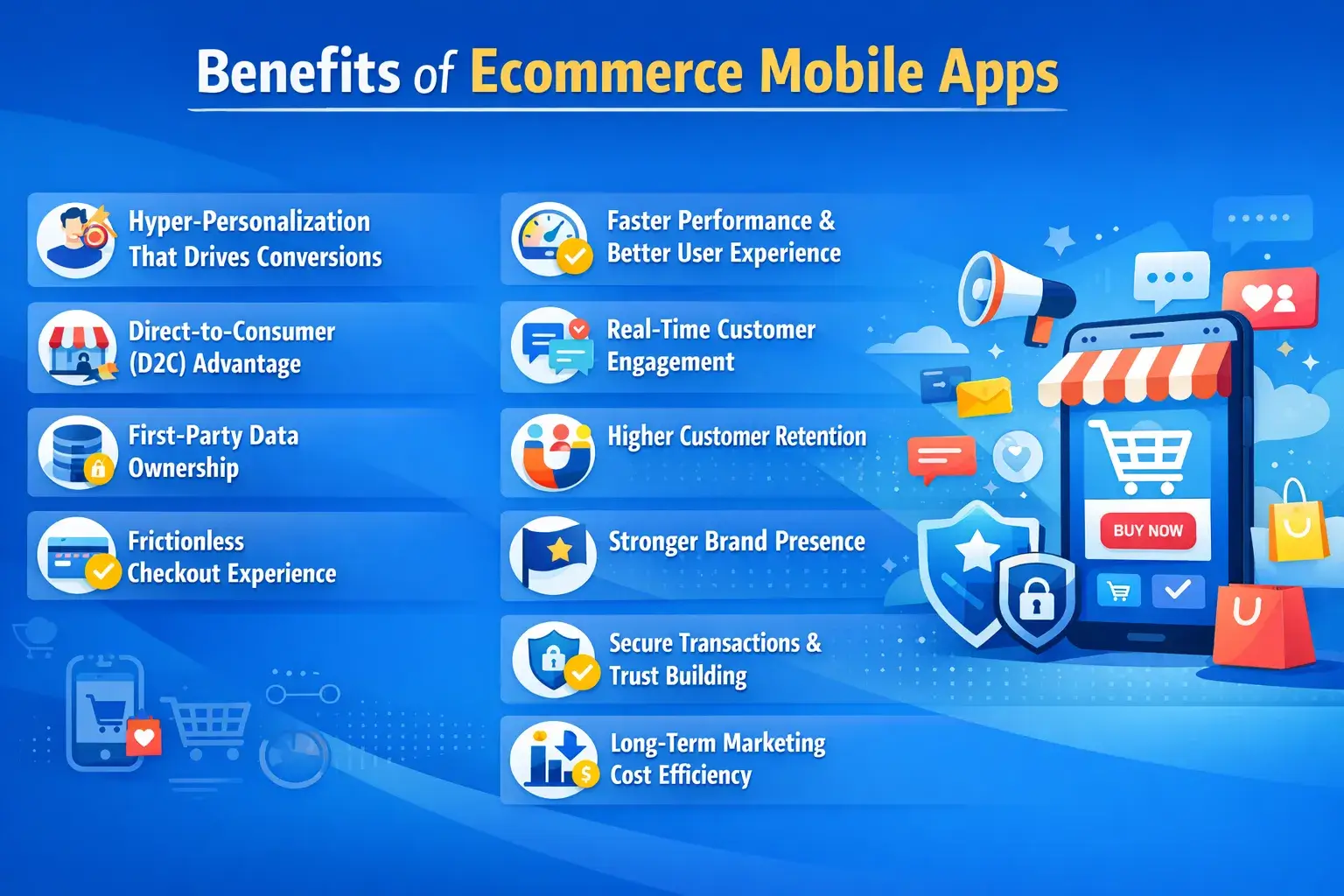
1. Hyper-Personalization That Drives Conversions
Modern eCommerce mobile apps leverage AI to analyze user behavior, preferences, and purchase history. This enables highly tailored product recommendations, personalized home screens, and relevant offers, ultimately boosting conversion rates and increasing customer lifetime value.
2. Direct-to-Consumer (D2C) Advantage
With a dedicated ecommerce mobile app, brands gain complete control over the customer journey. From discovery to checkout, everything is managed in-house, helping businesses strengthen brand identity, build trust, and improve profit margins without relying on third-party marketplaces.
3. First-Party Data Ownership
In a privacy-first digital landscape, owning customer data is crucial. Mobile apps allow businesses to collect and analyze first-party data, leading to better decision-making, improved targeting, and reduced dependence on external platforms and cookies.
4. Frictionless Checkout Experience
Features like one-tap checkout, saved payment methods, and biometric authentication simplify the buying process. This seamless experience minimizes cart abandonment and ensures a faster path from product discovery to purchase.
5. Faster Performance & Better User Experience
Compared to mobile websites, apps offer faster loading times and smoother navigation. This improved performance enhances user satisfaction, reduces bounce rates, and encourages longer browsing sessions.
6. Real-Time Customer Engagement
Push notifications and AI chatbots for ecommerce businesses enable instant communication with users. Whether it’s order updates, personalized deals, or reminders, real-time engagement helps increase retention and repeat purchases.
7. Higher Customer Retention
Once installed, mobile apps create a direct and long-term connection with users. This constant presence on a customer’s device encourages repeat visits, improving overall retention rates.
8. Stronger Brand Presence
An app icon on a user’s phone acts as a constant reminder of the brand. This visibility improves brand recall and encourages frequent engagement.
9. Secure Transactions & Trust Building
With advanced encryption, secure payment gateways, and biometric authentication, mobile apps provide a safer transaction environment, building trust among users.
10. Long-Term Marketing Cost Efficiency
Over time, apps reduce dependency on paid advertising. Direct channels like push notifications and in-app messaging allow businesses to engage users at a lower cost, improving overall marketing ROI.
Ecommerce Mobile App Development Cost Based on Diverse Factors
The evaluation of ecommerce app development cost stems from multiple factors that are based on the app functionalities and requirements. To be fair, no two businesses get the same ecommerce app development services, so costs can fluctuate. That being said, we must take a look at the app-based factors that influence the cost.
1. B2B Ecommerce App Development Platform
Based on the target audience that you are focusing on, the cost to build an ecommerce app fluctuates. For example, the US market has Apple in the majority, leading to businesses preferring to build iOS ecommerce apps more. However, in the global scenario, businesses lean towards finding the ecommerce android app development cost because it is the majority.
In such cases, the cost varies based on your requirement.
| Development Platform (Simple App) | Duration | Ecommerce App Development Cost |
| iOS App Development | 1000-1400 hours | $35,000 to $100,000 |
| Android App Development | 900-1300 hours | $30,000 to $80,000 |
| Cross-Platform Development | 1100-1500 hours | $20,000 to $70,000 |
2. Ecommerce Mobile App Size
Apart from the platform, another factor that influences the ecommerce app cost is the size. This includes the types of features, functionalities, and size of the app based on your requirements. While a normal app with a search bar might cost less, the app with AI-powered features will cost more. The table below mentions the ranges for your understanding.
| Ecommerce Mobile App Size | Ecommerce App Development Cost |
| Basic App | $30,000 to $55,000 |
| Medium App | $55,000 to $90,000 |
| Advanced App | $90,000 to $200,000+ |
3. Ecommerce App Design
When it comes to ecommerce mobile app design, the decision-makers are offered two options. One, choosing a template for the app. Two, you get a customized UI/UX design, keeping the interface in mind. The second may seem to be influencing the cost to create an ecommerce app, but it adds in personalized ideas, the company’s vision, and brand singularity.
| Ecommerce App Design Stage | Duration |
| Planning and Analysis | 2-3 weeks |
| Wireframing | 1-3 weeks |
| Low-Fidelity Wireframe | 2-3 weeks |
| High-Fidelity Wireframe | 3-4 weeks |
| App Designing | 1-2 weeks |
| Prototype | 4-5 weeks |
4. Custom Ecommerce App Development Hiring Model
When it comes to hiring ecommerce app developers for a solution, many decision-makers find themselves in confusion about whether to go for freelancing or outsource the ecommerce app development. In that case, if their needs somewhat changes that decision. For example, if a businesses on building an in-house team, they have to pay for the resources, benefits, and architecture from scratch.
Take a look at the table below.
| Hiring Model | Ecommerce App Development Cost |
| Freelancers | $35,000- $15,000 |
| In-House | $65,000-$300,000 |
| App Development Company | $60,000- $250,000 |
Hidden Factors That Affect the Ecommerce Mobile App Development Cost
The above sections weighed in as big factors. However, there are small ones as well that may seem little in the beginning but add up to the entire ecommerce app development cost. That being said, Take a look at the hidden factors.
| Hidden Factor | What It Means | Impact on Cost |
| Third-Party Integrations | Payment gateways, CRMs, analytics tools, shipping APIs | Medium to High |
| Scalability Planning | Preparing the app to handle future growth (users, products) | High |
| UI/UX Micro-Interactions | Animations, transitions, and user feedback elements | Medium |
| App Performance Optimization | Speed, responsiveness, and load time improvements | Medium to High |
| Security & Compliance | Data encryption, GDPR, PCI-DSS compliance | High |
| Cross-Platform Compatibility | Ensuring smooth performance across devices/OS versions | High |
| Backend Infrastructure Complexity | Server setup, databases, APIs, cloud architecture | High |
| Content Management System (CMS) | Managing products, categories, and content dynamically | Medium |
| App Store Deployment & Guidelines | Meeting Apple/Google submission standards | Low to Medium |
Conclusive Ecommerce App Development Cost
After talking about the cost to build ecommerce app, we came to an understanding that there is no fixed figure for it. However, it also brings us clarity that the cost can be estimated within a range.
The ecommerce app development cost ranges from somewhere between $30,000 to $250,000 and more, based on your app’s size, company’s experience, and ecommerce app features to be included.
How to Build Ecommerce Mobile App With a Step-By-Step Process?
You need the assistance of a custom ecommerce app development company that holds years of experience and functional understanding. They can help you build an app specific to ecommerce development.
Prior to hiring such a company, take a look at the process you must follow with the pointers mentioned below.
1. Define and Strategize a Custom Ecommerce App
Establish clear business goals, target audience, and core features to build a focused app roadmap.
2. Planning and Market Research
Analyze competitors, customer behavior, and market trends to validate your app idea and positioning.
3. Hire an Ecommerce App Development Company
Choose a reliable development partner with relevant experience to ensure quality and scalability.
4. Ecommerce Mobile App UI/UX Design
Create intuitive, user-friendly interfaces that enhance customer engagement and simplify navigation.
5. Custom Ecommerce App Development
Build tailored features and functionalities that align with your business requirements and user needs.
6. Ecommerce Mobile App Testing
Conduct thorough mobile app testing to identify bugs, ensure performance, and deliver a seamless user experience.
7. Maintenance and Support
Continuously update, optimize, and support the app to keep it secure, relevant, and high-performing.
Since you are aware of the systematic process that you must follow, consider the type of service provider you will be choosing for your ecommerce brand and associated app.
Why Choose AppsChopper as Your Custom Ecommerce App Development Company?
It is safe to say that you need a company that has experience with ecommerce mobile app framework while implementing intelligent technologies.
In that case, choosing AppsChopper, a trusted ecommerce app development company, means partnering with a team that delivers measurable results. For instance, one of our ecommerce clients experienced a 45% increase in user engagement and conversions after launching a custom-built mobile app optimized for performance and seamless checkout. This kind of impact highlights AppsChopper’s ability to turn ecommerce app ideas into high-performing digital products. If you’re looking to build an ecommerce app that truly drives growth, now is the time to connect with AppsChopper and bring your vision to life.
Frequently Asked Questions
1. How long does it take to develop an eCommerce mobile app?
Typically, it takes 3–6 months, depending on complexity, ecommerce app features, and integrations. Advanced apps may take longer.
2. Does adding AI features increase eCommerce app development cost?
Yes, AI features increase initial costs, but they improve personalization, engagement, and conversions, delivering strong ROI.
3. Is outsourcing eCommerce app development more cost-effective?
Yes, outsourcing reduces hiring and infrastructure costs while giving access to experienced professionals and faster delivery.
4. What technologies are commonly used in eCommerce app development?
Common technologies include React Native, Flutter, Swift, Kotlin, Node.js, and cloud-based solutions for scalability and performance.
5. What are the ongoing maintenance costs for an eCommerce mobile app?
App maintenance usually costs 15–25% of the initial development cost annually, covering updates, security, and performance optimization.