Table of Contents
Technology has always shaped how students learn and teachers teach. Today, the Internet of Things (IoT) is at the forefront of that transformation. From smart classrooms to connected campuses, IoT in education is redefining what is possible inside and outside the classroom. IoT is reshaping education at scale, with the market projected to reach over $48 billion by 2032, driven by the rise of smart classrooms and connected campuses.
Whether you’re an administrator eager to bring modern updates to your institution or a passionate educator exploring exciting new tools, this guide breaks down how IoT is transforming education and how you can apply it.
What Is IoT in Education and Why Does It Matter?
At its core, IoT is a network of physical devices connected to the internet that can collect, share, and act on data without constant human input. In an educational setting, this means smart devices ranging from sensor-equipped desks and interactive whiteboards to climate-controlled labs and wearable attendance trackers, all working together to create a more responsive learning environment.
This is important because schools and universities generate enormous amounts of data every day, yet most of it goes unused. IoT changes that. By making the physical environment intelligent and connected, institutions can act on real-time insights to improve outcomes for students and staff alike.
The role of IoT in education extends far beyond gadgetry. It touches academic performance, campus safety, resource efficiency, and the overall quality of the learning experience. As more institutions recognize this, adoption is accelerating rapidly across the globe.
Real-World IoT in Education Examples Across Every Level
Understanding how IoT works in theory is one thing. Seeing it in action makes the value undeniable. Here are some compelling IoT in education examples that illustrate the scope of its applications:
1. Smart attendance systems: RFID-enabled student ID cards and facial recognition software automatically record attendance, reducing administrative overhead and improving accuracy.
2. Environmental sensors: CO2 monitors, thermostats, and lighting systems adjust classroom conditions in real time to support focus and comfort.
3. Connected laboratories: Science labs equipped with IoT-enabled instruments al7. How is ROI measured for IoT in education? low students to run experiments and collect data remotely, expanding access beyond the physical lab.
4. Smart buses and campus security: GPS tracking and sensor-equipped vehicles ensure student safety during transit, while connected surveillance systems monitor campus perimeters.
5. Personalized learning devices: Wearables and connected tablets track engagement levels, helping teachers adapt lesson plans in real time based on student responses.
The application of IoT in education is as varied as the institutions deploying it. A rural K-12 school might use connected sensors to ensure building safety, while a metropolitan research university might deploy IoT across an entire campus ecosystem to manage energy, security, and student services simultaneously.
These are not distant possibilities. Institutions are partnering with providers offering app development services to build custom platforms that integrate IoT hardware with intuitive software dashboards for educators and administrators.
The Meaningful Benefits of IoT in Education
The benefits of IoT in education are wide-ranging and compound over time. Here is a closer look at why institutions are investing in this technology:
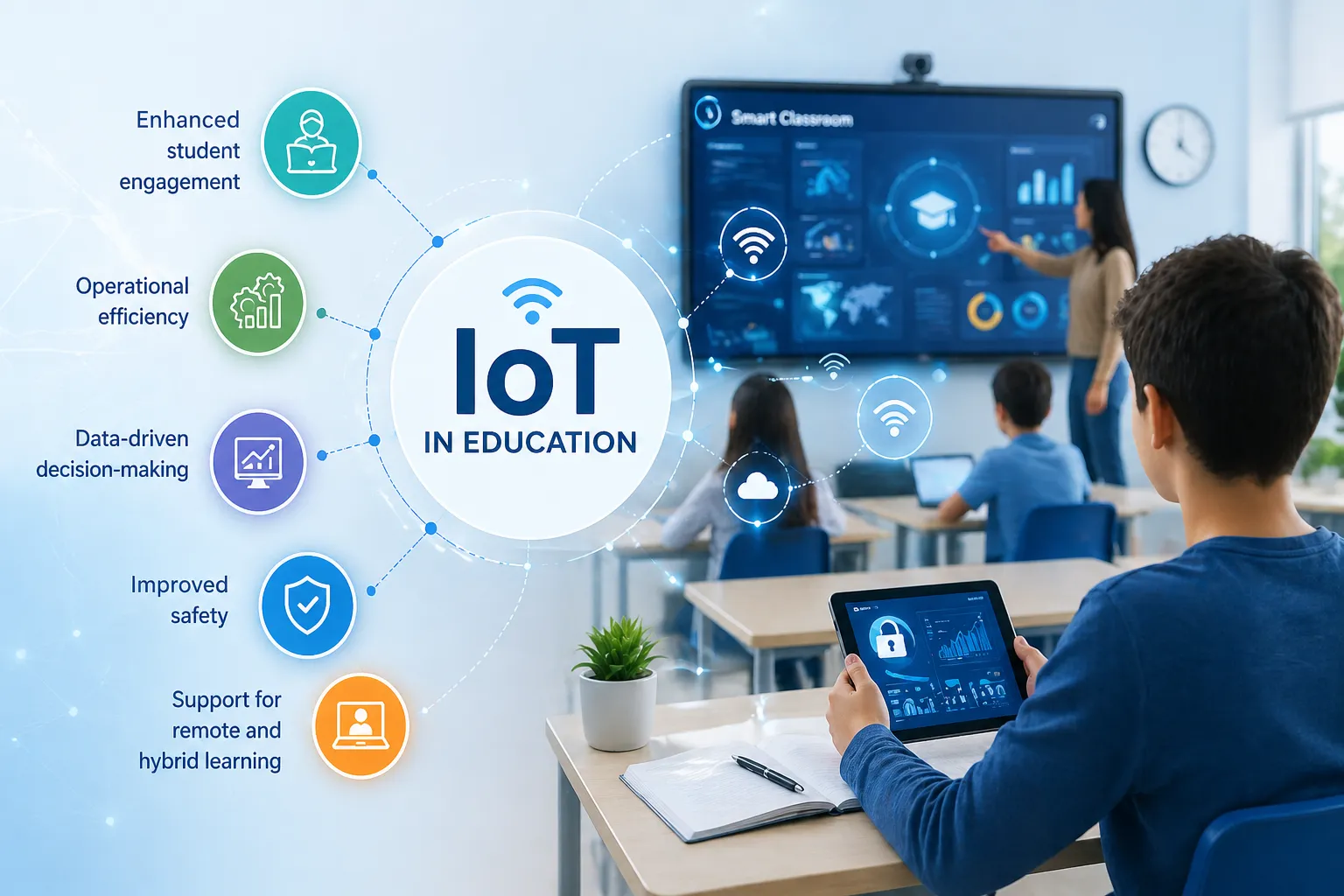
1. Enhanced student engagement: Interactive and responsive environments keep students more engaged. When the learning environment meets their needs, students feel more invested in the process.
2. Operational efficiency: Automated systems for lighting, HVAC, and resource management reduce energy waste and operating costs, freeing up budget for academics.
3. Data-driven decision-making: Administrators gain access to real-time and historical data that informs decisions ranging from staffing to curriculum planning.
4. Improved safety: From smart locks to emergency alert systems, IoT creates safer campuses for students and staff.
5. Support for remote and hybrid learning: IoT bridges the gap between in-person and remote learners, ensuring consistent access to resources regardless of physical location.
For institutions exploring custom tools to unlock these benefits, ML-based solutions can complement IoT infrastructure by adding predictive analytics, anomaly detection, and personalized learning pathways.
How IoT in Higher Education Is Transforming College Campuses?
Universities face a unique set of challenges: large, sprawling campuses; diverse student populations; significant infrastructure overhead; and growing pressure to deliver measurable outcomes. IoT in higher education addresses many of these challenges at once.
Smart campus initiatives are among the most ambitious deployments in the sector. These programs integrate everything from parking sensors and library kiosks to research equipment and student health centers into a unified data ecosystem. The result is faster decision-making, reduced operational costs, and improved student services
Universities are also leveraging IoT to support research. Connected instruments in labs generate continuous streams of data, reducing the time researchers spend on manual data collection. This is especially relevant in STEM fields, where precision and data volume directly impact research quality.
When it comes to managing the software side of these deployments, teams often weigh options carefully. Understanding mobile app development cost is an important step for higher education institutions building companion apps for their IoT ecosystems, especially when scaling across multiple departments or campuses.
The Growing Impact of IoT on the Education Industry
Zooming out to a macro level, the IoT in education industry is experiencing significant growth. The following factors are driving this growth:
- Post-pandemic digital infrastructure investment: COVID-19 exposed significant gaps in educational technology readiness. Institutions are now investing heavily to ensure resilience.
- Government policy support: Many national and regional governments have launched initiatives to modernize public schools with smart technology.
- Falling hardware costs: The price of IoT sensors, connectivity modules, and edge computing hardware has dropped dramatically, making deployment accessible to more institutions.
- Growing ecosystem of developers: Specialists, including dedicated IoT app developers, are building purpose-built applications that make it easier for schools to deploy and manage connected systems without deep technical expertise.
Industry reports project double-digit compound annual growth rates for EdTech IoT solutions over the next decade. Governments, private investors, and technology companies are directing resources toward this space.
Key Challenges of IoT in Education That Institutions Must Prepare For
No technology adoption is without friction, and the challenges of IoT in education are real and significant. Being aware of them upfront helps institutions plan more effectively.
1. Data privacy and security
Schools collect sensitive information on minors. IoT systems expand the attack surface, making robust cybersecurity protocols non-negotiable.
2. Infrastructure readiness
Many schools, especially in underserved areas, lack the network bandwidth and physical infrastructure needed to support large-scale IoT deployments.
3. Budget constraints
7. How is ROI measured for IoT in education? While hardware costs are falling, comprehensive IoT deployment still requires meaningful upfront investment. Understanding the full scope of education app development cost helps institutions budget accurately from the outset.
4. Teacher and staff training
New technology is only as effective as the people who use it. Without adequate training and change management, IoT tools risk being underutilized.
5. Equity concerns
If IoT adoption is concentrated in well-funded institutions, it risks widening the existing gap between well-resourced and under-resourced schools.
Addressing these challenges requires not only technical solutions but also thoughtful planning, stakeholder engagement, and long-term commitment. Institutions partaking in custom education app development can embed privacy-by-design principles and accessibility features from the ground up, reducing risk and improving outcomes for all users.
The Future of Connected Learning
The integration of IoT in education is not a passing trend. It marks a fundamental shift in how schools, colleges, and universities operate and deliver value to students. Schools and institutions that embrace this transformation thoughtfully, addressing security, equity, and training alongside technology, will be best positioned to thrive in an increasingly connected world.
Whether your institution is just beginning to explore smart classroom pilots or is ready to scale a campus-wide connected ecosystem, the key is to start with clear goals, the right partners, and a commitment to continuous improvement. The connected campus of tomorrow is being built today.
How AppsChopper Helps You Build an IoT-Powered Education App?
Building a successful IoT-powered education platform requires more than hardware; it requires a development partner who understands both the technology and the unique demands of the education sector.
AppsChopper specializes in designing and developing custom IoT applications for schools, colleges, and universities, ranging from smart attendance systems and connected classroom tools to full campus management platforms.
Our team combines expertise in mobile app development, machine learning integration, and IoT infrastructure to deliver secure, scalable solutions tailored to your institution’s goals. Whether you are launching a pilot program or scaling an existing system, we work with you at every stage, from planning and design through deployment and ongoing support, to ensure your investment delivers lasting results for students and staff alike.
FAQ
1. What role does data analytics play in IoT-powered education?
Data analytics transforms raw IoT data into actionable insights, helping educators identify trends in student behavior, optimize resource usage, and proactively address performance or operational issues.
2. Can IoT integrate with existing school management systems?
Yes, most modern IoT solutions are designed with APIs that allow seamless integration with learning management systems (LMS), student information systems (SIS), and other administrative platforms.
3. What industries support IoT in education?
IoT in education draws support from telecommunications, cybersecurity, enterprise software, hardware manufacturing, and EdTech industries. Their combined expertise enables connectivity, security, and application layers that make smart educational environments possible.
4. How long does it take to implement IoT in education?
Timelines range from a few weeks for a single smart classroom pilot to one to three years for a full campus-wide rollout. A phased approach, starting small and scaling gradually, typically yields the smoothest results.
5. What technologies are used in IoT in education systems?
Common technologies include RFID, Wi-Fi and Bluetooth Low Energy, cloud platforms, edge computing, and mobile applications. Machine learning is increasingly layered in to power predictive features like early student disengagement alerts.
6. What factors influence IoT implementation costs in education?
Key cost drivers include device type and quantity, network infrastructure complexity, software development, cybersecurity measures, and staff training. Institutions that plan for scalability from the start tend to see better long-term cost efficiency.
7. How is ROI measured for IoT in education?
ROI is tracked across energy savings, reductions in administrative labor, and improvements in student attendance and retention. Some institutions also use student satisfaction scores and academic performance data as broader indicators of impact.