
Table of Contents
Healthcare is experiencing one of its most profound shifts, which is based on the idea of moving from reactive to proactive, continuous, and data-driven care. The practitioners are no longer focusing on the traditional approach, but taking the assistance of AI and wearable technology in the healthcare industry.
What once started as simple step-counting devices leading the fitness-focused changes has evolved into diagnostic-grade, AI-powered health companions. The technology is now capable of monitoring chronic diseases, preventing emergencies, and empowering patients to take charge of their health.
Keeping this mindset and forward-thinking approach at the forefront, the healthcare institutions are also adapting the technology. They hire a trusted wearable app development company that brings in extensive experience in building models that integrate well with the devices.
In order to bring a judgment that not only aligns with the market but also with your hospital’s specific needs, let’s explore how wearable technology in healthcare is redefining the industry.
What is Wearable Technology?
 To come to better terms with the next-gen technology, it is better for you to have an understanding of what it is first. To assist you with that, we bring a dissection that can bring clarity to the topic.
In technical terms, the innovative wearable technology refers to sensor-powered devices worn on the body that continuously collect, analyze, and transmit health-related data. These devices bridge the gap between patients and clinical ecosystems by delivering real-time insights into vital signs, lifestyle metrics, and disease-specific parameters.
Unlike traditional diagnostics, which rely on episodic visits, wearables enable ongoing monitoring, improving accuracy, early detection, and personalized treatment.
How Does Wearable Technology for Health and Fitness Work?
The working of wearable technology is no mystery, but requires some explanation for the decision-makers. Since you might be planning on including it in the healthcare system and operations model, a deep understanding is much more imperative for you.
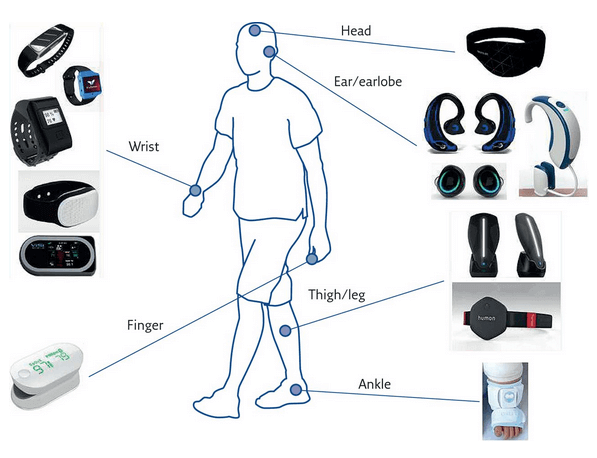
- Built-in sensors track physiological signals like ECG, SpO₂, heart rate, skin temperature, or glucose levels.
- Data is transmitted via Bluetooth or Wi-Fi to mobile apps or cloud dashboards.
- AI and mobile app analytics models interpret the data for anomalies or trends.
- Clinicians receive alerts or reports through integrated EMR/EHR systems.
These technicalities make it different and helpful in the long term for healthcare practitioners to analyze and assess the core problem and what specific treatment patients need.
What are the Different Types of Wearable Technology?
While the use of wearable technology in healthcare is indeed similar for hospitals and clinical care, the functionalities may differ. Keeping that in mind, here we go ahead with the types of technologies for the wearable system integrations that can assist you in building a better patient and doctor model.
Fitness & Activity Trackers
A fitness and activity tracker system monitors steps, sleep cycles, calories burned, and heart rate variability (HRV), which is used in corporate wellness programs and lifestyle coaching. Keeping that in mind, they hire a fitness app development company as per their needs.
Clinical-Grade Wearables
Next on the list are the clinical-grade wearable systems, which represent the most medically reliable category of health devices, designed with diagnostic precision and often backed by FDA approval. For the patient’s benefit, these wearables include continuous ECG patches that provide uninterrupted cardiac monitoring and wearable blood pressure cuffs that capture hypertensive trends.
Smartwatches for Health Monitoring
Up next for the wearable health technology, smartwatches have evolved to fitness tracking in the context of functioning as a compact, multifunctional health monitoring system.
Equipped with advanced optical and electrical sensors, modern smartwatches can perform medical-grade tasks such as detecting arrhythmias through ECG recordings and measuring blood oxygen saturation with high precision.
Wearable Biosensors
In the sensors and wearable technology in healthcare, biosensors are transitioning the industry by enabling continuous, non-invasive monitoring of complex physiological data. This is possible because of ultra-thin patches that are applied directly to the skin.
These sensors analyze various biomarkers such as sweat composition to measure hydration and electrolyte levels, cortisol-related indicators to monitor stress, and muscle activity patterns that assist in physical therapy and rehabilitation.
Wearable Medical Alerts
Medical alert systems are becoming imperative for the safety and immediate support with the assistance of wearable technology for seniors, patients with chronic diseases, and those with cognitive impairments.
Such alert-based devices are designed to detect falls, track real-time location through GPS, and allow users to request emergency assistance with a single action, or automatically in critical situations.
Next-Gen Wearable Technology Trends in Healthcare
Keeping in mind that the revolution of new wearable technology is restructuring the healthcare industry far beyond step counting or basic heart rate tracking. The next-gen wearables are smarter, more sensitive, medically accurate, and deeply integrated into clinical decision-making.
From devices that monitor patients remotely to AI-powered systems predicting illnesses before symptoms appear, you can get them built with the healthcare app development services for continuous, data-driven, and preventive care.
These next-generation trends are not just innovations but are shaping a future where healthcare becomes more personalized, accessible, and proactive. Below is a quick breakdown of the emerging trends defining the next phase of wearable healthcare technology.
| Wearable Technology Trends in Healthcare | What does it mean? | Impact of Wearable Technology in Healthcare |
| Remote Patient Monitoring (RPM) | Continuous tracking of vitals from home | Reduces hospital visits, improves chronic care |
| AI-Powered Predictive Health Analytics | AI analyzes wearable data for early risk alerts | Enables early diagnosis & proactive intervention |
| Non-Invasive Metabolic Tracking | Sensors monitor glucose, hydration, and lactate without needles | Supports diabetes care & fitness optimization |
| Continuous Cardiovascular Monitoring | Always-on ECG, BP, HRV, arrhythmia detection | Prevents cardiac emergencies & improves heart care |
| Integration With Telemedicine Platforms | Wearables sync with virtual care systems | Enhances remote consultations with real-time data |
| Wearables Supporting Personalized Healthcare | Data-driven insights tailored to individual health patterns | Enables customized treatment & lifestyle plans |
Examples of Wearable Technology in Healthcare Worth the Discussion
So far, the premise stays with the idea that the wearable technology has expanded from consumer fitness tools to medically relevant devices. This directly supports diagnostics, disease management, preventive care, and remote monitoring, and changes the view of treatments.
However, you must be wondering about the wearable technology examples that brought such a change. Now, to bring a broader understanding of the use cases, these examples are proven to be worth discussing.
- Apple Watch Health Suite: Offers continuous heart, activity, and ECG monitoring to help users detect irregularities early.
- Fitbit Health Solutions: Tracks sleep, stress, heart rate, and daily activity to support long-term health management.
- Dexcom G7: Provides real-time, needle-free continuous glucose monitoring for better diabetes control.
- Oura Ring: Delivers precise sleep, recovery, and readiness insights through advanced biometric sensing.
- BioSticker: A single-use wearable patch that enables continuous monitoring of vital signs and symptoms for clinical decision-making.
- Omron HeartGuide: A wrist-worn blood pressure monitor that allows users to measure BP anytime with medical-grade accuracy.
Based on these use cases, you must make a decision that changes the basic functioning of your hospital or medical institution for both the short and long terms.
Benefits of Wearable Technology in Healthcare
While understanding the overall changes that the technology brings, it is clear that healthcare decision-makers should choose healthcare wearable app development services to bring the necessary.
However, the benefits have still been confusing, and to bring a change in the perspective towards them, here we bring forth the information in a table for you to get a gist of it.
| Advantages of Wearable Technology in Healthcare | Description |
| Early Abnormalities Detection | Continuous monitoring helps identify irregular patterns |
| Chronic Disease Management | Supports long-term tracking for conditions like diabetes, hypertension, and cardiac disorders. |
| Reduced Hospital Readmissions | Remote monitoring alerts clinicians early, preventing complications that lead to readmissions. |
| Real-Time Data for Clinicians | Provides instant patient insights to improve diagnosis and treatment accuracy. |
| Patient Empowerment Through Self-Tracking | Enables users to stay informed and proactive about their health metrics. |
| Enhanced Telehealth Ecosystem | Seamlessly integrates with virtual care, enabling continuous, remote care delivery. |
| Improved Preventive Care | Early indicators and behavior insights help providers deliver timely preventive interventions. |
What is the Future of Wearable Technology?
As we have discussed, the wearable technology in healthcare is moving toward deeper integration, intelligence, and personalization, and restructuring the future. Considering that the devices are shifting from basic activity trackers to clinically-reliant tools, monitoring vitals, detecting abnormalities, and predicting health risks are bringing in the wave of positive treatment.
With advancements using the AI app development services, wearables will be able to interpret complex biological patterns, offering proactive industry insights rather than just showcasing data.
Keeping the above adaptations, ultimately, wearable technology is set to drive a future where care is more personalized, accessible, and continuous. This will empower individuals while transforming how healthcare is delivered.
Why Choose AppsChopper for Bringing Change With Wearable Technology?
As a leading mobile app development company with an extensive understanding of wearable app development, we have assisted 30+ healthcare practitioners in modernizing their business models with wearable development and integration services. Transition being the focus, we have 50+ AI and wearable app developers who have been changing the healthcare industry project by project.
If you have any requirement that needs modification as per the market, wearable needs, and healthcare monitoring, you can always connect with our experts and get the most reliable digital transformation services and change your patient experience.
Frequently Asked Questions
How can wearable technology affect your privacy?
Wearable technology collects continuous personal data, from biometrics to location insights. If not encrypted or securely stored, this data may be exposed to unauthorized access. As a wearable app development company, we ensure end-to-end security with compliant data handling, encrypted communication, and strict access controls to safeguard user privacy.
How can healthcare providers integrate wearables into their existing systems?
We integrate wearables through secure APIs, interoperable data exchange, and HIPAA-compliant cloud connectors. We help build seamless integrations by connecting wearable data streams with EMRs/EHRs, hospital dashboards, and remote patient monitoring systems without disrupting existing workflows.
How do wearables enhance emergency healthcare response?
Our solutions enable automatic emergency triggers, GPS coordination, and instant data transmission, helping providers act faster, reduce risks, and improve patient outcomes during critical moments.
Can wearable devices connect with AI-powered diagnostic tools?
Absolutely. We develop wearable ecosystems that feed continuous patient data into AI-driven diagnostic engines. This integration enables predictive health insights, early disease detection, personalized alerts, and automated recommendations, improving decision-making for both patients and clinicians.