
Table of Contents
Every business ideally wants to have apps with everlasting features, innovation, and user support. But, for a leader, the question is much deeper. It is actually about choosing the right development approach where the engineering efforts are optimal, and results are faster.
This is where cross platform mobile app development can provide you with a competitive edge. This methodology of app creation can help teams build apps for different platforms using a shared codebase, which can accelerate time-to-market while improving development efficiency. Beyond speed, it also enables faster updates, consistent user experiences across platforms, and better scalability as your product evolves.
This is why it’s no surprise that 1/3rd of mobile developers are shifting toward cross platform frameworks to optimize both cost and performance.
However, cross platform development is not a one-size-fits-all solution. It comes with trade-offs that can impact your app’s flexibility and long-term scalability if not evaluated carefully. So, to help leaders with their research, this definitive guide breaks down how to build a cross platform mobile app, covering the key steps, features, cost details, and when this approach makes more sense than native app development.
What is a Cross Platform App?
As we know, leaders today need to build apps for multiple platforms to improve their reach. This is where the role of a cross platform app comes into play.
These digital solutions can be designed based on a shared codebase, and they can cater to both iOS and Android by using a single codebase. Thus, cross platform apps are redefining the facets of app development in 2026.
What is Cross Platform App Development?
Basically, when we talk about a cross platform mobile app, we’re essentially looking for a digital platform that works for both iOS and Android. And the approach that backs this software is understood as cross platform app development.
For the user, this app is like any other solution. However, for a business owner, the difference lies in how teams develop the app’s codebase.
- That simply means that in the case of cross platform mobile app development, technology professionals don’t need to worry about creating two separate applications from scratch.
- Instead, these solutions can be built and deployed using a single, shared codebase using frameworks like React Native, Flutter, and Xamarin.
Thus, we can say that this app development approach is a very practical and scalable resource for enterprises today.
Why Are Cross Platform Mobile Apps a Scalable Choice for Businesses?
As technical teams discuss how they can streamline mobile app development, cross platform apps seem a commonly considered choice. That being said, this section explores why a business owner should invest in this approach to build and scale their apps.
- Well, this modern framework is key if you are aiming to build apps faster, reduce costs, and still deliver a consistent user experience across iOS and Android.
- In fact, professionals here use more sophisticated resources, modern frameworks, and tools to build highly scalable solutions for multiple platforms.
For decision-makers, this translates into the following key outcomes (which is why it’s a reliable investment).
- Frameworks like React Native and Flutter can be trusted to build large-scale digital solutions.
- Helps teams scale with confidence and stability.
- Rolling out new features, updates, and patches is easy.
- Helps minimize maintenance overheads.
- Ensures accelerated time-to-market.
In this manner, this approach improves the agility in app creation processes. which enables teams to deliver dynamic app features for iOS and Android, without building separate codebases. So, their engineering effort are drastically reduced, and their efficiency is increased.
Essential Features in Cross Platform Apps
As a cross platform mobile app development approach is in discussion, leaders further need to analyse the key features that they need for their hybrid mobile apps. This basically supports the app’s performance, scalability, and user experience across platforms.
That being said, here are some of the features that a cross-platform app cannot miss, if it wants to deliver exceptional user experiences.
| Features | Description |
| Adaptive UI/UX |
|
| High Performance Optimization |
|
| Scalable Architecture |
|
| Secure Data Handling |
|
| Offline Functionality |
|
| API-first design |
|
| Dynamic Real-time Capabilities |
|
| QA and Testing |
|
| Modular Code Structure |
|
| Analytics |
|
Well, this analysis (understanding which features you need to build from day one, and planning which ones you can add later) is key to creating a successful hybrid app. It helps teams build a scalable and reliable software application across platforms.
Top Benefits of Cross Platform App Development
All in all, the cross app development approach follows the “Write Once, Run Everywhere” (WORE) ideology. This simply means that mobile apps are compatible with both Android and iOS individually. It is one of the reasons why startups should go for cross platform app development.
Essentially, this approach allows a business to achieve the following key outcomes: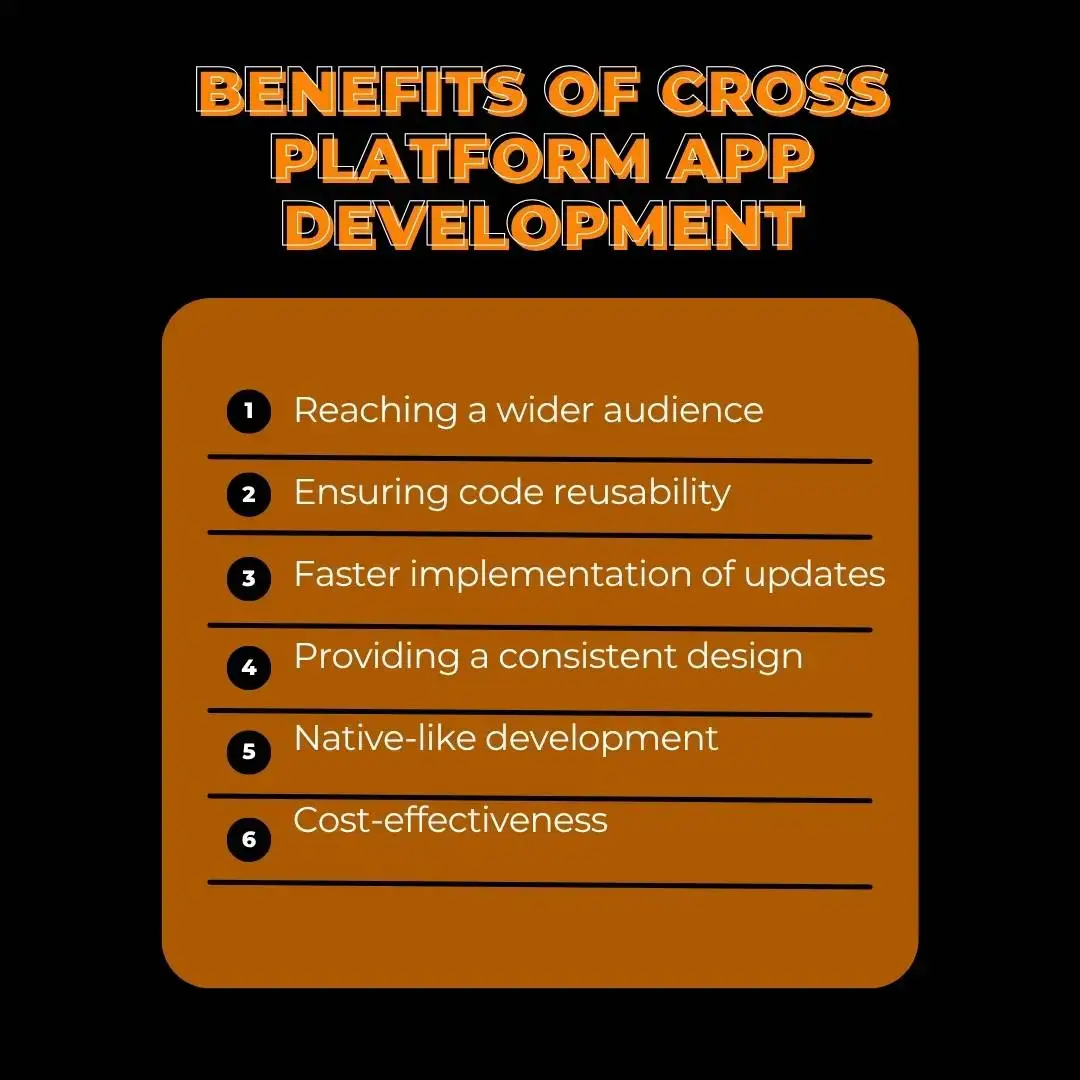
1. Reaching a wider audience
This approach allows mobile app developers to build an app and deploy it over various platforms, including the web. In this way, they can target iOS and Android platforms easily. Ultimately, this means reaching a larger audience with a single app, which will ultimately result in more profit indeed.
2. Ensuring code reusability
For mobile app developers, writing good, reusable code is a good practice. But why is it so? In a cross-platform app development framework, developers can reuse a single code to develop apps for multiple platforms. And they don’t need to create a new codebase for every platform.
3. Faster implementation of updates
Due to rising user demands, it has become crucial for businesses to release apps faster. This is where cross-platform mobile app development helps deliver better results like faster deployment, maintained app stability, and quality, and so on.
4. Providing a consistent design
As we know, apps need an optimized mobile app design to deliver seamless user experiences. Cross-platform app development tools readily enable modern developers and designers to create interactive design elements in the apps that users expect today.
5. Native-like development
There is no doubt that businesses prefer native app development because it offers impeccable app performance. Likewise, cross platform technologies help deliver native-like applications for the users. In fact, hybrid apps can match and exceed the performance of these apps for the customers.
6. Cost-effectiveness
Simply, native app development is more expensive because it is a resource-intensive process. On the other hand, a cross-platform development approach relies on one codebase for multiple platforms. This is why it is more economical, because hiring only one developer can be equally effective.
What’s more, employing cross platform tools and technologies also helps in streamlining development workflows while also enabling apps to sync updates faster across all devices. This is why it is a largely opted-for solution by development teams in 2026.
Native vs Cross-Platform Mobile App Development: A Practical Comparison
If we’re deciding how to build our mobile application, one question inevitably comes up. And that is, which is better for your enterprise? Cross platform or native development?
Well, the answer to this question is not straightforward. It is because both approaches solve different business needs.
Relatively, at a higher level, cross platform mobile app development frameworks may be better as they move faster and can be developed using a shared codebase. However, native apps are still better performing and have their pros as well. So, to help leaders define which choice is the right one for them, let us explore this differentiation shared below.
| Key Factors | Cross Platform Apps | Native Apps |
| Development Approach | Single codebase for iOS and Android | Separate codebases for each platform |
| Time-to-market | Faster | Slower |
| Development cost | Lower | Higher |
| Performance | Promising performance in most cases, but maybe limited for complex situations. | Better performance due to embedded dynamic native app capabilities. |
| User Experience | Consistent across multiple platforms | Fully optimized for specific platforms |
| Maintenance | Easier, as it uses a single codebase. | More complex to manage changes and maintenance. |
| Scalability | Scales efficiently as it has a unified architecture | Scales well, but teams need to manage more than one codebase. |
So, we can say that hybrid apps are easier to manage (in terms of updates, patches, and more), and they are also a more cost-efficient option. Here, teams also consult professionals offering hybrid app development services, who can help with this business facet.
When Should Businesses Choose Cross Platform Mobile App Development?
Based on the elaborate analysis of the approaches that leaders can adopt, the next stop in our way is to gauge whether cross platform app development tools and frameworks are the best approach for your enterprise.
Generally, it makes sense for a company in many cases, which include:
- When your development teams prioritize higher speed, better control, and lower costs.
- When your app requirements may be moderately complex, and your team wants more device-specific features.
- When the brand needs higher customizations in UI/UX to deliver consistent user experiences across iOS and Android.
- When your roadmap is complex and requires phased growth.
That being said, the most practical suggestion for leaders is to evaluate the firm’s business goals, user expectations, and long-term product strategy in formulation. Mainly, this can be done in a better way by consulting professional mobile app development services, which can help with this choice.
Tech Stack for Cross Platform Mobile App Development
Now, once leaders explore the dynamics of cross platform mobile app development, the next step in their research is diving into the mechanics of the frameworks themselves.
That being said, this section helps teams define and understand the tech stack that can power your application (from front-end to backend), and it can be better understood through the table below:
| Tech Stack Layer | Tools and Technologies | Description |
| Frontend | Flutter, React Native, Ionic, NativeScript | This layer handles the user interface. |
| Backend | Node.js, Django, Ruby on Rails, Spring Boot, .NET | This aspect manages the business logic, authentication, and data processing. |
| APIs | REST APIs, GraphQL, gRPC | It acts as the bridge between the frontend and backend. |
| Database Management | MongoDB, PostgreSQL, MySQL, Firebase Firestore, SQLite | This layer is responsible for storing and managing application data. |
| Cloud Services | AWS, Google Cloud Platform (GCP), Microsoft Azure, Firebase | Cloud platforms provide a secure infrastructure for your IT needs, like hosting, storage, scalability, and other real-time services. |
| DevOps | Jenkins, GitHub Actions, GitLab CI/CD, Bitrise, Codemagic | DevOps tools practically assist in automated testing, integration, and deployment of apps. |
| Security Layer | OAuth 2.0, JWT, SSL/TLS, Firebase Auth, Keychain (iOS), Keystore (Android) | This layer is critical for compliance. It helps ensure data protection, secure authentication, and safe communication between systems. |
In this manner, the right tech stack can be developed by a professional mobile app consulting solution provider and aligned as per your specific app development goals, scalability, and security needs. Ideally, this will also be dependent on your app complexity and integration requirements.
Cost Overview of Cross Platform Mobile App Development
Once we’ve aligned the necessary features and frameworks that a software needs (through your tech stack), the next critical aspect is understanding what its cost will be.
Well, the answer is not that straightforward here. The cost of cross platform mobile app development depends on multiple factors, including app complexity, features, integrations, and the development model we choose.
That being said, the average mobile app development cost for your project can be better understood through the table below:
| App Complexity | Features | Average Cost Range |
| Basic |
|
|
| Intermediate |
|
|
| Advanced |
|
|
With this comprehensive research, now you can strategically plan a realistic budget for your hybrid mobile app development project.
Why Choose AppsChopper as Your Trusted Cross Platform App Development Company?
We can confidently say that building a mobile app today is no longer just about choosing a platform. Rather, it involves working on the right development strategy that aligns with your business goals, planned timelines, and scalability needs.
Throughout this guide, we’ve seen how cross platform mobile app development is an app development enabler for multiple platforms.
Seeing all this, we can say that the future of cross platform app development is bright. We hope this ultimate guide helped you know everything about cross platform app development and cleared all your doubts related to it. So what are you waiting for? Go ahead and give your idea the needed shape via cross platform app development!
And for a more extensive discussion around your project, you can give our experts a notification through our contacts page!