
Table of Contents
Going digital has been an approach that the healthcare industry has understood. However, with imminent changes in the technological industry, modernization is becoming significant. It can be related to anything, like introducing new AI features to existing apps, building separate ones for institutional efficiency, or maybe bringing a new wellness and lifestyle app idea upfront.
Since the healthcare industry has been focusing more on the outlook of becoming technologically advanced, modifying basic functioning with apps has been appreciated. Huge names in the healthcare sector are bringing this change not only for patient experience but also to streamline their operational system. With healthcare mobile app development services, they are providing solutions to their tedious situations and bridging the gap between doctors and patients.
To be precise, they are offering healthcare practitioners a platform for doctors to connect with patients on a deeper level in terms of data, appointments, consultations, and prescriptions. That being said, we do get that often decision-makers find themselves in the middle while making a decision.
To build a healthcare app, you and other healthcare practitioners often find yourselves asking multiple questions. But to bring a rescue, we created this bifurcation guide that covers the intricacies, features, process, benefits, and costs, helping you think it through better. Since the vision is to open the mind and welcome new thoughts, here we go with the segment-wise discussion on healthcare app development.
What Is a Healthcare App?
A healthcare application (also known as mHealth application or medical mobile application) is a software application created to assist in clinical processes, patient interaction, administrative processes, or wellness tracking based on a mobile or web platform.
Notably, not every healthcare application is a patient-centered one. The ecosystem has three different levels of users:
- Patient-facing application intended to allow individuals to control their health status, appointments, and communication between them and care providers.
- To aid doctors, nurses, and other specialists, clinician-facing apps assist with diagnosis, communication, and care coordination.
- Platforms of administrative applications that improve the work of the hospital, its staff, billing, and compliance reporting.
A healthcare app ecosystem is a network where all layers interact via secure APIs, shared EHR databases, and encrypted messaging protocols. An independent patient appointment scheduling application can link a provider’s schedule board to a hospital billing platform; they can also be separate applications integrated with each other.
How Mobile Apps Uplift the Healthcare Industry?
Patient engagement is one prominent factor to justify how mobile apps extend the growth scale of the healthcare sector. The following factors illustrate how mobile apps are transforming healthcare delivery at scale:
1. Accessibility and instantaneous availability
Patients and clinicians can get access to important data and services whenever they need them, and eliminate delays in care delivery.
2. Wider scope
Remote monitoring apps and telehealth provide care to underserved and rural populations.
3. Clinical specialization
There is an increase in the accuracy of outcomes with apps that are designed to support diagnostics and clinical decision-making.
4. Centralized management of patient records
The integration of digital EHRs ensures the continuity of care across departments and providers.
5. Push notifications and feedback loops:
Post-care check-ins, medication reminders, and appointment alerts are effective in enhancing patient adherence.
6. Electronic prescriptions by health professionals:
E-prescriptions minimize mistakes caused by handwritten prescriptions and accelerate prescription filling.
Types of Healthcare Apps: Categories & Use Cases
Choosing the right type of healthcare app to build begins with identifying your target user and the specific problem you are solving. Below is a comprehensive categorization of healthcare app ideas by user group and function.
| For Hospitals & Healthcare Practitioners | For Patients & General Users |
|
|
A Closer Look at Key App Categories
1. Doctor & Medical Clinic Apps
These applications eliminate the communication barrier between clinicians and patients. They make the process of prescribing, scheduling appointments, accessing patient history, and conducting remote consultations easier. Physicians minimize administrative overhead and improve documentation to a greater degree, thereby enhancing the patient experience.
2. Hospital & Healthcare Administration Apps
Hospital applications have a structural role, helping organize staff work, maintain electronic records, handle billing, and provide virtual tours or gallery interfaces for patient-facing portals. The most important capabilities are ideal treatment monitoring, enhanced documentation, and cohesive departmental staff management.
3. Medicine & Pharmacy Apps
The alarming rise of mHealth apps corresponds to their use in the pharmacy sector. Patients and medical agencies are switching to mobile apps for medical emergencies, as automation offers effortless management of medicine inventory.
What is the best app for healthcare? Several medical practitioners and pharmaceutical centers opt for medical app development services to get medicine apps. Many healthcare organizations aspire to discuss their ideas on medication reminders, pill trackers, and emergency medicine apps.
Many people ask about the cost of developing an app. The costs differ as per the project, features, and technologies used for healthcare app development. It simply means that these types of mHealth apps are the best.
4. Fitness, Wellness & Lifestyle Apps
With the popularity of preventive health, fitness apps that monitor BMI, daily activity, calorie intake, and exercise programs are becoming the main focus of consumer health. These healthcare wearable app developments continuously monitor health and promote self-care before medical intervention is required.
Must-Have Features of a HIPAA-Compliant Healthcare App
Now that we have covered the distinction, it is time to discuss the must-have assets. Since every healthcare app may have different specifications, the core features would always be the same for them. For instance, every telehealth app may require user information, must protect privacy to ensure data integrity, and must build secure communication.
Keeping that in mind, here are some of the features that healthcare decision-makers prefer to have in their solutions with the assistance of experienced healthcare mobile app developers.
| Feature Category | Key Features | Purpose & Benefits |
| User Registration & Profiles | Secure sign-up, role-based profiles (doctor, patient, admin) | Enables personalized access and data control |
| Authentication & Security | Multi-factor authentication, secure login, and access control | Protects sensitive health data |
| Electronic Health Records (EHR/EMR) | Medical history, lab results, prescriptions | Centralizes patient health information |
| Appointment Scheduling | Book, reschedule, cancel, reminders | Reduces wait times and improves efficiency |
| Telemedicine & Virtual Care | Video consultations, chat, and file sharing | Enables remote care and convenience |
| Secure Messaging | Encrypted in-app chat, document sharing | Ensures private communication |
| E-Prescription | Digital prescriptions, refill requests | Minimizes errors and speeds up care |
| Remote Patient Monitoring | Vital tracking, device integration | Supports chronic and post-care monitoring |
| Notifications & Alerts | Appointment reminders, medication alerts | Improves adherence and engagement |
| Payments & Billing | Online payments, invoices, and insurance support | Simplifies financial transactions |
| Admin Dashboard | User management, analytics, reporting | Enables operational control |
| Compliance & Privacy | Data encryption, consent management, and audit logs | Ensures regulatory compliance (HIPAA/GDPR) |
| Analytics & Reporting | Health trends, usage metrics | Ensures regulatory compliance (HIPAA/GDPR) |
| Scalability & Integrations | API integrations, modular architecture | Supports better decision-making |
| User Authentication & Access Control | Multi-factor authentication, role-based access, and strong passwords | Prevents unauthorized access to protected health information (PHI) |
| Data Encryption | Encryption at rest and in transit, secure APIs | Protects PHI from data breaches and interception |
| Secure Data Storage & Backup | HIPAA-compliant cloud storage, automated backups | Ensures data availability while maintaining security |
Healthcare Software Development Best Practices in 2026
To build secure, scalable, and compliant healthcare applications, organizations must follow industry-proven best practices:
1. Security-First Architecture
Always design applications with encryption, secure APIs, and Zero Trust Architecture to protect sensitive patient data (PHI).
2. Ensure Regulatory Compliance from Day One
Compliance with HIPAA, GDPR, and other regulations should be embedded during the design phase, not added later.
3. Build for Interoperability
Use standards like HL7 FHIR to ensure seamless integration with EHR systems such as Epic and Cerner.
4. Prioritize User Experience (UX)
Design intuitive interfaces for both patients and healthcare providers to improve adoption and reduce errors.
5. Use Agile & Iterative Development
Adopt agile methodologies to continuously improve features based on user feedback and compliance updates.
6. Integrate Advanced Technologies Carefully
Use AI, IoT, and analytics responsibly to enhance care delivery without compromising safety or compliance.
Benefits of Healthcare Mobile Apps: For Providers & Patients
Now you must be wondering about the advantages that these solutions might bring to different healthcare practitioners and hospitals. A very valid thought that revolves around the benefits not only from the patients’ and users’ perspective but also for the hospitals themselves.
When decision-makers decide on professional healthcare app development services, they often have their revenue-focused benefits in hindsight. The perks are not limited to the revenue but largely stem from the operational feasibility, efficient time allocation, real-time data-driven insights, and proper patient engagement. The list goes on, but here we are to assist you with that during the contemplation phase for better decisions.
Here is a structured breakdown by stakeholder group.
| For Medical Professionals & Hospital Administration | For Patients & General Users |
| Real-Time Access to Clinical Data | Improved Access to Healthcare Services |
| Improved Clinical Workflow Efficiency | Personal Health Data Management |
| Remote Patient Monitoring (RPM) | Medication Adherence & Health Reminders |
| Clinical Decision Support Systems (CDSS) | Remote Health Monitoring & Self-Care |
| Secure Clinical Communication | Faster Diagnosis & Timely Care |
| Telemedicine & Virtual Care Enablement | Enhanced Patient Engagement |
| Data Accuracy & Reduced Medical Errors | Cost Efficiency & Time Savings |
| Regulatory Compliance & Audit Readiness | Data Privacy & Secure Access |
Emerging Technologies in Healthcare App Development
Coming to the health application development with the assistance of technological knowledge, currently, healthcare practitioners are preferring to include emerging assets. Keeping automation, augmented experience, and predictive analysis with data, the focus is shifting towards building healthcare apps using AI, ML, NLP, IoT, and AR/VR. These technologies have been welcoming modern innovations into operational functions and revolutionizing tedious tasks with accuracy, efficiency, and precision.
Keeping that in mind, we decided to assist you with custom healthcare app development, with cognitive technologies in focus. In the table mentioned below, we are bringing forward the technologies worth investment, why they need to be considered, and what sort of features they implement for the change.
| Technology | Why It’s Worth the Investment? | Key Features & Capabilities |
| Artificial Intelligence (AI) & Machine Learning (ML) | Improves diagnostic accuracy, reduces clinician workload, and enables predictive care models | Clinical decision support, predictive analytics, medical image analysis, symptom triage, personalized treatment recommendations |
| Internet of Medical Things (IoMT) | Enables continuous patient monitoring and early intervention, reducing hospital readmissions | Real-time vitals tracking, wearable integration, device connectivity, remote alerts, data synchronization |
| Telemedicine & Virtual Care Platforms | Expands access to care while lowering infrastructure and operational costs | Video consultations, secure messaging, remote diagnosis, virtual follow-ups, e-prescriptions |
| Blockchain Technology | Enhances data security, interoperability, and auditability of medical records | Immutable health records, secure data sharing, consent management, audit trails |
| Cloud Computing | Provides scalability, flexibility, and cost-efficient infrastructure | Secure cloud storage, high availability, disaster recovery, and real-time data access |
| Big Data & Advanced Analytics | Enables data-driven clinical and operational decisions | Population health analytics, trend analysis, risk stratification, outcome forecasting |
| Augmented Reality (AR) & Virtual Reality (VR) | Improves medical training, patient education, and surgical precision | Virtual simulations, surgical visualization, therapy support, and patient education modules |
| Natural Language Processing (NLP) | Automates clinical documentation and improves data usability | Speech-to-text, clinical note automation, voice commands, and semantic search |
| 5G Technology | Supports low-latency, high-speed healthcare applications | Real-time telemedicine, remote surgery support, high-quality video streaming, IoMT connectivity |
| Robotic Process Automation (RPA) | Reduces administrative overhead and human error | Automated billing, claims processing, appointment scheduling, and data entry |
| Cybersecurity & Zero Trust Architecture | Protects sensitive health data and ensures regulatory compliance | Advanced encryption, identity verification, intrusion detection, and access control |
How to Develop a Healthcare App With a Step-By-Step Process?
Once the type, technologies, and features are decided at your end, you come across another decision towards the healthcare app development lifecycle. Since following an organized system and structured flow is essential, you must have an understanding of the right approach.
Oftentimes, healthcare decision-makers confuse design and development as an intertwined step; the reality is not close to that assumption. With agile methodology, you can develop a healthcare app that follows essential guidelines and turns out to be worth the investment.
To assist you with the step-by-step process, we have outlined the necessary information during the healthcare app development cycle.
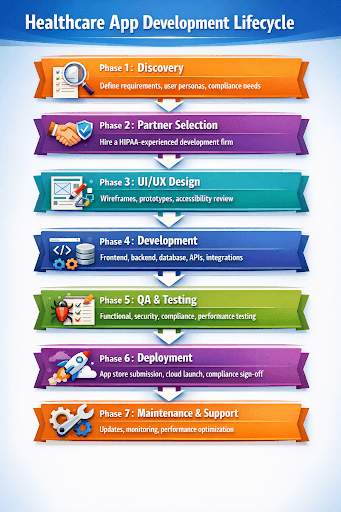
Phase 1: Define Requirements and Healthcare App Vision
Before beginning with making all the other decisions, you should focus on finalizing the type of healthcare app you are planning to build. The awareness towards the users, their review of existing apps, issues creating fuss in the market, and how to fix them with your app should be your priority. This way, you decide on what functionalities you are going ahead with and have a vision to elaborate on when you try to hire a service provider in the context of mobile app development for healthcare solutions.
Phase 2: Hire a Healthcare App Development Partner
Obviously, when you finalize your decisions, you need a development partner with extensive experience implementing new technology in healthcare apps, building them, and later deploying them. These skills require experience, and that can only be acquired from a firm that has been building and following HIPAA compliance for years. Keeping that in mind, you must hire a partner.
Phase 3: Healthcare App UI/UX Design
Once your hiring process is completed, the service providers first understand your healthcare app requirements and begin with the UI/UX design as part of a structured SDLC in the healthcare app development process. This allows them to build a proper layout, create the app’s theme, and make the interface user-friendly for further use. They work on screen, user stories, and information accessibility during this stage.
Phase 4: Custom mHealth App Development
As soon as the design for the healthcare app is ready, it is time to move ahead with the systematic development. During this phase, the mobile health app developers focus on frontend, backend, database, cloud computing, and third-party APIs to build robust source code and a strong app structure. That being said, this phase is considered the most crucial phase and requires experienced experts in it.
Phase 5: Healthcare App Testing and QA
Once development is complete, the app undergoes manual and AI-driven testing, including mobile app testing services and performance testing, to identify bugs, ensure stability, and deliver a reliable final product.
Phase 6: Deployment
As soon as the QA team gives a green flag, the deployment team initiates launch measures, often leveraging mobile app launch services to ensure compliance, smooth rollout, and a successful release upon your approval.
Phase 7: App Maintenance and Ongoing Support
Once the app is up and running for the users, the healthcare app still requires upgrades, performance augmentation tweaks, and proper app support and maintenance on a monthly or annual basis. This way, the apps run without any issue and assist in bringing efficiency into healthcare operations and patients’ experience.
Regulatory Compliance: HIPAA, GDPR, and HITECH
Compliance is not an add-on to the development of health care applications, it is an architectural requirement that is present at every stage of the design and engineering decision-making. The following list includes a brief description of the key responsible standards that can be applied to the majority of healthcare apps:
| Compliance Standard | Region | What It Requires | Estimated Compliance Cost |
| HIPAA (Health Insurance Portability and Accountability Act) | USA | Data encryption, access controls, audit logging, secure APIs, Business Associate Agreements (BAAs) | $20,000 – $100,000 |
| GDPR (General Data Protection Regulation) | EU / EEA | Data privacy by design, user consent management, right to erasure, data processing agreements | $15,000 – $80,000 |
| HITECH (Health Information Technology for Economic and Clinical Health Act) | USA | Strengthens HIPAA enforcement, mandatory breach notification requirements, and expanded liability | $20,000 – $70,000 |
Recommended Technology Stack for Healthcare Apps
Now comes the aspect of technology that changes as per your needs. For instance, if you are looking forward to an android app development for healthcare users, the cost may be different from that of an iOS app. And the figures change when you are planning for a custom cross-platform app that caters to both. Keeping this in mind, we have constructed a cost table based on the technologies that you will need.
| Technology Stack | mHealth App Development Cost (Basic App) | Considerations |
| Frontend (UI/UX Development) | $10,000 – $50,000 | React Native, Flutter, Swift (iOS), Kotlin (Android), Custom UI/UX, Responsive Design |
| Backend Development | $20,000 – $100,000 | Node.js, Python (Django), Ruby on Rails, .NET, Microservices, API development |
| Database | $5,000 – $30,000 | PostgreSQL, MySQL, MongoDB, Firebase, Cloud Firestore (Scalability, Security) |
| Cloud Infrastructure | $10,000 – $50,000 | AWS (HIPAA-compliant), Google Cloud, Azure, Kubernetes, Load Balancing |
| API Integrations | $10,000 – $80,000 | EHR/EMR (Epic, Cerner, Athenahealth), Payment Gateway, Telemedicine, AI APIs |
| AI/ML for Diagnostics | $50,000 – $250,000+ | TensorFlow, PyTorch, NLP, Predictive Analytics, Medical Image Processing |
| IoT & Wearable Integration | $50,000 – $200,000+ | Apple HealthKit, Google Fit, Bluetooth & IoT Device Sync |
| Blockchain for Data Security | $70,000 – $300,000+ | Smart Contracts, Decentralized Storage, Secure Medical Records |
| AR/VR for Training & Therapy | $150,000 – $400,000+ | Unity, Unreal Engine, 3D Modeling, VR Therapy, Simulation Apps |
| DevOps & Maintenance | $10,000 – $50,000/year | CI/CD, Automated Testing, Monitoring, Regular Updates |
Healthcare App Development Cost: Full Breakdown
Now that we have covered all the necessary discussions imperative for the healthcare app development guide, it is time to take a look at the cost section. Being honest, no two apps are going to be the same, would require equal efforts, and take the same time. These considerations bring us to the idea that there will not be a fixed figure for you to determine the investment. However, to find a range, your requirements and needs can help.
Since factors like an app’s intricacy, features and functionalities, experience of chosen developers, and the telehealth app’s size influence the cost, here we bring forth a guide for healthcare app development cost.
1. Custom Medical App Development Cost Based on Basic Features
The features you choose to include can change the cost range by thousands. Since that is the premise, here are the influences they put on cost that are mentioned in the table below.
| Basic Healthcare App Features | Estimated Cost |
| User Registration & Login | $3,000 – $8,000 |
| Doctor & Patient Profiles | $5,000 – $15,000 |
| Push Notifications | $2,000 – $5,000 |
| Geolocation | $4,000 – $10,000 |
| Third-Party Payment Gateway | $6,000 – $15,000 |
| In-App Chat | $8,000 – $20,000 |
| User Dashboard | $5,000 – $12,000 |
| Health Record Management | $10,000 – $30,000 |
| Prescription Management | $8,000 – $25,000 |
2. Custom Healthcare Software Cost Based on Advanced Features
While the basic features cost less, advanced features built with AI, ML, IoT, and other aspects are considered a little expensive. The healthcare app development cost in USA for the advanced features mentioned below needs to be considered before building a telehealth solution.
| Advanced Healthcare App Features | Estimated Cost |
| Wearable Device Data Collection | $10,000 – $30,000 |
| AI Chatbot for Appointment Assistance | $15,000 – $50,000 |
| Video Consultations (Telemedicine) | $20,000 – $60,000 |
| Medical Records Integration (EHR/EMR) | $10,000 – $40,000 |
| Virtual Waiting Room | $8,000 – $20,000 |
| AI/ML for Diagnostics | $50,000 – $250,000+ |
| IoT & Wearable Integration | $50,000 – $200,000+ |
| Blockchain for Data Security | $70,000 – $300,000+ |
| AR/VR for Training & Therapy | $150,000 – $400,000+ |
3. Telemedicine App Development Cost Based on Platform Type
After the technologies, we have medical app development platforms that affect that investment on a larger scale. Be it hybrid, PWA, or native, all bring a change in the cost that can be seen in the table mentioned below.
| Platform Type | Estimated Cost |
| Progressive Web App (PWA) | $30,000 – $90,000 |
| Web-Based App | $40,000 – $120,000 |
| Cross-Platform App (React Native / Flutter) | $40,000 – $130,000 |
| Native Mobile App (iOS or Android) | $50,000 – $150,000 |
| Hybrid App (Web + Mobile) | $70,000 – $200,000 |
4. Cost Based on Location of HIPAA Compliance App Development Company
Now we come to the factor that changes the premise a little when it comes to investment. The healthcare app development cost in USA is different from Canada due to political unrest, climatic changes, and global concerns. You may face significant decreases and elevation, but always remember that quality should always be considered over price.
| Region | Hourly Rate |
| USA | $30 – $100 |
| Canada / Australia | $80 – $200 |
| Western Europe | $80 – $180 |
| Eastern Europe | $40 – $100 |
| South America | $30 – $90 |
| Southeast Asia | $20 – $70 |
| Middle East | $60 – $150 |
5. Cost of Developing a Health App Based on Engagement Models
When you plan on outsourcing healthcare app development, the engagement model also brings a change in investment. These may differ as per your needs and influence the cost significantly. Keeping that in mind, take a look at the table below.
| Engagement Model | Estimated Cost | Best For |
| Fixed-Price | $30,000 – $130,000 | Well-defined scope, MVP builds |
| Time & Material | $40,000 – $140,000+ | Evolving requirements, iterative development |
| Dedicated Team | $50,000 – $150,000+ | Long-term product development |
| Staff Augmentation | $2,000 – $10,000/month per developer | Supplementing in-house teams |
Final Healthcare Mobile App Development Cost Estimation Formula
The final cost to build healthcare apps is dependent on the formula that estimates the figure and brings an idea of the closest numbers.
The formula below will bring forth the conclusive cost:
Final Healthcare App Development Cost = Total Development Hours × Hourly Rate
This still does not define the exact range. That can only be done when you are clear on what you are looking for. However, to bring a range, the healthcare app development cost begins from $35,000 and reaches $250,000 or above, based on your needs and requirements.
How to Choose the Right Healthcare Mobile App Development Company?
The choice of healthcare app development partner is as important in the success of your healthcare app project as are the features you specify. These are the requirements that make the difference between a qualified healthcare app development platform and generic software stores:
| Criteria | Description |
| Proven Healthcare Portfolio | Experience with HIPAA-compliant applications, telemedicine applications, EHR integrations, or mHealth solutions – not general applications. |
| Compliance Expertise | Partner must be well-versed with HIPAA, GDPR, and HITECH regulations. |
| HL7 FHIR & EHR Integration Experience | Has proven ability to integrate with major EHR systems such as Epic, Cerner, and Athenahealth using HL7 FHIR and other healthcare interoperability standards. |
| Agile Development Methodology | The iterative development that uses sprint reviews in order to have improved control over the scope, timeline, and quality. |
| Post-Launch Support & Maintenance | Continued updates, security patches, and compliance audits. |
| Transparent Communication & IP Ownership | Complete access to progress and source ownership. |
| Security-First Culture | Encryption, secure APIs, penetration tests, and Zero Trust architecture were applied at the beginning of implementation. |
Why Choose AppsChopper as Your Healthcare App Development Company?
So far, what we have understood is that you still need a trusted app development company that has healthcare-focused experience in building solutions. You need someone who has been in the field for a long time and has delivered products that assisted healthcare practitioners and hospitals in modifying their existing workflow.
In that case, you can always trust AppsChoppers, one of the new-age healthcare app development companies, with 15 years of experience in building telehealth apps. We are considered reliable by our clients for their apps, regardless of the healthcare department they are from.
For instance, we built belly bump, a pregnancy and wellbeing tracking app, for our client who planned to offer pregnant women monitoring tools. Another renowned healthcare-focused app we built was NeuCup, an AI-powered urinalysis testing system that leverages AI in healthcare to enable remote sample testing. Keeping that in mind, you should contact us and get assistance from our experts, bring efficiency to the workflow, and change the tedious functioning.
FAQ
Q1: How long does it take to develop a healthcare app?
The development timelines differ depending on complexity. An average medical application having essential features will require 3-6 months. For a full-featured telemedicine platform or AI-based clinical tool, 9-12 months are enough. The most common time and cost-saving strategy is to develop an MVP and build on it.
Q2: What is the minimum cost to build a healthcare app?
A simple healthcare application that includes the required features, user registration, appointment booking, and simple communication will cost around $35,000 dollars. More complex systems that include AI, IoT, blockchain, or video consultations may range from $70 thousand to $200 thousand or more.
Q3: Do healthcare apps need HIPAA compliance?
Yes, HIPAA compliance is mandatory if your application handles Protected Health Information (PHI) on behalf of users in the United States. This encompasses any app that stores, processes, or transmits personal health-related data. Failure to comply may mean huge fines and legal liability.
Q4: Can I build a healthcare app on both iOS and Android?
Yes. The development time and cost when using cross-platform frameworks such as React Native and Flutter are lower than when developing two native applications, which is worthwhile in practice given the price.
Q5: How do fitness and wellness apps differ from clinical healthcare apps?
Fitness and wellness applications (BMI trackers, workout planners, diet apps) are usually consumer-level products that do not handle Protected Health Information. Clinical healthcare apps, in turn, work with medical records, diagnostic information, or prescriptions and are regulated by HIPAA and other regulations. It is a difference that influences both the development architecture and compliance requirements.
Q6: How do developers test healthcare software for accuracy and safety?
Developers test healthcare software through functional, unit, and integration testing, along with security and compliance checks. They validate data accuracy, simulate real clinical scenarios, and ensure patient safety by following strict standards and regulations.