
Table of Contents
With users expecting instant access to services, mobile apps empower businesses to capture demand in real time, improve customer experience, and unlock new revenue streams. The feasibility of looking for something anywhere, anytime has driven businesses to build next-gen mobile apps for their users.
However, intense competition has increased user drop-offs, making retention a major challenge for businesses. With millions of options for the users, the businesses are finding themselves in a rut that is causing them revenue loss. You may ask why that is. Using statistics, it is evident that beauty businesses’ poor app user-friendliness has led users to bounce around, with approximately 37% leaving before finding the right service provider. That said, the emphasis is on mobile app development trends businesses choose to enhance the user experience.
Since businesses are planning on adopting next-gen trends, they prefer to hire a mobile app development company that has extensive experience with cognitive technologies and frameworks. However, if you want to look ahead at trends that can be incorporated into your business app to enhance the experience, here we go.
This guide breaks down the top 15 trends redefining mobile app development, what a mobile app growth strategy really means, and what the future of mobile apps will look like by 2030. Consider this your strategic blueprint.
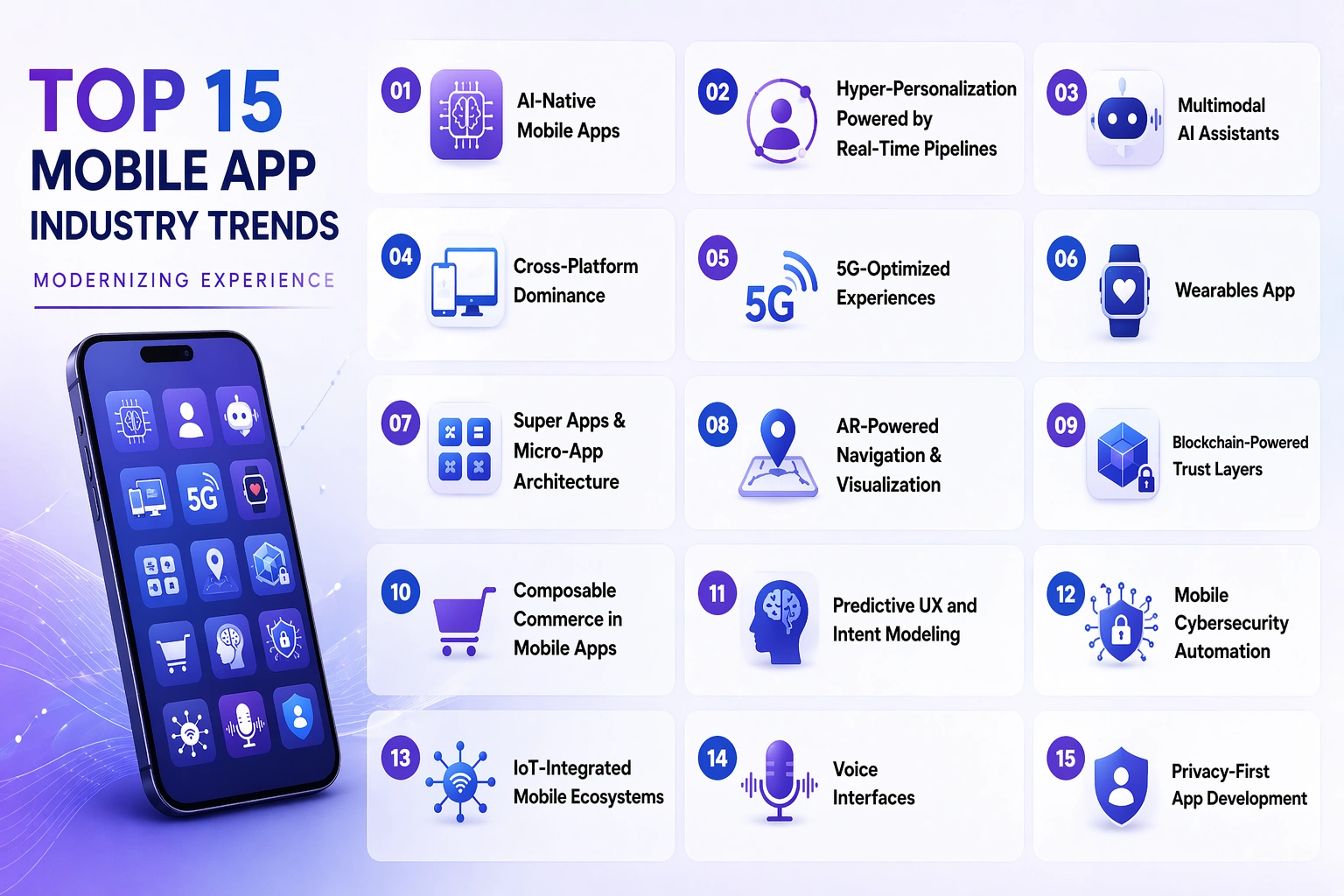
What are the Top 15 Mobile App Industry Trends Modernizing Experience?
With a clear understanding of user needs and app capabilities, it’s now important to explore the key trends shaping mobile app development. This way, you enable the pathway that changes the user perspective. Keeping that in mind, let’s take a look at those next-gen trends that are worth discussing:
1. AI-Native Mobile Apps
In recent times, the transition to AI development has drawn businesses closer to adopting it as a trend reshaping norms. For example, companies are ensuring their apps shift from “AI features” to fully AI-enabled apps, with architectures that run models both in the cloud and on devices. The reasoning is that this enables offline functionality, hyper-personalization, and task automation for workflow operations and user experience.
2. Hyper-Personalization Powered by Real-Time Pipelines
As we mentioned above, convenience is a driver of users’ choice of a particular brand. The premise is that everyone likes a personalized experience. In that case, AI-driven product recommendation and hyper-personalization are among the latest mobile app development trends, with apps now relying on real-time event pipelines, user cohorts, and AI-driven segmentation. This way, the businesses deliver dynamic screens, customized recommendations, and behavior-aware journeys to their users.
3. Multimodal AI Assistants
With the advantage of AI becoming an assistant either in terms of virtual assistance or intelligent chatbot, the next-gen apps integrate assistants that understand voice, text, images, and gestures simultaneously. Comfort enables users to take advantage of these multimodal bots for support, navigation, diagnostics, and workflow execution, unlocking rich mobile automation.
4. Cross-Platform Dominance
Not every business has the budget for two separate iOS and android app development teams, but cross-platform development is a better option in that case, as it is the best approach among mobile development trends. The frameworks like Flutter, React Native, and Kotlin deliver near-native performance while reducing development cycles by 40-50%.
5. 5G-Optimized Experiences
Among the new trends in mobile app development is the optimization towards 5G for ultra-low latency that enables cloud rendering, mobile gaming, remote monitoring, AR layers, and HD video workflows. This way, the apps are being redesigned to take advantage of higher bandwidth for richer, real-time experiences.
6. Wearables App
Keeping individuals’ well-being in mind, businesses now seamlessly choose wearable app development for RPM, fitness, productivity, payments, and safety workflows. With sensor fusion and edge AI, apps can trigger health alerts, automate routines, and provide continuous monitoring.
7. Super Apps & Micro-App Architecture
Nowadays,businesses adopt container-based micro-app systems as preferred mobile app trends, allowing multiple mini-services to exist in a single app shell. This reduces deployment overhead and supports plug-and-play service expansion.
8. AR-Powered Navigation & Visualization
Businesses are improving how users visually interact with their services by using AR/VR apps. These apps enable features like real-world overlays, indoor navigation, object scanning, virtual try-ons, and spatial search in a more accessible way. This new-age spatial ML augments accuracy for mapping, retail, real estate, and travel.
9. Blockchain-Powered Trust Layers
Trust is a factor worth implementing with the decentralized identity (DID), smart contracts, and tamper-proof logs to enhance transparency for finance, supply chain, gaming, and healthcare apps. Mobile wallets built with blockchain and on-chain credential verification are becoming the default tools and are necessary among the new trends in app development.
10. Composable Commerce in Mobile Apps
Among the many ecommerce mobile application development trends, the adoption of headless and composable architecture using MACH principles has allowed instant feature upgrades. This way, businesses have been getting omnichannel consistency across web, app, kiosk, and POS.
11. Predictive UX and Intent Modeling
With the predictive UX, apps analyze behavioral signals, scroll depth, pauses, and micro-gestures. This way, they can predict user intent for surfacing the right options at the right time, reducing friction and improving conversions.
12. Mobile Cybersecurity Automation
With cybersecurity in the focus of mobile application trends, the businesses ensure to use AI-driven threat detection, behavioral biometrics, on-device encryption, and automated policy enforcement to defend against fraud. To deter MITM attacks and data breaches, especially in fintech and government apps, this automation functionality transitions security.
13. IoT-Integrated Mobile Ecosystems
For a unified front, real-time sync, remote control, diagnostics, energy management, and predictive maintenance, IoT app development acts as a command center for next-gen environments for connected experiences.
14. Voice Interfaces
Keeping the Siri/Alexa integrations into custom domain-specific voice models for search, task automation, accessibility, hands-free workflows, and command-driven navigation, these trends in mobile app development change the experience.
15. Privacy-First App Development
Among the many trends in mobile apps, regulations like GDPR and HIPAA are on the rise, and on-device AI pushes developers toward federated learning, differential privacy, and zero-trust architectures.
While we have discussed trends for mobile app development, choosing them all together might end up becoming a hassle and turn into a debacle. However, a mobile app growth strategy aligned with the needs makes a difference.
How to Implement Mobile App Growth Strategy for Full-Funnel Optimization?
Prior to integrating any mobile app trends mentioned above into your software, we must have an in-depth knowledge of the strategies that businesses use to steer their way towards growth. Keeping that in mind, a mobile app growth strategy is a well-organized approach to how your business app acquires users, engages them, retains them, and turns them into long-term value. This may include both in terms of revenue and product evolution that drive the end results in a better flow.
For better comprehension, think of it as the blueprint for whether you’re building an AI-powered app, a fintech product, or a consumer marketplace. This well-planned growth strategy determines the speed and effectiveness of your app as it becomes a part of your users’ daily workflow.
This is exactly why modern growth strategies for mobile apps rely on machine learning app development, advanced data analytics, experience personalization, and scientifically tested monetization models.
To give a detailed idea of growth strategies, below is a deeper breakdown of the pillars that shape a modern strategy in the context of businesses.
1. Architectural Readiness
Keeping the modern mindset at the forefront, your app needs to be built on a scalable, modular, and integration-ready architecture. For a broader understanding, this includes microservices, API-first design, cloud-native development, and artificial intelligence app development.
2. Deep Data Intelligence Layer
Since the factor of growth relies on data-driven decision-making, a persistent data-powered intelligence layer that uses predictive analytics, AI segmentation, and user journey is imperative. This helps apps deliver personalized experiences, identify churn risks early, and optimize feature performance.
3. Experience Design for Retention
Among the mobile app design trends that are among the foundations, retention-focused design ensures users quickly reach value and remain engaged with the mobile app. This factor includes adaptive user interface, frictionless onboarding, micro-interactions, intelligent nudges, and personalized content flows. These elements reduce cognitive load and make the app feel intuitive and habit-forming.
In short, a strong mobile app growth strategy ensures that every stage of the user journey is intentional and optimized for impact. By aligning acquisition, engagement, retention, and monetization efforts, businesses can create seamless experiences that not only attract users but keep them coming back. When executed effectively, this approach turns your app into a sustainable growth engine, driving long-term value for both your users and your business.
What is the Future of Mobile Apps?
The future of mobile app development is shifting toward building AI-native, context-aware ecosystems, which will no longer wait for users to take action. Instead, they will predict what users need and act proactively. They are expected to be fully adaptive systems that personalize screens, automate tasks, and generate dynamic journeys based on behavioral data, location patterns, biometric signals, and historical preferences.
With mobile app development consulting, you can transform apps from static interfaces into intelligent assistants capable of reasoning, summarizing, planning, and executing workflows autonomously.
To be fair, the mobile apps are restructuring into intelligent, secure, always-connected digital ecosystems, augmenting how the enterprises engage with customers and deliver value in terms of experience.
Why Choose AppsChopper as Your Mobile App Development Company?
AppsChopper helps businesses translate emerging mobile trends into scalable, high-performing applications that drive measurable growth. We built an AI-powered urinalysis testing system, NeuCup, that leverages AI intelligence to render accessibility through remote sample testing mechanisms. This led to quicker result turnaround, reduced dependency on in-clinic visits, and more scalable diagnostic workflows. Our developers are experts in intelligent technologies such as AI, ML, IoT, blockchain, and more, enabling transformations worth investing in.
Not only that, we bring a decade of experience understanding market trends and adapting business models through our modern apps to drive measurable ROI.
Among the many trends in mobile apps, regulations like GDPR and HIPAA are on the rise, and on-device AI pushes developers toward federated learning, differential privacy, and zero-trust architectures.
While we have discussed trends for mobile app development, choosing them all together might end up becoming a hassle and turn into a debacle. However, a mobile app growth strategy aligned with the needs makes a difference.
How to Implement Mobile App Growth Strategy for Full-Funnel Optimization?
Prior to integrating any mobile app trends mentioned above into your software, we must have an in-depth knowledge of the strategies that businesses use to steer their way towards growth. Keeping that in mind, a mobile app growth strategy is a well-organized approach to how your business app acquires users, engages them, retains them, and turns them into long-term value. This may include both in terms of revenue and product evolution that drive the end results in a better flow.
For better comprehension, think of it as the blueprint for whether you’re building an AI-powered app, a fintech product, or a consumer marketplace. This well-planned growth strategy determines the speed and effectiveness of your app as it becomes a part of your users’ daily workflow.
This is exactly why modern growth strategies for mobile apps rely on machine learning app development, advanced data analytics, experience personalization, and scientifically tested monetization models.
To give a detailed idea of growth strategies, below is a deeper breakdown of the pillars that shape a modern strategy in the context of businesses.
1. Architectural Readiness
Keeping the modern mindset at the forefront, your app needs to be built on a scalable, modular, and integration-ready architecture. For a broader understanding, this includes microservices, API-first design, cloud-native development, and artificial intelligence app development.
2. Deep Data Intelligence Layer
Since the factor of growth relies on data-driven decision-making, a persistent data-powered intelligence layer that uses predictive analytics, AI segmentation, and What is the Future of Mobile Apps?user journey is imperative. This helps apps deliver personalized experiences, identify churn risks early, and optimize feature performance.
3. Experience Design for Retention
Coming to the mobile app design trends that are among the foundations, retention-focused design ensures users quickly reach value and remain engaged with the mobile app. This factor includes adaptive user interface, frictionless onboarding, micro-interactions, intelligent nudges, and personalized content flows. These elements reduce cognitive load and make the app feel intuitive and habit-forming.
In short, a strong mobile app growth strategy ensures that every stage of the user journey is intentional and optimized for impact. By aligning acquisition, engagement, retention, and monetization efforts, businesses can create seamless experiences that not only attract users but keep them coming back. When executed effectively, this approach turns your app into a sustainable growth engine, driving long-term value for both your users and your business.
What is the Future of Mobile Apps?
The future of mobile app development is shifting toward building AI-native, context-aware ecosystems, which will no longer wait for users to take action. Instead, they will predict what users need and act proactively. They are expected to be fully adaptive systems that personalize screens, automate tasks, and generate dynamic journeys based on behavioral data, location patterns, biometric signals, and historical preferences.
With mobile app development consulting, you can transform apps from static interfaces into intelligent assistants capable of reasoning, summarizing, planning, and executing workflows autonomously.
To be fair, the mobile apps are restructuring into intelligent, secure, always-connected digital ecosystems, augmenting how the enterprises engage with customers and deliver value in terms of experience.
Why Choose AppsChopper as Your Mobile App Development Company?
AppsChopper helps businesses translate emerging mobile trends into scalable, high-performing applications that drive measurable growth. We built an AI-powered urinalysis testing system, NeuCup, that leverages AI intelligence to render accessibility through remote sample testing mechanisms. This led to quicker result turnaround, reduced dependency on in-clinic visits, and more scalable diagnostic workflows. Our developers are experts in intelligent technologies such as AI, ML, IoT, blockchain, and more, enabling transformations worth investing in.
Not only that, we bring a decade of experience understanding market trends and adapting business models through our modern apps to drive measurable ROI.