Table of Contents
The healthcare industry is undergoing a massive shift, and at the heart of this transformation lies the Internet of Things (IoT). Smart sensors, connected devices, wearables, and healthcare IoT platforms are enabling hospitals and care providers to work with real-time insights, automate critical workflows, and deliver a patient-first experience like never before.
From remote monitoring that keeps patients safer at home to fully connected ICUs that empower doctors with instant data, IoT is the backbone of the smart, unified healthcare ecosystem of the future.
Let’s explore how IoT in healthcare is modernizing the industry, its benefits, key challenges, and why choosing the right IoT development partner matters.
What is IoT in Healthcare?
IoT in healthcare, often referred to as the Internet of Medical Things (IoMT), is a network of connected medical devices, sensors, wearables, hospital equipment, and software platforms that collect, share, and analyze real-time health data.
These devices communicate through secure internet protocols, enabling:
- Continuous patient monitoring
- Smart medication management
- Remote diagnostics
- Predictive analytics
- Automated workflows
- Data-driven decision-making
In simpler terms, IoT allows hospitals, clinics, and doctors to stay connected with patients at all times, whether at a hospital bed or hundreds of miles away.
What are the IoT Use Cases in Healthcare That Can Ensure a Unified Ecosystem?
As healthcare continues shifting toward smarter, more integrated systems, IoT stands at the center of this transformation. What truly makes IoT powerful is its ability to unify disconnected processes, linking patients, caregivers, healthcare IoT devices, and hospital operations into one seamless ecosystem. Below are some of the most promising IoT use cases in healthcare that help organizations break silos and create a continuous flow of information across the care journey.
Remote Patient Monitoring
RPM-focused IoT healthcare devices track vital signs like heart rate, glucose levels, and oxygen saturation in real time. This ensures that patient data flows directly to clinicians, enabling proactive care. It not only reduces hospital visits but also keeps patients continuously connected within the broader care ecosystem.
Smart Hospital Asset Tracking
From wheelchairs to infusion pumps, hospitals often lose precious time locating critical equipment. IoT applications in healthcare for asset tracking use RFID and Bluetooth beacons to pinpoint devices instantly. This helps hospitals maintain operational harmony while ensuring that staff spend more time on patient care and less time searching for equipment.
Connected ICU and Intelligent Bed Management
ICUs rely on continuous, high-accuracy monitoring. Healthcare IoT software integrates ventilators, monitors, and beds into a unified dashboard, allowing clinicians to manage multiple patients efficiently. Intelligent bed management ensures timely bed allocation, reduced wait times, and smoother patient flow across departments.
IoT-Enabled Medication Management
Smart pill bottles and automated dispensers ensure patients take their medications on time while relaying data to healthcare providers. This strengthens treatment adherence and provides clinicians with insights into patient behavior, an essential step toward building an integrated care plan.
IoT in Hospital Beds
These IoT-powered beds can monitor patient posture, weight, movement, and vitals. They assist nurses by generating alerts for fall risks or immobility, helping maintain patient safety. When connected to central systems, they become part of a coordinated care network that improves outcomes and reduces workload.
Telemedicine Powered by IoT
IoT solutions for healthcare elevate telemedicine beyond video calls. Devices like remote stethoscopes, ECG monitors, and health wearables transmit data instantly during virtual consultations. This creates a bridge between in-person and virtual care, ensuring continuity and closing gaps in diagnosis.
Environmental Monitoring
IoT sensors continuously track temperature, humidity, air quality, and contamination levels across hospital spaces. This safeguards sensitive areas like operating rooms, labs, and pharmacy storage, maintaining regulatory compliance while supporting a cleaner, safer environment.
Workflow Automation
Automate everyday tasks, from patient check-ins to predictive maintenance of equipment with IoT in medical field. By reducing manual intervention, hospitals achieve a smoother workflow where information moves freely, and staff can focus on what matters most: patient care.
What are the Benefits of IoT in Healthcare?
The true value of IoT in healthcare goes far beyond connecting devices, but is about creating a smarter, more responsive ecosystem that empowers both patients and providers. When sensors, wearables, medical equipment, and hospital systems share data seamlessly, healthcare shifts from being reactive to proactive. Suddenly, clinicians are no longer waiting for symptoms to escalate; they’re equipped with continuous real-time insights that help them intervene earlier, diagnose faster, and personalize treatments with unprecedented precision.
IoT doesn’t just enhance care delivery. It redesigns the way healthcare systems think, operate, and respond. Below is the impact of IoT in healthcare that highlights why IoT is rapidly becoming indispensable in today’s healthcare landscape.
| Benefit | Description |
| Real-Time Monitoring & Faster Diagnosis | Continuous data from wearables and sensors enables early detection of health issues and timely intervention. |
| Improved Patient Experience & Personalized Care | IoT devices track individual health patterns, helping providers deliver tailored treatments |
| Reduced Hospital Readmissions | Remote monitoring helps manage chronic diseases at home, preventing unnecessary hospital visits. |
| Enhanced Operational Efficiency | IoT automates workflows, optimizes staff allocation, and reduces manual documentation. |
| Smart Healthcare in IoT Asset Tracking | Hospitals can monitor medical equipment, reduce loss, and ensure timely maintenance. |
| Reduced Healthcare Costs | Early intervention, remote care, and optimized resource usage lower overall treatment expenses. |
| Enhanced Patient Safety | Smart alarms, fall-detection systems, and connected emergency devices improve rapid response. |
| Telemedicine Enablement | Live vitals during teleconsultations improve remote diagnosis and continuity of care. |
Next-Gen IoT Trends in Healthcare That You Should Rely on
As IoT continues to evolve, healthcare is entering a phase where connected systems don’t just collect data but interpret, predict, and act on it. The next generation of IoT devices in healthcare is all about intelligence, automation, and interoperability. These innovations are redefining how care is delivered both inside hospitals and across remote environments, ensuring that patients receive continuous, data-driven support wherever they are.
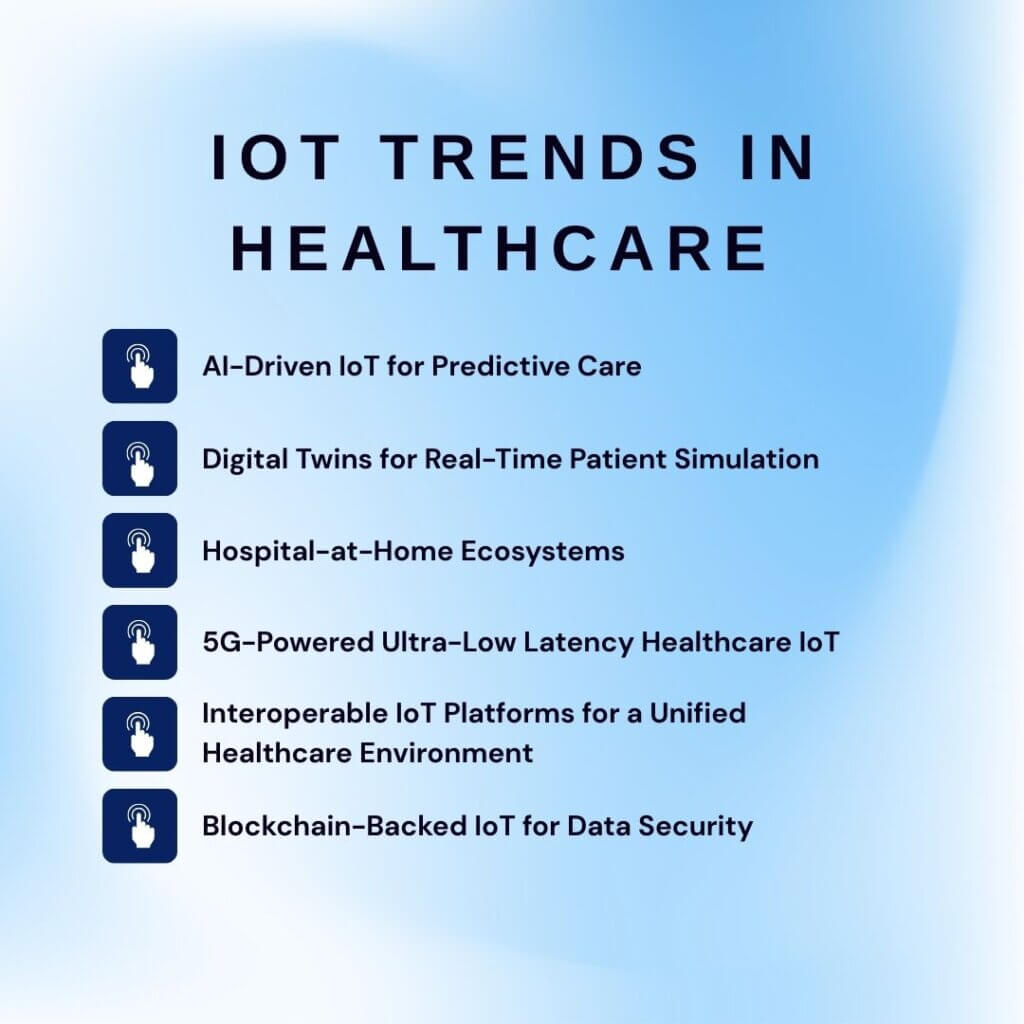 Below are the emerging IoT trends that are shaping the future of smart, connected healthcare ecosystems.
AI-Driven IoT for Predictive Care
AI and IoT in healthcare industry transform raw sensor data into actionable insights. Instead of waiting for medical issues to worsen, predictive algorithms analyze historical patterns, vital signs, and behavioral trends to forecast risks like heart failure, respiratory distress, or glucose spikes. This empowers clinicians to intervene early, long before symptoms escalate.
Digital Twins for Real-Time Patient Simulation
Combining IoT in medical and healthcare industry with Digital twins, virtual replicas of patients and organs, allows doctors to simulate treatments, predict outcomes, and personalize care strategies. When paired with IoT devices that stream real-time physiological data, these digital models evolve dynamically. They help practitioners test scenarios safely, optimize surgeries, and enhance chronic disease management with greater precision.
Hospital-at-Home Ecosystems
IoT is enabling a shift from hospital-centric to home-centric care without compromising clinical oversight. Through remote vitals monitoring, connected infusion pumps, smart wearables, and AI triage systems, patients can receive round-the-clock care from the comfort of home. This reduces hospital congestion, cuts costs, and improves patient satisfaction, while ensuring continuous physician visibility.
5G-Powered Ultra-Low Latency Healthcare IoT
The introduction of 5G brings massive bandwidth and near-zero latency, unlocking use cases that weren’t feasible before. Real-time telemedicine, remote robotic surgeries, continuous video-based patient monitoring, and high-speed medical imaging data transfers become seamless. For mission-critical IoT application development with emergency response and ICU monitoring features, 5G ensures reliability and speed.
Interoperable IoT Platforms for a Unified Healthcare Environment
One of the biggest challenges in healthcare has been system fragmentation, devices and software that don’t communicate with each other. Modern IoT platforms now support interoperability standards like FHIR, HL7, and MQTT, allowing hospitals to unify data across departments, devices, and EMRs. This results in a cohesive ecosystem where care teams have a single source of truth.
Blockchain-Backed IoT for Data Security
With billions of medical data points flowing through IoT devices, security becomes non-negotiable. Blockchain adds a decentralized, tamper-proof layer of protection. Every transaction, whether a vital sign reading or a medication alert, is encrypted and stored across distributed nodes, reducing the risk of breaches, manipulation, or unauthorized access. It also strengthens patient consent management and auditability.
What are the Challenges of IoT in Healthcare and How to Solve Them?
As powerful as the Internet of Things in healthcare is, integrating it into industry comes with real challenges. Hospitals must manage huge volumes of sensor data, ensure airtight security, and connect modern IoT systems with older, fragmented infrastructure, all while maintaining clinical accuracy and staying compliant with strict regulations. Even small device errors or connectivity issues can affect patient safety, making reliability essential.
The good news is that these challenges can be effectively addressed with the right mix of technology and the Internet of Things in healthcare applications. Advancements in edge computing, 5G connectivity, interoperability standards, and secure device management are helping healthcare organizations build stronger, smarter, and more resilient IoT ecosystems.
Let’s take a closer look at the key challenges and how to solve them.
| Challenge | IoT Healthcare Solutions |
| Data Security & Privacy | Use encryption, secure authentication, and compliance standards (HIPAA/GDPR). |
| Interoperability Issues | Adopt standardized protocols like FHIR/HL7 and interoperable IoT platforms. |
| High Data Volume | Use cloud storage, edge computing, and AI-based data processing. |
| Network Reliability | Deploy 5G, backup networks, and low-latency communication methods. |
| Device Management | Use centralized platforms for monitoring, updates, and remote management. |
| Battery & Hardware Limits | Build energy-efficient devices and use optimized power consumption methods. |
| Sensor Accuracy Issues | Use medical-grade sensors and regular calibration. |
| Regulatory Barriers | Align with healthcare compliance requirements from the design phase. |
Future of IoT in Healthcare
The future of healthcare is being built on a foundation of intelligent, interconnected systems, and IoT sits at the very center of this transformation. As sensors become more sophisticated, networks get faster, and IoT and AI in healthcare become more intuitive, evolving from simple data collection to real-time decision-making and autonomous care delivery. We’re moving toward a healthcare model where continuous monitoring, predictive diagnostics, and remote treatment aren’t exceptions but are the standard.
In the coming years, IoT will enable hospitals to operate more like intelligent ecosystems, where every device, bed, system, and patient touchpoint is seamlessly connected. Patients will receive more personalized care, clinicians will rely on real-time insights rather than periodic checkups, and homes will function as extensions of hospital infrastructure. Add innovations like 5G, digital twins, and AI-driven automation, and the possibilities become even more transformative.
In short, IoT is not just shaping the future of healthcare but redefining it. And the advancements coming next promise to make care more proactive, efficient, and accessible than ever before.
Why Choose AppsChopper as Your Trusted IoT App Development Company for the Healthcare Industry?
Building IoT solutions in healthcare requires more than just technical expertise, but demands a deep understanding of medical workflows, compliance frameworks, data security, device interoperability, and real-world user challenges. This is exactly where AppsChopper stands out.
At AppsChopper, a pioneer among the trusted IoT healthcare app development companies, we combine IoT innovation with healthcare precision. Our team specializes in secure, scalable, and compliant IoT healthcare application development to integrate seamlessly with wearables, medical devices, hospital systems, and cloud platforms. Whether it’s remote patient monitoring, smart hospital automation, AI-powered predictive care, or custom IoMT ecosystems, we engineer solutions designed to perform reliably in high-stakes clinical environments.
We don’t just build apps, but build connected healthcare ecosystems. From choosing the right sensors and optimizing data flow to ensuring interoperability with standards like FHIR/HL7, our approach focuses on end-to-end functionality. Every solution is designed with HIPAA-compliant architectures, strong encryption, and real-time analytics, ensuring that providers can deliver better care while keeping patient data protected.
What truly sets AppsChopper apart is our ability to tailor IoT solutions to the unique needs of healthcare organizations. Whether you’re a hospital, a medical device manufacturer, a wellness brand, or a digital health startup, we create applications of IoT in healthcare that enhance patient outcomes, streamline operations, and scale effortlessly with future advancements like AI, 5G, and digital twins.
If you’re looking to build future-ready, compliant, and clinically reliable IoT apps for healthcare, AppsChopper is the development partner you can trust.
Frequently Asked Questions
1. What industries benefit the most from IoT healthcare solutions?
Hospitals, telemedicine providers, medical device companies, and pharma benefit most through better monitoring, automation, and patient care.
2. What standards and regulations apply to the application of IoT in healthcare?
Solutions must follow HIPAA, GDPR, FDA, ISO 13485, and interoperability standards like HL7/FHIR, all of which we build into our development process.
3. What technologies are most commonly used in healthcare IoT software?
Wearable sensors, BLE, Wi-Fi/5G, cloud, edge computing, AI/ML, and secure APIs are technologies we use to build scalable IoMT systems.
4. What is the ROI of adopting IoT in the medical field?
Lower operational costs, fewer readmissions, improved asset utilization, and better patient outcomes. Our solutions are designed to maximize these gains.
5. What are the ongoing maintenance requirements for IoT in healthcare projects?
We handle regular device monitoring, firmware updates, security patches, and cloud optimization to ensure sustained performance.
6. What is the impact of IoT in healthcare?
It enables smarter care delivery, real-time insights, automation, and improved patient safety. We help organizations unlock these benefits.