Table of Contents
Are you looking to develop a feature-packed iOS app backed by the latest trends? This is the right post for you. This blog lists the top iOS app design and development trends you should look forward to in 2026 and develop an intuitive app for your business to thrive.
Apple is ever-ready for future technology. With a 27.48% market share, iOS continues to thrive in the market.
With each passing year, the new vogue comes and goes. The iOS mobile app development industry is continuously evolving at a breakneck pace, and it’s not going to stop soon. Having said that, app development companies that stay up to date with ever-changing trends in iOS app design and development are in high demand, as they help businesses deliver “beat-the-competition” apps.
And it’s no rocket science to understand that every business today (irrespective of size and niche) wants to stay ahead and win over a competitive advantage over others, along with generating better ROI.
For that reason, they’re looking for the ideal iOS app development trends, process, and are going with reliable mobile app development services, as it is considered a revenue-driven investment.
However, with the advent of technology, competition has also surged. This is why, when starting off with iOS app development, it’s crucial to stay abreast of the latest happenings in the world of iOS development. iOS developers should stay up to date with the latest iOS app design and development trends that will rule in 2026.
Why Choose iOS App Development for Your Business?
Apple has 124.7 million iPhone users, and this is likely to grow in the coming years. Consequently, business owners are placing greater emphasis on developing iOS-based mobile applications to expand their businesses and reach a broader audience. This is where you have a chance to develop a scalable iOS mobile application and increase brand awareness.
Selecting the iOS platform for your app can help build a brand name thanks to its unparalleled user experience. Of greatest importance, the mobile app development cost is reduced on the iOS platform.
The relentless adoption of iOS state-of-the-art technologies can prompt several business owners to seek the services of a well-experienced iOS app development company to develop a result-oriented application for their business.
The extensive range of iOS advantages, such as quality standards, a defined customer base, a technology-oriented audience, and impeccable user experience, is sufficient to demonstrate that it is gaining popularity. Right?
Nonetheless, the competitive world is what you should excel in: iOS app development, which will help drive impressive business growth.
The iOS App Development Technology Stack at a Glance
Modern iOS apps are built using a layered technology stack. Understanding this architecture helps business stakeholders make informed decisions about feature scope, timelines, and technology investments.
| Layer | Technologies | Purpose |
|---|---|---|
| UI Layer | SwiftUI, UIKit | User interface rendering and interaction |
| Business Logic | Swift (5.x+), Objective-C | Core app functionality and data processing |
| Data & Storage | Core Data, CloudKit, SQLite | Local and cloud data management |
| AI/ML | Core ML, Create ML, Vision, NLP | Intelligent features and automation powered by Artificial Intelligence Development and advanced ML Solutions. |
| AR & Spatial | ARKit, RealityKit, SceneKit | Immersive augmented reality experiences |
| Connectivity | HomeKit, HealthKit, WatchKit, CoreBluetooth | IoT, wearable, and smart device integration |
| Payments | Apple Pay, StoreKit | Secure in-app and point-of-sale transactions |
| Security | ATS, Keychain, Face ID, Touch ID | Data encryption and user authentication |
To stay competitive, businesses must understand the latest trends in app development and how they impact user experience and scalability.
Core iOS App Development Trends
The trends continuously evolve with technological advancements, and app companies use these improvements to develop highly functional apps and provide users with world-changing experiences.
In this case, we present some of the most potent and outstanding trends in designing apps for iOS that will be on the horizon in 2026.
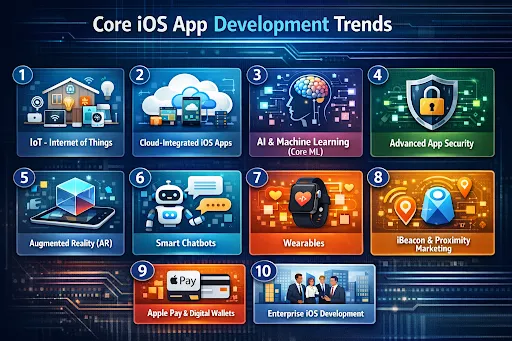
Trend 1: Internet of Things (IoT)
The Internet of Things (IoT) is a prominent trend in iOS app development that enables users to connect multiple devices and transfer data. According to Statista, the IoT market revenue will reach $1.6 trillion by 2025. As a result, this technology is becoming increasingly significant for app developers globally.
Users can easily connect their Apple devices to wearables, such as the Apple Watch, for a smooth user experience. The Healthcare industry is leveraging the features of IoT, where healthcare providers can check their patients’ conditions.
IoT apps have a lot of scope and are expected to grow exponentially. It has become the driving factor in advancing IoT and iOS mobile app development.
Trend 2: Cloud-Integrated iOS Apps
Cloud technology is another iOS app development trend for 2026 and is becoming more popular. These apps assist with organizing and storing a large amount of information online. The cloudkit originally developed by Apple, is a direct interface between iCloud and iOS applications. It supports:
- Public and Private Databases: Developers are able to save personal and common data, which can be shared with all others using the iCloud infrastructure of Apple.
- Real-Time Sync: The changes in the data are synced in real time across the user’s Apple devices, including iPhone, iPad, Mac, and Apple Watch.
- Server-Side Push Notifications: Send push notifications manually using CloudKit when data is updated without any custom backend server.
Beyond CloudKit, iOS apps commonly integrate with third-party cloud platforms:
| Cloud Platform | Common Use Cases | Key Benefit |
|---|---|---|
| AWS (Amplify) | Backend APIs, real-time data, analytics | Mature ecosystem, extensive services |
| Google Firebase | Real-time database, authentication, push notifications | Rapid prototyping, generous free tier |
| Microsoft Azure | Enterprise apps, Active Directory integration | Strong enterprise compliance and support |
| Apple CloudKit | iCloud sync, Apple Watch data, cross-device state | Zero backend cost up to generous limits; native iOS integration |
Trend 3: Artificial Intelligence and Machine Learning (Core ML)
Artificial intelligence and machine learning solutions are the main reasons behind business process automation and decision-making algorithms. AI and ML analyze customers’ behavior and interactions and offer similar content.
According to Business Wire, AI technology will generate nearly $98 billion in 2026. AI and ML app development will surely dominate the iOS app design and development trends in the coming year.
For instance, social media platforms like Facebook or Instagram show relevant data to users based on their preferences or requirements. AI-based apps analyze user behavior by checking their buying patterns or history, the type of content they are consuming, and more. This is one of the key factors behind the rise of trending iOS apps in today’s market.
Apple has an advanced version of the Machine Learning framework called Core ML 3. This tool has various features, like computer vision, speech recognition, and more.
Trend 4: Advanced App Security ATS and Beyond
We all know Apple is safer than other OS and has unmatched security algorithms. It is known for uncompromising policies that don’t let anyone breach, but then it also emphasizes improving overall security from data breaches.
App developers can integrate App Transport Security (ATS) into mobile applications for top-notch security. With the help of ATS integration, privacy and data integrity between iOS applications and web browsers increase.
Trend 5: Augmented Reality (AR) and ARKit
These days, AR and VR development has become crucial for all developers. However, for iOS developers, the focus has shifted slightly to ARKit with the release of iOS 11 in 2017.
ARKit enables developers to create 3D and augmented reality experiences, and delivering these immersive experiences effectively depends on strong mobile app design, including intuitive navigation, responsive interactions, and optimized performance.
Amazon has collaborated with Apple to take ARKit innovation to the next level. With help from Amazon, Apple ARKit will be more prominent for users now.
In the past few years, we observed how augmented reality enhanced the user experience in gaming applications like Pokémon Go. Besides that, the integration of AR is becoming prominent in the retail, healthcare, and eCommerce industry.
For instance, IKEA delivers an excellent user experience, allowing customers to try out furniture at their store on a mobile screen to make better decisions.
Trend 6: Conversational AI and Smart Chatbots
Modern customers want 24/7, quick, and precise customer service, which human teams often cannot deliver. iOS apps embedded with conversational AI and chatbots provide automated support that responds to questions and assists users in completing tasks in real time. This is made possible through advanced AI chatbot development.
Contemporary AI chatbots rely on NLU to interpret user messages and maintain conversation context, enabling them to complete multi-step processes such as appointment booking or returns.
iOS chatbots also support text, voice, and image inputs, enabling more engaging experiences.
Chatbots can provide more realistic conversations with generative AI. They are used in many industries today, including ordering, banking services, healthcare advice, and eCommerce product recommendations.
As an example, Starbucks has a Chatbot with which people can refer to what they want to order, along with other details about coffee. Mega corporations such as Amazon and Facebook have chatbots that provide a pleasant user experience by quickly responding to user inquiries.
Trend 7: Wearables
In today’s era, wearable apps have greatly benefited the fitness and healthcare industries. Wearable devices are gaining huge popularity due to their optimal convenience.
The global end-user spending on wearable devices was $62.11 billion in 2021 and is expected to increase in the coming years. Considering the stat, wearable development is sure to be one of the most profitable iOS app development trends to look out for in 2026 and beyond.
Wearable devices like fitness trackers or smartwatches are skyrocketing because of their convenience. Some of the most common features for wearables are health data collection, real-time notifications, social media integration, and more.
Trend 8: iBeacon and Proximity-Based Marketing
iBeacon is a powerful Apple technology that enables location-based interactions. While widely used in marketing, it’s also influencing iOS app design trends for 2026.
A beacon is a wireless transmitter that sends signals via Bluetooth. A push notification with messages appears on the user’s iPhone as an example of this technology.
Integrating iBeacon technology is another prominent trend in iOS app development, helping businesses boost sales. This technology sends targeted messages to users, such as coupons, exciting offers, and upcoming sales.
Overall, this technology is excellent as a marketing tool, and apps built on iBeacon technology will become prominent in the coming year.
Trend 9: Apple Pay and Digital Wallet Integration
The evolution of Apple Pay witnessed a huge furor among users seeking a reliable digital payment option. As a trustworthy online wallet, Apple Pay lets users make quick, easy transfers for movie tickets, online shopping, and more through a reliable, secure platform. Apple witnessed surging transaction figures through its app, tantalizing the senses of millions of small businesses that accept invoices using Apple Pay.
Apple Pay gives small businesses the flexibility to easily manage their entire payments on a single screen, minimizing time and effort and improving cash flow management
Comparing iOS Development Trends: Business Impact Table
The table below provides a quick reference for business stakeholders evaluating which iOS trends to prioritize for their product roadmap.
| Trend | Primary Benefit | Industries | Complexity | Business Priority |
|---|---|---|---|---|
| AR / ARKit | Immersive UX, product visualization | Retail, Healthcare, Education, Real Estate | High | High for visual industries |
| AI / Core ML | Personalization, automation, intelligence | All industries | Medium-High | Very High table stakes |
| IoT / Wearables | Device connectivity, real-time data | Healthcare, Fitness, Industrial | Medium | High for hardware businesses |
| Cloud Integration | Cross-device sync, scalability | All industries | Medium | High foundational |
| App Security (ATS) | Data protection, compliance | Finance, Healthcare, Enterprise | Low-Medium | Critical non-negotiable |
| AI Chatbots | 24/7 support, engagement | eCommerce, Banking, Healthcare | Medium | High for customer-facing apps |
| Apple Pay | Friction-free payments | eCommerce, Hospitality, Retail | Low | Very High for commerce apps |
| Swift (Modern) | Performance, maintainability | All industries | Low (for new apps) | High quality baseline |
| HomeKit | Smart environment control | Hospitality, PropTech, Healthcare | Medium | High for physical spaces |
| iBeacon | Proximity marketing | Retail, Events, Hospitality | Low-Medium | Medium-High for physical retail |
How to Choose the Right iOS Trends for Your App?
iOS trends do not apply to every app. Business owners most often make the mistake of trying to do everything new at once, which leads to scope creep, delayed releases, and scope dilution. The appropriate solution is strategic prioritization.
Following is a structural framework that will help you to pinpoint which trends are in tandem with what you want to achieve with your products:
Define Your Core User Problem.
Begin with the issue that your app addresses. All technologies must be used to serve that issue, rather than vice versa.
Identify Your Industry-Specific Opportunities.
Consider the columns of the industry in the above comparison table. Trends that align with industry use cases have a lower risk of implementation.
Assess Your Users’ Device Habits
ARKit native experiences require newer devices. iBeacon works only on Bluetooth-enabled devices, and HomeKit depends on hardware within the Apple ecosystem. Be sure to know your audience’s device profile before committing to a technology.
Prioritize by Business Impact
Rank by how directly they relate to your important business metrics: user acquisition, retention, conversion, or operational efficiency.
Sequence Your Roadmap
Start with a narrow MVP that consists of trends that make up your core value proposition. Introduce additional features in later releases based on user feedback and data.
Partner With Specialists
Enterprise MDM integration, ARKit, and training of Core ML models are some of the trends that have specific knowledge requirements. Select a development partner that has a track record in the fields that you need.
Why Choose AppsChopper for iOS App Development?
We are iOS app designers and developers at AppsChopper, providing solutions for the retail, healthcare, fintech, logistics, education, and enterprise markets. Our priorities are developing applications that address the real issues businesses face, and the apps must have a smooth user interface.
Our team comprises certified iOS engineers who have expertise in Swift, ARKit, Core ML, CloudKit, HomeKit, WatchKit, and enterprise iOS architecture. We also have UI/UX designers who adhere to Apple Human Interface Guidelines, business consultants, QA engineers to perform extensive testing, and post-launch support, and new features.
We follow a structured iOS development process. First, we dive into discovery and strategy, understanding your goals, user needs, competition, and technical requirements. Then we design UX architecture, wireframes, and a high-fidelity iOS-native UI that aligns with your brand.
Using agile development, we build in two-week sprints with regular demos for full transparency. We handle QA testing across all Apple devices, manage App Store submission, and continue supporting growth through analytics, feedback, and roadmap planning.
Conclusion
iOS app development in 2026 is defined by convergence: AI intelligence meets immersive AR, and Apple’s maturing Swift ecosystem makes all of it faster to build and safer to ship than ever before.
The trends covered in this guide, AR/ARKit, AI/Core ML, IoT and wearables, cloud integration, advanced security, conversational AI, Apple Pay, Swift, HomeKit, iBeacon, and Enterprise Development, are not isolated features. They are interconnected capabilities that combine to create iOS apps that are genuinely transformative for users and measurably impactful for businesses.
The businesses that win in mobile are those that identify which of these trends align with their core user problems, invest in the right expertise to implement them correctly, and commit to iterative improvement based on real user data. iOS gives you the platform, the tools, and the audience. The opportunity to build something remarkable is there.
If you’re unsure where to begin, with our expert mobile app consulting services, we can help you align the right trends with your business goals.
When you’re ready to turn these trends into a concrete product strategy, the AppsChopper team is prepared to partner with you, from the initial concept to a live App Store app and beyond.
FAQs
Q1: What is the most important iOS app development trend for businesses in 2026?
AI/ML integration via Core ML and advanced security, like ATS and biometric authentication are crucial for most apps. Commerce apps benefit from Apple Pay, while ARKit or iBeacon boost physical-space experiences.
Q2: How long does it take to build an iOS app with AR or AI features?
A single-feature app, like AR or ML, typically takes 3–6 months. Complex apps combining multiple features, such as Core ML, cloud sync, and HomeKit, may require 6–12 months. MVP approaches can significantly reduce time to market.
Q3: Is Swift better than Objective-C for new iOS apps?
Yes. Swift is faster, safer, and fully supported by Apple. It powers all modern frameworks like SwiftUI and Swift Concurrency. Objective-C is mainly for legacy maintenance. New apps in 2026 should use Swift exclusively.
Q4: How does Apple’s Core ML protect user privacy compared to cloud-based AI?
Core ML runs AI models on-device, keeping all input data local. Unlike cloud-based AI, user information isn’t sent to external servers, making it ideal for privacy-conscious users and regulated industries like healthcare or finance.
Q5: What is the difference between ARKit and RealityKit?
ARKit handles environment tracking, plane detection, image recognition, and face tracking. RealityKit renders and animates 3D content in AR, applying lighting, shadows, and physics. Most apps use both frameworks together for AR experiences.
Q6: Can small businesses afford to integrate these iOS development trends?
Yes. Apple Pay, Swift, CloudKit, and ATS security add minimal cost when included early. Advanced features like ARKit or custom Core ML require more investment but offer higher user value and competitive advantage.