Table of Contents
Ecommerce has always been shaped by customer expectations, but in 2026, those expectations are higher than ever. Shoppers want instant answers, personalized product recommendations, seamless support across channels, and zero friction during checkout. When these expectations are not met, they don’t wait, but they leave.
Recent research shows that up to 80% of ecommerce businesses already use or plan to use AI chatbots, underscoring how quickly conversational AI has become mainstream in online retail.
This shift in behavior is one of the biggest reasons why AI chatbots for ecommerce have moved from being a “nice-to-have” to a business-critical capability. What started as simple rule-based pop-ups has evolved into intelligent conversational systems capable of guiding purchases, resolving issues, and supporting customers across the entire lifecycle.
In this guide, we’ll explore what AI chatbots for ecommerce really are, how they work, where they add the most value, and what businesses need to consider before implementing one. Whether you’re evaluating chatbots for the first time or looking to scale an existing solution with AI chatbot development services, this article is designed to help you make informed, future-ready decisions.
What Is an AI Chatbot for Ecommerce?
An AI chatbot for ecommerce is a conversational interface powered by artificial intelligence that interacts with shoppers in real time. Unlike traditional rule-based bots that follow predefined scripts, modern ecommerce chatbots understand intent, learn from interactions, and respond dynamically based on context.
From Rule-Based Bots to Intelligent Assistants
Early ecommerce chatbots relied on decision trees. For instance, if a customer clicked option A, they were shown response A. While useful for basic FAQs, these bots struggled with complex or unexpected queries.
In contrast, AI-powered chatbots in 2026 leverage:
- Natural Language Processing (NLP) to understand how customers phrase questions
- Machine Learning (ML) to improve responses over time
- Large Language Models (LLMs) to generate human-like, context-aware replies
As a result, today’s AI-powered chatbot for ecommerce functions as a hybrid sales assistant, customer support agent, and product expert, capable of assisting users before, during, and after a purchase.
Why Ecommerce Businesses Are Actively Searching for AI Chatbots in 2026?
The growing interest in retail AI chatbots is not driven by trends but by pressure. Businesses are facing new realities every day, and chatbots have moved from being a curiosity to a necessity.
Rising Customer Expectations
Shoppers expect instant responses regardless of time zones or business hours. Delays of even a few minutes during checkout can lead to abandoned carts. Beyond speed, customers now demand relevant and personalized guidance. They want to feel like the brand understands their needs without them explaining everything.
Increasing Support Costs
As ecommerce scales, so does customer support volume. Hiring and training large support teams is expensive, especially during seasonal spikes. Businesses realize that every unanswered query represents a potential lost sale and frustrated customer. An AI chatbot for retail offers a scalable way to handle routine questions while freeing human agents to focus on complex issues.
Omnichannel Shopping Behavior
Customers move fluidly between websites, mobile apps, WhatsApp, Instagram, and email. They expect conversations to continue seamlessly across these touchpoints. Imagine a shopper asking a question on Instagram and expecting an answer when they revisit the website later. The expectation for continuity is higher than ever.
Demand for Personalization at Scale
Personalized experiences drive conversions, but delivering them manually is impossible at scale. AI chatbots bridge this gap by using behavioral and transactional data in real time. They can suggest products based on browsing history, recommend add-ons, or even predict when a customer might need replenishment, all while maintaining a natural conversational tone.
Reducing Friction Across the Journey
Ecommerce businesses are recognizing that small points of friction, delays in response, unclear product details, or complicated return processes can drastically affect conversion and retention. Chatbots help remove these; the AI impact on ecommerce creates a smoother, more satisfying shopping journey.
Building Loyalty Through Engagement
Beyond immediate sales, AI chatbots help build longer-term loyalty. By providing consistent support, personalized recommendations, and proactive engagement, they turn occasional shoppers into repeat customers who feel valued and understood.
For many ecommerce brands, AI chatbots are emerging as a practical solution to manage growth without compromising customer experience. They are becoming the connective tissue that holds modern ecommerce experiences together.
How AI Chatbots Work in an Ecommerce Ecosystem?
Understanding how a chatbot in ecommerce functions behind the scenes is crucial for teams. It helps set realistic expectations, ensures smooth implementation, and builds trust that these bots can genuinely enhance customer experience.
AI chatbots are sophisticated systems that combine language understanding, data access, and automated action. Let’s explore how this works in a way that reflects a natural conversation between a shopper and a virtual assistant.
Step-by-Step Workflow
There is a flow that AI chatbots follow to offer services:
Intent Detection
The chatbot listens to what the customer is saying and interprets the meaning.
For example, when a shopper asks, “Do you have this in size M?” the bot identifies a product inquiry intent rather than a general question.
This contextual understanding is critical to providing useful responses.
Data Retrieval
Once intent is clear, the chatbot pulls information from relevant systems, product catalogs, inventory databases, CRM tools, or order management systems.
It’s like the bot has instant access to the brand’s knowledge base, ready to fetch the right answer.
Response Generation
Using generative AI ecommerce models, the chatbot crafts a conversational, human-like response.
Instead of rigid pre-set messages, it can generate tailored replies that match the customer’s tone and intent, making interactions feel personal and helpful.
Action Execution
The chatbot doesn’t just talk, but acts. It can update order statuses, initiate refunds, provide tracking links, or recommend alternative products, turning conversation into tangible outcomes that enhance the shopping experience.
A Chatbot Ecommerce Example
Imagine a customer messaging: “I forgot my password and need to track my order.”
A well-designed AI chatbot can:
- Guide them through resetting the password
- Pull the order status from the database
- Provide an estimated delivery time in a single, seamless conversation without human intervention.
Common Ecommerce Integrations
AI chatbots integrate with your existing ecommerce setup, CRM, or customer support tools, without requiring technical development. This makes implementation faster and less complex, while still providing a smooth, professional experience.
Data Privacy & Compliance
Modern AI chatbots are designed with privacy in mind, following data protection regulations and ensuring sensitive customer information is handled securely. This allows businesses to confidently scale automated conversations while staying compliant.
By viewing chatbots as conversational partners rather than just automated tools, ecommerce teams can better understand their potential, limitations, and how they enhance both operations and customer satisfaction.
High-Impact Retail Chatbot Use Cases
Chatbots add value at multiple stages of the customer journey. To make this easier to understand, here’s a table with common use cases and their benefits:
| Stage | Retail Chatbot Use Cases | How Chatbots Add Value |
| Pre-Sales | Guiding product discovery and decision-making | Helps shoppers explore options, compare products, and get instant answers, reducing decision fatigue and increasing purchase likelihood |
| Checkout | Supporting checkout and reducing cart abandonment | Clarifies shipping, returns, and payment questions in real time, boosting confidence and conversion rates |
| Post-Purchase | Order updates and support | Provides delivery updates, helps with returns, and answers product questions, enhancing satisfaction and loyalty |
| Sales Growth | Upselling and cross-selling | Suggests complementary products or bundles naturally, based on past behavior, without being pushy |
| Engagement | Proactive customer engagement | Sends reminders about replenishments, sales, or loyalty programs, keeping customers engaged |
| Feedback & Insights | Collecting customer feedback | Gathers product reviews, satisfaction ratings, and service feedback to inform business decisions |
| Customer Retention | Personalized retention strategies | Offers targeted promotions or loyalty rewards to repeat customers, increasing retention and lifetime value |
AI Chatbot Benefits for Ecommerce Businesses
AI chatbots are more than automated tools, as they are strategic partners. Here’s how they add real-world value:
 Operational Efficiency
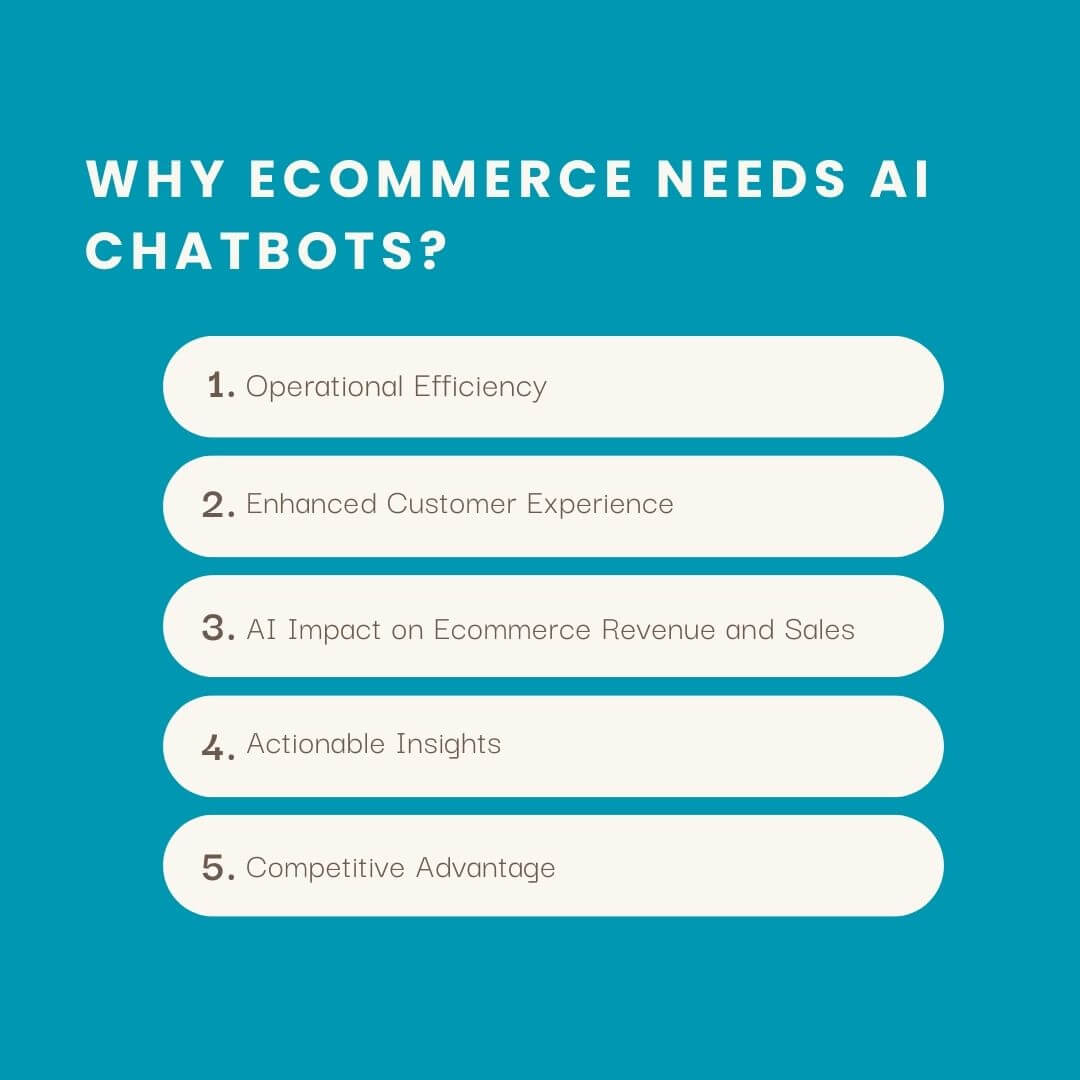
Picture your team during peak season: chats are piling up, customers are waiting. Chatbots step in, handling routine questions instantly and freeing humans for complex tasks. This reduces costs and scales effortlessly.
Enhanced Customer Experience
A shopper asking a question at 10 PM expects an immediate, helpful response. A chatbot shopping assistant provides accurate, personalized guidance at any time, making the shopping experience seamless.
AI Impact on Ecommerce Revenue and Sales
A hesitant customer at checkout can be guided to complete their purchase, or offered complementary products naturally. Over time, this boosts conversions, encourages upselling/cross-selling, and increases repeat purchases.
Actionable Insights
Every conversation generates insights. Understanding common questions, objections, and preferences helps refine products, marketing, and sales strategies.
Competitive Advantage
A brand using a chatbot in business effectively can respond faster, offer personalized support, and scale operations without extra staff, gaining an edge over competitors.
AI Chatbot Tools for Ecommerce in 2026 – What to Look For?
By the time ecommerce leaders reach this stage of their research, the question usually shifts from “Do we need an AI chatbot?” to “How do we choose the right one without overcomplicating things?”
In 2026, the best chatbot tools aren’t defined by flashy features—they’re defined by how seamlessly they fit into your existing ecommerce operations and how effectively they drive real business outcomes.
| Tool Name | Best For | Key Capabilities |
| Tidio | Small to mid‑sized ecommerce stores | Live chat + AI automation, Shopify/WooCommerce integration, abandoned cart support |
| ManyChat | Social media engagement | Messenger, Instagram, WhatsApp chatbots with sales automation and lead funnels |
| Botsify | Easy, no‑code setup | Drag‑and‑drop chatbot builder with ecommerce templates and multichannel support |
| Text.com (Chatbot.com) | End‑to‑end ecommerce support | AI‑powered chat handling FAQs, shipping, returns; integrates with backend workflows |
| Gorgias | Shopify‑centric support automation | Automated responses for order questions and customer tickets (often paired with AI rules) |
| Intercom | Scalable mid‑to‑enterprise solutions | Conversational customer support with proactive messaging, lead qualification widgets |
Key Evaluation Criteria That Actually Matter
When evaluating AI chatbot solutions, focus on these fundamentals:
1. Integration capability
A chatbot should work smoothly with your current ecommerce setup, customer support tools, and order systems. The goal is continuity that your chatbot should feel like an extension of your business, not a disconnected add-on.
2. Personalization depth
Modern shoppers expect relevance. The best chatbot for ecommerce should tailor conversations based on browsing behavior, purchase history, and context, without requiring manual configuration or complex workflows.
3. Analytics & insights
Every conversation is data. Strong chatbot tools help you understand customer intent, common objections, drop-off points, and conversion opportunities, turning conversations into actionable insights, not just replies.
Types of AI Chatbots in the Market
Ecommerce chatbot development focuses on three broad categories:
1. SaaS-based chatbot platforms
These are ready-to-use solutions designed for quick deployment. They’re ideal for businesses looking to launch fast, scale easily, and avoid technical complexity.
2. Custom-built chatbot solutions
Best suited for brands with highly specific customer journeys or advanced personalization needs. These offer greater flexibility but require more planning and ongoing optimization.
3. Platform-native chatbot tools
Often built into ecommerce platforms or support systems, these tools are convenient but may have limitations in customization and long-term scalability.
A Practical Way to Decide
Rather than choosing based on buzzwords, ask a simpler question:
Will this ecommerce AI chatbot help my customers get answers faster, buy with confidence, and come back again, without adding operational friction?
The right tool is the one that supports growth while keeping the experience human, helpful, and consistent.
Challenges and Limitations of AI Chatbots for Ecommerce and How to Solve Them?
As powerful as AI chatbots are, they are not a plug-and-forget solution. Ecommerce businesses that see real results are the ones that understand the limitations early and design around them. Addressing these challenges thoughtfully not only improves performance but also builds trust with customers.
The key is to approach chatbot adoption as an ongoing conversation strategy, not a one-time implementation.
| Challenge | Why It Happens | Practical Solution |
| AI hallucinations (incorrect or fabricated responses) | The chatbot attempts to answer questions beyond its trained knowledge | Limit responses to verified data sources, apply guardrails, and enable human escalation for uncertainty |
| Over-automation | Chatbots are expected to replace human support entirely | Use an agentic AI ecommerce chatbot to assist, not replace, human agents, especially for complex or emotional queries |
| Inaccurate or generic responses | Training data is limited or outdated | Continuously retrain the chatbot using real customer conversations and updated business information |
| Compliance and data privacy risks | Sensitive customer data is mishandled or overexposed | Follow data protection regulations, limit data access, and maintain transparency with customers |
| Loss of brand voice | Responses feel robotic or inconsistent | Regularly review conversations and align chatbot tone with brand guidelines |
| Limited business impact | Chatbot goals are not aligned with KPIs | Tie chatbot performance to metrics like conversion, CSAT, and retention |
Best Practices to Mitigate Ecommerce Chatbot Limitations
The ecommerce brands that succeed with AI chatbots don’t treat them as “set it once and forget it” tools. They treat them as living conversational AI in ecommerce systems, ones that learn, improve, and mature alongside the business.
Let’s break this down properly.
Start With Clearly Defined Retail Chatbot Use Cases Where Automation Adds Real Value
One of the biggest mistakes ecommerce teams make is trying to automate everything on day one. Not every customer interaction needs AI. And not every interaction should be automated.
The smartest starting point is identifying high-frequency, low-complexity conversations, such as:
- Order status queries
- Shipping and delivery questions
- Product availability or sizing questions
These use cases deliver immediate value because:
- Customers get instant answers
- Support teams reduce repetitive workload
- The chatbot operates within predictable boundaries (reducing errors)
By starting small and focused, businesses build confidence in the system and avoid the frustration that comes from over-promising automation too early.
Combine AI Automation With Easy Access to Human Support
AI chatbots should support human teams, not replace them. Customers are generally comfortable interacting with AI, as long as they know help is available when things get complex, emotional, or urgent.
Best-performing ecommerce chatbots:
- Handle routine queries automatically
- Detect frustration or ambiguity
- Offer a seamless handoff to a human agent when needed
This hybrid approach does two important things:
- It protects customer experience during edge cases
- It prevents the “bot loop” frustration that damages trust
In practice, this balance often becomes a competitive advantage rather than a limitation.
Monitor Conversations Regularly to Catch Errors and Hallucinations Early
AI chatbots don’t fail all at once but fail quietly, one confusing answer at a time. That’s why ongoing conversation monitoring is non-negotiable.
Successful ecommerce teams:
- Review chatbot transcripts weekly or bi-weekly
- Identify incorrect responses, dead ends, or hallucinations
- Retrain or restrict responses based on real customer interactions
This ongoing oversight transforms the chatbot from a risk into a learning system, one that improves accuracy, tone, and usefulness over time.
Be Transparent With Customers About When They’re Interacting With AI
Customers don’t mind AI chatbots, but they do mind being misled.
Best practices include:
- Clearly stating when a chatbot is AI-powered
- Explaining what the chatbot can and cannot help with
- Reassuring users about data usage and privacy
This openness builds trust, reduces frustration, and aligns with evolving compliance and ethical AI standards. Ironically, being honest about limitations often increases customer comfort, not resistance.
How Ecommerce Businesses Should Approach AI Chatbot Implementation?
AI chatbot implementation doesn’t have to look like traditional app development. For ecommerce businesses, the focus should be on business outcomes and conversations, not complex builds or long technical cycles.
Start with clear objectives.
Identify where customers need faster answers or better guidance, such as pre-sales questions, order tracking, or post-purchase support.
Design conversations, not features.
Map common customer questions and decision points instead of technical workflows. The value lies in how naturally the chatbot supports the buying journey.
Integrate gradually.
Begin with essential data like product and order information, then expand to CRM and personalization as confidence grows.
Optimize continuously.
Monitor real conversations, refine responses, and adjust guardrails regularly. Chatbots improve through use, not one-time launches.
When approached this way, AI chatbots become an evolving customer experience asset rather than an AI chatbot development-heavy project.
Why Choose AppsChopper as a Trusted AI Chatbot Development Partner for Ecommerce?
At this stage, the question for ecommerce leaders isn’t whether AI chatbots matter but who can implement them responsibly and deliver real business outcomes. AppsChopper’s approach is grounded in understanding ecommerce goals first, whether that’s improving conversions, scaling customer support, or enhancing post-purchase experience, rather than pushing tools or automation for its own sake.
By focusing on conversation-led design, responsible AI practices, and scalable integrations, AppsChopper helps businesses deploy chatbots that feel natural, reliable, and ready to grow. With continuous optimization built into the process, chatbots evolve alongside customer behavior, positioning AppsChopper as a strategic AI chatbot development company, not just a service provider.
Frequently Asked Questions (FAQs)
Are AI chatbots suitable for all ecommerce businesses?
AI chatbots are most effective for ecommerce businesses with recurring customer queries, growing traffic, or expanding product catalogs. Brands experiencing support load, cart abandonment, or personalization challenges benefit the most from chatbot adoption.
Can AI chatbots fully replace human customer support?
No. AI chatbots are designed to augment human teams, not replace them. They handle repetitive and time-sensitive queries while escalating complex, emotional, or high-value conversations to human agents.
How long does it take to see results from an AI chatbot?
Most ecommerce businesses begin seeing measurable improvements, such as faster response times, reduced support tickets, or higher engagement, within a few weeks of focused implementation and optimization.
How do ecommerce businesses measure AI chatbot success?
Success is measured using KPIs such as response time reduction, conversion lift, cart abandonment recovery, customer satisfaction (CSAT), and support cost efficiency, rather than chatbot usage alone.
What Is the AI Chatbot Development Cost for Ecommerce?
AI chatbot development typically ranges from $10,000 to $50,000+, depending on complexity, customization, and integrations. It’s an investment in better customer experience, faster support, and higher conversions.