Table of Contents
The financial industry is undergoing one of its most significant transformations in decades. Across trading floors, risk departments, and retail banking apps, machine learning in finance is no longer a futuristic concept reserved for tech giants. The global AI in finance market size is projected to reach USD 1045.60 billion in the next few years. It is an active, revenue-generating force that institutions of every size are racing to adopt. Whether you are a financial executive evaluating your technology roadmap, a developer building the next generation of fintech tools, or simply curious about how data is reshaping money, this guide will walk you through everything you need to know.
From foundational concepts to real-world applications, challenges, and emerging trends, here is a comprehensive look at how machine learning is rewriting the rules of finance in 2026.
What Is Machine Learning in Finance and Why Does It Matter?
At its core, machine learning in finance is the application of algorithms and statistical models that enable computer systems to learn from financial data, identify patterns, and make decisions with minimal human intervention. Unlike traditional software that follows explicit rules, ML systems improve their performance over time as they are exposed to more data.
In finance, this means a fraud detection system that improves with each transaction, a credit scoring model weighing thousands of variables, or a trading algorithm adapting in real time. The value comes from automation and rapid insights. Finance generates vast volumes of structured and unstructured data: market prices, transaction histories, news articles, earnings calls, regulatory filings, and more. Machine learning thrives on this kind of data richness, making the two a natural fit. As a result, firms that successfully deploy ML solutions gain a measurable competitive edge in accuracy, efficiency, and risk management.
Machine Learning in Finance Examples: Real-World Applications Across the Industry
Some of the most compelling examples of machine learning in finance are already operating at scale. These are not pilot programs or proof-of-concept experiments. They are production systems that drive decisions affecting millions of customers and billions of dollars.
1. Fraud Detection
Banks such as JPMorgan Chase and PayPal use real-time ML models to flag suspicious transactions as soon as they occur. These models analyze behavioral patterns, device fingerprints, and transaction velocity to detect fraud that rule-based systems often miss.
2. Credit Underwriting
Lenders are moving beyond the traditional FICO score. ML models now assess creditworthiness using alternative data sources such as utility payments, rental history, and even social signals, expanding access to credit while reducing default rates.
3. Algorithmic Trading
Hedge funds and proprietary trading desks use ML-powered algorithms to identify arbitrage opportunities, execute high-frequency trades, and dynamically adjust portfolios in response to market signals.
4. Customer Service and Personalization
Retail banks deploy natural language processing models in chatbots and virtual assistants to handle millions of support queries and surface personalized product recommendations.
5. Regulatory Compliance
Anti-money laundering (AML) systems powered by machine learning sift through transaction networks to detect unusual patterns consistent with financial crime, significantly reducing the manual burden on compliance teams.
Each of these is a product of machine learning and AI in finance working in concert, with the AI layer providing the reasoning framework and the ML layer delivering the adaptive learning engine.
The Core Benefits of Machine Learning in Finance
Understanding the benefits of machine learning in finance helps explain why adoption has accelerated so dramatically. These advantages span operational, strategic, and customer-facing dimensions.
| Benefit | Description |
| Speed | ML models process data in milliseconds, enabling rapid decisions that would take humans hours or days. This speed is especially critical in trading environments where timing directly impacts profit or loss. |
| Accuracy | When trained on high-quality data, ML models outperform rule-based systems in complex tasks such as loan default prediction and anomaly detection. |
| Scalability | A single ML model can serve millions of users simultaneously without performance degradation—something no human team can replicate. |
| Cost Reduction | Automating labor-intensive processes like document review, compliance screening, and customer onboarding significantly reduces operational costs. |
| Personalization at Scale | ML enables financial institutions to tailor offers, recommendations, and communications based on individual customer behaviors and preferences. |
| Proactive Risk Management | Predictive models detect risks and market exposures early, allowing teams to act proactively rather than reactively. |
These benefits collectively explain why app development services teams and financial technology divisions are increasingly prioritizing ML integration as a first-order strategic investment rather than a peripheral experiment.
Machine Learning Use Cases Reshaping Financial Services
The range of machine learning use cases in finance extends across virtually every functional area of a financial institution. Here is a closer look at where the technology is delivering measurable value today.
1. Portfolio Management
Robo-advisors like Betterment and Wealthfront use ML to construct and rebalance portfolios based on individual risk tolerance, time horizon, and market conditions. More sophisticated platforms are now layering in alternative data to optimize returns further.
2. Loan Origination
Data analysis with machine learning in finance allows lenders to make faster, more accurate credit decisions. What once took days now happens in seconds, improving customer experience and reducing processing costs.
3. Insurance Underwriting
Insurers use telematics data, satellite imagery, and claims history analyzed through ML models to price policies with far greater precision than actuarial tables alone permit.
4. Market Surveillance
Stock exchanges and regulatory bodies deploy ML systems to detect patterns indicative of insider trading, spoofing, and other forms of market manipulation.
5. Financial Planning Tools
Consumer-facing applications use ML to analyze spending patterns, predict upcoming expenses, and provide personalized savings recommendations in real time.
The depth of ML applications in finance continues to expand as data infrastructure matures and model architectures improve. What was computationally impractical three years ago is now deployable on standard cloud infrastructure.
Challenges of Machine Learning in Finance: What the Industry Must Navigate
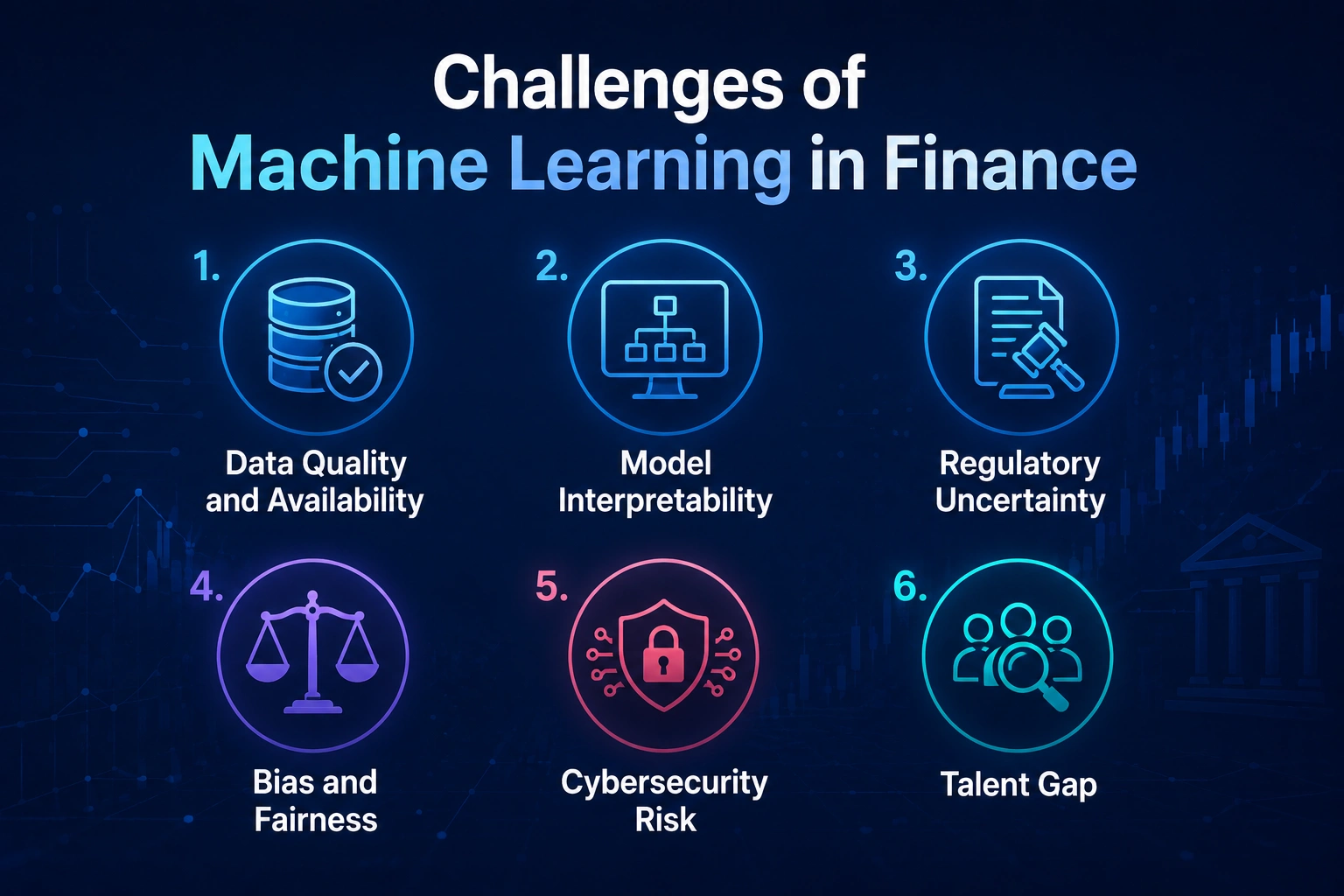
The challenges of machine learning in finance are real and should not be underestimated. Technology adoption at scale in a heavily regulated industry carries unique risks that demand careful management.
 1. Data Quality and Availability
ML models are only as good as the data they learn from. Financial data is often siloed, inconsistent, or incomplete, requiring significant investment in data infrastructure before meaningful model development can begin.
Solution:
Organizations are investing in centralized data platforms, data governance frameworks, and automated data cleaning pipelines to ensure consistency, accessibility, and reliability across systems.
2. Model Interpretability
Regulators and internal risk committees increasingly require that automated decisions be explainable. Deep learning models, while powerful, often operate as black boxes, making compliance with explainability requirements difficult.
Solution:
Techniques such as model explainability tools (e.g., SHAP, LIME) and the use of inherently interpretable models are helping institutions balance performance with transparency.
3. Regulatory Uncertainty
The legal framework governing algorithmic decision-making in credit, insurance, and trading is still evolving. Firms must navigate a patchwork of national and regional regulations that may conflict with one another.
Solution:
Firms are adopting proactive compliance strategies—working closely with legal teams, implementing audit trails, and designing models with regulatory flexibility in mind.
4. Bias and Fairness
If historical training data encodes systemic bias, ML models will perpetuate and potentially amplify that bias. This is particularly acute in credit scoring and hiring decisions within financial firms.
Solution:
Bias detection tools, fairness audits, and diverse training datasets are increasingly being used to identify and mitigate unintended discrimination.
5. Cybersecurity Risk
ML systems themselves can be targets of adversarial attacks designed to manipulate model outputs. Ensuring the integrity of deployed models requires ongoing security investment.
Solution:
Robust security practices, including model monitoring, adversarial testing, and secure deployment pipelines, help safeguard ML systems over time.
6. Talent Gap
Skilled machine learning engineers with domain expertise in finance remain scarce and expensive. Building effective ML teams is a sustained organizational challenge.
Solution:
Organizations are addressing this through partnerships with ML solution providers, internal upskilling programs, and the use of pre-built ML platforms to accelerate development.
Addressing these challenges is where strong ML solutions partners become particularly valuable, helping institutions navigate technical complexity while maintaining compliance and ethical standards.
Trends in Machine Learning in Finance to Watch Through 2026 and Beyond
The trends in machine learning in finance in 2026 point toward several powerful shifts that will define the next chapter of fintech innovation.
- Generative AI in Financial Services: Large language models are being deployed for contract analysis, earnings call summarization, regulatory document review, and client communication drafting. The speed gains in knowledge work are substantial.
- Federated Learning: As data privacy regulations tighten globally, federated learning allows institutions to train collaborative models without sharing raw customer data across organizational boundaries.
- Explainable AI (XAI): Driven by regulatory pressure, investment in model interpretability tools is growing rapidly. Firms are building XAI layers into their ML pipelines to make automated decisions auditable.
- Real-Time Decisioning: The shift from batch processing to real-time ML inference is accelerating. Credit decisions, fraud checks, and risk alerts are moving toward sub-second response times at scale.
- Embedded Finance and API-Driven ML: Financial intelligence is being embedded directly into non-financial platforms via APIs, enabling e-commerce sites, payroll tools, and healthcare platforms to offer sophisticated financial services powered by ML.
- Quantum-Enhanced Machine Learning: While still early stage, quantum computing is beginning to intersect with financial ML for portfolio optimization and risk simulation tasks that currently strain classical computing resources.
Staying current with these trends is essential for any firm looking to remain competitive. The fundamentals of machine learning in finance have not changed, but the tools, architectures, and deployment environments are evolving at a remarkable pace.
ML in Financial Software Development: Building for the Future
The practical aspect of implementing these capabilities lies in ML in financial software development, which requires a different approach than typical enterprise software due to higher stakes around accuracy, latency, and auditability. Effective financial ML systems rely on strong data pipelines, experimentation infrastructure, low-latency model serving, and monitoring frameworks that detect drift and performance issues early.
The cost of building this infrastructure from scratch is significant, which is why many financial institutions partner with specialized development teams. Understanding the mobile app development cost is one early consideration, but the full investment picture includes data engineering, model development, integration work, and ongoing maintenance.
Teams building ML in financial software development also benefit from leveraging the rapidly growing ecosystem of pre-trained models, cloud ML platforms, and open-source libraries. Rather than building every component from scratch, smart teams assemble best-of-breed components and focus their custom development on the differentiated logic specific to their financial use case.
Integrating ML into Mobile Financial Applications
Mobile banking has become the primary interface through which most consumers interact with their finances, and ML for finance is increasingly embedded directly into these experiences. From spending insights to real-time fraud alerts to personalized savings nudges, mobile financial apps are becoming intelligent companions rather than passive transaction records.
The benefits of integrating ML into mobile apps are particularly pronounced in financial applications. On-device ML models can run inference without sending sensitive data to external servers, addressing privacy concerns while maintaining responsiveness even in low-connectivity environments.
Mobile ML in finance is commonly applied in the following ways:
- Biometric Authentication: Behavioral ML models analyze usage patterns to verify whether a device is being used by its legitimate owner, adding an extra layer of security beyond traditional logins.
- Spending Categorization: ML-powered engines automatically classify transactions and continuously improve accuracy by learning individual user habits over time.
- Investment Insights: Investment apps leverage ML to generate portfolio insights, detect drift, and recommend rebalancing strategies based on market conditions.
- AI-Powered Customer Support: Natural language processing (NLP) enables apps to resolve common user queries instantly, reducing the need for human intervention.
For fintech companies and traditional banks building mobile experiences, working with specialists in artificial intelligence development services ensures that ML capabilities are integrated thoughtfully, with appropriate attention to model performance, data privacy, and regulatory compliance.
Final Thoughts: The Road Ahead for Machine Learning in Finance
The financial industry is not merely adopting machine learning as one tool among many. It is being fundamentally reconstituted around the capabilities that ML makes possible. The institutions that will lead in 2026 and beyond are those that treat machine learning in finance not as an IT project but as a core business strategy. Whether starting or scaling ML efforts, the opportunity is clear. The question isn’t if but how quickly and thoughtfully to invest. Those acting decisively now will gain advantages that grow, widening the gap with laggards each quarter.
AppsChopper specializes in building intelligent, scalable applications for fintech companies and financial institutions. From ML-powered fraud detection to personalized mobile banking experiences, our team combines deep technical expertise with real-world financial domain knowledge to deliver production-ready solutions. Get in touch with AppsChopper today to build the ML capabilities your business needs to compete in 2026 and beyond.
Frequently Asked Questions
1. How long does it take to implement machine learning in finance?
Implementation timelines vary, but most ML projects in finance take anywhere from 3 to 12 months, depending on data readiness, complexity, and regulatory requirements. Pilot models can be deployed faster, while full-scale production systems require longer for validation and compliance.
2. What is the ROI of machine learning in finance?
The ROI of machine learning in finance comes from cost reduction, improved decision accuracy, and increased revenue through better risk management and personalization. Many institutions see measurable returns within the first year of deployment.
3. How does machine learning improve fraud detection in finance?
Machine learning improves fraud detection by analyzing transaction patterns in real time and identifying anomalies that traditional rule-based systems often miss. This allows financial institutions to detect and prevent fraud more quickly and accurately.
4. How does machine learning differ from traditional financial modelling?
Traditional financial models rely on fixed rules and predefined assumptions, while machine learning models adapt and improve over time by learning from new data. This makes ML more effective in handling complex, dynamic, and large-scale financial datasets.