Table of Contents
The global demand for digital mental health tools has never been higher. With therapist waitlists stretching weeks to months and over one billion people worldwide living with a mental health condition, the gap between need and access is enormous.
Mental health app development has emerged as one of the most impactful and fastest-growing sectors in healthcare technology, and businesses that move thoughtfully into this space have a real opportunity to make a difference while building something sustainable.
Whether you are a startup founder, a healthcare organization, or an enterprise looking to expand into digital wellness, this guide breaks down everything you need to know, from planning and features to costs and compliance. For broader context on building in this regulated space, our overview of healthcare app development is a useful companion read.
How to Develop a Mental Health App: A Step-by-Step Overview
Understanding how to develop a mental health app starts with knowing that the process is more than just writing code. It requires balancing clinical insight, regulatory obligations, and user experience in a way that very few other app categories demand. 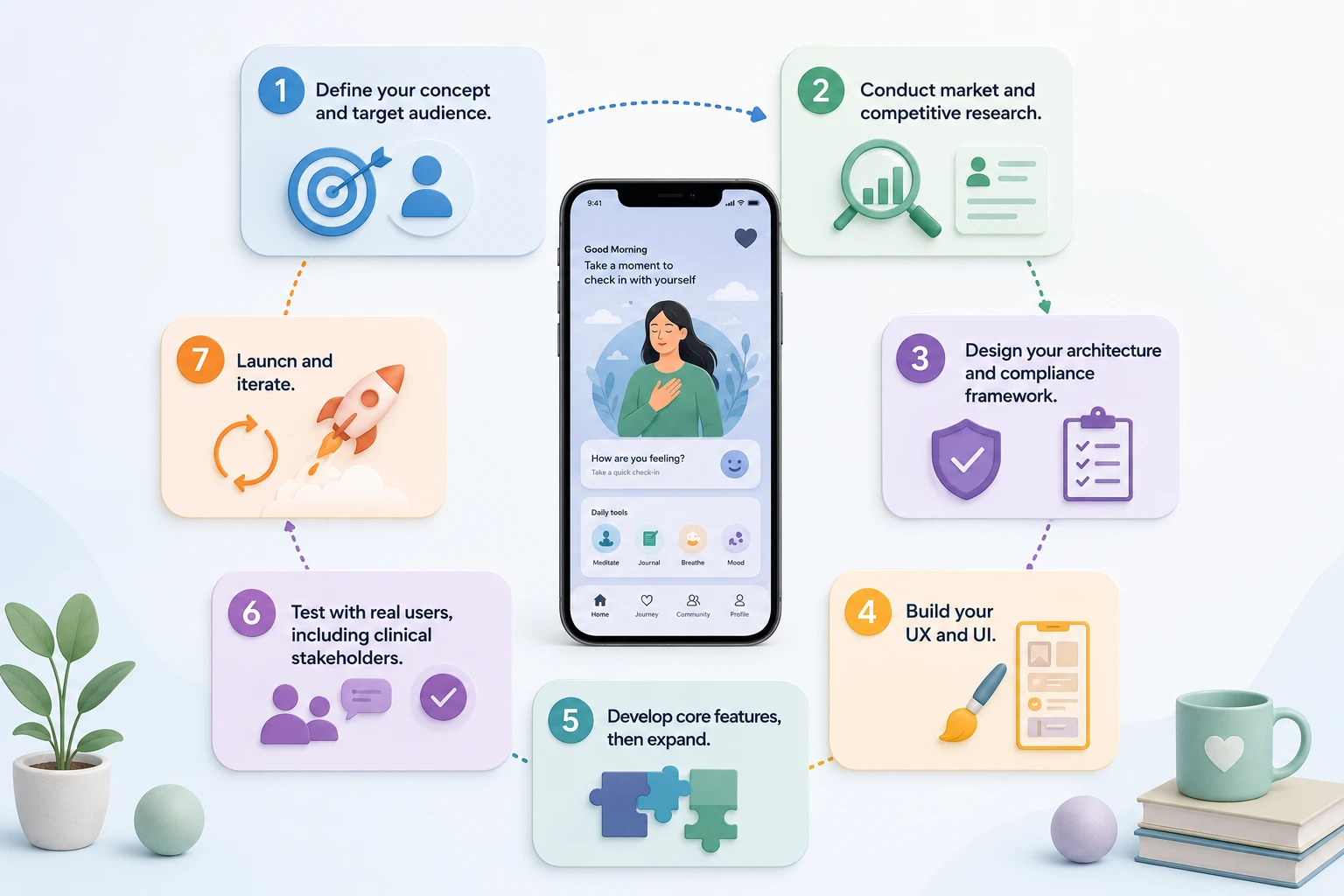
Step 1: Define your concept and target audience
Before anything else, decide what problem your app solves and for whom. Are you building for teenagers struggling with anxiety, professionals managing burnout, or people in recovery from addiction? The clearer you define your user, the better every subsequent decision becomes, from design to features to monetization.
Step 2: Conduct market and competitive research
Study what already exists, including platforms like Headspace, Calm, Woebot, and BetterHelp. Identify the gaps your product can fill and the clinical evidence base you will build on. Choosing to develop a mental health application without this step often leads to building something that duplicates what is already out there.
Step 3: Design your architecture and compliance framework
Before a single line of code is written, your data architecture must be designed around regulatory requirements. This means decisions about how protected health information is stored, who has access, and what happens in the event of a breach. Getting HIPAA compliance for healthcare baked in from the start is far less costly than retrofitting it later.
Step 4: Build your UX and UI
Mental health app design is not like designing a productivity tool. Color psychology, simple navigation, and accessibility standards all influence whether users trust the app enough to engage with it honestly. A jarring interface during a moment of emotional vulnerability can permanently lose you the user.
Step 5: Develop core features, then expand
Build a focused MVP that delivers genuine value from day one. Add complexity as real usage patterns emerge rather than front-loading every feature at once.
Step 6: Test with real users, including clinical stakeholders
Testing for a mental health platform should involve both technical QA and feedback from licensed clinicians. Edge cases in this category are not just bugs; they can be safety issues.
Step 7: Launch and iterate
The launch is the beginning, not the end. Track engagement metrics, address user feedback, and continuously improve. Mental health app trends in 2026 confirm that the platforms retaining users are the ones that evolve alongside their needs.
Essential Mental Health App Features That Drive Retention
Choosing the right mental health app features is one of the most important decisions in the entire development process. Features should be tied directly to user value, not added simply to make a feature list look impressive.
1. Onboarding and personalized assessment
First impressions are critical. A focused onboarding flow that asks meaningful questions and groups users by need creates relevance from the first session. This is where many users decide whether the app is worth their trust.
2. Mood tracking and journaling
One of the most universally valued features across all categories of mental health application features, mood logging gives users visibility into their emotional patterns over time. With visual summaries and trend charts, it becomes a core reason users return daily.
3. Guided content libraries
Evidence-based therapeutic content rooted in cognitive behavioral therapy, mindfulness, dialectical behavior therapy, and breathwork gives users practical tools they can use between professional sessions. This content should be developed in collaboration with licensed mental health developers and clinicians to ensure it is both safe and effective.
4. Secure messaging and teletherapy
Whether through text, audio, or video, connecting users with licensed professionals is one of the highest-value features in the category. Telehealth functionality requires end-to-end encryption and compliance with healthcare privacy standards.
5. Crisis support and emergency resources
In high-risk moments, users need immediate access to help. An embedded SOS feature that links to crisis lines, trusted contacts, or emergency services is not optional for platforms that position themselves as mental health tools. This feature must be built for low latency and high reliability, above all else.
6. Gamification features
Points, badges, activity streaks, and challenges can boost consistent engagement with therapeutic content. They turn mental health management from a tedious task into a sense of progress.
7. AI-powered personalization
In 2026, users increasingly expect apps to adapt to their behavior. AI-driven recommendations, adaptive content delivery, and smart reminders based on usage patterns are features that separate leading platforms from generic ones. A well-built mental health AI app uses machine learning to surface the right content at the right moment.
8. Wearable and third-party integrations
Connecting with Apple Watch, Fitbit, or Garmin to pull in sleep data, heart rate variability, and activity levels gives the app a richer picture of user well-being and enables more relevant interventions.
Mental Health App Development Costs: What to Budget in 2026
Mental health app development costs vary significantly based on the type of app, the feature set, the compliance requirements, and where your development team is located. Here is a realistic breakdown for 2026.
Mental health app development costs vary significantly depending on the app type, feature set, compliance requirements, and your development team’s location. Here is a realistic breakdown for 2026.
| App Tier | Development Timeline | Typical Cost Range | Best For | Key Features Included |
| Basic MVP | 3–6 months | $40,000 – $60,000 | Startups validating an idea or launching quickly | User registration, mood tracking, content library, secure messaging |
| Mid-Tier Platform | 6–12 months | $80,000 – $150,000 | Growing companies expanding features and engagement | AI-powered features, teletherapy video sessions, wearable integrations, enhanced compliance |
| Enterprise-Grade Platform | 9–12+ months | $150,000 – $400,000+ | Established healthcare providers and scalable platforms | EHR integration, advanced AI, multi-provider support, full HIPAA & GDPR compliance |
Key Cost Driver:
Patient data security is the single largest cost factor in 2026. Implementing end-to-end encryption, biometric authentication, audit trails, and breach detection requires specialized healthcare engineers and ongoing compliance investment. Cutting corners here significantly increases legal and reputational risk.
The timeline follows a similar pattern. A basic version can be ready in three to six months. More complex platforms with AI, video sessions, and deep integrations typically take six to twelve months from kickoff to launch.
HIPAA Compliance for Healthcare: Building on a Secure Foundation
No area of mental health app development demands more careful attention than compliance. HIPAA compliance for healthcare is not a checkbox; it is an architectural requirement that shapes every decision from how data is stored to how users are authenticated.
Apps that store or process personal health information must ensure HIPAA compliance, including end-to-end encryption, role-based access, session timeouts, audit logs, and breach alerts. EU apps must also comply with GDPR requirements on consent, data portability, and deletion. Clinical tools or Medical Device Software are subject to FDA oversight by the Digital Health Center. The 2026 regulatory landscape is tougher than it was two years ago, and teams without expert guidance often face costly rework.
The key principle is simple: build in compliance from the beginning, not as an afterthought. Teams that get their HIPAA compliance for healthcare foundations right in the planning and architecture phases save enormous time and money compared to those who try to retrofit it after the product is built. Our dedicated guide on HIPAA Compliance for Healthcare walks through the specific technical and legal requirements in detail.
Types of Mental Health Apps Shaping the Market
The market encompasses several distinct categories, each with its own clinical scope, regulatory load, and development complexity. The three most important categories shaping the market right now are:
1. Teletherapy Platforms (Highest Impact + Revenue Potential)
Apps that connect users to licensed therapists via video, audio, or messaging are at the center of the industry. They require HIPAA-compliant infrastructure, strong clinical operations, and reliable real-time communication systems. Despite the complexity, they drive the most sustainable revenue and align closely with healthcare systems and employer-sponsored benefits.
2. CBT & Self-Guided Therapy Apps (Evidence-Driven Growth)
These apps deliver structured therapeutic programs based on cognitive behavioral therapy and similar frameworks. They guide users through exercises, track symptoms, and monitor progress. What matters most here is clinical validation—apps backed by research and measurable outcomes are gaining trust with both users and healthcare partners.
3. Meditation & Stress Relief Apps (Mass Adoption Entry Point)
This category continues to dominate in terms of user acquisition and accessibility. Apps focused on mindfulness, sleep, and stress reduction (like Headspace and Calm) are easy to adopt and require minimal regulation. Success here depends less on technical complexity and more on content quality, personalization, and engagement design.
Mental Health App Design and User Experience Considerations
Mental health app design is one of the most consequential and often underestimated parts of the development process. A poor user experience in a mental health context does not just cause churn; it can actively cause harm.
Color palettes should be calm, warm, and non-clinical. Navigation must be intuitive enough to use during moments of emotional distress. Accessibility compliance, including WCAG 2.1 standards, ensures the app works for users with visual or motor impairments. Consent forms and privacy disclosures should be clear and written in plain language, not legal jargon. Trust is the currency of mental health apps. Users are being asked to share their most private thoughts, fears, and behaviors. Every design decision should reinforce that the app is a safe, supportive space.
Investing in strong mental health app design from the start also pays dividends in retention. Studies consistently show that apps with clean, intuitive interfaces see significantly better engagement metrics than those where users have to work to find the features they need.
Mental Health Apps Trends to Watch in 2026
The mental health app trends shaping the landscape in 2026 reflect both technological maturation and shifting user expectations.
1. AI-Driven Personalization (Now Expected, Not Optional)
AI-powered personalization has become a baseline expectation. Users increasingly demand apps that adapt in real time and include features like analyzing behavior patterns, tailoring content, and delivering interventions that feel uniquely relevant rather than generic. This shift is pushing developers to invest heavily in machine learning and behavioral data modeling.
2. Blended Care Models (Digital + Human Support)
The most successful platforms are moving toward blended care—combining self-guided tools (like journaling, CBT exercises, and mood tracking) with access to licensed therapists. This hybrid approach improves outcomes, retention, and long-term engagement, making it a cornerstone strategy for serious mental health platforms.
3. Wearable Integration & Real-Time Health Data
Integration with wearables is rapidly becoming a key differentiator. By combining app data with physiological signals such as sleep patterns, heart rate variability, and activity levels, platforms can deliver more accurate insights and enable proactive interventions before issues escalate.
Overall, mental health app trends shaping the landscape in 2026 reflect both technological maturation and shifting user expectations. Our piece on AI in healthcare explores how these capabilities are being applied across the broader digital health space.
Choosing the Right Mental Health App Development Services and Partner
Partnering with experienced mental health app development services makes a material difference in both timelines and outcomes. Building in healthcare is genuinely different from building other software products. It involves regulatory expertise, clinical awareness, data security specialization, and the ability to design for sensitive user populations.
Also look at the team composition they bring to the project. A strong engagement should involve a business analyst, UX and UI designers with healthcare experience, mobile and backend mental health application developers, a QA engineer, a regulatory consultant, and a cybersecurity specialist. Teams missing those specialized roles tend to create problems that surface during launch or, worse, after users are already on the platform.
Mental health app developers who have shipped real products in this space bring practical knowledge that saves time, reduces risk, and ultimately produces a better product. Working with experienced partners can cut timelines significantly in early builds and help teams avoid the kind of early mistakes that turn a six-month project into a fourteen-month one. Our guide to choosing a healthcare app development company covers the full set of criteria worth applying to that evaluation.
Frequently Asked Questions
1. How long does mental health app development take?
A basic version with mood tracking, content library, and profiles takes 3-6 months, while advanced platforms with AI, teletherapy, and HIPAA compliance usually need 6-12 months. Rushing complex builds risks compliance gaps or stability issues, costing more to fix later.
2. What security measures are needed in mental health application development?
Mental health application development requires end-to-end encryption, multi-factor authentication, role-based access controls, session timeouts, and audit logs. HIPAA-covered apps must meet these legal standards, with 2026 updates demanding even stricter encryption and documentation.
3. Which technologies are used in mental health app development?
On mobile, React Native and Flutter are widely used for cross-platform development, while Swift and Kotlin remain the standard for native iOS and Android development. Backend infrastructure typically runs on Node.js or Python on AWS or Google Cloud, with WebRTC or APIs such as Twilio handling real-time teletherapy communication and Apple HealthKit or Google Fit powering wearable integrations.
4. What is the best monetization model for a mental health app?
The subscription model dominates the mental health app market, with freemium tiers that deliver real value and premium plans that unlock advanced features such as unlimited AI interactions, provider connectivity, and personalized intervention plans. B2B contracts with employers, health systems, and insurers are the fastest-growing revenue channel in 2026, providing more predictable income than direct-to-consumer subscriptions alone.
5. Can a mental health app replace therapy?
Mental health apps are designed to complement professional care, not replace it. They are most effective as tools that support users between therapy sessions, provide accessible entry points for those on waiting lists, and help people build daily wellness habits. However, they are not a substitute for licensed clinical treatment when it is needed.