Table of Contents
After weeks of stakeholder meetings, it is clear that introducing a customized Buy Now, Pay Later (BNPL) app requires significant investment and careful planning. But as leadership shifts focus to execution, the conversation shifts directly to financial feasibility. The most important question that roams in business leaders’ minds is “How much does it cost to develop a scalable BNPL platform?”
Buy Now, Pay Later app development costs vary widely depending on factors such as backend architectural choices and regulatory compliance overhead. This guide explores key cost factors, must-have features, and a strategic roadmap to help decision-makers accurately project total investment.
What is a BNPL App?
A Buy Now Pay Later app goes beyond traditional payment experiences by letting customers buy products instantly and pay in smaller, often interest-free scheduled installments. Each payment acts as a short-term loan, with a clearly defined end date and repayment period.
BNPL service providers pay merchants upfront and take the risk that customers will pay later. They also earn money from merchant fees, interest on delayed payments, and other services.
A BNPL app integrates payment processing, consumer lending, and retail technology. It needs to process payments reliably, assess customer risk like a lender, and provide an intuitive shopping experience. That is why the cost of building the Buy Now, Pay Later app can vary widely. Developing a secure, scalable, legally compliant system that banks and merchants can trust is much more complex.
Key Factors Defining the Cost of Developing a BNPL App
The cost of developing a BNPL app depends on more than the number of screens or features. A simple financing app with basic repayment functionality requires a lower investment. On the other hand, a full BNPL platform costs more because it includes complex features such as automated credit decisions, fraud monitoring, merchant integrations, regulatory controls, and real-time payment processing.
The following factors most influence the overall BNPL app development price.
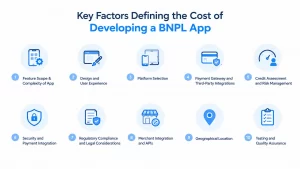
1. Feature Scope & Complexity of App
Feature scope is one of the biggest factors affecting BNPL mobile development cost. A basic application may let customers register, complete verification, view available credit, make purchases, and manage repayments.
A more advanced platform may include dynamic spending limits, automated underwriting, merchant settlement, installment scheduling, dispute management, refunds, fraud monitoring, credit reporting, and personalized offers.
The more workflows and business rules your BNPL app includes, the more development and testing time it requires.
2. Design and User Experience
The BNPL checkout experience needs to make financial information easy to understand. Customers should know what they are purchasing, how much they will pay, when payments are due, and what happens if a payment fails.
This makes UX design particularly important for BNPL products.
The number of user journeys and the level of customization influence design costs. A highly tailored experience with interactive repayment information and personalized dashboards requires more UX research, prototyping, and usability testing than a basic interface.
For this, businesses can also choose UI and UX design services to create easy-to-use interfaces that build trust and improve usability.
3. Platform Selection
The platforms you plan to support directly affect BNPL app development cost.
Creating separate iOS and Android apps generally requires more development and testing than launching on a single platform. A cross-platform approach using technologies such as Flutter or React Native can help reduce repeated development work. For merchant and administrative functions, a web-based solution may be a practical option.
The right choice depends on your target customers and operating model. For example, a consumer-focused BNPL service may prioritize mobile apps, while a merchant-focused product may require a strong web portal and APIs for eCommerce integration.
Cost increases when you add:
- Multiple mobile platforms
- A responsive web application
- Separate merchant and customer interfaces
- Tablet or additional device support
- Platform-specific features
4. Payment Gateway and Third-Party Integrations
Payment infrastructure is central to a BNPL product. The application must connect merchants, customers, payment processors, and financial systems while keeping transaction data synchronized.
The integration may cover:
- Payment gateways
- Card processing
- Bank account services
- Digital wallets
- Merchant payment systems
- Refunds and cancellations
- Recurring repayments
- Settlement and reconciliation
The number and complexity of integrations directly influence development time. A product supporting multiple payment providers or markets requires more integration and testing.
Third-party providers may also charge transaction, API, verification, or subscription fees, which should be considered separately from the initial development budget.
5. Credit Assessment and Risk Management
BNPL platforms need a reliable way to determine whether a transaction or customer qualifies for financing. This makes credit assessment an important cost factor that is often underestimated.
The implementation may range from simple eligibility rules to sophisticated automated underwriting that considers customer information, transaction history, repayment behavior, external credit data, and risk signals.
You may also need integrations with credit bureaus or alternative data providers, depending on the market and business model.
Development costs increase with:
- Credit bureau integrations
- Automated eligibility rules
- Credit scoring models
- Dynamic spending limits
- Risk-based approval decisions
- Machine learning models
- Real-time underwriting
The more automated the lending decision becomes, the more investment is required in backend architecture, data processing, model development, testing, and monitoring.
6. Security and Payment Integration
BNPL applications handle financial and personal information, making security a core part of the product rather than an optional add-on.
The development scope may include encrypted data transmission, secure authentication, tokenization, access controls, fraud detection, device monitoring, transaction monitoring, and suspicious-activity alerts.
Fraud prevention is especially important because BNPL transactions create immediate financial exposure for the provider.
For example, the platform may need to identify unusual purchasing patterns, repeated account creation, suspicious devices, abnormal transaction values, or rapid changes in customer behavior.
More sophisticated fraud prevention requires additional rules, third-party services, data processing, and monitoring infrastructure, increasing development and operating costs.
7. Regulatory Compliance and Legal Considerations
A BNPL platform operates within financial and consumer-protection frameworks that vary by market. The applicable requirements influence both the technical architecture and the development timeline.
Depending on the market and business model, the product may require capabilities related to:
- Know Your Customer (KYC)
- Anti-Money Laundering (AML)
- PCI DSS
- Consumer protection
- Data privacy
- Payment security
- Credit reporting
- Transaction monitoring
- Record retention
The technical cost often comes from implementing these requirements through identity-verification providers, compliance workflows, audit trails, consent management, data controls, and reporting systems.
Launching in additional countries can further increase scope because requirements, currencies, payment methods, lending rules, and data-handling expectations may differ by jurisdiction.
8. Merchant Integration and APIs
A BNPL service needs to work where customers actually make purchases. This often means connecting the platform with online stores, marketplaces, POS systems, payment platforms, or custom merchant applications.
A merchant integration may include APIs, SDKs, plugins, webhooks, authentication, order verification, payment status updates, refunds, and settlement information.
Supporting several eCommerce platforms or providing a flexible API for enterprise merchants increases the development scope.
For a BNPL business targeting large retailers, investing in a strong merchant integration layer may therefore have a greater impact on the budget than adding consumer-facing cosmetic features.
9. Geographical Location
The development team’s location can significantly affect BNPL app costs. Developer rates vary widely by region, with Western Europe and North America generally costing more than South Asia or Eastern Europe. Choosing the right location can help control development costs, helping the audience manage expenses while maintaining quality and features.
An experienced team with financial technology knowledge may cost more initially but reduce the risk of expensive rework, security issues, and integration problems later.
The development model also matters. Hiring an in-house team, working with a local development company, or outsourcing to an offshore team produces different cost structures.
Region-Wise Cost
Where you hire a BNPL development team can significantly impact the cost, as hourly rates differ from country to country.
| Development Region | Typical Hourly Rate |
| North America | $80–$110/hr |
| Western Europe | $70–$90/hr |
| Eastern Europe | $50–$90/hr |
| South Asia | $25–$50/hr |
| Southeast Asia | $30–$60/hr |
10. Testing and Quality Assurance
Financial applications require extensive testing because an incorrect transaction or repayment calculation can directly affect customers and merchants.
Testing typically covers:
- Functional testing
- API testing
- Payment testing
- Security testing
- Performance testing
- Device and browser testing
- User acceptance testing
- Integration testing
- Regression testing
Complex repayment rules and multiple external integrations increase the number of scenarios to test.
For example, developers need to account for failed payments, duplicate transactions, refunds, partial repayments, expired cards, network interruptions, and changes in transaction status.
This makes QA a significant part of the BNPL development budget, not just a final step before launch.
BNPL App Development Cost Breakdown
As discussed above, multiple factors affect the cost of building a secure lending payment app. By reading the cost breakdown below, you can understand where your investment goes and plan the right features.
App Type Cost
The more features and complexity your BNPL app has, the higher the development cost will be.
| App Type | Estimated Cost | Featuers |
| Basic BNPL App | $25K–$50K |
|
| Mid-Complexity App | $50K–$100K |
|
| Enterprise-Grade Platform | $100K–$250K+ |
|
Team-Wise Cost
A BNPL app usually needs six to ten people to handle development, security, design, and testing. The more people and time your project needs, the higher the overall development cost.
| Team Role | Estimated Cost Per Hour |
| Project Manager / Business Analyst | $20–$25 |
| UI/UX Designer | $20-$25 |
| iOS & Android Developers | $20-$30 |
| Backend Developers | $20-$30 |
| QA Engineer | $15-$20 |
| DevOps / Cloud Engineer | $10-$99 |
Essential Features to Consider for Buy Now Pay Later App Development
The right features make a BNPL app easier to use, safer for transactions, and more useful for both customers and merchants. These are the Buy Now, Pay Later app functionalities every business should consider.
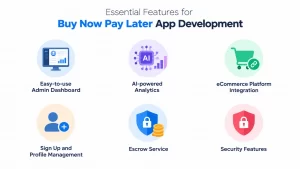
Easy-to-use Admin Dashboard
Gives teams a clear, real-time view of transactions, repayments, merchant activity, and risk alerts. This reduces manual work and helps teams make faster decisions.
AI-powered Analytics
AI can check a customer’s creditworthiness in real time and help identify risky applications. This can reduce defaults while helping more eligible customers get approved.
eCommerce Platform Integration
Integrations with platforms like Shopify, WooCommerce, and Magento let merchants add BNPL to checkout with minimal technical work, making it easier to onboard more merchants.
Sign Up and Profile Management
A quick and simple sign-up process helps customers complete checkout without dropping off. Keeping the registration process short can improve conversions.
Escrow Service
Escrow holds the merchant’s payment until the order is delivered or the return period ends. This adds protection against fraud, returns, and payment disputes.
Security Features
Features such as multi-factor authentication, biometric login, secure card storage, and fraud monitoring help protect customer data and reduce the risk of unauthorized transactions.
Steps to Create a Fintech App Development Solution Like BNPL
Developing a Buy Now, Pay Later app requires a strategic roadmap from proper ideation to post-launch support. These are the most crucial steps needed to meet market needs and ensure regulatory compliance.
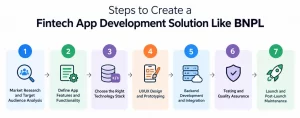
Market Research and Target Audience Analysis
Start by understanding your target customers, market trends, and competing BNPL apps. This helps you identify what users actually need, find gaps in existing solutions, and build features that give your app a clear advantage.
Define App Features and Functionality
Decide what your BNPL app needs to offer. Focus on essential features for the first version, such as user registration, credit checks, payment plans, and repayment tracking. You can also add additional features as the app grows.
Choose the Right Technology Stack
Choose the technologies that can support your app as the number of users and transactions increases. The right technology also helps keep the app secure, reliable, and easier to maintain.
Here’s a technology stack you can adjust based on your BNPL app features, compliance requirements, target market, and expected user volume.
| Technology Area | Recommended Technologies |
| Frontend | React Native, Flutter |
| Backend | Node.js, Python |
| Database | PostgreSQL, MySQL |
| Cloud | AWS, Google Cloud |
| Payment Gateway | Stripe, Adyen, Braintree |
| Credit & Risk | Experian, Equifax APIs + ML Models |
| Authentication | OAuth 2.0, JWT, MFA |
| Notifications | Firebase Cloud Messaging, Twilio |
| Analytics | Google Analytics, Mixpanel |
| Security | Encryption, Tokenization, Fraud Detection |
| Admin Dashboard | React.js, Next.js |
UI/UX Design and Prototyping
Design a simple and intuitive interface for customers and merchants. Creating a prototype first lets you test the user journey, find problems early, and avoid expensive design changes later.
Backend Development and Integration
Build the core systems that manage credit decisions, payments, user data, and repayments. Integrate payment gateways, credit services, banking systems, and other third-party tools needed to make the BNPL app work smoothly.
Testing and Quality Assurance
Test every part of the app, including payments, security, performance, and credit-related functions. Thorough testing helps prevent payment errors, security issues, and other problems that could affect user trust.
Launch and Post-Launch Maintenance
Launch the app with proper monitoring and track how users interact with it. Use their feedback to fix issues, improve features, strengthen security, and keep the app aligned with changing customer needs.
How to Monetize from BNPL App Development
A good BNPL business model can help you earn from customer purchases and merchant partnerships while keeping the app affordable for users.
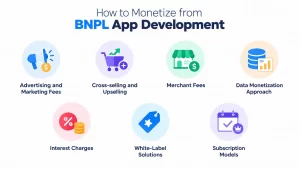
Advertising and Marketing Fees
Merchants can pay to promote their products or offers inside the BNPL app. This gives merchants more visibility while creating an additional revenue stream for the platform.
Cross-selling and Upselling
The app can suggest related products or better payment plans based on what customers are buying. This can increase the merchant’s sales and the platform’s revenue.
Merchant Fees
Merchants pay a small fee on each BNPL transaction. This is one of the main ways BNPL platforms earn money while helping merchants increase sales and offer flexible payment options.
Data Monetization Approach
The platform can use aggregated and anonymous shopping trends to help merchants understand customer preferences and improve their marketing. This should always follow applicable privacy and data protection rules.
Interest Charges
The app can charge interest on longer-term payments. This creates an additional income stream beyond standard short-term, interest-free BNPL plans.
White-Label Solutions
You can license your BNPL technology to banks, retailers, or other fintech companies. This allows you to earn B2B revenue without acquiring every customer directly.
Subscription Models
Customers can pay a monthly or yearly fee for premium benefits, such as higher spending limits or reduced fees. This creates a more predictable recurring revenue stream.
Best Strategies for Minimizing BNPL App Development Costs
Building a BNPL app doesn’t have to be expensive. The right development approach can help you control costs while still delivering the features users need. Here are some practical ways to reduce BNPL app development costs.
Use Open-Source Technologies
Using open-source tools and frameworks can reduce software licensing costs. They also provide ready-made features and strong community support, saving development time and money.
Follow Agile Development
Agile development breaks the project into smaller stages, so you can test features and fix issues early. This helps avoid costly changes later and keeps the development process more efficient.
Outsourcing to Cost-Effective Regions
Hiring developers from regions with lower development rates can help reduce your overall budget. Also, businesses can save money to invest in other parts of their BNPL platform.
Conclusion
Buy Now, Pay Later app development costs vary based on technology, features, compliance needs, security, development location, and team size. A basic app may cost around $25,000, while an advanced enterprise platform can cost $250,000 or more. To get better value from your investment, plan your costs early, focus on essential features, prioritize security and compliance, and choose a development approach that supports your long-term goals.
With the BNPL market continuing to grow, businesses have an opportunity to enter the space and build a strong position. However, rising competition and changing regulations make proper planning important. A scalable app, clear budget, and strong revenue plan can help you grow without rebuilding the platform later.
How Does AppsChopper Help You Build a BNPL App?
AppsChopper helps businesses build BNPL apps at any scale, from simple MVPs to large platforms serving multiple markets. Our team brings experience in secure payments, fintech development, compliance, and AI-based risk management.
Instead of using the same approach for every project, we recommend the right technology, team, and development plan based on your business goals and budget. This helps you launch faster while keeping security, compliance, and future growth in focus.
What We Offer?
- End-to-End BNPL App Development: From initial idea to launch, we handle the full BNPL app development process, including design, development, testing, and deployment for both iOS and Android.
- Secure and Compliant Payment Solutions: We integrate secure, PCI-compliant payment gateways and fraud-prevention tools to keep transactions safe and reliable.
- Flexible Installment Plans: We build flexible payment and installment options based on your target customers and business needs. This can help improve customer conversions and encourage more merchants to adopt your platform.
With AppsChopper as your mobile development partner, you get a BNPL app built around your business needs, with a focus on security, compliance, ease of use, and future growth. Our goal is to help you build a platform that attracts users, supports merchants, and grows with your business.
FAQs
Q1. How much does it cost to build a BNPL app in 2026?
Ans. Costs typically range from $25,000 for a basic app to more than $250,000 for an enterprise-grade BNPL app that integrates full regulatory compliance across regions, AI underwriting, and other advanced features.
Q2. How long does it take to develop a BNPL app?
Ans. A standard BNPL app will take 3-4 months. An advanced-level platform will take 6-9 months. It depends on the number of features, integrations, and compliance requirements.
Q3. Is a white-label BNPL solution cheaper than building from scratch?
Ans. Yes, white-label BNPL solutions are usually less expensive and launch faster. This makes them a strong choice for businesses that want to enter the market quickly.
Q4. What regulatory requirements should enterprises plan for?
Ans. Regulatory compliance varies by region but usually includes anti-money laundering, affordability assessment obligations, and data protection compliance, such as PCI DSS, GDPR, or CCPA.
Q5. How do BNPL apps make money if the interest-free plans generate no interest revenue?
Ans. Most BNPL providers make most of their money by charging merchants a fee on each transaction. They may also earn money from interest on longer-term delayed payments, selling or using customer data, licensing their BNPL solution to other businesses, and offering premium subscription features.