Table of Contents
Healthcare organizations today generate massive volumes of data through electronic health records (EHRs), medical imaging systems, wearable apps, and connected healthcare technologies. While this data holds valuable insights, the real challenge lies in analyzing it quickly and effectively to improve patient care and operational efficiency.
This is where machine learning in healthcare is transforming the industry. As a key component of artificial intelligence in healthcare, machine learning enables systems to analyze complex medical datasets, identify hidden patterns, and generate predictive insights. Such a system supports faster and more accurate clinical decisions.
The healthcare providers are increasingly using machine learning algorithms for applications such as disease diagnosis, medical imaging analysis, patient risk prediction, and predictive analytics in healthcare.
To address the doubts you may have about adopting machine learning in hospitals, we have curated a bifurcated guide for you.
What is Machine Learning in Healthcare?
Machine learning in healthcare refers to the use of advanced algorithms that can analyze large volumes of medical data, learn from patterns, and generate insights that support clinical and operational decision-making. As a subset of artificial intelligence in healthcare, machine learning enables systems to continuously improve their performance by learning from historical and real-time healthcare data.
Machine learning models can process this complex data far more efficiently than traditional analytical methods, helping healthcare professionals identify patterns that may not be immediately visible through manual analysis.
By transforming raw healthcare data into actionable insights, machine learning helps physicians deliver more accurate diagnoses, develop personalized treatment plans, and improve overall patient outcomes.
As healthcare systems continue to embrace data-driven care, machine learning is becoming a foundational technology for modern healthcare innovation and predictive healthcare analytics.
Types of Machine Learning Used in Healthcare
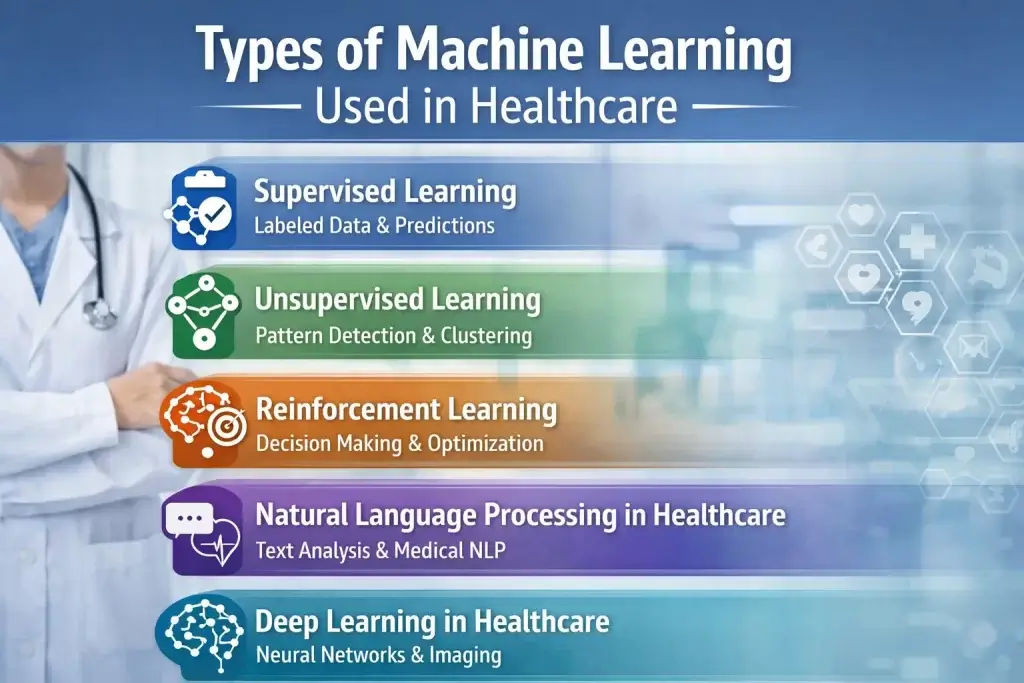
Machine learning in healthcare relies on different types of learning models, each designed to analyze medical data in unique ways. Below are the primary types of machine learning commonly applied in healthcare systems.
 1. Supervised Learning
Supervised learning is one of the most widely used approaches for the applications of ML in healthcare. In this model, algorithms are trained using labeled datasets, where both the input data and the expected output are already known. The system learns to map inputs to correct outputs and then applies that knowledge to new data.
In healthcare, supervised learning is frequently used for tasks such as disease diagnosis, medical imaging analysis, and patient outcome prediction. For example, machine learning models can be trained on thousands of labeled medical images to identify tumors, detect fractures, or recognize early signs of diseases like cancer or diabetic retinopathy.
2. Unsupervised Learning
Unlike supervised learning, unsupervised learning works with unlabeled healthcare data. The algorithm analyzes the data to discover hidden patterns, relationships, or clusters without predefined outcomes.
This approach is particularly useful in healthcare for identifying patient segments, disease subtypes, and hidden correlations within clinical datasets. Hospitals and research institutions often use unsupervised learning to analyze electronic health records (EHRs) and discover patterns that may help improve treatment strategies or identify previously unknown disease trends.
3. Reinforcement Learning
Reinforcement learning focuses on training algorithms through a system of rewards and feedback. The model learns by interacting with an environment and improving its decisions over time based on the outcomes of its actions.
In healthcare, reinforcement learning is being explored for treatment planning, robotic surgery, and adaptive healthcare systems. For instance, algorithms can learn optimal treatment strategies by analyzing how different interventions affect patient outcomes, helping clinicians make more informed care decisions.
4. Natural Language Processing in Healthcare
A large portion of healthcare data exists in unstructured formats, such as physician notes, discharge summaries, clinical reports, and electronic health records (EHRs). Natural Language Processing (NLP) in healthcare uses machine learning techniques to analyze and interpret this textual data, allowing systems to extract meaningful insights from clinical documentation.
Healthcare providers use NLP-powered machine learning models for tasks such as clinical documentation analysis, automated medical coding, and identifying key patient information from medical records. By converting unstructured medical text into structured data, NLP helps improve clinical decision-making, data analysis, and predictive healthcare analytics across modern healthcare systems.
5. Deep Learning in Healthcare
Deep learning is a specialized subset of machine learning that uses neural networks with multiple layers to process complex data. It is particularly effective for analyzing high-dimensional healthcare datasets such as medical images, genomic data, and clinical text.
Deep learning plays a major role in medical imaging, radiology automation, pathology detection, and drug discovery. For example, deep learning models can analyze CT scans and MRIs to detect abnormalities with high accuracy, assisting radiologists in identifying diseases earlier and improving diagnostic precision.
As healthcare data continues to grow in volume and complexity, tools for building predictive systems are changing the use of machine learning in medical field.
Why Organizations are Investing in Machine Learning for Healthcare?
Healthcare systems today are under pressure to improve patient outcomes, operational efficiency, and care delivery while managing growing patient volumes and rising costs. As healthcare data continues to expand, many organizations are turning to machine learning in healthcare to transform complex datasets into actionable insights that support smarter clinical and operational decisions.
Rising patient expectations
Patients today expect faster diagnoses, personalized treatment plans, and more convenient healthcare experiences. By using machine learning algorithms in healthcare, providers can analyze patient data to identify potential health risks, recommend personalized treatment strategies, and improve patient engagement.
Rising healthcare data volume
Modern healthcare generates vast amounts of data from electronic health records (EHRs), medical imaging systems, wearable devices, and laboratory reports. However, much of this information remains underutilized. According to the World Economic Forum, nearly 97% of healthcare data goes unused, highlighting the need for advanced technologies like machine learning to analyze and extract meaningful insights.
Physician burnout and workforce shortages
Healthcare professionals often face heavy workloads due to growing patient demand and administrative responsibilities. Machine learning technologies can help reduce this burden by automating documentation, medical coding, and data analysis, allowing clinicians to focus more on patient care.
Data fragmentation across systems
Healthcare data is often scattered across multiple systems, including hospital databases, imaging platforms, and insurance systems. Machine learning solutions can integrate and analyze data from these sources, helping organizations develop more comprehensive patient insights and coordinated care strategies.
Need for predictive healthcare
Healthcare is gradually shifting from reactive treatment to predictive and preventive care. Through predictive analytics in healthcare, machine learning models can detect early warning signs of disease progression, predict hospital readmissions, and identify patient deterioration risks, enabling providers to intervene earlier and improve treatment outcomes.
What are the Benefits of Machine Learning in Healthcare?
Machine learning helps healthcare organizations analyze large volumes of medical data to improve clinical decision-making, streamline operations, and enhance patient care. By adopting ML in healthcare, providers can deliver faster diagnoses, reduce operational inefficiencies, and support more personalized treatment strategies.
| Key Benefits of ML in Healthcare | Impact in Healthcare |
| Improved Diagnostic Accuracy | ML models analyze medical images and patient data to help detect diseases earlier and support accurate diagnoses. |
| Faster Clinical Decision-Making | Predictive insights enable clinicians to make quicker, data-driven treatment decisions. |
| Reduced Healthcare Costs | Automation of administrative tasks and better resource management improve operational efficiency. |
| Improved Patient Outcomes | Personalized treatment insights help deliver more targeted and effective care. |
| Operational Efficiency | ML optimizes hospital workflows such as scheduling, staffing, and bed management. |
| Early Disease Detection | Predictive analytics identifies early warning signs, enabling preventive healthcare strategies. |
| Scalable Healthcare Systems | ML systems allow healthcare providers to manage growing patient data efficiently. |
According to Accenture, AI applications in healthcare could generate up to $150 billion in annual savings for the U.S. healthcare economy by 2026.
How Machine Learning is Used in Healthcare?
From predictive analytics to medical imaging analysis, machine learning applications in healthcare help providers deliver faster diagnoses, personalized treatments, and more efficient care delivery.
Below are some of the most impactful machine learning use cases in healthcare.
1. Disease Diagnosis and Early Detection
Machine learning models can analyze patient records, lab results, and imaging data to identify early signs of diseases.
Common applications include:
- Cancer detection through imaging analysis
- Cardiovascular disease risk prediction
- Early detection of neurological disorders
These capabilities help clinicians diagnose conditions earlier and improve treatment outcomes.
2. Medical Imaging and Radiology Automation
AI medical imaging generates large volumes of complex data. Deep learning models can analyze images quickly and assist radiologists in identifying abnormalities.
Examples include:
- Tumor detection in CT scans and MRIs
- Fracture identification in X-rays
- Automated pathology image analysis
ML in medical terms, reduces diagnostic time while improving accuracy.
3. Predictive Analytics for Patient Risk
Healthcare providers use predictive analytics in healthcare to identify patients who may develop complications or require hospital readmission.
Machine learning models can help predict:
- ICU admission risks
- Hospital readmission probability
- Disease progression trends
These insights allow providers to intervene earlier.
4. Personalized Treatment and Precision Medicine
Machine learning in medicine enables providers to develop personalized treatment plans by analyzing patient-specific data.
This includes:
- Genetic data analysis for targeted therapies
- Treatment response prediction
- Precision medicine recommendations
These insights help improve treatment effectiveness.
5. Drug Discovery and Clinical Trials
Pharmaceutical companies use machine learning to accelerate drug research and clinical trials.
Machine learning helps with:
- Identifying potential drug compounds
- Predicting drug interactions
- Selecting suitable clinical trial candidates
This can significantly reduce drug development timelines.
6. Remote Patient Monitoring
Machine learning systems analyze data from wearable devices and connected health technologies to monitor patients remotely.
Applications include:
- Monitoring chronic diseases such as diabetes or heart disease
- Detecting abnormal health signals from wearable devices
- Alerting clinicians about potential health risks
This enables proactive healthcare management.
7. Hospital Operations Optimization
Machine learning is also improving hospital operations and resource management.
Examples include:
- Predicting patient admission rates
- Optimizing staff scheduling
- Managing hospital bed capacity
These insights help healthcare organizations improve operational efficiency.
8. Fraud Detection and Healthcare Claims Analysis
Machine learning algorithms can analyze insurance claims and billing data to detect unusual patterns.
These systems help:
- Identify fraudulent claims
- Detect billing errors
- Improve healthcare compliance monitoring
This reduces financial losses and strengthens healthcare system transparency.
Future Trends of Machine Learning in Healthcare
As healthcare systems continue to adopt advanced technologies, machine learning and artificial intelligence in healthcare are expected to drive the next wave of medical innovation. From predictive analytics to autonomous healthcare systems, emerging technologies are enabling providers to deliver more personalized, efficient, and data-driven care.
| Trends | Impact on Healthcare |
| Generative AI in Healthcare | Generative AI models are being used to summarize clinical documentation, support medical research, and accelerate drug discovery. |
| Federated Learning for Medical Data | Enables machine learning models to train on decentralized healthcare data across institutions while maintaining patient privacy. |
| Digital Twins in Healthcare | Virtual patient models simulate disease progression and treatment outcomes to support personalized medicine. |
| Explainable AI in Healthcare | Improves transparency by helping clinicians understand how AI models arrive at medical predictions and recommendations. |
| AI-Assisted Surgery | AI-powered robotic systems assist surgeons with greater precision, reducing risks and improving surgical outcomes. |
| Autonomous Healthcare Systems | AI-driven systems are expected to automate clinical workflows, patient monitoring, and hospital operations to improve efficiency. |
Real-World Machine Learning in Healthcare Examples
Many healthcare organizations are already using machine learning and artificial intelligence in healthcare to improve diagnosis, patient care, and hospital operations. The examples below highlight how leading institutions are applying machine learning technologies in real clinical environments.
Google DeepMind + Moorfields Eye Hospital NHS Foundation Trust
A deep-learning system trained on retinal OCT scans can identify over 50 eye diseases and recommend referral decisions with about 94% accuracy, performing at a level comparable to expert clinicians.
Stanford Medicine
Researchers developed a deep learning algorithm capable of classifying skin cancer from medical images with performance comparable to dermatologists, demonstrating the potential of AI in diagnostic imaging.
Mayo Clinic
Mayo Clinic researchers created an AI-enabled ECG algorithm that can identify heart conditions such as left ventricular dysfunction using routine electrocardiogram data.
Mount Sinai Health System
Researchers developed machine learning models that can predict sepsis hours before clinical symptoms appear, enabling earlier intervention in critical care.
Challenges of Machine Learning in Healthcare And How to Solve Them
Coming to the challenges, since the technology uses large data sets, it is obvious to come across a few. However, in that case, your machine learning development company must know how to fix it. Keeping that in mind, take a look at the table below.
| Challenge | Solution |
| Data Privacy & Compliance | Use strong data governance, encryption, and comply with regulations such as HIPAA and GDPR. |
| Bias in ML Models | Train models on diverse datasets and conduct regular bias audits. |
| Poor Data Quality | Standardize and clean healthcare data before model training. |
| Legacy System Integration | Use APIs and standards like FHIR to integrate ML systems with existing hospital infrastructure. |
| Lack of Model Transparency | Implement explainable AI techniques so clinicians can understand model decisions. |
| High Implementation Costs | Start with pilot projects and use scalable cloud-based infrastructure. |
This approach helps healthcare organizations adopt reliable, compliant, and scalable machine learning solutions while minimizing operational risks.
Step-By-Step Process for Healthcare Machine Learning Development
Building machine learning solutions in healthcare requires a structured development process that ensures data reliability, clinical accuracy, and regulatory compliance. A well-defined workflow helps healthcare organizations deploy ML systems that integrate smoothly with hospital infrastructure while maintaining patient data security.
Healthcare data collection
ML engineers and healthcare data specialists gather structured and unstructured data from sources such as EHRs, medical imaging systems, and clinical databases.
Data preprocessing and cleaning
Data scientists clean, normalize, and standardize datasets to remove inconsistencies and prepare them for machine learning model training.
Model development
Machine learning engineers design algorithms tailored to specific healthcare use cases such as disease prediction, imaging analysis, or patient risk scoring.
Training and validation
Models are trained on historical medical datasets and validated to ensure accuracy, reliability, and clinical relevance.
Regulatory compliance
Compliance experts ensure the solution aligns with healthcare regulations such as HIPAA, GDPR, and other regional compliance requirements.
Deployment in Hospital Systems
Engineers integrate the ML solution with hospital platforms such as EHR systems, diagnostic tools, and clinical workflows.
Why Choose AppsChopper To Implement Machine Learning Applications in Healthcare?
Implementing ML in healthcare requires deep technical expertise, clinical insight, and rigorous adherence to industry regulations like HIPAA. At AppsChopper, our team of data scientists, ML engineers, and healthcare technology specialists builds secure, compliant solutions that support predictive analytics, automated diagnostics, and streamlined care workflows tailored to real clinical needs.
For example, AppsChopper developed NeuCup, an AI‑powered urinalysis testing solution that uses machine learning and advanced image interpretation to support rapid urine diagnostics.
In another project, Tres, a centralized healthcare insurance management platform, AppsChopper delivered an intuitive user experience for managing policies, claims, and provider data, reflecting our ability to build technology solutions that enhance healthcare administration. For more information into adoption of ML, contact our experts.
Frequently Asked Questions
1. What is machine learning in healthcare?
Machine learning in healthcare refers to the use of algorithms and data models to analyze medical data, identify patterns, and support clinical decision-making. It is commonly used for disease diagnosis, predictive analytics, medical imaging, and personalized treatment planning.
2. How is machine learning used in healthcare?
Machine learning is used in healthcare for applications such as early disease detection, medical imaging analysis, patient risk prediction, drug discovery, remote patient monitoring, and hospital operations optimization.
3. What are the benefits of machine learning in healthcare?
Key benefits include improved diagnostic accuracy, faster clinical decision-making, reduced operational costs, enhanced patient outcomes, and better hospital efficiency through automation and predictive analytics.
4. What are the challenges of implementing machine learning in healthcare?
Common challenges include data privacy concerns, regulatory compliance (such as HIPAA), biased datasets, poor data quality, integration with legacy systems, and a lack of model transparency for clinicians.
5. Is machine learning in healthcare secure and compliant?
Yes, when implemented correctly. Machine learning solutions in healthcare must follow strict data privacy regulations and security standards. This requires proper data governance, encryption, and compliance with frameworks such as HIPAA and GDPR.