Table of Contents
The difference between stalled automation and compounding productivity has nothing to do with the software.
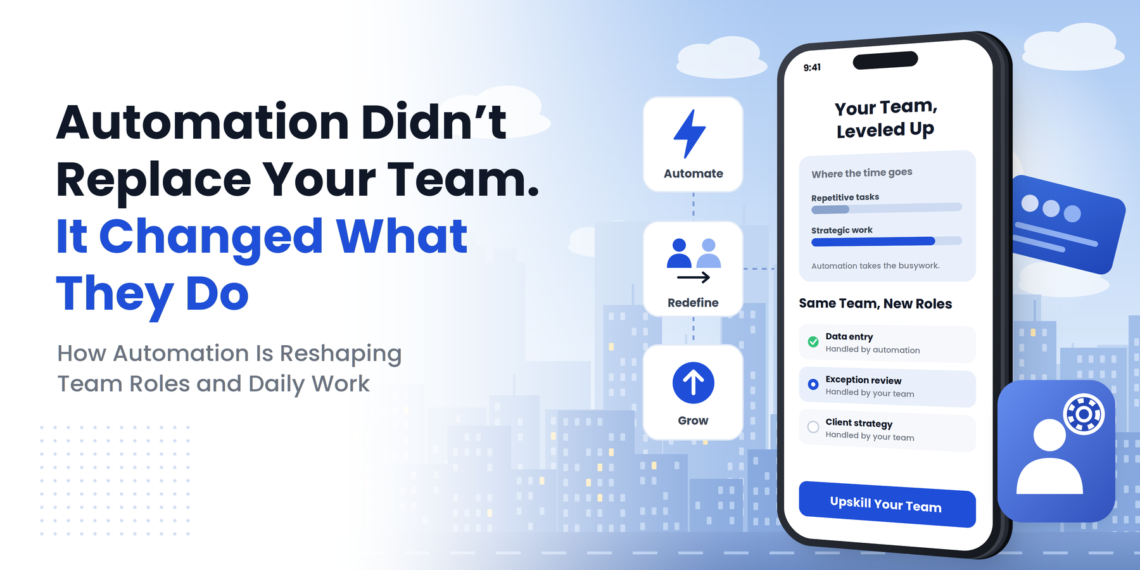
As a healthcare leader, you have likely sat through automation pitches. The promise is that claims adjudication, prior authorization review, eligibility checks, and member correspondence will lighten your team’s workload. The questions are not about the technology but about how the it is framed for employees. The most common pattern within organizations is to frame AI and process automation as a headcount reduction, and these organizations have the lowest adoption rates. On the flip side, those who have framed AI automation as capacity expansion and as a tool that will help the same team do higher-value work see productivity gains compound quarter over quarter.
This article focuses on internal AI and automation, the tools that support your clinical, administrative, and operations teams behind the scenes, rather than patient- or member-facing chatbots.
Why AI Raises the Stakes
Rule-based automation handles structured, predictable steps. AI automation can do much more, including reading unstructured documents, summarizing records, triaging exceptions, and completing entire workflows. BCG notes that most insurance workflows involve judgment and exceptions that traditional automation cannot manage, and that about 60% to 80% of operations, like claims reimbursement processes and benefits administration, can be automated.
What Capacity Expansion Looks Like
The overall goal for health insurers is to redirect human expertise rather than cut headcount. Higher-value work is where human judgment can shift outcomes. This includes complex appeals, borderline clinical decisions, fraud patterns that do not match any known signature, and personalized case support for members with chronic conditions. Agents handle intake, extraction, and eligibility checks. Experienced staff can become specialists and AI governors who monitor decision quality and maintain the rules agents follow.
Leaders who are successful with AI automation do the following three things:
1. Define new roles before deployment
Role maps and clear ownership of higher-value workstreams should exist and be distributed by day one of the launch.
2. Make the frontline experts your co-designers
BCG recommends involving caseworkers early and measuring employee experience alongside efficiency.
3. Measure what the capacity buys
Instead of measuring only the hours saved by automation, track complex case resolution times, denial rates, member satisfaction, and rework.
Communication is Part of the Architecture
According to Gallup, employees whose managers actively support AI use are 1.7 times as likely to use it regularly and 7.4 times as likely to say it helps them do their work better. Specificity is what drives the gains employees can achieve from AI automation. Simply stating that it will make the organization more efficient does not tell employees enough. Guiding employees on how they can take on more complex cases while letting the AI handle the easy work gives them something to act on.
Making It Effective at Enterprise Scale
In a large organization, the framing has to survive every layer between the executive team and the claims floor. Across multiple lines of business, legacy systems, and thousands of staff, it is important to ensure that automation is incorporated in a way that is not passive. Employees want to see manager enablement, automation built into the role design, and the necessary metrics.
Ready for Automation?
AppsChopper designs and builds AI automation solutions for healthcare and insurance organizations, centered on their people, not just their processes. From identifying the right workflows to building intelligent document processing and AI-assisted review, and supporting the change management that drives adoption, our team partners with HR leaders, COOs, and operations teams to turn AI into sustained capacity gains.
If you are planning or rethinking an automation initiative, reach out to AppsChopper to start the conversation.