Table of Contents
As digitization continues to rise and competition between businesses is ever-increasing, organizations are primarily focusing more on enhancing efficiency and productivity. That said, enterprise app development has become imperative to achieve these indispensable goals.
Having said that, the mobile enterprise application market size increased to USD 252.89 billion in 2023 and is projected to reach USD 626.39 billion by 2030, growing at a CAGR of 14.3% from 2024 to 2030.
Seeing the ever-growing demand for enterprise applications, more and more businesses are turning towards enterprise app development. Mobile enterprise applications enable organizations to mobilize their business processes and extend their brands for greater interaction with employees and clients.
All in all, enterprise mobile apps optimize the operational functioning of enterprises and enhance the performance of the workforce. By streamlining and automating business processes, companies can save time and reduce production costs tremendously.
To drive efficiency, streamline processes, and engage employees, businesses must build enterprise mobile applications. This comprehensive guide to custom enterprise mobile app development tells everything you need to know about enterprise app development to get started with it. Through this guide, we will walk you through all the crucial aspects of its types, core benefits, the ideal process, popular tools to leverage, enterprise app development cost, and much more. So without any further ado, let’s get started with it.
Ready to dive into the world of mobile enterprise app development? Perfect! Let’s dive in!
What is an Enterprise App?
An enterprise app (short for enterprise application) is software designed for use within a large organization, like a corporation, government agency, or institution, rather than for individual consumers.
Enterprise apps are built to handle complex business needs at scale, often involving many users, departments, and large amounts of data.
What Is Enterprise Mobile Application Development?
In layman’s terms, enterprise mobile development is a sophisticated approach to building a mobile app for an enterprise to streamline its business operations, workflow optimization, stakeholder engagement, and much more. It is developed with the primary goal of improving business efficiency and productivity.
The main strategy behind building an enterprise app is to improve efficiency, streamline data, or prevent data mishandling. With that being said, combining an enterprise mobile application development with a cloud-based enterprise system offers benefits like reduced operational cost and better control over the business.
Types of Enterprise Mobile Applications
Enterprise mobile applications can be categorized based on the scope of their functionality and the level of organizational access they provide. From streamlining individual employee tasks to connecting entire departments and enterprise-wide operations, each type serves a distinct business purpose.
Understanding these categories helps organizations choose the right mobile solution to improve productivity, communication, workflow management, and overall operational efficiency.
Employee Level
These are employee-focused apps designed only for internal use and are packed with limited features. These apps keep an eye on employee workflow and help executives track employees’ progress.
Department Level
These types of applications aim to facilitate the internal workflow of specific departments such as HR, finance, sales, marketing, and others. These apps incorporate department-level features and enable monitoring of subordinates’ productivity.
Enterprise Level
These apps connect various departments of an enterprise and bring the enterprise under a single umbrella. These apps enable employees from different departments to connect and communicate with higher-level executives.
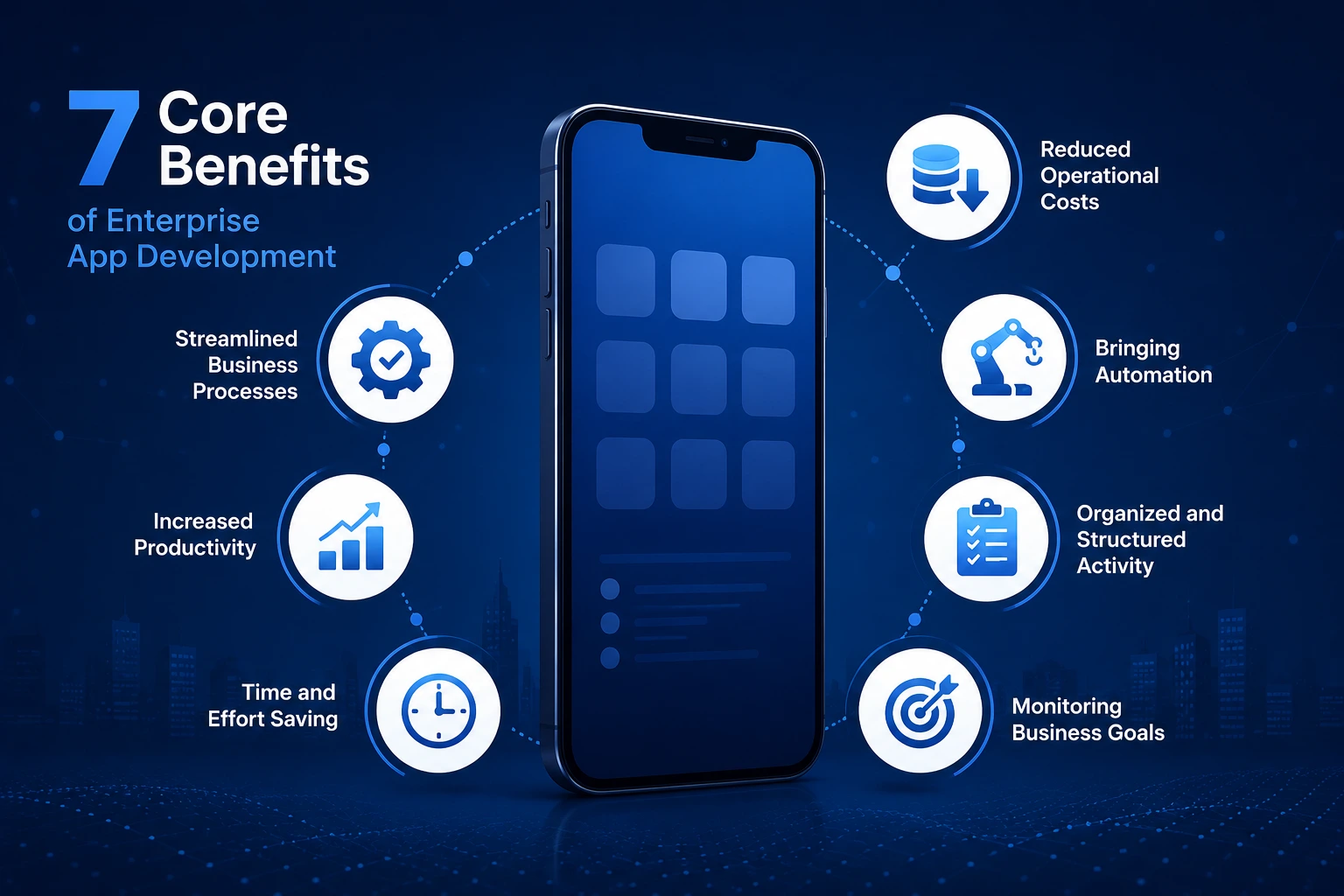
7 Core Benefits of Enterprise App Development
Enterprise app development offers businesses a wide range of advantages, from improving operational efficiency to enhancing employee productivity and reducing overall costs. By integrating advanced technologies and automating repetitive processes, enterprise applications help organizations streamline workflows and manage operations more effectively.
These applications not only simplify daily business activities but also enable better communication, data management, and performance monitoring across the organization. As businesses continue to evolve in the digital era, enterprise app development has become a crucial investment for achieving long-term growth, efficiency, and scalability.
 1. Streamlined Business Processes
Enterprise apps can streamline your business processes and fix your key company challenges effortlessly. An enterprise app can automate most of your business operations, such as common, low-value tasks. This allows employees to focus more on revenue-generating activities rather than indulging in non-productive actions. So this is one of the significant benefits of enterprise mobile development for your business.
2. Increased Productivity
Attaining higher productivity is every business’s dream. An enterprise application helps them accomplish that goal. The enterprise app plays a vital role in establishing seamless communication across various departments and between companies and customers. Therefore, an enterprise app can increase productivity, ensuring 24/7 communications.
3. Time and Effort Saving
Another noteworthy benefit of custom enterprise mobile app development is that it can save a lot of time and effort for the overall business. With enterprise mobile development, it becomes easy to perform daily tasks and address customers’ queries using the feature-rich enterprise app. All in all, enterprise apps can save all your precious time and effort and significantly ease your tasks.
4. Reduced Operational Costs
Every company strives to save money, irrespective of its size and niche. Having said that, when you integrate advancements of emerging technologies such as AI, ML, blockchain, AR/VR, and others into your enterprise app, you will add value to your business. Therefore, an enterprise app designed to bring automation can save a lot of bucks over the period and enable you to invest more wisely in other areas.
5. Bringing Automation
When employees are asked to do repetitive and mundane tasks, they become less efficient, resulting in decreased productivity. And then, they simply start avoiding those tasks or do them unwillingly. With that being said, an enterprise application can bring automation to such tasks and free employees from mundane, regular, uninteresting tasks. That will lead them to focus on other core and productive tasks.
6. Organized and Structured Activity
It’s been observed that the data generated by overall company activity is not well structured and organized. This sometimes appears confusing, resulting in a poor impact. However, an enterprise mobile app enables management to easily and rapidly access databases and archives for performing routine tasks. Data obtained from such software involves a high level of standardization.
7. Monitoring Business Goals
One of the benefits of developing enterprise mobile apps is monitoring employees’ performance and overall business productivity. That said, it would also help you manage and use your time wisely. It would be great if you could incorporate specific analytics tools to increase the overall company’s efficiency and take it to a whole new level.
7 Things to Keep in Mind While Developing an Enterprise App
Developing a successful enterprise application requires more than just integrating advanced features and technologies. Businesses must focus on creating a solution that aligns with user expectations, business objectives, performance standards, and security requirements. From understanding end users’ needs to building a scalable and secure application, every stage of enterprise app development plays a crucial role in determining the app’s success.
By keeping a few essential factors in mind during the development process, businesses can create enterprise applications that deliver exceptional user experiences, improve operational efficiency, and support long-term business growth.
Know About Your Users’ Needs
The best thing to do is to empathize. Keep yourself in your users’ shoes, and then consider enterprise mobile development. This will help you understand the expectations and pain points of your users. So think from your users’ perspective before you begin designing or coding your enterprise app. Once you create a user-centric mindset, your enterprise app will grow for sure.
Make User-Centric Design
Design is the very first thing that can make or break your app’s reputation. Therefore, it becomes imperative for you to create a visually appealing app design for your enterprise mobile application. Having said that, your enterprise mobile app should be user-centric; hence, you need to make the design user-centric as well so that they can relate better with your enterprise app and gravitate more towards it.
Focus on Performance, Not Features
Most businesses think that developing a feature-packed enterprise app will win everyone’s heart. However, it’s not the features that win users’ hearts; it’s always performance. That’s why your enterprise mobile application should focus on performance first and features later. Remember, the functionality of a mobile app is the prime factor that influences end users. So strive to create an app with easy operation and smooth navigation.
Make Your USPs More Appealing
Unique Selling Propositions (USPs) are not dead and can never be outdated. USPs are something that differentiates your app from others. If you aim to build an enterprise mobile app with some unique angle and put some greatest USPs while building the app, you can make your app stand out amid today’s clutter and noise. Also, incorporating USPs can be a great way to draw users’ attention towards your app.
Emphasize MVP
Rather than aiming to incorporate too many features all at once, try making the app MVP-centric. An effective app is never loaded with too many features; it always follows the MVP path. What is MVP? It’s a minimum viable product, which means having enough features to attract early adopters. Later on, adding the features based on the users’ feedback and recommendations. Aiming for MVP app development is always a lucrative move.
Map the Business Objectives
Before you begin your enterprise app development, you must map your business objective. What number of target audiences do you want to reach? What will be the overall app development cost? What’s your budget? What features can improve customer retention and adoption? You need to find answers to these questions to know about the objective of the business and ensure high popularity.
Create Robust Security
No one wants to access an application that can compromise their security, especially in today’s times, when you hear the news of data breaches every other day. Having said that, you need to develop an enterprise mobile app that can keep intruders and hackers far away. To do so, you can leverage security measures like SSL encryption, X-frame options, security testing, and more.
Step-by-Step Enterprise Mobile App Development Process
Building a successful enterprise mobile application requires a well-structured development process that transforms an idea into a fully functional and scalable solution. From identifying business requirements and selecting the right platform to designing, development, testing, deployment, and post-launch support, every stage plays a critical role in the app’s overall success.
Following a step-by-step enterprise mobile app development process helps businesses minimize risks, improve efficiency, and ensure the application aligns with user expectations and organizational goals. A systematic approach also enables companies to deliver secure, high-performing, and future-ready enterprise applications.
Outline Your Ideas and Specifications
It’s an undeniable reality that every successful app starts with a promising idea, and enterprise app development is no different at all. It’s essential to explore the aim and goals more deeply and frame the strategies accordingly for better outcomes. So in this step, you must identify the requirements and pain points of your app audience and outline the idea and specification, considering that only.
Choosing the Platform(s)
Well, to make the process easier, be where your users are. That means choosing the platform based on your users. However, enterprise application developers suggest having an enterprise mobile app on both iOS and Android platforms to succeed. Why? Because they’re the leading OS with more than 99% of market share (combined), dominating the market right now.
Deciding the Functionality
In this step, you need to determine the core functionality you would want to have in your enterprise mobile application. You can think of integrating all the core features depending on your users and goals. Based on the functionality, the app development company will shape the entire app that will appear completely irresistible to your users. As a result, you will gain more downloads and ultimately more ROI.
Prototyping and Design
Once you decide the goal, platform, and functionality, the very next step is prototyping and designing. Based on your functionality, the app design firm will create a prototype and then begin the overall UI/UX design process. Prototyping and designing will help you know the features and aesthetics of your enterprise mobile application. UI/UX app designers will focus on creating more intuitive, attractive, and user-friendly app designs.
App Development
This is one of the most crucial aspects of the custom enterprise mobile app development process. In this step, your hired app development company codes the app based on the prepared designs. They work on the front-end and backend app development, integrating the right set of features and ensuring that the back-end is entirely secured. Also, it can go a long way in ensuring the app’s sustainability and scalability. All in all, they turn your design into a full-fledged working app.
Enterprise Mobile App Testing
This is one of the most imperative steps in enterprise app development; however, it’s also the most overlooked aspect. You need to ensure that your enterprise mobile app is tested thoroughly for any sort of bugs, glitches, errors, or so. For that, you must hire a reliable mobile app testing company that can perform meticulous testing and deliver a flawless, reliable, and user-ready enterprise mobile application.
App Launch
Once everything is ready, it’s time to market your enterprise mobile app. This can be considered the final chapter of your enterprise app development process. So if you have targeted both iOS and Android, your app will be deployed to the App Store and Play Store accordingly. That said, once you meet their guidelines, your app will be launched. What will be the next step after that? Also, for a better launch strategy, you can opt for greater mobile app launch services.
Post Launch Maintenance
Post-launch maintenance and support matter a lot in keeping your enterprise app up and running. To ensure that, you need a lot of ongoing app management, maintenance, and support. Also, as an application gets in the hands of app users, feedback will pour in, and for future versions of the app, you will need to incorporate that as an app update. So it’s crucial to hire a renowned mobile app maintenance company that can handle all your post-launch maintenance jobs effortlessly.
What are the Enterprise Application Development Tools and Technologies?
Enterprise application development requires a robust set of tools and technologies to build scalable, secure, and high-performing applications. From front-end frameworks and backend technologies to cloud enterprise mobile app development platforms, databases, and testing tools, every technology stack plays a crucial role in the overall development process.
Choosing the right tools not only accelerates development but also ensures better app performance, seamless integrations, enhanced security, and long-term scalability. Depending on business requirements, developers select technologies that support enterprise-grade functionality, cross-platform compatibility, and smooth user experiences.
| Category | Tools & Technologies |
| Front-End Development | React Native, Flutter, Angular, React.js |
| Back-End Development | Node.js, Java, .NET, Python, PHP |
| Mobile App Development | Swift, Kotlin, Xamarin |
| Database Management | MySQL, PostgreSQL, MongoDB, Firebase |
| Cloud Platforms | AWS, Microsoft Azure, Google Cloud |
| API & Integration Tools | REST APIs, GraphQL, Postman |
| DevOps & CI/CD | Jenkins, Docker, Kubernetes, GitHub Actions |
| Security Technologies | SSL Encryption, OAuth, JWT, MFA |
| Testing Tools | Selenium, Appium, JUnit, TestNG |
| Analytics & Monitoring | Google Analytics, Firebase Analytics, New Relic |
How Much Does Enterprise App Development Cost?
How much does mobile app development cost? This is one of the most common questions all companies get. However, this is one of the simplest questions to ask, but the hardest to answer.
Why?
Because there’s no one-size-fits-all answer to this million-dollar question, there can never be. It can vary from purpose to purpose and business objective. There can be an estimate, but no one can tell you an exact figure for your enterprise app development cost.
That said, depending on your enterprise app types, goals, features, functionalities, design, budget, and more, you can figure out the estimated enterprise mobile app development cost. Your app features, development timescales, the platform you choose, development iterations, and others are the biggest cost drivers in enterprise app development costs.
| Enterprise App Type | Estimated Development Time | Approximate Cost Range |
| Basic Enterprise App | 2–4 Months | $30,000 – $70,000 |
| Medium Complexity Enterprise App | 4–8 Months | $70,000 – $120,000 |
| Advanced Enterprise App | 8–12+ Months | $120,000 – $300,000+ |
Concluding Thoughts
Whether you’re looking to engage your employees, streamline your internal business processes, or increase your overall business efficiency, an enterprise app is needed. We hope this comprehensive guide to mobile app development for enterprises gave you an in-depth breakdown of everything you need to know to get started with it.
So are you all set to develop enterprise mobile apps backed with automation techniques and quality features that can contribute to your overall company’s success? Get started towards development right now, then! Good Luck.
We would love to hear your comments relating to the post. Got some other thoughts? Drop us a word through our contact page.
Frequently Asked Questions
1. How long does it take to build enterprise mobile app?
Enterprise mobile app development usually takes 2–12 months, depending on the app’s complexity, features, integrations, and platforms.
2. Which platforms are best for enterprise mobile applications?
iOS and Android are the most preferred platforms. Businesses often choose cross-platform technologies like Flutter and React Native for faster and cost-effective development.
3. Do enterprise mobile apps require ongoing maintenance?
Yes, enterprise apps need regular maintenance for bug fixes, security updates, performance improvements, and compatibility with new devices and OS versions.
4. What industries benefit from enterprise mobile app development?
Industries like healthcare, finance, retail, logistics, education, manufacturing, and eCommerce benefit greatly from enterprise mobile applications.