Table of Contents
The way healthcare organizations operate, communicate, and care for patients has changed dramatically over the past decade, and at the center of that shift is healthcare software development. From hospitals streamlining patient records to startups building remote monitoring tools, every corner of the industry now relies on digital systems to function efficiently and safely.
Whether you are a healthcare provider, a startup founder, or simply curious about how digital health tools come to life, this guide breaks down everything you need to know, from the basics to costs, types, and the development process itself.
What Is Healthcare Software Development and Why Does It Matter?
At its core, healthcare software development is the process of designing, building, testing, and maintaining digital tools that support clinical, administrative, and operational functions within the healthcare industry. This can include everything from electronic health record (EHR) systems to mobile apps that help patients track medication schedules.
What sets this field apart from general software development is the layer of complexity added by regulations like HIPAA, GDPR, and HL7/FHIR data standards. Every application must be built with patient privacy, data security, and interoperability in mind from day one. Beyond compliance, the stakes are simply higher: a bug in a scheduling app is an inconvenience, but a bug in a medication dosage calculator can be dangerous.
That is why healthcare organizations increasingly turn to specialized teams of healthcare software developers who understand both the technical and regulatory landscape, rather than relying on general-purpose developers who may not be familiar with clinical workflows or compliance requirements.
The Rise of Custom Healthcare Software Development
Off-the-shelf software can work for general business needs, but healthcare is rarely “general.” Every clinic, hospital network, or telehealth company has its own workflows, patient populations, and compliance obligations, which is why custom healthcare software development has become a popular path for organizations that want technology built specifically around how they operate.
Custom solutions allow healthcare organizations to:
- Integrate seamlessly with existing systems like EHRs, lab systems, and billing platforms
- Build features tailored to specific specialties, such as cardiology, oncology, or behavioral health
- Scale the software as the organization grows, without being locked into a vendor’s roadmap
- Maintain tighter control over data security and compliance configurations
Partnering with a custom healthcare software development company also means having a dedicated team that understands your long-term goals, rather than a one-size-fits-all product that requires constant workarounds. Many organizations choose to work with providers of healthcare software development services specifically because they offer end-to-end support, from initial strategy through ongoing maintenance and updates.
Exploring the Different Types of Healthcare Software
Healthcare software is an umbrella term covering dozens of tools, each designed to solve a specific problem within the care continuum. Some of the most common types of healthcare software include:
1. Electronic Health Records (EHR) and Electronic Medical Records (EMR) systems, which store and manage patient health information digitally
2. Practice management software, which handles scheduling, billing, and administrative workflows
3. Telemedicine platforms, which allow patients to consult with providers remotely via video or chat
4. Patient portals, which give patients access to their records, lab results, and appointment scheduling
5. Healthcare CRM systems, which help organizations manage patient relationships, outreach, and communication
6. Remote patient monitoring (RPM) tools, which track vitals and health data from wearable devices
7. Medical billing and revenue cycle management software
8. Clinical decision support systems, which assist providers in diagnosis and treatment planning
Among these, healthcare CRM software development has seen particular growth as organizations look for better ways to manage patient acquisition, retention, and communication, especially as more care moves to outpatient and virtual settings. For a closer look at how connected devices and wearables fit into this picture, this guide to IoT in healthcare breaks down common use cases and platforms.
Real World Healthcare Software Examples Worth Knowing
To understand how these categories play out in practice, it helps to look at some practical examples of healthcare software that are widely used today.
Large hospital systems often rely on enterprise EHR platforms to manage patient charts across multiple departments and locations. On the patient-facing side, telehealth apps have become a staple for primary care, mental health counseling, and even specialist consultations, especially since virtual care adoption accelerated in recent years. If you want a deeper dive into how these patient-facing tools improve communication, this overview of mobile apps and doctor-patient interaction is worth a read.
AI in healthcare software is another fast-growing field, where machine learning models aid with tasks like medical image analysis, predicting risks for chronic diseases, and automating administrative duties such as clinical documentation. Instead of reducing the number of clinicians, these tools reduce time spent on repetitive tasks, allowing providers to devote more attention to patient care.
Smaller, more specialized examples include medication adherence apps, appointment reminder systems, and tools that help patients estimate out-of-pocket costs before a procedure. Each example shows how software, when designed thoughtfully, can solve a specific, real-world problem in the healthcare experience.
Breaking Down the Healthcare Software Development Process
Building reliable, compliant healthcare technology requires more structure than a typical app development project. The healthcare software development process typically follows these stages:
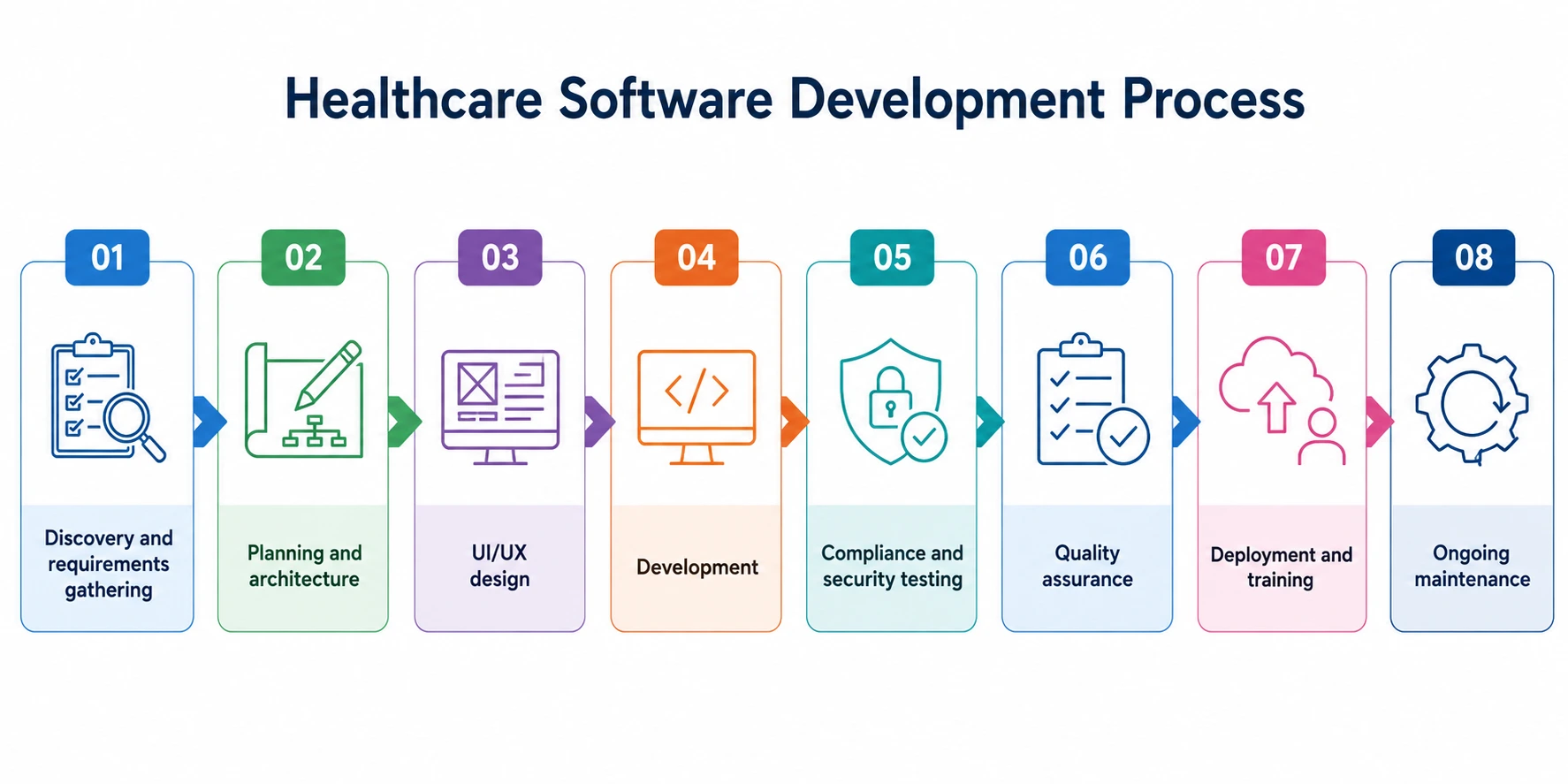
 1. Discovery and requirements gathering:
Understanding the clinical workflow, user needs, and regulatory requirements before any code is written
2. Planning and architecture:
Deciding how the system will be structured, what integrations are needed (EHRs, lab systems, billing), and how data will be stored securely
3. UI/UX design:
Creating interfaces that are intuitive for both clinical staff and patients, since usability directly affects adoption and safety
4. Development:
Writing the actual code, often in iterative sprints so stakeholders can review progress along the way
5. Compliance and security testing:
Verifying that the software meets HIPAA, HL7/FHIR, and other relevant standards
6. Quality assurance:
Rigorous testing to catch bugs, especially in features tied to clinical decisions or patient data
7. Deployment and training:
Rolling out the software and training staff on how to use it effectively
8. Ongoing maintenance:
Updates, bug fixes, and improvements based on real-world usage and changing regulations
Following a structured medical software development process reduces the risk of costly rework later and helps ensure the final product fits how clinicians and patients work daily. Skilled healthcare software developers are essential at every stage, from writing code to asking the right questions about workflows, edge cases, and compliance early on.
Understanding Healthcare Software Development Cost
One of the first questions any organization asks is about healthcare software development cost, and the honest answer is that it varies widely depending on several factors.
Key cost drivers include the following:
| Cost Driver | Impact on Cost |
| Project complexity | A simple appointment scheduling app costs far less than a full EHR system with integrations across multiple departments |
| Compliance requirements | Building in HIPAA-compliant security, audit logs, and data encryption from the start adds development time |
| Integrations | Connecting to existing EHRs, lab systems, payment processors, or insurance databases requires additional engineering work |
| Team structure | An in-house team, a freelance developer, or an outsourced agency each have different cost structures |
| Ongoing maintenance | Post-launch support, updates, and security patches are all ongoing costs |
Smaller applications like patient portals often cost tens of thousands of dollars, while larger systems like custom EHRs can reach six or seven figures. For a more detailed breakdown of pricing across different app categories, this guide on healthcare app development costs walks through the variables in greater depth. The best approach is to start with a minimum viable product (MVP) and expand based on user feedback, rather than building everything at once.
Why Choose Custom Software Development for Healthcare Organizations?
Given the cost considerations above, some organizations wonder whether custom development is worth it compared to buying an existing product. In most cases, custom software development for healthcare organizations pays off over the long run, particularly as the organization grows or its needs become more specialized.
The advantages include:
- Better alignment with actual clinical workflows, rather than forcing staff to adapt to generic software
- Stronger data ownership and control, since the organization is not dependent on a third party vendor’s infrastructure decisions
- Easier long term scalability, as new features can be added without waiting on a vendor’s product roadmap
- A competitive edge, since custom tools can be designed around what makes the organization’s care model unique
For organizations without an internal engineering team, the right move is often to develop healthcare software in partnership with experienced specialists who can guide both the technical build and the compliance side of the project, rather than trying to manage both independently. If insurance is part of your organization’s focus, this guide to health insurance app development covers the features and considerations specific to that space.
Key Considerations in Healthcare Software Application Development
Before starting a project, it is worth thinking through a few key factors that influence healthcare software application development from the very beginning.
Security and compliance:
HIPAA compliance, data encryption, access controls, and audit trails need to be part of the architecture from the start, not bolted on after launch
Interoperability:
Healthcare data rarely lives in one system, so any new application should be designed to communicate with EHRs, lab systems, and other tools using standards like HL7 and FHIR
User experience:
Clinicians are often working under time pressure and patients may not be tech savvy, so interfaces need to be simple, intuitive, and accessible across devices
Scalability:
An application built for a single clinic should be able to grow into a multi-location deployment without requiring a complete rebuild
Getting these four areas right from the start lays out the foundation for software that is secure, adaptable, and genuinely useful to the people who rely on it every day.
Final Thoughts
Healthcare software development sits at the intersection of technology, compliance, and patient care, making it one of the more complex yet rewarding areas of software engineering today. Whether you are exploring custom solutions, evaluating costs, or simply trying to understand the different types of tools available, the key is to start with a clear understanding of your organization’s workflows and goals before diving into development.
For organizations ready to take the next step, partnering with a team that offers comprehensive healthcare software development services and has real experience navigating healthcare’s unique requirements can make the difference between a tool that gets adopted and one that gathers dust. With the right approach, healthcare software actively improves how care is delivered.
Frequently Asked Questions
1. How long does it take to develop healthcare software?
Timelines vary widely by scope, ranging from a few weeks for a simple MVP to 12 months or more for complex systems such as custom EHR platforms. Compliance requirements and integration needs are often the primary drivers of extended project timelines.
2. What is the future of AI in healthcare software?
AI will increasingly influence diagnostics, predictive analytics, and documentation, helping providers detect issues early and reduce administrative tasks. Eventually, AI tools will become a standard part of healthcare software instead of standalone features.
3. What technologies are commonly used in healthcare software development?
Common technologies include cloud platforms such as AWS and Azure, interoperability standards such as HL7 and FHIR, and programming languages such as Python, Java, and JavaScript. Secure databases and encryption frameworks are also essential for safeguarding patient data.
4. What security measures are essential in healthcare software?
Essential measures include end-to-end data encryption, role-based access control, detailed audit logs, and full HIPAA compliance. Regular security testing and vulnerability assessments are also critical to keep pace with evolving threats.
5. What industries can benefit from healthcare software development?
Beyond healthcare facilities, industries like insurance, pharmaceuticals, telehealth, fitness, wellness, and medical device makers depend on custom software. Organizations managing patient data, clinical workflows, or health services benefit from tailored digital tools.