Table of Contents
Every morning, thousands of commuters stand on crowded city curbs, watching busy streets pass by as empty seats sit inside single-occupant cars. Traditional urban transportation feels broken. Rising fuel costs, endless traffic, and unpredictable public transit schedules make the daily commute stressful.
Meanwhile, transport operators face their own silent crisis. Despite having plenty of vehicles and drivers, they struggle to deliver a smooth journey. Outdated manual booking systems, poor tracking, and revenue loss to global megacorporations leave drivers waiting idle while riders face long pickup times, unclear fares, and limited payment options.
Recognizing this gap, investing in custom ride sharing app development has shifted from a tech luxury to an urgent necessity. Regional operators can no longer afford a fragmented service. They need a connected digital platform that matches nearby riders with drivers, manages bookings, and provides real-time trip visibility.
The financial opportunity is massive. According to Fortune Business Insights, the global ride-sharing market was valued at $144.10 billion in 2025 and is projected to reach $170.32 billion in 2026.
Yet building a successful platform isn’t just about adding a booking button. Transport businesses must solve real-world challenges, including driver availability, route optimization, secure payments, and safety, all while keeping the experience simple for everyone.
How much longer will passengers settle for delayed rides when a smarter, locally tailored solution is just a tap away?
This guide explains the features, development process, technology considerations, and costs so businesses can plan the project more realistically.

Image Source: Fortune Business Insights
What is a Ride Sharing App?
A ride-sharing app is a digital platform that connects people who need transportation with drivers or other travelers through a mobile or web-based system.
Depending on the business model, the platform can support:
- On-demand rides
- Scheduled rides
- Carpooling
- Corporate transportation
- Airport transfers
- Campus transportation
- Intercity travel
- Bike or scooter sharing
- Fleet-based transportation
It is useful to distinguish ride-sharing from ride-hailing.
In a traditional ride-hailing model, a passenger requests a vehicle and an available driver fulfills the trip. In a carpooling model, multiple passengers may share a journey with a driver traveling along a similar route.
The distinction affects the product architecture. A carpooling platform may need route compatibility and seat management, while an on-demand service may prioritize real-time dispatch, driver availability, and rapid matching.
Why Ride Sharing App Development Is a Marketplace Decision
A ride sharing platform connects two groups who depend on each other. If riders wait too long, they leave. If drivers earn too little, they leave. Decisions about pricing, matching, and launch area therefore matter as much as the code, and they shape your return on investment.
1. Choose Your Model First
Different models need different features, pricing, and licenses, so settle this before you ask anyone for an estimate.
- Ride-hailing: One rider books one car on demand.
- Ride pooling: Several riders share one vehicle and split the fare. Fares per rider drop, but matching gets harder.
- Carpooling: Private drivers with planned trips share empty seats, often for commutes or intercity travel.
- Business-paid rides: A company pays for rides for employees, guests, or customers.
- Bike and micro-mobility: Motorcycles, bicycles, and e-bikes, covered in a later section.
2. Optimize for Marketplace Density Before Scaling
Rather than launching citywide, successful platforms first build liquidity in a tight geographic zone. Dominating a single neighborhood creates the quick pickup times and steady driver earnings needed to prove your unit economics before expanding.
What does a Ride-Sharing Platform Actually Need?
One of the most important points businesses often overlook is that a ride-sharing product is not just a passenger app.
A production-ready platform generally consists of several connected components:
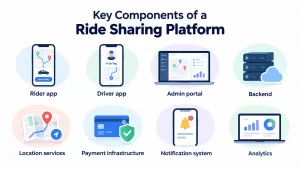
| Component | Main purpose |
| Rider app | Search, booking, tracking, payments, and trip management |
| Driver app | Availability, trip requests, navigation, earnings, and trip management |
| Admin portal | User, driver, trip, payment, and operational management |
| Backend | Business logic, APIs, matching, authentication, and data processing |
| Location services | GPS, geocoding, routing, and real-time tracking |
| Payment infrastructure | Rider payments, refunds, commissions, and driver payouts |
| Notification system | Push notifications, SMS, email, and in-app alerts |
| Analytics | Operational, financial, and user-performance reporting |
This architecture matters because adding another feature later can become expensive if the initial backend is not designed to support it.
For example, a business that initially supports only individual rides may later want scheduled rides, corporate accounts, and multi-stop trips. If the original system has been built around a rigid booking flow, adding those capabilities may require significant backend changes.
Which Features Should a Ride-Sharing App Include?
A functional ride-sharing platform is not a single app. It is a connected system of three parts: rider (passenger), driver, and an admin/backend panel. Each must work in real time with reliable matching, accurate location data, and secure payments. When any of these foundations fails, trust erodes quickly, and users leave.
The features below are organized by role. Core capabilities form the minimum viable product. Advanced options help the platform stand out and generate stronger retention and revenue once the basics are solid.
Rider-Side Features for Ride Sharing App Development
These determine whether passengers return after the first ride.
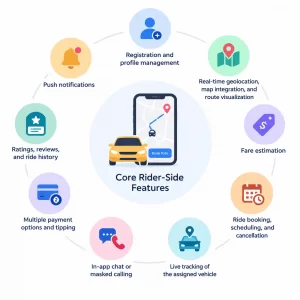
Registration and profile management
Users should be able to sign up with email, phone number, or social login. Profiles store preferred payment methods, home and work locations, and past destinations. A clean onboarding flow reduces drop-off. Many riders abandon the process if it requires too many steps or unnecessary personal details early on.
Real-time geolocation, map integration, and route visualization
Accurate pickup and drop-off pins, live vehicle movement on the map, and clear route previews are non-negotiable. Riders want the estimated arrival time to update as the driver approaches. Poor map accuracy or delayed location updates create friction and support tickets. Integration with established mapping services (with offline fallback where possible) is essential.
Fare estimation
Before confirming a ride, the app should display a clear price or price range based on distance, expected time, current traffic, vehicle type, and any surge. Transparent estimates reduce cancellation rates and complaints. Showing how the fare is calculated (base + distance + time + fees) builds confidence, especially for first-time users.
Ride booking, scheduling, and cancellation
Immediate booking is the default. Scheduled rides and the ability to book for someone else add convenience for airport trips, medical appointments, or family needs. Cancellation policies must be clear and fair, as riders should understand any fees before they cancel. Flexible options here increase usage frequency.
Live tracking of the assigned vehicle
Once a driver accepts, riders need continuous visibility of the vehicle’s location and ETA. This reduces anxiety and the need to call the driver. Sharing the live trip link with family or colleagues is a simple safety feature many users value.
In-app chat or masked calling
Exposing direct phone numbers creates privacy and safety risks. Masked calling or in-app messaging lets riders and drivers coordinate pickup details without sharing personal contact information. This is particularly important for late-night or solo rides.
Multiple payment options and tipping
Integrating digital wallets enables secure, seamless transactions, while automatic post-ride charging, clear digital receipts, and easy tipping create a smoother payment experience. Split-payment options for group rides can also make shared trips more convenient while increasing the average ride value.
Ratings, reviews, and ride history
Two-way ratings help maintain quality. Riders should see past trips with receipts and be able to rebook frequent routes. Transparent history also supports expense tracking for business users.
Push notifications
Timely updates on driver assignment, arrival, and ride completion keep users informed without requiring them to keep the app open. Well-timed promotional notifications (with clear opt-out) can drive re-engagement without feeling spammy.
Driver-Side Features
Drivers are independent contractors in most models. Ride-sharing app features must make their work efficient and transparent, or drivers will multi-home on competing platforms.
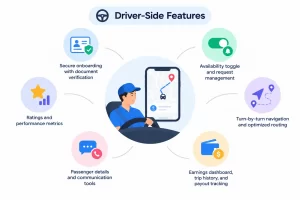
Secure onboarding with document verification.
Drivers upload licenses, vehicle registration, insurance, and sometimes background-check consent. The system should support guided document capture, status tracking, and admin review. Slow or opaque verification is a common reason quality drivers never activate.
Availability toggle and request management
Drivers need a simple online/offline switch and the ability to accept or decline requests with enough information (pickup distance, destination direction, estimated earnings) to decide quickly. Showing destination filters or preferred zones helps drivers stay in profitable areas.
Turn-by-turn navigation and optimized routing
Integrated navigation that accounts for real-time traffic, road closures, and preferred routes saves time and fuel. Drivers often prefer the app’s navigation over switching to a separate maps app. Accurate routing also improves on-time performance and rider ratings.
Earnings dashboard, trip history, and payout tracking
Clear visibility into daily and weekly earnings, tips, commissions deducted, and upcoming payouts builds trust. Drivers should be able to see which trips contributed to incentives or bonuses. Instant or near-instant payout options (where legally and financially feasible) are a strong retention lever.
Passenger details and communication tools
Drivers need the rider’s name, rating, and pickup notes without exposing full contact details. In-app messaging or masked calling reduces pickup friction. Safety tools that let drivers share their live trip with a trusted contact are increasingly expected.
Ratings and performance metrics
Drivers benefit from seeing their acceptance rate, completion rate, and average rating. Constructive feedback helps them improve. Platforms that surface these metrics transparently tend to maintain higher service quality.
Admin Panel and Backend Essentials
This is the operational control center. Weak admin tools push teams into spreadsheets and manual workarounds that don’t scale.
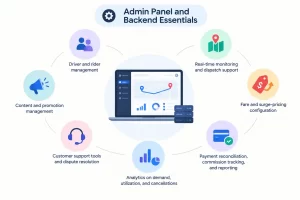
Driver and rider management
Admins need tools to approve, suspend, or deactivate accounts; review documents; and handle disputes. Searchable profiles with activity history speed up support and compliance work.
Real-time ride monitoring and dispatch support
A live map of active trips, available drivers, and demand heat lets operations teams intervene when matching fails or a driver needs help. Manual dispatch capability is useful during system issues or in low-density areas.
Fare and surge-pricing configuration
Operators should be able to set base rates, per-kilometer and per-minute charges, minimum fares, and surge multipliers by zone or time of day. Clear rules and audit logs prevent pricing disputes.
Payment reconciliation, commission tracking, and reporting
Automated tracking of rider payments, driver payouts, platform commissions, and refunds is essential for financial accuracy. Exportable reports support accounting and tax requirements.
Analytics on demand, utilization, and cancellations
Dashboards showing peak hours, popular corridors, driver utilization rates, and cancellation reasons help operators adjust supply, pricing, and marketing. Without this data, decisions remain guesswork.
Customer support tools and dispute resolution
Ticket systems linked to specific rides, chat logs, and payment records allow support agents to resolve issues faster. Structured dispute workflows (rider claims, driver claims) reduce back-and-forth.
Content and promotion management
Admins should be able to create promo codes, referral campaigns, and in-app banners without engineering involvement. Controlled rollouts of new messaging reduce risk.
These core capabilities form the foundation of most ride sharing app development projects. Matching accuracy, mapping reliability, and payment security are the areas where shortcuts most often damage user trust and retention.
Advanced and Differentiating Capabilities for Ride Sharing App Development
Once the core platform is stable, these features create competitive advantage and additional revenue streams.
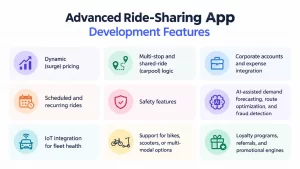
Dynamic (surge) pricing
Prices rise in high-demand periods to attract more drivers and balance supply. When implemented transparently (with clear explanations to riders), it improves availability without permanent price increases. Poorly communicated surge, however, generates strong negative reactions.
Multi-stop and shared-ride (carpool) logic
Allowing intermediate stops or matching multiple riders heading in the same direction increases vehicle utilization and can lower per-person cost. The matching algorithm must protect time and route efficiency for both drivers and passengers.
Corporate accounts and expense integration
Businesses often need centralized billing, ride policy controls (allowed times, locations, or vehicle classes), and automatic expense coding. This segment tends to have higher lifetime value and more predictable demand.
Scheduled and recurring rides
Airport transfers, daily office commutes, and school runs benefit from booking. Recurring options reduce daily decision friction for frequent users.
Safety features
An emergency button that shares live location with emergency contacts or local authorities, trip sharing, and driver/rider identity verification (photo checks at pickup) address real concerns, especially for late-night or solo travel. These features also support regulatory expectations in many markets.
AI-assisted demand forecasting, route optimization, and fraud detection
Machine learning app development models can predict busy zones and times, suggest optimal driver positioning, improve routing under changing conditions, and flag suspicious payment or account behavior. The value shows up in higher utilization, fewer empty miles, and reduced fraud losses.
IoT integration for fleet health
When the operator owns or manages vehicles, sensors for location, diagnostics, and maintenance alerts help keep the fleet reliable. This is less common in pure peer-to-peer models but valuable for company-operated or hybrid fleets.
Support for bikes, scooters, or multi-modal options
Extending the platform to micromobility creates a broader mobility offering. Users can choose the most suitable mode for short trips, and the operator captures more of the journey. Hardware integrations (locks, battery status) and different pricing models are required.
Loyalty programs, referrals, and promotional engines
Points, ride credits, or tiered benefits encourage repeat usage. Referral programs that reward both the referrer and the new user remain one of the most cost-effective acquisition channels when fraud is controlled.
Evaluate each advanced feature against clear business goals, such as higher utilization, better retention, new revenue, or regulatory compliance, rather than adding it simply because competitors have it. Prioritize based on the specific market, user base, and operational model.
A well-designed feature set balances rider convenience, driver economics, and operator control. Successful platforms treat these three sides as interdependent, not separate products.
Build, Buy, or Blend: Which One to Choose for Ride Sharing App Development Solutions?
You have several ways to get a platform. The right one depends on how different your model is and how fast you need to move.
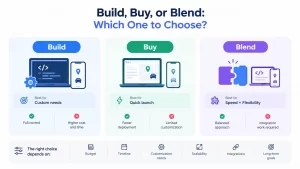
| Approach | Best for | Advantages | Notes |
| Custom build | A distinctive model, plans to scale, need to own data and features | Full control and ownership, tailored experience | Higher upfront cost, longer timeline |
| White-label platform | Testing a market quickly | Faster start, lower upfront cost | Limited customization, license fees, dependence on the vendor’s roadmap |
| No-code builder | A simple local service or pilot | Fastest and lowest cost | Limits on live tracking and scale; vendors of these tools acknowledge advanced live driver tracking needs custom backend work |
| Blend | Growing operators | Launch on a ready base, then replace parts with custom modules | Needs planning so the pieces fit together |
Ask three questions to decide.
- Does your model differ from what exists?
- Is rider and driver data a core asset you must own?
- Will your volume need performance a template cannot give?
Two or more “yes” answers point to custom ride sharing app software development.
Step-by-Step Ride-Sharing App Development Process
Creating a mobility app requires an agile engineering methodology to ensure safety, security, and performance under peak load conditions.
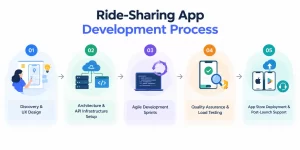
Phase 1: Discovery & UX Design
Conduct competitor analysis and map out user journey flows for riders and drivers. Then, create wireframes and interactive prototypes in Figma, prioritizing frictionless 2-tap ride requests and clear driver navigation interfaces.
Phase 2: Architecture & API Infrastructure Setup
Next, establish cloud infrastructure environments (AWS/GCP), configure CI/CD pipelines, and define microservices schemas. Integrate map routing APIs, SMS authentication gateways, and spatial database tables (PostGIS).
Phase 3: Agile Development Sprints
- Sprint 1–2: Core authentication, profile management, and driver verification workflows.
- Sprint 3–4: Set up real-time WebSocket connections, map rendering, and live GPS location broadcasting.
- Sprint 5–6: Build the ride-request dispatching algorithm, fare-estimation engine, and in-app payment integrations.
- Sprint 7–8: Build the admin console dashboard, push notifications, driver earnings, and rating systems.
Phase 4: Quality Assurance & Load Testing
- Geofence & GPS Simulation: Rigorous testing using simulated movement routes across varying cellular signal strengths (4G/5G/Offline fallback).
- Load & Stress Testing: Simulating thousands of simultaneous driver pings to ensure WebSocket servers maintain low latencies under peak load.
- Security Audits: OWASP vulnerability scans, PCI-DSS payment compliance validation, and data encryption verification (TLS 1.3 in transit, AES-256 at rest).
Phase 5: App Store Deployment & Post-Launch Support
Navigate Apple App Store and Google Play Store review guidelines (specifically surrounding background location permissions and safety guidelines). Provide ongoing SLA support, database index optimization, and continuous feature expansion based on telemetry analytics.
Regulatory Compliance & Legal Requirements
Launching a ride-sharing platform involves navigating strict regional regulations, data privacy mandates, and transport authority guidelines. Ignoring these compliance requirements can lead to massive fines, app store removals, or total operational shutdowns.
- Transport Authority & Regional Licensing: Platforms must comply with local Department of Transportation (DoT) regulations. This includes commercial vehicle licensing, digital taxi permits, and municipal medallion requirements.
- Driver Screening & Background Checks: Integrating third-party verification APIs (such as Checkr or IdentityMind) to run criminal history checks, motor vehicle record (MVR) reviews, and continuous license status monitoring.
- Data Privacy Laws (GDPR, CCPA, HIPAA): Ride sharing apps track precise GPS locations continuously. You must implement strict consent mechanisms, right-to-be-forgotten protocols, data encryption (AES-256 at rest, TLS 1.3 in transit), and transparent privacy policies.
- Payment Security & Financial Regulations: Adherence to PCI-DSS standards for storing or processing credit card information. Operating in Europe requires compliance with PSD2 and Strong Customer Authentication (SCA) for 3D Secure payments.
- Insurance & Commercial Liability: Ride sharing software must track multi-phase insurance coverage:
- Phase 1: App on, waiting for request (Contingent liability).
- Phase 2: En route to pick up passenger (Primary commercial liability).
- Phase 3: Passenger in vehicle (Full coverage including uninsured motorist protection).
Technical Stack for Ride Sharing App Development
Building a reliable, fast ride-sharing platform requires the right technology stack to handle thousands of real-time location updates every second without slowing down.
| Layer | Technologies / Tools |
| Frontend Layer | iOS: Swift, SwiftUI Android: Kotlin Cross-Platform: Flutter, React Native Communication: HTTPS, WebSockets, gRPC |
| API & Gateway Layer | API: NGINX/Kong API Gateway: GraphQL, REST |
| Backend Services | Node.js, Go, Python Microservices: Kafka (Event Bus) Redis (Geohashing) |
| Database & Maps | PostgreSQL + PostGIS, MongoDB (Logs), Google Maps SDK, Mapbox Matrix |
How Much Does Ride Sharing App Development Cost
The costs of ride sharing software development vary based on feature complexity, platform targeting, backend scaling needs, and the location of your software engineering team.
Cost Breakdown by Platform Complexity
| Development Approach/Scope | Scope & Functional Capabilities | Timeline | Estimated Cost Range |
| Minimum Viable Product (MVP) |
| 3–4 Months | $30,000 – $50,000 |
| Advanced Mid-Tier App |
| 5–7 Months | $60,000 – $110,000 |
| Enterprise Scalable Solution |
| 8–12+ Months | $120,000 – $220,000+ |
What Drives the Ride Sharing App Software Development Price
Model and Features: Pooling costs more than simple hailing because matching is more complex.
Platforms: iOS, Android, and web each add development work. Native builds generally cost more than cross-platform solutions.
Design: Custom, polished UI/UX takes more time and resources than standard templates.
Integrations: Maps, payment gateways, SMS, identity verification, and other integrations require additional setup and testing.
Custom vs. Reused Components: Reusing proven components can reduce development costs and risks.
Team Size and Location: Development rates and delivery speed vary based on team size, expertise, seniority, and location.
Security and Compliance: Security testing, certifications, and compliance requirements add development effort while helping reduce legal and operational risks.
Costs That Appear After Launch
Many budgets stop at launch, then run short. Plan for:
- Maps and location fees, which grow with trip volume
- SMS and one-time password messages
- Payment processing fees
- Identity and background check services
- Cloud hosting
- Maintenance and updates for new phone software versions
- A customer support team
- Insurance
- Driver and rider incentives, plus marketing
Ask vendors to include a 12-month running cost estimate, not just a build quote.
How to Control Cost Without Adding Risk
- Launch a focused first version and add features based on real usage.
- Buy proven services for maps, payments, and identity checks.
- Fix the scope in writing and price any change before work begins.
- Consider cross-platform development where your performance needs allow it, since one shared codebase can reduce cost and time.
Monetization Strategies for Ride Sharing Platforms
To build a sustainable transport enterprise, platforms utilize multiple revenue streams:
- Commission Fee per Ride: The primary model where the platform charges a percentage fee (typically 15% – 25%) on every completed journey.
- Dynamic Surge Pricing: Algorithms automatically increase base rates during peak demand hours, bad weather, or high-traffic events, boosting platform revenue and driver incentives.
- Flat Cancellation Fees: Standard charges applied when riders cancel a trip after a driver has already traveled toward the pickup location for a set time window.
- Subscription Plans: Premium-tier memberships for riders offering discounted fares, zero booking fees, or priority matching, alongside subscription models for micro-mobility bike rentals.
- In-App Advertising & Sponsorships: Contextual banner ads or sponsored pickup locations for local businesses, restaurants, and entertainment venues.
The Future of Ride Sharing App Development
The platform you approve today should still work in three years. One market report ties future growth to autonomous ride services, electric ride fleets, integration with public transport, and sustainable urban mobility. Here is what that means for your decisions.
AI that helps now
Artificial intelligence already supports demand forecasting, smarter pricing, arrival time prediction, fraud detection, and support chat. The business impact is shorter waits, healthier margins, and fewer losses. Start collecting clean trip data from day one, because AI is only as useful as the data behind it. Do not add advanced AI before the basics work.
Electric fleets
If you plan to work with electric vehicles, your admin tools may need to track charging and range, and your driver app may need to guide drivers to charging points. Ask your vendor how such features would be added later.
Autonomous vehicles and partner fleets
Big platforms are testing driverless services. Lyft and Uber partnered with Baidu on driverless taxi trials in London planned for 2026. You do not need to build for driverless cars now. You do need an architecture with clean connections (APIs) so you can add partner fleets later without a rebuild.
Multi-modal apps
Platforms are evolving into multi-modal mobility providers and super apps. Bikes, scooters, and public transport tickets may one day sit in the same app as cars. A modular design keeps that door open.
What to consider: Choose an architecture that lets you add these capabilities in stages rather than paying twice.
How to Choose & Hire the Right Ride Sharing App Development Company
Selecting an experienced mobile app development partner is critical to launching a scalable product and avoiding technical debt.
Key Criteria When Evaluating Software Partners:
- Proven Mobility Portfolio: Request real-world case studies demonstrating experience with live location tracking, geospatial databases, and high-concurrency microservices.
- Deep IoT Expertise (For Bike/Scooter Sharing): Ensure the agency has hands-on experience integrating BLE protocols, smart hardware lock SDKs, and firmware communication.
- Transparent Code Ownership & Licensing: Require 100% intellectual property (IP) assignment upon project completion, including full repository access (GitHub/GitLab) and documentation.
- Robust Security & Compliance Knowledge: Verify that the team adheres to global data security standards (GDPR, CCPA) and implements secure data-masking mechanisms for user safety.
- Post-Launch Maintenance & Support: Partner with a company that provides SLA-backed technical maintenance, infrastructure monitoring, and OS compatibility updates.
How AppsChopper Can Help You Build a Scalable Ride Sharing App
Building a resilient, enterprise-grade ride-sharing platform requires a software partner with deep domain experience, cognitive AI capabilities, and scalable engineering practices. AppsChopper helps businesses turn these requirements into a production-ready platform that improves operational efficiency.
- Product Discovery & Strategic Roadmap: AppsChopper helps founders validate mobility concepts, design clean wireframe workflows, and leverage MVP development to bring high-impact mobility solutions to market faster.
- AI-Driven Route & Matching Optimization: Integrating machine learning algorithms for dynamic pricing, heat-map demand forecasting, and intelligent driver dispatching.
- Scalable Cloud-Native Architecture: Engineered on AWS/Azure using Kubernetes, WebSockets, and microservices to support continuous scaling without performance drops.
- Strict Compliance & Security: Built with end-to-end encryption, OAuth 2.0 authentication, PCI-DSS payment gateways, and GDPR/CCPA privacy alignment.
- End-to-End Development & Support: AppsChopper provides native iOS (Swift), Android (Kotlin), and cross-platform (Flutter / React Native) mobile app development solutions backed by ongoing maintenance and App Store Optimization (ASO).
Conclusion
Ride sharing app development goes beyond creating a simple app interface. A successful platform needs more than basic booking and payment features. It must support real-time GPS tracking, smart route planning, secure payments, AI-powered ride matching, and strong data security. It should also handle many riders and drivers simultaneously.
Businesses need to plan for infrastructure, third-party integrations, compliance, maintenance, and future growth. Choosing the right technology stack can help control costs and improve performance. Working with an experienced engineering partner like AppsChopper can also simplify development. With the right approach, businesses can build a secure, scalable, user-friendly ride-sharing platform that can grow with changing market needs.
Frequently Asked Questions (FAQs)
1. How long does it take to build a custom ride-sharing app from scratch?
Developing a Minimum Viable Product (MVP) with core passenger, driver, and admin features typically takes 3 to 4 months. A fully featured enterprise mobility platform with dynamic pricing, AI routing, and multi-region fleet controls takes 6 to 10+ months.
2. How do ride-sharing apps track drivers in real time without draining phone batteries?
Modern ride-sharing apps use lightweight, bidirectional communication like WebSockets or MQTT, combined with adaptive GPS sampling rates. The app reduces tracking frequency when the vehicle is stationary and increases it during active trips, significantly conserving battery and mobile data.
3. Which navigation API is best for ride-sharing app development?
Google Maps Platform is popular for map rendering and address search, while Mapbox offers highly customizable map styles and cost-effective navigation matrix calculations. Many enterprise platforms use a hybrid approach to balance performance and operational cost.
4. What is the difference between a ride-hailing app and a carpooling app?
In a ride-hailing app (like Uber), a passenger hires a private vehicle for a dedicated trip with dynamic pricing. In a carpooling app (like BlaBlaCar), private drivers traveling along a specific route offer open seats to passengers heading the same way, allowing them to split travel costs.
5. Why should I choose custom development over a ready-made white-label clone script?
White-label scripts offer a faster initial launch, but they struggle with scalability, security vulnerabilities, rigid feature sets, and heavy technical debt. Custom app development provides 100% IP ownership, scalable cloud architecture, unique UI/UX, and the flexibility to integrate custom AI or IoT solutions as your business grows.