Table of Contents
Farmers have always had to rely on their physical labor to cultivate high-quality crops. Although many technologies have been developed to make farming easier, there are still many innovations to make farming more efficient. IoT in smart agriculture is making hands-off farming automation possible.
In recent years, the agricultural industry has benefited greatly from technological advancements. There are different kinds of technologies that help leaders in the agricultural industry make decisions on which farming techniques to use, predict farming conditions, and much more. Smart agriculture has also helped address concerns in terms of food quality and safety. In 2026, the smart farm market is valued at $20.42 billion.
In this blog, you will learn about the role of IoT in smart farming, its benefits, the different tools and technologies used for it, real-life use cases, and the challenges of modern agriculture smart technologies.
What is Smart Farming in Agriculture?
Smart farming is the integration of IoT-based agriculture to make operations as sustainable as possible. Today, smart farming technology focuses on enhancing food security and making food production more efficient. By partnering with a trusted IoT app development services businesses can incorporate these advanced technologies to increase output and product quality while optimizing human labor.
How Does Digital Farming Work?
Digital farming is a method for gathering and analyzing data from farm operations. Then, the data is turned into actionable insights that can boost productivity, minimize waste, and optimize resources. Below are the five steps that make digital farming work.
Step 1: Data Collection
The initial stage of digital farming involves gathering real-time data from the farm environment through a network of connected devices and sensors. There are numerous sources of data, such as soil sensors that measure moisture, temperature, and nutrient levels, livestock wearables that track health and behavior, and water meters and irrigation flow monitors.
Step 2: Data Transmission
Collected data is sent from devices in the field to centralized digital platforms through various connectivity networks. Transmission options include cellular networks like 4G/5G, satellite links for areas lacking cellular coverage, Bluetooth for short-range device communication, and LoRaWAN, which offers long-range, low-power wireless communication for remote locations.
Step 3: Data Storage and Processing
Raw data is stored and processed in the cloud or on local edge computing devices. Then, it is organized, cleaned, and prepared for analysis. During this stage, cloud platforms aggregate data from all farm sources, historical data is archived for long-term pattern recognition, and multiple data streams are integrated into a unified dashboard.
Step 4: Data Analysis and AI Decision Making
Data analysis and AI decision-making are the steps where raw numbers turn into impactful recommendations. AI and ML algorithms analyze the processed data to identify patterns, predict outcomes, and suggest or automate actions. Examples include predicting optimal irrigation schedules based on soil and weather data, forecasting yield based on current growing conditions, detecting livestock health anomalies from biometric patterns, and recommending precise fertilizer application rates by field zone.
Step 5: Action and Automation
The final step is turning insights into real-world results. This can be done through automated systems that operate independently or farmer-facing alerts that support human decisions. Actions include adjusting greenhouse climate controls in real time, sending alerts to farmers about pest detection or livestock distress, and creating variable rate application maps for fertilizer or pesticide.
Different Smart Farming Tools and Smart Farming Technologies
There are many smart agricultural technologies that help make the farming industry more efficient. Smart farming tools are developed by mobile app development services, and through their development expertise, they make the farming industry more efficient and reliable. Below is a breakdown of the different smart farming technologies and the tasks and operations they support.
1. Generative AI and Decision Support
Generative AI in farming offers many benefits. First, it bridges agricultural data and decisions. Generative AI translates complex sensor outputs into simple, actionable insights. For example, the AI might tell a farmer to spray the fields on specific days to avoid wind and maximize uptake. In 2026, adoption of this technology is still emerging, but it is the fastest-evolving sector as software companies use IoT development platforms to integrate AI assistants into existing farm management systems.
2. IoT Soil and Environment Sensors
IoT sensors in agriculture allow farmers to engage in “invisible management,” enabling them to work without guessing what is happening with farming conditions. For example, these sensors can provide live data on moisture, temperature, and NPK levels. Using this data, farmers can prevent over-fertilization and water waste. These sensor technologies are now mainstream, and because they are designed to work immediately upon connection, they have become accessible to farms of all sizes, including family farms.
3. Autonomous Tractors and Robotics
Autonomous tractors and robotics are pieces of smart farming equipment that can address labor shortages and the high cost of skilled operators. These machines can operate 24/7 with high-level precision. This significantly reduces soil compaction by following the same protocol every time. While this technology is highly advanced and well-known, adoption remains moderate.
4. Agricultural Drones and UAVs
The primary benefit of modern drones is their ability to provide high-resolution, real-time “prescription mapping” and targeted applications. Unlike satellite imagery, which can be blocked by clouds, drones can fly under the weather to identify specific patches of pests or nutrient stress.
What are the Benefits of IoT in Agriculture?
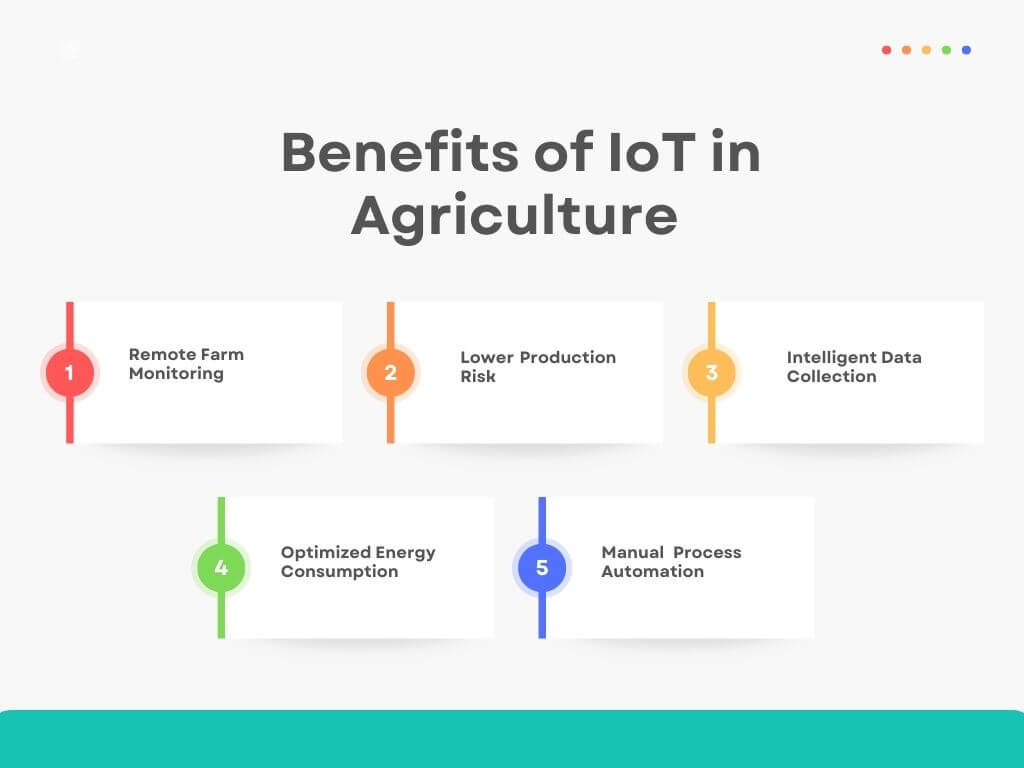
There are many benefits to applying the Internet of Things in agriculture. Not only can smart farming save money, but it can also help farmers earn money by improving the quality of farmland, cattle, and crops. Below are the various advantages of smart farming.
 1. Remote Farm Monitoring
The use of IoT in farming eliminates the need for on-site visits to check on distant fields or infrastructure. High-definition cameras and connected sensors allow farmers to monitor crop health, livestock movement, and gate security. Remote farm monitoring developers also consider mobile app design so that sensor data is stored on smartphones.
Key outcome: Reduced fuel costs and time spent manually scouting fields.
2. Lower Production Risk
The use of IoT in agriculture can serve as an insurance policy. It can provide early warnings of frost, heat stress, or pest infestations. These real-time alerts enable immediate intervention before a localized issue becomes a total crop failure.
Key outcome: More predictable yield and lower insurance premiums over time.
3. Intelligent Data Collection
Beyond just “tracking,” smart agriculture technology can create a historical record of every inch of the farm. Over time, this generates a high volume and variety of data, enabling deep analysis of which seed types and soil treatments are best suited to specific weather conditions.
Key outcome: Data-backed decision-making that replaces intuition with evidence.
4. Optimized Energy Consumption
IoT integrations enable climate-smart agriculture. Smart grids and connected pumps ensure that heavy machinery and irrigation systems operate only when necessary, often during “off-peak” hours when electricity is cheaper.
Key outcome: A significant reduction in the farm’s carbon footprint and utility overhead.
5. Manual Process Automation
Manual process automation allows tedious tasks to be automated and requires no human oversight. Whether it is greenhouse climate control or self-filling water stations for livestock, sensors trigger actions based on real-time needs.
Key outcome: Reallocation of human labor toward higher-value strategic tasks.
Real Life Use Cases of IoT in Agriculture
There are many organizations that have been able to take simple smart farming ideas and turn them into comprehensive and
1. CropX: Precision Irrigation
Irrigation supports soil resilience and fertility. Proper systems help reduce costs and boost output. CropX’s Vertex 4 Sensor, inserted into soil at various depths, tracks moisture, temperature, and salinity, sending data to the cloud. Analyzing this data provides farmers with irrigation recommendations, using “actual evapotranspiration” (ETa) sensors that compare soil water with plant moisture loss. This prevents over- or underwatering, saving nutrients and money.
2. Sensehub Allflex: Livestock Biometrics
IoT in smart agriculture can also be used to monitor livestock health, behavior, and reproduction. This is often done through wearable devices. Sensehub developed ear tags and collars worn by cows. They track location, body temperature, rumination, and early signs of illness or injury. Sensehub’s Distress Index also notifies farmers of optimal breeding windows and when cows are in labor. Integrating a technology like Sensehub Allflex helps businesses save money and stay on top of their livestock.
3. DJI: Autonomous Drone Scouting
DJI has been a key player in smart farming IoT in agriculture. Their farming drones, such as the DJI Agras and DJI Phantom, can supplement manual field inspections by using sensors to survey, map, and analyze farmland. When paired with the DJI Terra software, these drones can autonomously scan fields at scale. The analysis includes RGB imagery that highlights crop health, uneven growth, and pest damage. Thermal imaging detects water stress and disease, and 3D terrain maps provide information on land elevation and drainage modeling. Overall, adopting the DJI drone ecosystem can make land maintenance and monitoring more efficient for farmers.
4. AppHarvest by Jeevn AI: Controlled Greenhouse
AppHarvest is a controlled environment agriculture (CEA) technology that combines greenhouse farming with AI crop management technology. This system can control and monitor things like irrigation and fertigation, pest and disease detection through vision cameras, required light intensity and photoperiod, and temperature, humidity, and carbon dioxide.
The greenhouse technology comes with hydroponic growing systems where plants can grow in nutrient-rich water without soil.
What are the Challenges of Modern Agriculture Smart Technologies?
Although integrating agricultural IoT devices benefits farmers and farmland, there are some challenges and considerations that come with adopting smart technologies. Here are the various challenges to watch out for before implementing agricultural smart technology.
1. High Cost and Financial Barriers
Most agricultural technologies require a large upfront investment that most farmers cannot afford. Tools like soil sensors, drones, and greenhouse systems can cost hundreds of thousands of dollars. Many software programs also require ongoing subscription fees that increase recurring costs. Additionally, it takes about 3-7 years for farmers to see a return on investment from these technologies, which can be too long for smaller operations. Smart agriculture generally works better for large commercial farms than for small farms.
2. Connectivity and Infrastructure Gaps
Many IoT applications in agriculture depend on reliable internet and cellular connectivity, which can be hard to find in rural farming areas. Remote fields often have weak 4G/5G coverage, and sometimes there is no connectivity at all. The power infrastructure in developing regions is often unreliable. Even in developed areas, rural broadband gaps are notable. The digital access gap between urban and rural areas results in many practical limitations.
3. Interoperability and Data Silos
Different smart agricultural platforms often don’t interact with each other, which forces farmers to manage multiple disconnected systems. A farmer might integrate different technologies for different farming operations (CropX for soil, DJI for scouting, and Allflex for livestock) without any integration between the systems.
4. Cybersecurity and Data Privacy
Connected farm systems create new vulnerabilities that the agricultural sector is largely unprepared for. Farm operational data is increasingly stored in third-party clouds, which can make data ownership confusing. Also, large agricultural businesses and tech companies can potentially access the data and use it for competitive intelligence.
5. Regulatory and Legal Challenges
Because smart agricultural technology is new, it operates within a complex and inconsistent regulatory landscape. Drone flight regulations differ by country and region. Data sovereignty laws influence where farm data can be stored. For autonomous machinery, there are many liability concerns, such as who is responsible if an autonomous tractor causes damage to farmland.
Trends in Agriculture Smart Technologies 2026
IoT for agriculture is becoming more efficient and effective over time. In 2026, the farming industry trends aim to make crop cultivation easier, quicker, and automated.
1. Robotics on the Fields
In recent times, the deployment of physical autonomous or semi-autonomous machines that can perform traditional farm labor tasks, which can replace human insights, has become very popular. There are different types of robots that are responsible for different things, like weeding robots, which can use AI vision and lasers to destroy weeds without herbicides. There are also pruning robots, which can be used in vineyards and orchards to trim vines and branches.
To incorporate robotics into farming fields, many different types of technologies are used to automate various tasks. Technologies such as LiDAR and GPS are used for precise navigation. For delicate crop handling, robots with soft hardware features are built
2. AI-Driven Agricultural Optimization
Developers of farm technology have been using AI, machine learning, and big data analytics to make smarter and more precise decisions across every aspect of farm management. AI technology can be applied to things like crop management, resource optimization, supply chain and market intelligence, and climate adaptation.
For example, computer vision is often used to analyze crops and soil imagery. Predictive analytics technology is used to forecast outcomes from previous farming data, and natural language interfaces allow farmers to talk to AI systems conversationally.
3. Resilient Technology
Resilient technology is a system that is adaptable, dependable, and able to operate under real-world stressors, including harsh environments, infrastructure failures, climate disruptions, and supply chain shocks.
To ensure resilience with IoT farming solutions, the technology should include ruggedized sensors, robots, and drones designed for IP67 or IP68 waterproofing. Many agricultural devices also utilize solar and battery power to operate off the grid. It is also crucial to have multiple sensor networks so that a single failure does not compromise the entire system.
Conclusion
The role of IoT in smart precision agriculture is to make crop cultivation more efficient, effective, and sustainable. From soil sensors and livestock biometrics to autonomous drones and AI-powered greenhouses, smart farming technologies continue to shape how food is grown, monitored, and distributed worldwide.
The applications and innovations in smart agriculture continue to grow, with companies like CropX, SenseHub, Allflex, and DJI leading the way in implementing technology for optimal farming results. By advancing agricultural technology, they show that data-driven farming can greatly reduce waste, lower risks, and increase yields across various farm operations.
In the future, the convergence of robotics, AI optimization, resilient infrastructure, and a commitment to sustainability will lead to more productive and responsible farming. Farms that integrate IoT into their systems will become smarter, more adaptable, and better connected. Implementing these technologies will benefit both farmers and consumers over time.
How can AppsChopper Help You Build an IoT-Based Agriculture Solution?
AppsChopper is a full-service IoT and mobile app development company that specializes in designing custom smart agriculture solutions. From soil sensor integration and livestock monitoring systems to AI-powered crop management platforms and drone data visualization tools, we oversee every stage of development from concept to launch.
Our team develops scalable, secure, and user-friendly mobile and web applications tailored to your farm’s specific needs. Whether you own a small farm or a large commercial agribusiness, AppsChopper provides dependable, future-proof technology that helps you farm smarter.
Ready to get started? Reach out to AppsChopper today.
Frequently Asked Questions
1. Is IoT in agriculture suitable for small-scale farmers?
Smart agriculture using IoT can help small farmers, but high costs and connectivity issues are obstacles. Low-cost sensors and government subsidies are making it easier for smaller farms to adopt.
2. What is the ROI for implementing IoT in agriculture?
ROI varies depending on farm size and technology employed. Most farmers see returns within 3–7 years through reduced water usage, lower labor costs, and improved crop yields.
3. What factors affect the cost of IoT deployment in smart farming?
Key cost factors include farm size, sensor quantity, connectivity infrastructure, software subscriptions, installation complexity, and ongoing maintenance. Additionally, integration with existing equipment significantly impacts total deployment costs.
4. How long does it take to implement an IoT-based smart agriculture system?
Implementing IoT-based smart agriculture usually takes 2 weeks to 6 months, depending on farm size, system complexity, and infrastructure readiness. Basic sensor deployments can become operational within days of installation.
5. What ongoing maintenance is required for IoT agriculture systems?
Regular maintenance involves sensor calibration, battery replacement, software updates, connectivity checks, and hardware cleaning. Regular data audits help ensure system accuracy and consistent performance through changing seasonal conditions.
6. What are the key KPIs to measure success in smart agriculture using IoT?
Key KPIs include reducing water usage, improving crop yields, saving on labor costs, increasing pest and disease detection speed, lowering energy consumption, shortening ROI timelines, and decreasing input costs per harvest.