Table of Contents
The way people search for property has changed completely. Gone are the days of newspaper listings and word-of-mouth referrals. Today, buyers, sellers, renters, and agents turn to mobile technology to get things done faster and with far less friction. Real estate app development has become one of the most in-demand areas in the tech industry, and for good reason. The market rewards businesses that make property transactions easier, and an app is the most direct way to do that.
According to the Deloitte Center for Financial Services, around 69% of real estate decision-makers have already adopted modernized technology or are actively moving in that direction. However, a significant portion of the industry still runs on legacy systems and manual processes, which creates a real opportunity for companies willing to invest in the right technology.
If you are thinking about building a real estate mobile app, this guide covers everything you need to know, from types and features to the development process and cost.
What a Real Estate App Actually Does?
At its core, a real estate app connects people with the property market in a way that suits their specific role in it. A buyer needs different tools than a landlord. A property investor thinks differently than someone looking for a short-term rental. This is exactly why a one-size-fits-all approach rarely works in real estate mobile app development. The most effective apps are designed around a specific user type and a specific set of goals.
The broader purpose of any real estate app is to remove the barriers that typically make property transactions slow and frustrating. That means simplifying search, improving communication between buyers and agents, streamlining documentation, and putting useful data directly in the hands of the user. When done well, the result is an app that people genuinely rely on rather than abandon after a single session.
Types of Real Estate Mobile Apps Worth Knowing About
Before diving into features and costs, it helps to understand the different categories of real estate app development solutions available. Each type serves a distinct audience and solves a different problem.
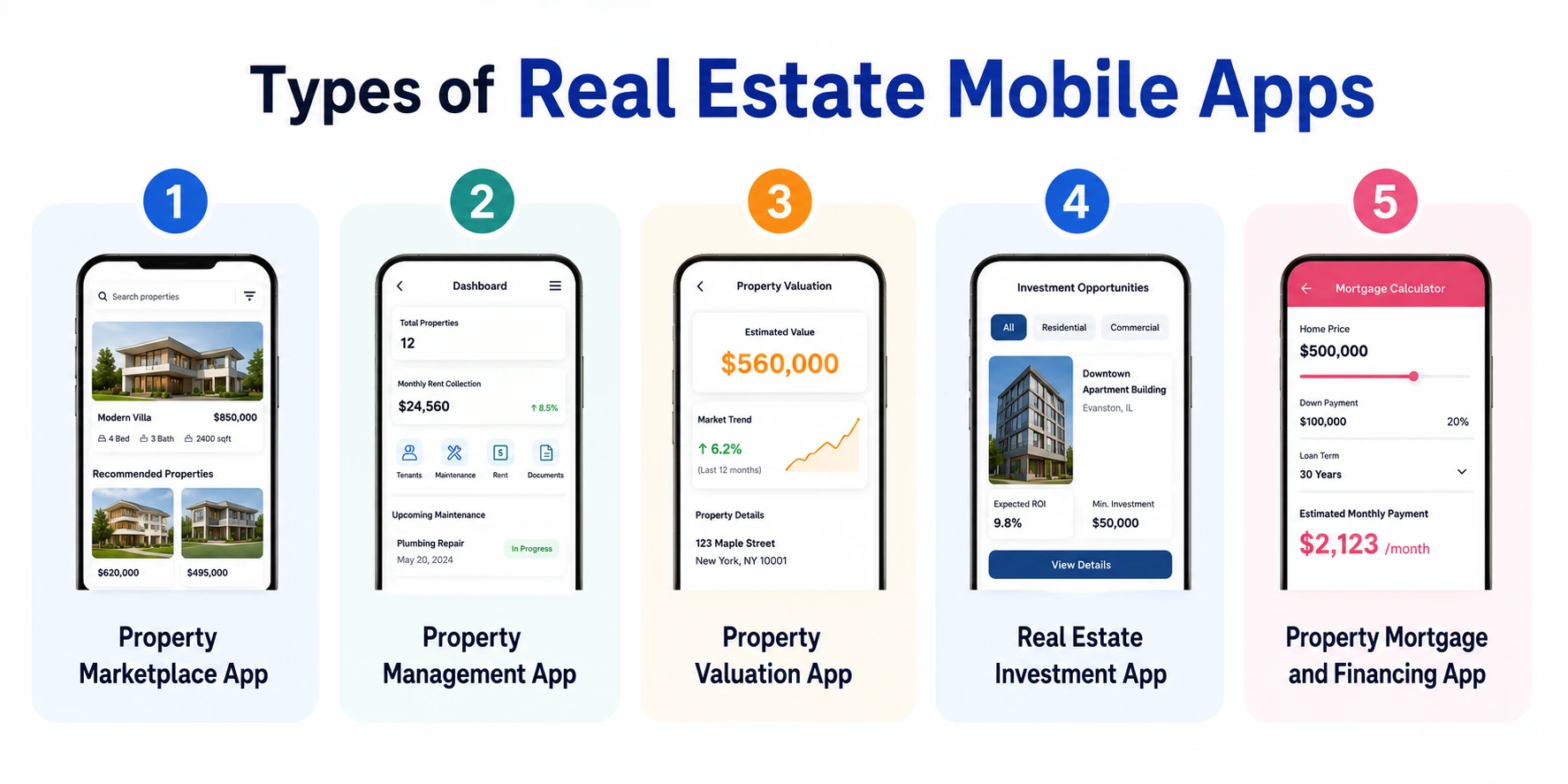
1. Property Marketplace App
This is the format most people picture when they think of a real estate application. A marketplace app lets buyers, sellers, renters, and landlords connect in one place. Users can browse listings with photos and detailed descriptions, filter by location and price, contact agents, and schedule viewings.
Custom real estate app development in this space often takes inspiration from platforms like Zillow and Redfin while differentiating through design, niche focus, or regional targeting.
2. Property Management App
Designed for landlords and real estate brokers, a property management app keeps everything organized in one place. Users can handle lease agreements, track maintenance requests, communicate with tenants, and process rent payments digitally. For anyone managing multiple properties, this type of real estate development app saves significant time and reduces the risk of administrative errors.
3. Property Valuation App
These apps estimate the market value of a home or commercial space using data like neighbourhood trends, comparable sales, and property conditions. They are useful for both individual homeowners curious about their property’s worth and agents who need fast, data-backed pricing information. Some valuation tools are built as standalone apps, while others are integrated into larger real estate app development solutions.
4. Real Estate Investment App
Property has always been a popular asset class, and investment apps make it more accessible. These platforms allow users to research markets, analyze potential returns, and, in some cases participate in crowdfunded real estate deals. For firms focused on this audience, enterprise real estate app development is often the right approach, since investment tools typically require deeper data integrations and more sophisticated backend infrastructure.
5. Property Mortgage and Financing App
These apps simplify the financing side of buying property. Users can compare loan options, check eligibility, upload documents, and track their application status from their phone. Given how complicated the mortgage process can be, a well-built financing app adds real value for both consumers and lenders.
Core Features to Include When You Create a Real Estate App
Whether you are planning to build a real estate app from scratch or upgrade to an existing platform, certain features are non-negotiable. These are the functionalities users expect from day one.
1. User Profiles and Onboarding
Buyers, sellers, renters, and agents need personalized profiles with tailored features. Onboarding should be quick and simple via email, phone verification, or social login. A complicated registration can drive users away before exploring the app.
2. Property Listings with Rich Media
Every listing should include high-quality photos, accurate descriptions, pricing history, neighborhood information, and contact details for the listing agent. Research consistently shows that property images are the single biggest factor in whether a buyer pursues a listing further, so the image experience in particular needs to be fast and visually strong.
3. Advanced Search and Filters
Users need to be able to narrow results by location, price range, property type, number of bedrooms, square footage, and more. Strong search functionality is one of the most direct ways real estate app development companies add value, since it directly reduces the time users spend looking for relevant properties.
4. Favorites and Saved Searches
Letting users save properties they like and receive alerts when new matching listings appear keeps them engaged over time. This feature is simple in concept but has a measurable impact on retention, since it gives users a reason to keep coming back to the app even when they are not actively browsing.
5. Cost and Mortgage Calculator
A built-in calculator that estimates monthly payments, total loan costs, or return on investment removes one of the main reasons users leave an app to search elsewhere. Connecting the calculator to live financial data makes it even more useful.
6. In-App Messaging and Agent Communication
Direct communication between buyers and real estate apps for agents should be possible without leaving the platform. In-app messaging reduces friction and keeps the entire conversation thread connected to the relevant listing.
Advanced Features That Set Modern Real Estate Apps Apart
Beyond the basics, there is a growing set of intelligent features that separates competitive apps from average ones. If you are working with a real estate app development company that understands where the industry is heading, these are the capabilities worth discussing.
| Technology | What It Does | Key Value |
| AI (Recommendations & Appraisal) | Suggests properties based on user behavior and estimates property values. | Faster search, better matches, accurate pricing |
| AR / VR Tours | Let users explore properties virtually in 3D. | More engagement, fewer physical visits |
| Blockchain | Secures transactions and records with tamper-proof systems. | Trust, transparency, safer deals |
| Machine Learning (ML) | Analyzes market data to predict trends and risks. | Smarter investment decisions |
| Cloud Infrastructure | Provides scalable and reliable backend support. | Handles growth, ensures performance |
How Does the Real Estate App Development Process Work Step by Step?
Understanding the app development process helps you set realistic expectations around timeline, budget, and deliverables. Here is how most professional teams approach real estate app development.
Step 1: Define Requirements and Goals
The first step is getting clear on what the app needs to do, who it is for, and what success looks like. This means defining features and functionality, identifying the primary user types, deciding on platform (iOS, Android, or both), and documenting any third-party integrations required. Clarity at this stage saves significant time and money later. It is also the right moment to consider the benefits of real estate apps for business and how those align with your specific objectives.
Step 2: Hire Real Estate App Developers
Choosing the right development partner is one of the most important decisions in this process. When you hire real estate app developers, look carefully at their portfolio, client reviews, and experience with similar projects. A good team will ask the right questions before writing a single line of code and will be transparent about timelines and costs. Real estate app development companies that specialize in this vertical bring domain knowledge that generalist agencies often lack.
Step 3: UI/UX Design
Great real estate app UI design is not just about aesthetics. It is about creating an experience that feels intuitive for someone browsing properties on a mobile device. Skilled designers will wireframe the layout, map user flows, and ensure the interface is clean and accessible. This stage typically involves competitive analysis and user research to validate design decisions before development begins.
Step 4: App Development and Integration
With the design finalized, development begins. This includes building the frontend interface, setting up the backend, integrating third-party APIs for maps, payments, and data feeds, and implementing any advanced features like AI or AR. Most experienced real estate app development teams work in agile sprints, which allows for regular check-ins and course corrections along the way.
Step 5: Quality Assurance and Testing
Before anything goes live, the app goes through thorough testing. QA engineers build test cases, check for bugs across different devices and screen sizes, verify performance under load, and ensure security standards are met. This step is not optional; it is what separates a polished product from one that frustrates users on day one.
Step 6: Launch and Ongoing Maintenance
After a successful QA process, the app is deployed to the App Store, Google Play, or both. But launch is not the end. Real estate applications require ongoing maintenance to fix post-launch issues, update features, adapt to operating system changes, and respond to user feedback. Budgeting for maintenance from the start is a sign of a mature development strategy.
Real Estate App Development Cost: What to Expect
The real estate app development cost varies widely depending on several factors. A basic MVP with core features will sit at the lower end of the range, while a fully featured platform with AI, AR, and custom integrations will cost considerably more. Here are the main variables that influence the final number.
| Cost Factor | Lower-Cost Scenario | Higher-Cost Scenario | Estimated Cost Impact |
| Features & Complexity | Core MVP features (search, listings, filters) | Advanced features (AI, AR/VR, analytics) | $5,000 – $20,000+ |
| Platform | Single platform (iOS or Android) | iOS + Android (native or cross-platform) | $5,000 – $15,000 |
| UI/UX Design | Templated or minimal custom design | Fully custom, branded UI/UX | $3,000 – $10,000 |
| Technology Stack | Standard backend + APIs | AI, AR/VR, blockchain integrations | $5,000 – $20,000+ |
| Team Experience & Location | Mid-level / offshore team | Senior developers / high-cost regions | $10,000 – $25,000+ |
| Project Scope | Focused single-purpose app | Full marketplace platform | $5,000 – $20,000+ |
As a general benchmark, real estate app development costs typically range from $30,000 to $60,000 USD for a solid, well-featured product. For a more accurate estimate, the best approach is to scope your project in detail with a development team before committing to a budget. You can also explore how mobile app development cost is calculated more broadly to understand where your money goes.
Choosing the Right Real Estate App Development Company
The technical execution of your app is only as good as the team behind it. Selecting the right real estate app development company means finding a partner with relevant experience, a transparent process, and the ability to communicate clearly throughout the project.
Look for companies that have worked with similar clients, can show you live examples of their work, and are willing to provide a clear breakdown of costs and timelines upfront. A team that specializes in mobile app development for real estate will move faster, make fewer mistakes, and deliver a product better suited to your audience than a generalist agency working in the space for the first time.
It is also worth considering what happens after launch. The best real estate app development companies offer ongoing support, maintenance, and the ability to scale the app as your business grows. Long-term partnership matters in this industry because user expectations and market conditions change quickly, and your app needs to keep up.
Whether you are building a real estate app for business, launching a marketplace platform, or developing a specialized tool for agents or investors, the right development partner makes all the difference. AppsChopper has worked with real estate businesses across different segments and brings the technical and industry expertise needed to build a real estate app that works for your users and your goals.
Final Thoughts
The real estate industry is not going backward. Buyers expect to browse listings on their phones. Agents expect tools that help them close deals faster. Investors expect data that helps them make smarter decisions. All of that happens through apps, and the businesses investing in real estate mobile app development today are positioning themselves to lead tomorrow.
Whether you are just starting to explore the idea or ready to move into production, the first step is getting clear on your goals and finding a team with the expertise to bring them to life. The technology is available, the market is ready, and the opportunity is real.
FAQ
1. How long does it take to develop a real estate app?
It typically takes 3 to 6 months to build a basic real estate app, while more complex platforms with advanced features can take 6–12+ months.
2. What technologies are used for real estate app development?
Common technologies include AI/ML for recommendations, AR/VR for virtual tours, blockchain for secure transactions, cloud computing, and mobile frameworks like Flutter or React Native.
3. What is the ROI of investing in real estate app development?
ROI comes from increased lead generation, higher conversion rates, reduced operational costs, and improved user retention through better digital experiences.
4. How can real estate app development improve customer experience?
It enhances experience by offering personalized property recommendations, virtual tours, instant communication via chatbots, and easy property search from anywhere.
5. What factors affect the cost of real estate app development?
Key factors include app complexity, feature set, platform choice, design quality, tech stack, and the development team’s location and expertise.