
Table of Contents
Outsourcing software development has evolved significantly over the last decade. What was once viewed primarily as a cost-reduction tactic is now widely used as a strategic delivery model by startups, mid-sized organizations, and enterprises alike. As technology stacks become more complex and product lifecycles shorten, organizations are increasingly turning to outsourcing to maintain momentum without overextending internal teams.
Today, outsourcing supports a range of business objectives beyond cost efficiency. It enables faster product development, provides access to specialized engineering skills, and offers the flexibility to scale teams based on changing requirements. For organizations operating in competitive or fast-moving markets, outsourcing can help balance execution speed with long-term sustainability.
At the same time, software development outsourcing is not a one-size-fits-all solution. Outcomes depend heavily on factors such as engagement models, process maturity, communication practices, and alignment between internal stakeholders and external teams. Without a clear understanding of how outsourcing works, organizations risk misaligned expectations, delivery delays, or quality issues.
A structured software development outsourcing guide of these factors allows organizations to assess outsourcing as part of a broader product and technology strategy, one that balances speed, scalability, and sustainability without compromising technical standards or business objectives.
What is Software Development Outsourcing?
Software development outsourcing refers to the practice of engaging external professionals or teams to handle software-related work that might otherwise be performed internally. In simple terms, it is the outsourcing of software development activities, including planning and design, development, testing, deployment, and ongoing maintenance.
From a practical standpoint, the software outsourcing definition extends beyond writing code. It often includes collaboration with an external software development team that operates as part of an organization’s broader delivery ecosystem. Depending on the engagement, this team may take responsibility for a complete product or work alongside internal stakeholders on specific components or phases.
Outsourcing can take several forms, including:
- Outsourcing custom software development for tailored business needs
- Software engineer outsourcing to supplement in-house expertise
- Outsourcing software development to a dedicated team for long-term or complex initiatives
The model an organization chooses depends on factors such as product maturity, internal capacity, regulatory requirements, and delivery timelines.
Importantly, outsourcing software development is not limited to a particular company size or industry. It is used by early-stage companies building their first products, as well as by enterprises modernizing large-scale systems. The common thread is the need to deliver reliable software without placing unsustainable pressure on internal resources.
At its core, outsourcing custom software development is a structured way to access skills, capacity, and delivery capability, while retaining strategic oversight and ownership of the product.
In House Software Development VS Outsourcing
When planning a software initiative, organizations often evaluate software development in-house vs outsourcing. This decision affects delivery timelines, cost structure, team flexibility, and long-term scalability.
Neither approach is universally better. The right choice depends on business goals, internal capabilities, and the type of software being developed.
In House Software Development
In-house development relies on an internal software development team embedded within the organization. It offers strong alignment with business processes and long-term ownership.
Strengths
- Direct control over priorities and architecture
- Deep domain and system knowledge
- Easier coordination with internal stakeholders
Limitations
- Longer hiring and onboarding cycles
- Higher fixed operational costs
- Limited flexibility for specialized skills
In-house teams work best for core systems requiring continuous internal control.
Outsourced Software Development
Outsourced development involves external teams or software engineers outsourcing for specific roles or full delivery through outsourcing software development to dedicated teams.
Key advantages
- Faster access to experienced engineers
- Flexible scaling based on project needs
- Broader exposure to tools and technologies
Successful outsourcing depends on clear communication, documentation, and ownership.
Making the Right Choice
Many organizations adopt a hybrid model, keeping strategy in-house while outsourcing execution. Factors influencing the decision include project complexity, skill availability, budget predictability, and regulatory requirements.
A clear understanding of these trade-offs helps organizations select a delivery model aligned with both short-term execution and long-term product strategy.
Outsourcing Software Development Pros and Cons
Outsourcing software development offers organizations a practical way to accelerate delivery and access specialized expertise. At the same time, it introduces operational considerations that require structure and oversight. Understanding both sides helps organizations assess whether outsourcing fits their delivery strategy.
| Aspect | Advantages | Limitations |
| Access to Talent | Immediate access to experienced engineers and specialized skills | Limited control over individual resource selection without clear agreements |
| Speed to Market | Faster project initiation due to ready-to-deploy teams | Dependency on external team availability and timelines |
| Cost Structure | Variable costs reduce long-term hiring and infrastructure expenses | Budget overruns are possible without a clear scope and change control |
| Scalability | Easy to scale teams up or down based on project needs | Scaling too quickly may impact knowledge continuity |
| Technical Expertise | Exposure to diverse tools, frameworks, and industry practices | Tooling or standards may differ from internal preferences |
| Operational Focus | Internal teams can focus on core business priorities | Requires strong governance to maintain alignment |
| Knowledge Management | Documentation and shared repositories support continuity | Knowledge loss risk if documentation practices are weak |
| Communication | Structured collaboration tools enable remote coordination | Time zone differences can slow real-time communication |
What are the Software Development Outsourcing Models?
Software development outsourcing models define how external teams are engaged, managed, and billed. Selecting the right model is critical, as it influences cost predictability, flexibility, collaboration, and delivery outcomes.
Organizations typically choose a model based on project scope clarity, timeline certainty, and the level of control required over the software development team.
| Model | Best Suited For | Cost Structure | Flexibility | Level of Control |
| Dedicated Team | Long-term projects, scaling products | Monthly or ongoing cost | High | High |
| Time and Material | Evolving requirements, agile projects | Pay per hour or effort | Very High | Medium |
| Fixed Price | Clearly defined, short-term projects | Fixed upfront cost | Low | Medium |
Step-By-Step Software Development Process
A clearly defined process is a critical success factor in software development outsourcing. It provides structure for collaboration, ensures accountability across teams, and reduces the risks commonly associated with distributed development.
While the exact execution may vary depending on project scope and industry, most outsourcing engagements follow a multi-phase lifecycle designed to support consistent and predictable outcomes.
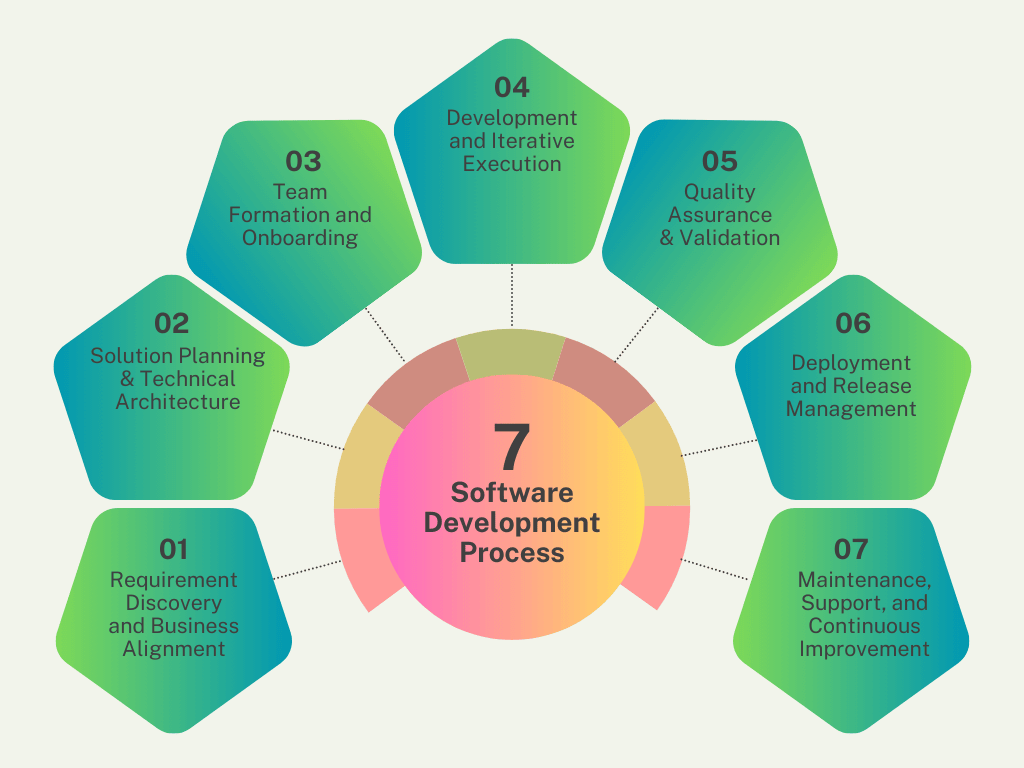
 1. Requirement Discovery and Business Alignment
The outsourcing process begins with a detailed discovery phase focused on understanding business objectives, user needs, technical constraints, and success criteria. This stage involves requirement clarification, stakeholder alignment, and documentation of functional and non-functional expectations.
Clear discovery helps determine whether outsourcing is appropriate for the project and sets a shared foundation for decision-making throughout the engagement.
2. Solution Planning and Technical Architecture
Once requirements are defined, the focus shifts to solution planning. This includes selecting the technology stack, defining system architecture, identifying integrations, and outlining scalability, security, and compliance considerations.
At this stage, delivery milestones, risk factors, and dependencies are documented to create a realistic execution roadmap.
3. Team Formation and Onboarding
Based on the project scope and chosen outsourcing model, a dedicated or shared software development team is assembled. Team onboarding includes knowledge transfer, access to repositories and tools, and alignment on communication workflows.
This phase is especially important in software engineering outsourcing, as early clarity reduces friction during development.
4. Development and Iterative Execution
Development is typically conducted using agile or hybrid methodologies. Work is delivered in incremental cycles, allowing stakeholders to review progress, validate assumptions, and refine requirements as needed.
Iterative execution improves transparency and supports adaptability without disrupting overall timelines.
5. Quality Assurance and Validation
Testing is conducted throughout the development lifecycle to ensure reliability, performance, and security. This includes functional testing, integration testing, performance validation, and, where applicable, regulatory or compliance checks.
Quality assurance plays a central role in maintaining consistency across outsourced development efforts.
6. Deployment and Release Management
Deployment involves preparing production environments, configuring infrastructure, and executing controlled releases. Monitoring and rollback strategies are defined to minimize risk during go-live.
This phase ensures that software transitions smoothly from development to real-world use.
7. Maintenance, Support, and Continuous Improvement
Post-deployment activities include ongoing maintenance, performance optimization, issue resolution, and feature enhancements. Documentation and knowledge continuity ensure long-term sustainability, especially for extended outsourcing engagements.
Maintenance is often an ongoing part of outsourcing custom software development, particularly for evolving products and platforms.
What is the Cost of Outsourcing Software Development?
The outsourcing software development cost varies widely depending on multiple technical, operational, and strategic factors. Rather than a fixed number, outsourcing costs are best understood as a range shaped by scope, complexity, and engagement structure.
For decision-makers, the key consideration is not just upfront development cost, but the total cost of ownership over the lifecycle of the software.
| Cost Factor / Model | Description | Typical Cost Range (USD) | Notes |
| Dedicated Team Model | A team works exclusively on the project, usually long-term | $25,000 – $100,000+ per month (depending on team size & expertise) | Ideal for complex, evolving products; cost varies with team composition and seniority |
| Time & Material Model | Billing based on actual hours or effort spent | $20 – $150 per hour | Flexible for projects with evolving requirements; global rates vary by region and experience |
| Fixed Price Model | Predefined scope, cost, and timeline | $5,000 – $200,000+ per project | Best for clearly defined projects; scope changes can increase cost |
| Project Scope & Complexity | Features, integrations, workflows, scalability | $5,000 – $500,000+ | Higher complexity drives more development time and resources |
| Engineer Experience Level | Junior, mid-level, senior engineers | $20 – $150 per hour | Senior engineers cost more but can reduce delays and rework |
| Technology Stack & Tools | Programming languages, frameworks, CI/CD, cloud services | $1,000 – $50,000+ (tools/licenses) | Tooling costs are often upfront but improve long-term efficiency |
| Industry Requirements | Compliance-heavy industries (e.g., healthcare, finance) | +10% – 30% of project cost | Includes testing, documentation, security, and audit |
| Maintenance & Support | Post-launch updates, bug fixes, feature additions | $1,000 – $20,000+ per month | Depends on product complexity and usage |
Why Hire AppsChopper for Software Development Outsourcing?
AppsChopper has extensive experience in software development outsourcing, providing structured processes that cover requirement analysis, architecture planning, iterative development, testing, deployment, and ongoing maintenance. Whether it involves software engineer outsourcing for specific roles or full-scale outsourcing software development to a dedicated team, AppsChopper ensures predictable delivery, transparency, and alignment with business objectives. Its teams combine expertise in web, mobile, and enterprise software, enabling end-to-end delivery while maintaining quality and timeline control.
In addition, AppsChopper brings domain experience across industries, including healthcare, startups, and enterprise systems, allowing it to navigate regulatory, compliance, and operational requirements effectively. With flexible engagement models, thorough documentation, and collaborative workflows, AppsChopper supports knowledge retention, smooth handovers, and close alignment with internal teams. Organizations working with AppsChopper benefit from process maturity, technical expertise, and scalable delivery, ensuring complex software projects are executed efficiently while meeting strategic business goals.
Frequently Asked Questions
1. When does outsourcing software development make more sense than building in-house?
Outsourcing is often more practical when internal teams lack specific skills, when timelines are tight, or when scaling an in-house team would create long-term cost or management overhead.
2. How do companies maintain control when outsourcing software development?
Control is maintained through clear scope definition, regular checkpoints, shared documentation, and ownership of architecture, code repositories, and decision-making authority.
3. Can outsourced teams work alongside internal developers?
Yes. Many organizations use outsourced teams as extensions of their internal software development team, especially in hybrid delivery models.
4. What types of projects are least suitable for outsourcing?
Projects that rely heavily on undocumented legacy systems or require constant, informal collaboration with multiple internal stakeholders may be harder to outsource effectively.
5. How is quality ensured in outsourced software development?
Quality is ensured through defined coding standards, automated testing, code reviews, and continuous integration practices throughout the development lifecycle.