
Table of Contents
Figuring out how to integrate AI into your organization is one of the most important decisions a business leader can make right now, and one of the most confusing. The technology has advanced well beyond the hype, and artificial intelligence development is extensive enough to impact nearly every part of your business. But knowing where to start, what to prioritize, and how to avoid costly mistakes? That’s where most companies get stuck.
The AI industry is expanding faster than many predicted just five years ago. In 2026, the AI market is projected to be valued at $347.05 billion. This swift growth is fueled by advances in large language models, automation, and machine learning infrastructure, making AI more accessible and powerful than ever. For businesses, it’s a fundamental change in how competitive advantages are created and maintained. Those who recognize this and invest wisely in AI now will be best positioned as the industry evolves.
We’ll dive into what an enterprise AI strategy really looks like, the main framework parts that make it effective, what an AI consultant does and when you need one, and how to create a roadmap that delivers tangible, measurable results.
Figuring out how to integrate AI into your organization is one of the most important decisions a business leader can make right now, and one of the most confusing. The technology has advanced well beyond the hype and artificial intelligence development is extensive enough to impact nearly every part of your business. But knowing where to start, what to prioritize, and how to avoid costly mistakes? That’s where most companies get stuck.
The AI industry is expanding faster than many predicted just five years ago. In 2026, the AI market is projected to be valued at $347.05 billion. This swift growth is fueled by advances in large language models, automation, and machine learning infrastructure, making AI more accessible and powerful than ever. For businesses, it’s a fundamental change in how competitive advantages are created and maintained. Those who recognize this and invest wisely in AI now will be best positioned as the industry evolves.
We’ll dive into what an enterprise AI strategy really looks like, the main framework parts that make it effective, what an AI consultant does and when you need one, and how to create a roadmap that delivers tangible, measurable results.
What is an AI Strategy for Enterprises?
An enterprise AI strategy is a clear, organization-wide plan for incorporating artificial intelligence into business operations in a way that delivers lasting value. AI strategy definition involves systematically aligning AI initiatives with your business goals, building the right infrastructure to support them, and managing the people and process adjustments that come with these initiatives.
It’s the difference between testing AI and truly implementing it. Companies with a clear AI plan move quicker, spend less, and see bigger results. Those without one often end up with a pile of disconnected projects that never grow.
Benefits of an AI Strategy
Having a clear AI strategy isn’t just about keeping up with the competition; it’s about giving your organization a deliberate framework for turning AI investments into real business outcomes. Here are the key benefits: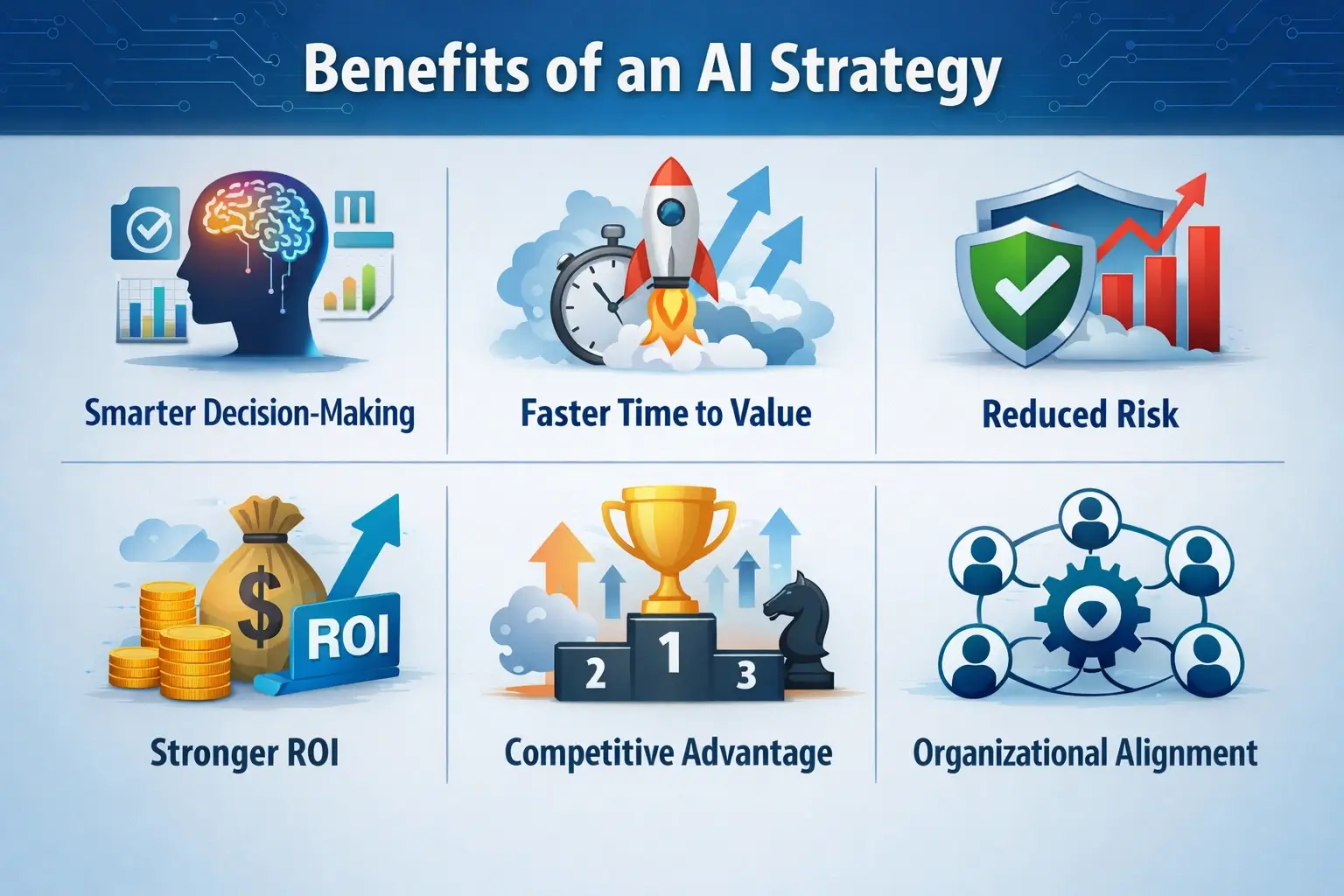
1. Smarter Decision-Making
When AI initiatives are aligned with specific business goals from the beginning, leaders make better decisions about where to invest, what to prioritize, and when to withdraw. A strategy replaces guesswork with a structured way to evaluate opportunities.
2. Faster Time to Value
Organizations with a clear AI strategy progress from idea to implementation more quickly because their foundational elements like data infrastructure, governance, talent, and tools are already in place. This reduces the time spent reinventing the wheel with each new project.
3. Reduced Risk
A well-built strategy accounts for governance, compliance, and ethical considerations before problems arise. That proactive posture significantly reduces the likelihood of costly missteps, regulatory issues, or reputational damage down the line.
4. Stronger ROI
Without a strategy, AI spending tends to be scattered across disconnected pilots that never scale. A clear strategy ensures resources are concentrated on the use cases with the highest potential return, making every dollar work harder.
5. Competitive Advantage
Companies that can build genuine AI capability consistently develop advantages that compound over time. A strategy is what separates organizations that use AI tactically from those that use it to fundamentally reshape how they operate.
6. Organizational Alignment
An AI strategy aligns leadership, technical teams, and business units. When everyone understands the vision, priorities, and their role in execution, adoption becomes easier, and results are quicker.
AI Strategy Framework Components
A solid AI strategy is a collection of interconnected components that all need to work together. Here’s a breakdown of each one.
1. Business Objectives and Value Alignment
AI strategy starts with decision-makers pinpointing the business outcomes that AI will target, like revenue growth, cost reduction, or improving customer experience. Without this clear focus, AI projects risk turning into costly experiments that don’t produce measurable results. Leaders should define success metrics from the beginning and connect AI investments directly to strategic goals. If you can’t justify why an AI project matters to the bottom line, it probably shouldn’t get funding.
2. Use Case Identification and Prioritization
Not every AI opportunity justifies the same level of investment. Organizations should identify, assess, and prioritize use cases based on feasibility, potential value, and how well they align with the overall strategy. A structured framework helps prevent the mistake of chasing flashy applications instead of focusing on those with real impact. The goal is to build a balanced portfolio with quick wins that build momentum and long-term bets that can transform how the business operates.
3. Data Strategy
A solid data strategy includes everything from data collection and labeling to governance, maintenance, and accessibility for models at scale. This foundation is what allows machine learning solutions to perform reliably in production rather than just in controlled test environments. Before pursuing specific AI use cases, organizations should evaluate their data maturity. Building advanced AI on a weak data foundation is one of the most frequent and costly mistakes companies make.
4. Technology and Infrastructure
Choosing the right technology stack influences how efficiently and reliably your AI solutions are developed and maintained. You must decide when to build versus buy, how to incorporate AI into your existing systems, and how to design for scalability from the start. It’s also worth considering adjacent investments like mobile app development costs when scoping the full budget for customer-facing AI features. These infrastructure choices have long-term effects on cost, flexibility, and your team’s pace.
5. Talent and Operating Model
Execution requires the right people and structure around them. That usually means a mix of data scientists, ML engineers, product managers, and domain experts working within a deliberate operating model. Organizations need to decide whether to embed talent within business units or take a hybrid approach. Upskilling your current workforce alongside strategic external hiring is equally important. Companies that treat this as an afterthought risk underperforming.
6. Governance, Risk, and Ethics
As AI systems become more integrated into operations, governance becomes essential. Clear policies for model accountability and human oversight are necessary, especially in high-stakes areas like finance, healthcare, legal, and hiring. Managing risks related to bias, privacy, and compliance is not only a legal requirement but also a competitive advantage. Companies that prioritize strong AI ethics build greater trust with customers, regulators, and employees, and they are more likely to avoid reputational damage from mistakes.
7. Execution and Delivery
Even the best strategy fails without disciplined execution. This involves applying agile delivery methods, fostering strong cross-functional collaboration, and managing the complexity of transitioning from prototype to production. Areas like AI in software testing are a practical example of how AI can be integrated into delivery pipelines to improve speed and quality. Speed is important, but so is building solutions that are reliable, maintainable, and trusted by the users.
8. Change Management and Adoption
Successful adoption requires clear, honest communication about how AI will affect workflows, early involvement of frontline employees in the design process, and ongoing training that builds genuine confidence rather than just compliance. Thoughtful mobile app design can make the difference between features that are embraced and ones that are ignored. Resistance is natural and predictable; organizations that view adoption as a strategic investment rather than just an IT rollout are the ones that truly see the ROI they expect.
9. Measure and ROI Tracking
Strong measurement frameworks track both technical metrics (accuracy, latency, uptime) and business outcomes (cost savings, revenue impact, customer satisfaction). Establish your baselines before deployment and build dashboards that make performance visible to both technical teams and executive stakeholders. Consistent ROI tracking is what turns AI from a cost center into a credibility-building investment.
10. Scaling and Innovation Roadmap
Scaling requires reusable platforms, shared data assets, and standardized processes that enable faster and cost-effective deployment of future use cases. This is also where your AI product strategy comes into focus, as it is crucial to maintain a forward-looking innovation roadmap by continuously monitoring emerging AI capabilities and identifying where the next wave of value will originate before your competitors do. The organizations excelling at AI aren’t just performing well today; they’re actively building the infrastructure to move faster in the future.
What Does an AI Consultant Do?
An AI consultant guides organizations through every phase of the framework, from developing strategy to implementing solutions. Unlike broader organizational strategy consulting, which focuses on market positioning or operational efficiency, AI consulting concentrates on how intelligent systems can be utilized. Instead of recommending a specific tool or platform, a good AI consultant provides an objective, industry-wide perspective that helps you avoid common pitfalls and reach your goals more quickly. Here’s what working with an AI consultant typically involves:
1. Assessing your current state
Evaluating your data maturity, tech stack, talent, and existing processes to identify gaps and opportunities
2. Defining the strategy
Helping leadership align on which AI use cases to prioritize and build a roadmap with realistic timelines and milestones
3. Vendor and technology selection
Cutting through the noise of hundreds of AI vendors to recommend solutions that genuinely fit your needs
4. Overseeing implementation
Ensuring that AI projects are built and deployed in a way that’s scalable, governable, and integrated with existing systems
5. Driving adoption
Supporting change management efforts so that the people who need to use AI tools do
6. Tracking results
Building measurement frameworks that connect AI performance to business outcomes. Consultants are especially valuable when an organization lacks internal AI expertise, explores new areas, or needs external input to challenge assumptions. Whether you work with one of the largest AI strategy consulting firms or smaller firms, they don’t replace developing internal skills, but can accelerate the process.
Example of an AI Strategy Roadmap
A real AI strategy roadmap is a living document, not a one-time plan. A structured AI implementation plan typically follows a phased approach that keeps teams aligned and makes it easy to show progress at every stage.
Phase 1: Foundation (Months 1–3)
This phase involves use case identification and prioritization, data audits, and early stakeholder alignment. The goal is to gain clarity on where the opportunities are, what’s actually feasible with your current assets, and what gaps need to be closed before you can move forward.
Phase 2: Pilot and Prove (Months 4–6)
Here, you run targeted pilots on your highest-priority use cases, ideally ones that can show results within 90 days. The goal is to validate assumptions, learn quickly, build internal momentum, and justify further investment. Not every pilot will succeed, but learning what doesn’t work is valuable too.
Phase 3: Scale and Integrate (Months 7–12)
Successful pilots get productionized and scaled across the organization. This phase involves deeper technology integration, more formal governance structures, broader change management efforts, and the beginning of capability-building for internal teams. You’re transitioning from experimenting to actually operating.
Phase 4: Optimize and Innovate (Year 2+)
At this stage, AI is embedded into the fabric of how the business runs. The focus shifts to continuous improvement, expanding into new use cases, and staying ahead of emerging capabilities. This is where the compounding returns of a well-built AI program really start to show up.
How to Create Enterprise AI Strategy?
Building an enterprise AI strategy doesn’t have to be overwhelming. The core principles apply whether you’re at a large enterprise or developing an AI strategy for startups. Start by identifying the two or three biggest operational or strategic challenges your organization faces, then ask where AI could realistically help. Before committing to use cases, assess whether you have the data to support them and whether it’s clean, accessible, and properly governed.
Focusing on a small number of high-value, high-feasibility use cases rather than trying to cover everything will help build credibility. It’s important to allocate time and resources for training, communication, and the cultural changes associated with AI adoption. Additionally, businesses should not wait until issues arise to consider factors like risk management, explainability, or accountability. Lastly, define your KPIs before you deploy and track them consistently so you can demonstrate value and make the case for continued investment.
The organizations that get AI right aren’t necessarily the ones with the biggest budgets or the most sophisticated tools. They’re the ones with the clearest strategy, the strongest execution discipline, and the willingness to learn and adapt as they go.
When to Get Help with AI Strategy Consulting?
Knowing when to bring in outside expertise is just as important as knowing what kind of help you need. Below are the most common situations where AI strategy consulting makes sense.
1. You’re Starting from Scratch
If your organization hasn’t made significant AI investments yet and leadership is unsure where to start, a consultant can help you avoid the trial-and-error process. They bring a proven framework and cross-industry perspective that speeds up the shift from exploration to implementation.
2. Your AI Projects Aren’t Delivering Results
If you’ve already run pilots or launched AI initiatives but aren’t seeing the ROI you expected, that’s a strong signal that something in the strategy is off, whether it’s use-case selection, data quality, or change management. A consultant can diagnose the gaps and help you correct your course.
3. You’re Scaling and Things Are Getting Complex
Moving from one or two AI projects to an enterprise-wide program introduces a new level of complexity around governance, infrastructure, and organizational alignment. Consultants who have navigated that transition before can help you avoid the most common scaling pitfalls.
4. You Lack Internal AI Expertise
Not every organization has data scientists, ML engineers, or AI-savvy product leaders on staff. If the internal knowledge isn’t there yet, a consultant can fill that gap while simultaneously helping you build the capability in-house over time.
5. You Need Executive Buy-In
Sometimes the strategy exists internally but isn’t gaining traction with leadership. An outside expert can validate your approach, pressure-test assumptions, and communicate the business case in a way that resonates with decision-makers who aren’t deeply technical.
6. You’re Entering a New Market or Launching a New Product
Expanding into new territory, whether that’s a new customer segment, geography, or product line, often surfaces new AI opportunities and risks. A consultant can help you assess where AI fits into that growth strategy before you commit significant resources.
Conclusion
AI is no longer a “wait and see” technology. The gap between companies that are developing serious AI capabilities and those that aren’t continues to grow, and it worsens over time. The good news is that a clear, well-implemented strategy can quickly close that gap.
Whether you’re just getting started or looking to accelerate an existing program, the framework above gives you a proven structure to work from. And if you want a partner to help you navigate it, that’s exactly what AI strategy consulting services are for.
Frequently Asked Questions
1. What’s the difference between AI consulting and AI strategy consulting?
AI consulting focuses on implementation and technical execution. AI strategy consulting zooms out to align AI initiatives with broader business goals and long-term priorities.
2. How much does AI strategy consulting cost?
Costs vary widely based on scope and provider, typically ranging from $10,000 for focused engagements to $500,000+ for enterprise-wide strategy projects.
3. What are the key components of an AI strategy roadmap?
A strong roadmap covers business alignment, use case prioritization, data strategy, infrastructure, talent, governance, execution, change management, ROI tracking, and scaling plan.
4. What factors affect the cost of an AI strategy consulting project?
Key factors include project scope, company size, data complexity, number of use cases, consultant experience level, and whether you engage in a boutique firm or a large consultancy.
5. Should I hire an independent AI consultant or a large consulting firm?
Independent consultants offer flexibility and lower cost; large firms bring broader resources and credibility. The right choice depends on your project’s scope and budget.