Table of Contents
In today’s highly competitive digital world, speed is what defines whether software succeeds or becomes obsolete. Businesses can no longer afford to take 18 months to build software before it reaches users. That’s where rapid application development (RAD) comes in. Whether you’re a startup trying to test an idea or an enterprise aiming to upgrade legacy systems, RAD provides a smarter, quicker way to deliver working software.
This guide covers everything you need to know about RAD, from the core principles to the stages, tools, and real-world examples that make this methodology so effective.
What Is Rapid Application Development, and Why Does It Matter?
Rapid Application Development (RAD) is an iterative software development approach that emphasizes quick prototyping and ongoing user feedback instead of detailed upfront planning. Instead of locking in requirements for months before writing any code, teams develop, test, and refine in short, focused cycles.
Traditional waterfall development follows a strict, step-by-step process: plan, design, build, test, deploy. RAD reverses this approach. Development occurs in overlapping cycles, users see functional software early, and changes are accepted rather than avoided. The result is a product that genuinely meets user needs, created in a fraction of the time.
This is especially valuable for companies that provide app development services across various industries. When client requirements change, which they always do, the ability to adapt during the process rather than start over is what separates a successful project from one that stalls.
Breaking Down the Rapid Application Development Process
The rapid application development process usually unfolds in four phases. Understanding each phase helps teams know what they’re aiming for and how to keep momentum from kickoff to launch.
Phase 1: Requirements Planning
It is possible for teams to define their goals efficiently without having to deal with excessive documentation. Unlike the waterfall model, this phase does not aim for exhaustive documentation. It concentrates on understanding the scope, identifying key stakeholders, and aligning on the most critical outcomes. Flexibility is incorporated from the beginning.
Phase 2: User Design
Developers and designers collaborate closely with users to create interactive prototypes. These are not finished final products; they are working models that demonstrate key functionality and gather real feedback. This phase often repeats multiple times, with each iteration bringing the product closer to what users truly need.
Phase 3: Rapid Construction
Once the design is validated, development accelerates with reusable components and automation. Prototypes are turned into production-ready code. Teams rely heavily on reusable components, pre-built libraries, and purpose-built rapid application development tools to shorten timelines without sacrificing quality. Continuous integration and automated testing help ensure quality as the pace increases.
Phase 4: Cutover
The final phase includes testing, data migration, user training, and deployment. Since users have been involved throughout the process, this phase usually goes more smoothly than in traditional development. Fewer surprises occur because feedback has been incorporated into every previous cycle.
The Advantages of Rapid Application Development You Should Know
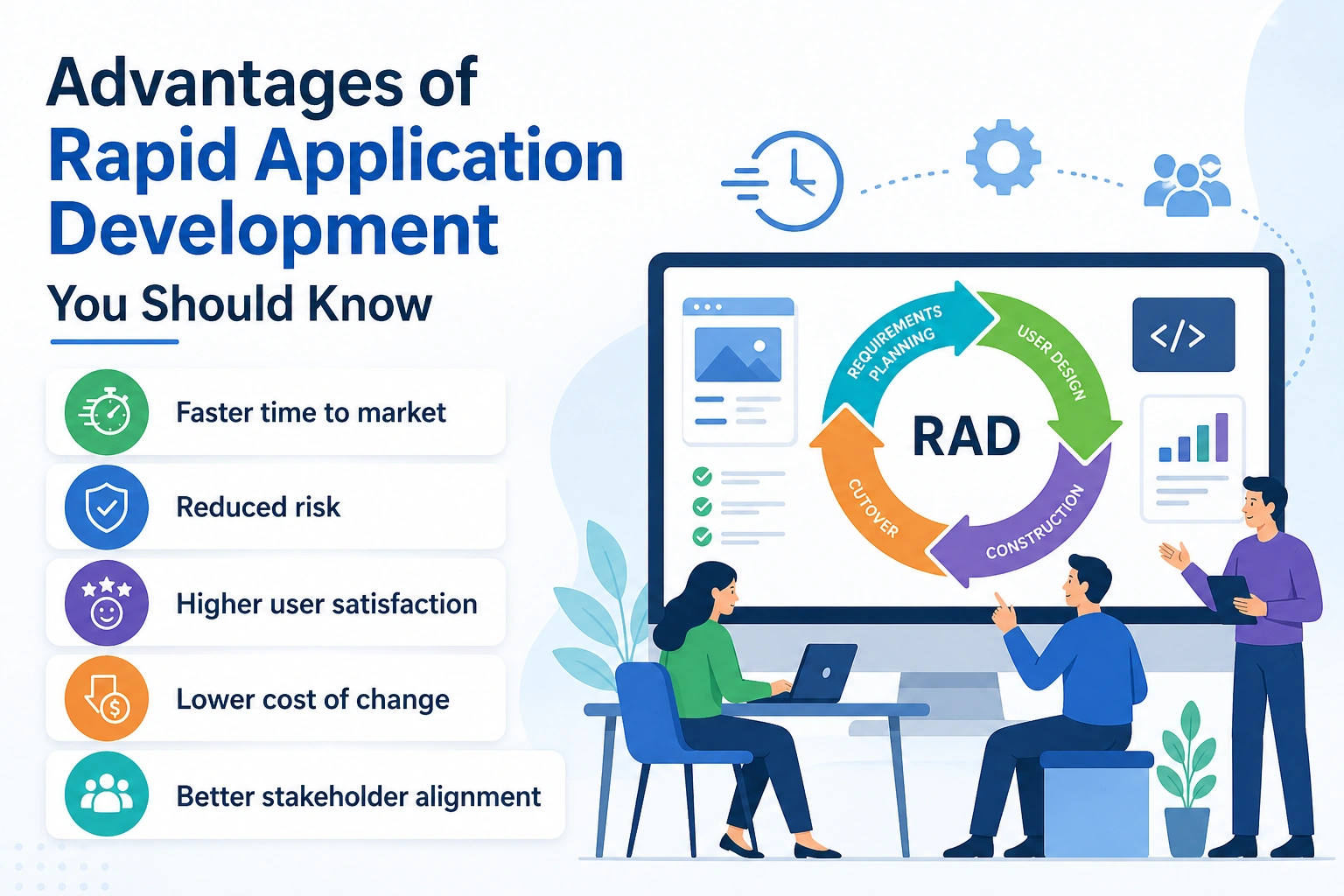
The advantages of rapid application development extend beyond just moving faster. When implemented thoughtfully, RAD changes how teams think about risk, quality, and collaboration.
1. Faster time to market: Iterative cycles mean working software ships in weeks, not months.
2. Reduced risk: Continuous feedback loops surface problems early, before they become expensive to fix.
3. Higher user satisfaction: Users help shape the product throughout development, so the end result actually fits their needs.
4. Lower cost of change: Adjusting direction during development costs far less than reworking a completed system.
5. Better stakeholder alignment: Decision-makers see regular progress and stay informed without waiting for a big reveal at launch.
These benefits are especially pronounced in complex domains. Teams delivering healthcare app development solutions, for instance, find that iterative development is nearly essential given the pace at which clinical workflows and regulatory requirements change. Getting real feedback from clinicians in week two rather than month eight prevents entire rebuilds.
An Example of Rapid Application Development in the Real World
The best way to grasp the methodology in practice is through a specific example of rapid application development applied to a real business challenge. Imagine a hospital system struggling with slow patient intake and outdated systems. With traditional approaches, the requirements phase alone could take months, leading to a detailed specification that is already outdated by the time development kicks off.
With RAD, the team creates a working prototype within two to three weeks and presents it to intake coordinators right away. The scheduling process might be confusing, or a key field could be missing from the intake form. These insights come to light within days instead of months, allowing the team to adjust before writing much code.
The same principle is true in technology-intensive settings. Teams developing ML solutions use RAD to test model outputs with real users early on, confirming whether the predictions are actually useful before investing in infrastructure and scaling. Being able to expose a working model to end users in a prototype environment is one of the quickest ways to spot gaps between what the model delivers and what users truly need.
Understanding the Rapid Application Development Model
The rapid application development model is a flexible framework built for iteration, speed, and adaptability. It’s a philosophy characterized by several well-defined traits: iterative development, active user involvement, component reuse, and flexible planning. Teams customize it to suit their specific context, technology stack, and the type of product they are creating.
A key feature of this model is its focus on time-boxing. Development cycles, often called sprints or iterations, have a fixed duration. This encourages prioritization and prevents scope creep from disrupting progress. Teams decide what is most important, build it, test it, and deliver it, then start the next cycle.
The model also naturally suits projects that involve emerging technology. Organizations offering artificial intelligence development services benefit from RAD’s structure because AI products are inherently experimental. You can’t fully specify the behavior of a machine learning system before building it. Iterative development allows teams to explore, test, and refine without committing to a direction too early.
Mapping Out the Rapid Application Development Life Cycle
Unlike traditional software development life cycles, which progress in a straight line from requirements to deployment, the rapid application development life cycle is designed to enable rapid feedback loops. Teams repeatedly go through design, build, and test phases until the product fulfills its specified requirements, with each cycle producing a more polished result than the last.
Each cycle delivers usable functionality that stakeholders can test immediately. Stakeholders review these parts, give feedback, and help decide what to do next. This quick loop is what allows RAD teams to adapt to changes without causing major disruptions. It also makes it easier to identify quality issues early because testing happens continuously, not just at the end.
The individual rapid application development stage within each cycle usually includes requirements refinement, design updates, development, user testing, and review. Cycle durations vary by team and project, but most teams keep them short, typically from one to four weeks, to preserve visibility and momentum.
For teams building mobile products, this cycle is especially valuable. Evaluating mobile app development cost through an iterative lens often reveals that catching a flawed assumption in week three is exponentially cheaper than redesigning a shipped feature. RAD’s structure makes those early catches the rule rather than the exception.
Why Rapid Application Prototyping Is the Heart of the RAD Approach?
If one practice best defines RAD, it is rapid application prototyping. In the RAD context, prototyping isn’t just a one-time phase you finish and move past. Instead, it is a continuous practice integrated into every stage of development. The aim is to present something functional to users as quickly as possible so that genuine feedback, rather than assumptions, guides the next step.
Prototypes in RAD are not just mockups or static wireframes. They are working demos that users can interact with directly. This difference is important because real interaction reveals real issues. A user will only mention that a workflow feels off after they try to use it. That insight can’t be gained just by reviewing a slide deck.
This is especially true for conversational products. Companies investing in AI chatbot development find that no amount of requirements documentation can predict how users will phrase their questions or where they will get confused. Showing a working chatbot prototype to real users within the first few weeks of development exposes these gaps early, when they are still inexpensive to fix.
Choosing the Right Rapid Application Development Tools to Power Implementation
The right tools reduce development friction and speed up delivery. Most teams focus on a core set of capabilities: visual development environments, CI/CD pipelines, automated testing frameworks, and real-time collaboration tools. Getting these right from the beginning helps teams spend less time on infrastructure and more on building.
Version control systems keep code organized and allow parallel work streams across teams. Project management tools help everyone track progress through iterations without depending on status meetings. Automated testing detects regressions quickly, which is crucial when the pace of change is rapid. Cloud infrastructure reduces much of the friction from deployment and scaling.
The selected tools for implementation depend on industry requirements and compliance needs. Teams working with healthcare mobile app developers need toolchains that support compliance requirements along with speed. That means audit logging, role-based access controls, and secure data handling integrated into the development process, not added as an afterthought before launch.
Applying RAD in Healthcare and Other Regulated Industries
Some industries are often viewed as too complex or heavily regulated for an iterative approach. Healthcare is a common example. However, the reality is that RAD is especially suited for environments where user needs are complex and difficult to define upfront, which describes healthcare almost perfectly.
The regulatory layer does impose constraints. Teams cannot simply ship a prototype to actual patients without validation. However, within these limits, the RAD cycle still offers tremendous value. Testing with clinicians and coordinators in a controlled environment early in development reveals workflow mismatches that no requirements document would identify. Each iteration improves the alignment between the software and the real clinical setting.
Maintaining HIPAA compliance throughout a RAD cycle requires discipline, but it is completely achievable. Compliance checks become part of each iteration’s review process rather than a final audit before launch. This spreads the compliance workload across the project instead of concentrating it in a high-pressure sprint at the end.
The increasing use of AI in healthcare makes RAD even more important. AI-powered clinical tools, from diagnostic support to patient communication, need thorough real-world testing to confirm their results. An iterative approach allows teams to build, test, and improve these tools in controlled environments before wider deployment.
Building Conversational AI Products with a RAD Mindset
Conversational AI is one of the fastest-growing application categories, and it is also one where RAD is one of the most effective approaches. Teams deploying AI chatbots in healthcare and other high-stakes verticals have found that the quality of a conversational AI experience is impossible to fully predict from requirements alone. The only way to know if it works is to put it in front of real users.
RAD provides these teams with a structured approach to do exactly that. Create the conversation flow, test it with a small group, analyze where users drop off or become confused, and make improvements. Each cycle results in a more natural, more effective experience. This iterative process of shaping the product is not a workaround for uncertainty; it is the most dependable way to navigate through it.
The same principle applies to any product where predicting user behavior is difficult. Consumer apps, internal enterprise tools, e-commerce platforms, and developer-facing systems all benefit from building in smaller steps and testing assumptions early, rather than launching a fully developed product and hoping users respond as expected.
When Is RAD the Right Choice for Your Project?
RAD is a powerful methodology, but it isn’t suitable for every project. Recognizing when to apply it and when to avoid it helps teams make better decisions before choosing a development approach.
RAD tends to work well when:
- Requirements are unclear or expected to evolve during development.
- User feedback is essential to defining the right product experience.
- Time to market is a critical competitive factor.
- The team has consistent access to end users for testing throughout development.
- The project involves building on existing platforms, APIs, or reusable components.
RAD may be a poor fit when:
- Requirements are fixed, well-understood, and unlikely to change.
- The system involves deeply complex integrations with little tolerance for iteration.
- Meaningful user involvement during development is not feasible.
For most modern software projects, especially those that will evolve after launch, iterative development helps reduce risk and speed up delivering value. The question is rarely whether to iterate, but how to organize that iteration for maximum clarity and momentum.
Final Thoughts
Rapid Application Development gives teams a practical way to build faster without losing control. In a world where user expectations are high, market windows are short, and technology constantly shifts, the ability to build quickly and learn rapidly offers a real strategic advantage. It’s not about cutting corners. It’s about making smarter use of your time and resources.
Teams that adopt this approach, invest in the right process, and keep users at the center of every iteration consistently produce better software faster and with less waste. Whether you’re developing a consumer app, an enterprise platform, or a specialized tool for a regulated industry, the principles in this guide provide a framework for moving quickly without compromising quality.
If you’re considering whether this approach suits your next project, start by identifying your main uncertainties. Create a small prototype to test them. Present it to real users. The feedback gathered during that initial cycle will provide more insight than months of planning ever could.
FAQ
1. How does RAD differ from Agile development methodologies?
RAD focuses on rapid prototyping and minimal planning, while Agile emphasizes structured sprints and team roles. Both are iterative, but RAD prioritizes speed and user feedback over formal processes.
2. What types of projects benefit the most from RAD?
RAD works best for projects with evolving requirements, user-driven design needs, and tight deadlines. It is especially effective for startups, MVPs, and applications requiring frequent iteration and validation.
3. What are the main risks associated with RAD?
RAD can lead to scope creep, inconsistent architecture, and technical debt if not managed properly. Limited documentation and heavy reliance on user availability may also create challenges during development.
4. Do you need highly skilled developers to implement RAD successfully?
Yes, RAD typically requires experienced developers who can quickly adapt, prototype efficiently, and make architectural decisions on the fly while maintaining code quality throughout rapid iterations.
5. How does RAD impact long-term software maintenance?
If not carefully managed, RAD can result in less structured codebases, making maintenance harder. However, with proper documentation and refactoring, long-term scalability and stability can still be achieved.
6. Can RAD be combined with other development methodologies?
Yes, many teams blend RAD with Agile or DevOps practices. This hybrid approach allows organizations to balance rapid prototyping with structured workflows, improving both speed and long-term project sustainability.