Table of Contents
Originally intended to store digital information and serve as a decentralized currency, blockchain technology is being used to transform businesses across industries. Typically, as an example, Cash App, a peer-to-peer payment platform, accepts Bitcoin through the Lightning Network.
Blockchain is also increasingly shaping mobile app development, enabling secure, decentralized experiences directly on smartphones.
The transition, which seems unconventional but at the same time new, is not restricted to a quantifiable number of businesses but is being identified by global enterprises. As more organizations realize the capabilities of blockchain app development, they are integrating these capabilities into well-organized processes to generate new revenue streams.
Since its launch in 2009, the need for blockchain applications has grown by rocket. A Statista compilation shows that the global Decentralized Finance market was estimated at $11.78 billion in 2021 and will expand at an alarming 42.5% CAGR between 2022 and 2030.
In addition to cryptocurrencies, blockchain has the potential to revolutionize the industries of finance and supply chains in the entertainment industry, and is thus an effective tool in the contemporary business world.
This guide will give you an idea of how an app development firm will approach the development of blockchain apps. The initial step will be to know what blockchain apps or dApps are.
What Is Blockchain Application Development?
Blockchain application development is the process of creating, developing, and deploying applications that run on decentralized networks rather than central server-based systems.
Unlike conventional software development, it involves developing intelligent contracts, implementing distributed registries, and facilitating peer-to-peer interactions without intermediaries.
This kind of development focuses on distrusted systems, where users rely on cryptographic evidence rather than third-party validation. It should also be carefully planned in terms of data immutability, transaction costs, and user identity management (wallets).
What Is Blockchain Technology?
Blockchain is a decentralized, immutable ledger that enables the secure transfer of digital assets between parties without intermediaries. It has the potential to transform various industries by offering a clear, secure platform for peer-to-peer transactions.
Its main characteristics are: immutability, transparency, and decentralization. These characteristics make blockchain technology suitable for supply chain management, voting systems, and finance.
Satoshi Nakamoto created a decentralized digital currency based on blockchain technology, which was first introduced in 2008. Since that time, blockchain technology has evolved into a highly versatile platform with many applications.
How Blockchain Works and What Its Core Components Are?
Blockchain technology is a distributed ledger of blocks, each containing a list of transactions. These blocks are connected to one another and are stored on multiple network nodes. The nodes verify the transactions and reach a consensus on their validity through a consensus algorithm.
a) Blocks
A block is a group of validated transactions added to the blockchain. Each block has a unique cryptographic hash that links it to the previous block, forming a chain of blocks, hence the name “blockchain.” Blocks are created by miners, who are rewarded for adding new blocks to the blockchain.
b) Nodes
Nodes are individual computers that participate in the blockchain network. They store a copy of the blockchain and can be used to validate transactions and add new blocks to the blockchain. Nodes can be full nodes, which store a complete copy of the blockchain, or light nodes, which store only a subset of the blockchain.
c) Miners / Validators
Miners are nodes on the blockchain network that validate transactions and add new blocks to the blockchain. They use their computational power to solve complex mathematical problems, and when they solve a problem, they’re rewarded with cryptocurrency. In blockchains, mining adds new blocks.
d) Consensus Algorithms
Consensus algorithms ensure that all nodes on the blockchain network agree on the state of the blockchain. They determine how transactions are validated and how new blocks are added to the blockchain. Some popular consensus algorithms include Proof of Work (PoW), Proof of Stake (PoS), and Delegated Proof of Stake (DPoS).
Types of Blockchains: Public, Private & Consortium
Blockchains fall into three major categories: public, private, and consortium. Public blockchains are open to anyone, private blockchains are restricted to a group of authorized participants, and consortium blockchains are a hybrid of the two.
| Type | Access | Transparency | Best For |
| Public Blockchain | Open to all | Fully transparent | Crypto, DeFi, public dApps |
| Private Blockchain | Permissioned only | Restricted to members | Enterprise internal systems |
| Consortium Blockchain | Multi-org permissioned | Visible to consortium | Industry consortia, B2B networks |
| Hybrid Blockchain | Configurable | Selective transparency | Regulated industries need both |
What Are Blockchain Apps (dApps)?
Blockchain applications are also known as decentralized apps or dApps in the market. These apps are built on blockchain technology, meaning they use a distributed ledger system that stores data in merged blocks across numerous nodes and executes transactions via smart contracts. The architecture of decentralized apps makes them safe, transparent, and censorship-resistant. Users can interact with each other rather than depend on a central authority that can control everything.
One prime example is the centralized nature of X (formerly Twitter). Threads can contain all types of information, but if the information is sensitive to the audience, authorities can remove any tweet or comment. However, this is not possible with dApps (decentralized apps). A single entity does not own the app or have the power to administer its operation. Therefore, these features make dApps distinctive in nature while offering the user an autonomous identity on the app.
The technology is an adaptable mechanism in blockchain-based application development, capable of making a comprehensive variety of applications. This flexibility, combined with scalability, extends to a world of opportunities across varied industries.
Key characteristics of dApps include:
- Open-source codebase: The application logic is publicly auditable.
- Decentralized consensus: Operates on a peer-to-peer network with no central point of control.
- Tokenization (optional): Many dApps issue crypto tokens to incentivize network participation and enable in-app economies.
- Smart contract execution: Business rules are encoded as self-executing contracts on-chain.
Key Benefits of Blockchain for Enterprise
The rise of blockchain mobile app development is enabling decentralized apps to deliver secure and transparent user experiences on mobile devices. Let us walk finance businesses and firms through the benefits of blockchain app development.
1. Enhanced Security
Data is sensitive and essential for association, right? Nonetheless, developing a blockchain application can change how essential data is perceived and deliver the benefits of blockchain applications. By using a distributed ledger system to record transactions in blocks and nodes, blockchain enables the most effective control over fraud and unauthorized activity.
2. Improved Transparency
Every business needs to retain a separate database without utilizing blockchain. When businesses develop blockchain applications, the ledger is distributed, meaning transactions and data are recorded identically across multiple locations. By guaranteeing comprehensive transparency, authorized participants can view the exact information.
3. Instant Traceability
With blockchain, an audit trail records an asset’s provenance at every stage of its journey. In several industries where people are concerned about human rights and other such things, blockchain helps provide the ultimate proof. Thanks to blockchain technology, data on provenance can now be shared directly with customers.
4. Enhanced Efficiency and Speed
Traditional paperwork is quite time-consuming and prone to human error. Nonetheless, most trades can be completed efficiently by leveraging blockchain app development to facilitate these procedures. Blockchain will help businesses document transaction details, eliminating the need to exchange documents.
5. Cost Reduction
By removing intermediaries and automating trust-dependent processes, blockchain reduces operational overhead. For example, financial institutions can eliminate clearing and settlement costs. Trade finance organizations can digitize documentary credit workflows. The efficiency gains compound across the value chain.
Real-World Use Cases Across Industries
The primary characteristics of blockchain app development services include immutability, decentralization, transparency, and automation. These components can be involved in different industry verticals, forming many blockchain applications.
1. Financial Services and Capital Markets
Blockchain streamlines peer-to-peer payments, cross-border remittances, and securities settlement. It reduces counterparty risk, lowers clearing costs, and creates programmable financial instruments through smart contracts. DeFi (decentralized finance) protocols have demonstrated that complex financial services, such as lending, borrowing, and derivatives, can operate without traditional intermediaries.
2. Supply Chain Management
Global supply chains suffer from opacity, fragmentation, and fraud. Blockchain provides end-to-end visibility across multi-party supply chains, enabling real-time tracking of goods, automated customs documentation, and instant recall traceability. Major retailers and logistics companies have deployed blockchain to verify product authenticity and reduce counterfeit goods.
3. Healthcare and Life Sciences
Healthcare blockchain applications enable secure sharing of electronic health records across providers without compromising patient privacy. They also support drug serialization (verified provenance for pharmaceuticals), clinical trial data integrity, and insurance claims automation. A blockchain-based health data system can reduce diagnostic errors by giving physicians complete, accurate patient histories.
4. Digital Identity Management
Blockchain enables self-sovereign identity: individuals control their own verifiable credentials without relying on a central identity authority. This reduces identity fraud, streamlines KYC (Know Your Customer) processes for financial institutions, and gives users portable, tamper-proof digital identities for use across services and borders.
5. Energy and Sustainability
Energy firms are exploring blockchain for peer-to-peer trading of renewable energy (enabling households with solar panels to sell excess power directly to their neighbors), to monitor carbon credits, and operate their grid more openly. The blockchain is an ideal platform for verifying environmental claims and sustainability certifications because it is immutable.
6. Sports and Esports
Smart contracts on Ethereum are changing how fans engage with each other by issuing token-based loyalty programs, NFT-based digital experiences, and decentralized ticketing that removes scalping and fraud. Blockchain is utilized in Esports companies, where prize pools are distributed transparently, and game assets are owned.
7. Real Estate
As real estate is tokenized on a blockchain, it allows for fractional ownership by lowering the entry barrier to investing in real estate by a significant margin. Smart contracts automate property transfer, title searches, escrow, and deed transfer, cutting transaction time to weeks and eliminating the legal expenses that were previously critical.
8. Blockchain for eCommerce
Blockchain for eCommerce is transforming online businesses by enabling secure payments, transparent supply chains, and fraud prevention. Businesses can develop blockchain applications that allow crypto payments, verify product authenticity, and improve customer trust through transparent transaction histories. This makes blockchain a strong tool for current digital trading platforms.
Blockchain App Ideas & Business Opportunities
As blockchain adoption grows, entrepreneurs are actively exploring innovative blockchain business ideas to stay competitive. Decentralized finance (DeFi) platforms, NFT marketplaces, supply chain tracking systems, and identity verification apps are some of the popular concepts.
Entrepreneurs looking to create blockchain apps can also explore industries like gaming, healthcare, and logistics, where decentralization adds significant value. These ideas demonstrate how companies can build blockchain apps that solve real-world problems while unlocking new revenue streams.
Blockchain Development Technology
Blockchain development technology refers to the combination of platforms, protocols, programming languages, and infrastructure used to build secure, decentralized applications (dApps). It is the foundation of contemporary blockchain ecosystems and defines the efficiency, security, and scalability of a blockchain application.
It is often integrated into mobile ecosystems through Android app development, enabling decentralized applications to reach a broader audience. At its fundamental concept, blockchain technology is based on the distributed ledger system, cryptographic algorithms, and consensus mechanisms to guarantee the integrity of data and trust without centralized control.
But to construct practical blockchain applications, a stack of technologies is needed to collaborate. It is time to look at the fundamental technologies of blockchain development:
1. Distributed Ledger Technology (DLT)
The blockchain systems are based on DLT. It enables data storage across many nodes rather than a central server, providing transparency and fault tolerance. Each node within the network has a replica of the ledger.
2. Smart Contracts
Smart contracts are automated business logic programs that run on the blockchain as self-executing programs. They eradicate mediators by automatically carrying out pre-established conditions. They are also conventionally programmed in languages such as Solidity and are commonly employed in DeFi, NFTs, and business automation.
3. Consensus Mechanisms
Consensus algorithms validate transactions and maintain agreement across the network. Popular mechanisms include:
- Proof of Work (PoW) – Highly secure but energy-intensive
- Proof of Stake (PoS) – Energy-efficient and scalable
- Delegated Proof of Stake (DPoS) – Faster with delegated validators
These mechanisms directly impact the performance, cost, and security of blockchain applications.
4. Cryptography
Cryptography methods are used to protect the data, identity of the user and to verify the transaction. Blockchain systems also require hashing algorithms (such as SHA-256) and public-private key encryption.
5. Decentralized Storage
However, developers do not store all the data on-chain (this is quite expensive) but use decentralized storage systems, including IPFS (InterPlanetary File System). This enhances the scale and minimizes transaction costs.
Blockchain Development Technology Stack
A standard blockchain application is constructed from multiple layers, each with a particular purpose, and different programming languages and emerging technologies enhance its functionality. This layered approach defines the overall blockchain application architecture, ensuring scalability, security, and seamless integration between components.
| Layer / Category | Description / Examples |
| Frontend Layer | User interfaces built using frameworks like React, Angular |
| Middleware Layer | APIs and libraries connecting frontend to blockchain, e.g., Web3.js, Ethers.js |
| Smart Contract Layer | Business logic deployed on blockchain networks |
| Blockchain Network Layer | Platforms like Ethereum, Hyperledger, Solana |
| Infrastructure Layer | Node services, cloud hosting, decentralized storage |
| Programming Languages | Solidity (Ethereum smart contracts), Rust (Solana), Go & JavaScript (Hyperledger), Python (scripting/testing/analytics) |
What is Blockchain Development Framework?
A blockchain development framework is a structured set of tools, protocols, libraries, and guidelines that simplifies the process of blockchain dApp development and blockchain solutions.
These frameworks offer developers ready-to-use elements, templates, and integrations, which reduce application development time, minimize errors, and ensure secure, scalable applications built on blockchain.
An appropriate framework can play a huge role in enhancing efficiency and standardization, and in helping teams focus on application logic rather than redefining underlying blockchain infrastructure. Some of the key features of a blockchain development framework are:
1. Pre-Built Smart Contract Templates
The majority of frameworks offer templates of typical use cases such as creation of tokens, voting, tracking of supply chain, and DeFi protocols. These templates allow the developers to customize them rather than developing contracts.
2. Integrated Development Environment (IDE) Support
Frameworks can also be integrated with or comprise IDEs such as Remix or Hardhat, which offer syntax highlighting, debugging, and testing facilities specific to blockchain development.
3. Testing and Simulation Tools
Simulators or local networks (e.g., Ganache, Hardhat Network) are a part of blockchain frameworks, aimed at testing smart contracts and transactions, and can be deployed to the mainnet once they are deemed functional.
4. Security Features
They impose best practices on the secure coding of contracts, such as automated vulnerability detection, cryptography libraries, and audit-ready templates.
5. Cross-Platform Compatibility
Most blockchain platforms (Ethereum, Hyperledger, Solana) are usually supported by frameworks, which enable developers to write a single time and run it on a variety of environments.
6. Scalability and Modularity
A modular architecture also enables efficient application scaling by adding modules or upgrading components without recreating the entire system.
Popular Blockchain Development Frameworks
These frameworks offer the tools and libraries to develop, implement, and operate blockchain applications in an effective manner.
| Framework | Best For | Key Features |
| Truffle Suite | Ethereum & EVM-based dApps | Smart contract compilation, automated testing, deployment scripts |
| Hardhat | Modern Ethereum apps | TypeScript support, fast compilation, local network simulation |
| Embark | Decentralized applications | Integration with IPFS, Whisper, and Ethereum, auto-deployment |
| Hyperledger Fabric | Enterprise blockchain | Private networks, modular architecture, high privacy, and permission control |
| Corda | Financial institutions | Consortium-based networks, secure contract execution, and compliance-friendly |
| Solana SDK | High-performance dApps | Rust-based smart contracts, low-latency transaction support |
Blockchain App Development Tools & Platforms
Selecting the right combination of blockchain application platform and development tooling is critical to project success. The ecosystem has matured considerably, and there are now robust, well-supported options for every category of application.
Blockchain Platforms
| Platform | Type | Language | Best Use Case |
| Ethereum | Public | Solidity | DeFi, NFTs, public dApps |
| Hyperledger Fabric | Private/Consortium | Go, JavaScript | Enterprise B2B networks |
| Polygon | Public (L2) | Solidity | Scalable Ethereum apps |
| Corda | Consortium | Kotlin, Java | Financial services |
| Solana | Public | Rust | High-throughput dApps |
| Binance Smart Chain | Public | Solidity | DeFi, gaming |
Development and Testing Tools
- Truffle Suite: A comprehensive Ethereum development framework providing compilation, migration, and automated testing tools. The industry standard for Ethereum project scaffolding.
- Hardhat: A modern, flexible Ethereum development environment with excellent TypeScript support, fast compilation, and a powerful task runner. Increasingly preferred over Truffle for new projects.
- Remix IDE: A browser-based IDE for writing, testing, and debugging Solidity contracts. Ideal for rapid prototyping and learning.
- Ganache: A local blockchain emulator that simulates a private Ethereum network on your development machine, enabling fast, free testing without testnet dependencies.
- Hardhat Network / Anvil (Foundry): Advanced local network simulators supporting mainnet forking, allowing developers to test against real on-chain state.
- AWS Blockchain Templates: Pre-configured cloud-based blockchain deployments for teams that prefer managed infrastructure over self-hosted nodes.
Step-by-Step Blockchain App Development Process
A comprehensive blockchain development roadmap ensures every step from research to mainnet deployment is clearly defined.
Let’s look at the steps required to develop the blockchain app: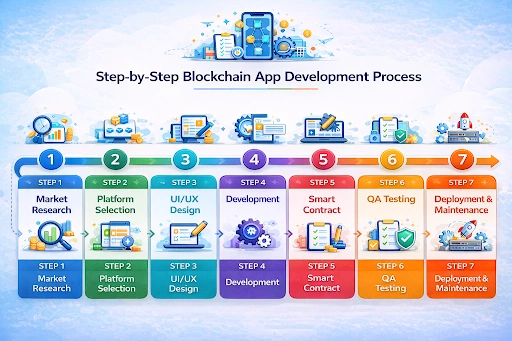
Step 1: Market Research and Requirements Analysis
Any successful blockchain use case starts with a strict interpretation of the issue it addresses. It is a stage of capturing the target user base, pinpointing pain points, competitor research, and identifying which blockchain attributes (immutability, transparency, decentralization) are actually relevant to the use case. Not all problems are enhanced with the help of blockchain. This step eliminates those use cases that can be better handled by conventional databases.
Step 2: Choose the Right Blockchain Platform
Among the most significant choices in the project is the platform selection. Among the important assessment criteria, there are:
- Scalability: What number of transactions/sec. Does the application require?
- Privacy requirements: Is transaction data to be made public or confidential?
- Smart contract features: Does the platform handle the necessary contract complexity?
- Maturity of developer ecosystem: Does the project have libraries, documentation, and developer communities?
- Gas prices and economics: Which is the long-run model of the cost of on-chain operations?
Step 3: Define Deployment Strategy
Decision on whether the application will run on a public blockchain (maximum decentralization, more costly), private blockchain (controlled access, less costly), or on a hybrid architecture (selective transparency). This choice has been made to influence all future architectural and operational decisions.
Step 4: UI/UX Design
Blockchain apps present new UX issues that are absent in regular apps: wallet connection flows, transaction confirmation dialogue, gas fee explanations, and key management.
The interfaces that harness these complexities without sacrificing user agency require expert UI/UX designers with experience in blockchain. Front-end code must not be written before wireframes are reviewed by real target users.
A well-designed interface, supported by strong mobile app design practices, ensures that users can easily navigate complex blockchain functionalities without confusion.
Step 5: Smart Contract and Backend Development
The development stage takes place concurrently: development of smart contracts and development of the front-end/middleware. Agile sprint methodology guarantees persistent delivery and integration of feedback.
Many organizations also integrate advanced technologies like artificial intelligence development and machine learning solutions to enhance automation and decision-making within blockchain applications.
Step 6: Quality Assurance and Security Audit
Blockchain applications are even harder to QA than traditional software since bugs in smart contracts cannot be removed. This phase of blockchain application testing is essential because even minor vulnerabilities can lead to irreversible losses. The regimen of testing should consist of:
- Each smart contract functionality has unit tests.
- Testing: Tests that verify the entire application stack.
- Real user journey simulation tests.
- Third-party audit of the security of a smart contract (required prior to mainnet deployment)
- Load testing and stress testing to test performance at peak load.
Businesses often rely on specialized mobile app testing services to ensure performance, security, and reliability across devices and blockchain environments.
Step 7: Deployment to Mainnet
The process starts with a gradual deployment: testnet, then limited beta access, and finally the full public deployment. Migration scripts are used to deploy smart contracts. The application frontend is placed with a hosting provider or IPFS (as decentralized as possible). Passes that optimise gas help to save users the cost of interacting with contracts.
Step 8: Maintenance, Monitoring, and Upgrades
Maintaining blockchain programs after launch is not comparable to maintaining traditional software. Smart contracts cannot be patched; upgradeable proxy patterns need to be thought out during development.
Continued activities include network monitoring, monitoring smart contract events, wallet-related support, regular security re-audits, and integration, all due to the ongoing development of the underlying blockchain protocol.
Ongoing support can be streamlined through dedicated application maintenance services, ensuring the app remains secure and up-to-date with evolving blockchain protocols.
What are Blockchain Development Trends that are Shaping the Future?
The blockchain ecosystem is evolving rapidly, and staying updated with the latest blockchain development trends is essential for developers, enterprises, and investors looking to leverage this technology.
These trends are defining the future of blockchain-based decentralized applications (dApps) and enterprise-level blockchain solutions by improving scalability and supporting newer technologies.
1. Layer 2 Scaling Solutions
Scalability and high transaction costs are some of the key issues as blockchain networks continue to expand. Solutions with Layer 2, including Optimistic Rollups and zk-Rollups, are on the increase.
They off-chain process transactions and ensure security on the primary blockchain, making dApps and DeFi platforms dramatically more high-performing and lower-cost.
2. Interoperability Between Blockchains
Cross-chain communication is gaining priority as businesses and application developers need to have smooth communication across different blockchain networks.
Different projects, such as Polkadot, Cosmos, and Chainlink, make this possible, enabling assets, data, and smart contracts to cross chains effectively.
3. Decentralized Finance (DeFi) Expansion
DeFi is further altering traditional finance, and new protocols have appeared in lending, borrowing, staking, and insurance.
Automated smart contracts are enabling transparent, trustless financial services that appeal to both retail and institutional users. There is also a short-term increase in the integration with stablecoins and cross-chain DeFi solutions.
4. NFT Evolution and Tokenization
Non-Fungible Tokens (NFTs) are evolving beyond digital art into games, intellectual property, real estate, and loyalty programs.
Physical and digital assets can be easily fractionally owned, royalties automated, and traded safely through tokenization. NFT adoption is increasing in enterprises, with the marketplaces becoming more mainstream.
5. Enterprise Blockchain Adoption
Priva and consortium blockchains are pervasively used in supply chains, healthcare, finance, and energy industries.
Blockchain is being applied in businesses to provide traceability, secure data sharing, regulatory compliance, lower operational costs, and enhanced transparency. Hyperledger Fabric and Corda are the forefront systems in this field.
6. Privacy and Zero-Knowledge Proofs (ZKPs)
In blockchain development, privacy is becoming an issue. Cryptographic devices such as Zero-Knowledge Proofs can be used to verify transactions without disclosing sensitive data. This is especially applicable in the financial services, healthcare, and identity management applications.
Monetization Strategies for Blockchain Apps
Monetization of blockchain applications is a niche industry, as the decentralized architecture changes the list of objects that are technically possible and commercially viable. These are the subsequent strategies that demonstrated achievements in real-life blockchain products.
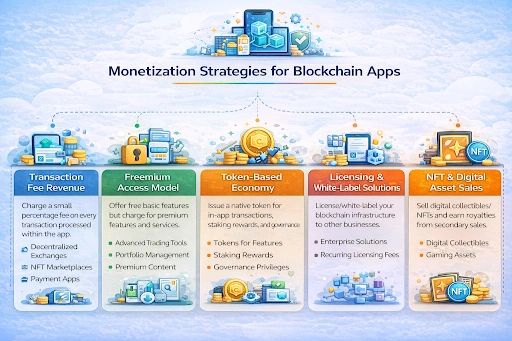
1. Transaction Fee Revenue
The easiest monetization: impose a small fee on every transaction made on your site. The model scales well with usage and is typically used in decentralized exchanges (DEXs), NFT marketplaces, and payment apps. The charges should be presented clearly to ensure they do not forfeit to competing sites and to cover operating costs.
2. Freemium Access Model
Provide basic functionality that is free and limit premium functionality to subscription or one time fee. This lowers the adoption barrier and creates a valuable upsell channel. The value proposition is experienced by users before committing funds. This model is applied in a number of DeFi and portfolio management applications.
3. Token-Based Economy
Issue a native token, the currency of trade in your application ecosystem. Users buy tokens to gain access to premium features, stake tokens to earn rewards, or hold tokens to exercise governance privileges. The token economy (tokenomics) should also be designed so that all participants have incentives and does not result in an inflationary crash.
4. Licensing and White-Label Solutions
The network-based blockchain enterprise, particularly the consortium and privately operated ones, can be licensed to other businesses. You provide the infrastructure and charge recurring licensing fees rather than competing with consumer applications. It is a B2B model with high-value, predictable revenue streams.
5. NFT and Digital Asset Sales
Applications with digital collectible capabilities (gaming items, membership passes, loyalty assets) are able to make revenue by selling primary NFTs and collecting royalties on the secondary market. Smart contracts can be used to spend royalties on every resale, creating an infinite royalty stream of revenue.
Best Practices for Blockchain Development
Adhering to established best practices dramatically reduces the risk of security incidents, technical debt, and failed deployments. These are the practices that distinguish professional blockchain development teams from those who learn through costly mistakes.
- Keep Security In Mind: Blockchain technology is inherently secure, but your code can still be vulnerable to attacks. Make sure to follow best practices for security, such as code reviewing, penetration testing, and smart contract auditing.
- Test Early And Often: Testing is crucial to ensure your blockchain app works as planned. Use automated testing frameworks and conduct regular manual testing to catch bugs and errors early on.
- Use Version Control: Version control is essential for managing code changes in a blockchain project. A version control system like Git will help you track changes, collaborate with team members, and manage code versions.
- Follow Coding Standards: Consistent coding standards make it easier for team members to work together and maintain the codebase. Use coding standards like Solidity Style Guide to ensure consistency in your code.
- Collaborate With The Community: Blockchain development is a community-driven effort, and collaborating with the community can help you stay updated with the latest trends and best practices. Participate in online forums, attend conferences, and contribute to open-source projects to learn from others and share your knowledge.
Blockchain App Development Cost Breakdown
The cost of blockchain application development varies significantly based on application complexity, the blockchain platform chosen, the geographic location of the development team, and the scope of smart contract functionality required. The ranges below reflect market rates as of 2026.
| App Complexity | Estimated Cost (USD) | Timeline |
| Simple App (Basic Smart Contract, Single Function) | $40,000 – $60,000 | 8–12 weeks |
| Medium App (Advanced Platform, Multiple Contracts) | $60,000 – $150,000 | 3–6 months |
| Complex App (Full DeFi / Enterprise Distributed Network) | $150,000 – $300,000+ | 6–12+ months |
For a more accurate estimate, businesses should also consider factors similar to mobile app development cost, including design complexity, integrations, and long-term maintenance.
How to Choose the Right Blockchain Development Partner?
A partner specializing in custom blockchain app development can tailor solutions for your unique business needs. These are criteria that should be used in your selection:
a) Technical Depth and Portfolio
Ask to demonstrate the implementation of smart contracts on mainnet networks before. Vet their GH repositories. Enquire specifically about the security issues of previous projects and their management. An unsipped partner with no prior experience in shipping production blockchain code is a significant risk, regardless of their overall software qualifications.
b) Domain Knowledge
Development at the enterprise level of blockchain requires understanding the regulatory environment, compliance requirements, and industry-specific requirements. A medical blockchain partner must be well-versed in the HIPAA data requirements; a financial services partner must be aware of AML/KYC requirements. Anonymity of blockchain knowledge is not enough.
c) Transparency and Communication
Close collaboration with clients is a must in blockchain work, especially in the requirements and smart contract design stage. Observe the communication procedures, the sprint review schedule, and the partner’s documentation. The partner who cannot justify their architecture choices in plain language is not the right partner.
d) Post-Deployment Support
The monitoring of smart contracts, the management of protocol upgrades, and re-auditing the security are continuous needs. Make sure your partner provides well-organized post-deployment support contracts rather than ad hoc availability.
Conclusion
Blockchain application development is one field where preparation is rewarded. The successful ones are the projects founded on a well-established problem statement, an attentively chosen architecture, well-tested smart contracts, and a user experience that ensures the end user does not see the complexity of the technology the project uses.
We have taken it all: the underlying mechanics of how blockchain operates, the strategic choice of which type of blockchain to implement, the process of developing the tooling, the monetization models, and the cost analysis.
The most significant understanding that ties all the parts together is that blockchain can deliver real value only when the demands of the application align with its properties: decentralization, immutability, and transparency.
To investors in blockchain, entrepreneurs, and CTOs, the way forward is easy: state the problem, choose the architecture, work with partners who have been there, and conduct audits. The technology has reached the stage where the blockchain risk is not on the blockchain itself but rather on the quality of the team operating on top of it.
Why Choose AppsChopper for Your Blockchain App Development?
AppsChopper has more than 10 years of experience in the development of high-quality applications across mobile, web, and emerging technology platforms, including blockchain. We have Solidity engineers, DeFi architects, Hyperledger developers, and UI/UX professionals in our blockchain practice, and we know that a blockchain app can be as good as its user experience.
We are an actual technology partner, not a development vendor. Our team will be responsible for the entire project lifecycle, from initial discovery and architecture design to smart contract security audits, mainnet deployment, and long-term maintenance. Our customers include venture-backed DeFi startups as well as multinational corporations implementing their own blockchain networks for supply chain and compliance use cases.
We are open to discussing ideas or problems you think could be solved by blockchain. Our consultants will assist you in deciding whether blockchain is a good fit for your use case, the most suitable platform, and a realistic budget and timeframe to meet your specific needs.
FAQs
1. What is the difference between a blockchain app and a regular app?
A conventional application is one that stores information on central servers managed by a single company. A blockchain solution uses a distributed ledger to store critical data and business logic without a central point of control. This also renders blockchain applications resistant to censorship, manipulation, and points of failure, but complicates their development and increases their operational costs.
2. Do I need a public blockchain for my enterprise application?
Not necessarily. Most enterprise blockchain applications rely on private or consortium blockchains (such as Hyperledger Fabric or Corda), which limit access to authorized users. The use of public blockchains is best suited when censorship resistance and open participation are essential issues. Internal enterprise applications require higher performance and lower costs, which are provided by private blockchains.
3. How long does it take to build a blockchain app?
A simple blockchain application (basic smart contract with a standard frontend) can be developed in 8–12 weeks. Medium-complexity applications typically require 3–6 months. Enterprise-grade distributed network applications can take 6–12 months or more. Timeline is heavily influenced by smart contract complexity, security audit scope, and front-end requirements.
4. What programming languages are used in blockchain development?
Solidity is the dominant language for Ethereum and EVM-compatible chains. Vyper is an alternative to Ethereum, focused on simplicity and security. Rust is used for Solana development. Go and JavaScript are the primary languages for Hyperledger Fabric chaincode. Kotlin and Java are used for Corda development.
5. Is a security audit required for blockchain applications?
A security audit is mandatory for any blockchain application that handles real user assets or sensitive data. Smart contract vulnerabilities cannot be patched after deployment; they must be identified and resolved before launch. The cost of an audit ($10,000–$50,000+) is negligible compared to the cost of a security incident that drains user funds or damages the platform’s reputation.
6. How do I estimate the cost of building a blockchain app?
Start with the complexity tier: simple (basic smart contract, $40K–$60K), medium (multi-contract platform, $60K–$150K), or complex (distributed enterprise network, $150K–$300K+). Add estimates for security audits, infrastructure costs, and post-launch maintenance. A detailed cost estimate requires a discovery engagement with your development partner to precisely scope the requirements.