Table of Contents
Analyzing large data sets has traditionally been tedious, and without modern tools, finding actionable insights has been challenging. The development of analytics technology has increased our ability to explore large datasets through data mining in healthcare and extract key insights that can enhance everything from business operations to customer experience.
Large companies like Netflix and Amazon engage in data mining to identify user interests. They leverage their data to promote products they believe users are most likely to interact with. By 2026, the global data mining market is valued at $1.66 billion and is expected to grow by 11.25% over the next five years.
In this blog, you will learn how data mining is applied in the healthcare industry, including techniques, real-life examples, and the challenges it presents.
What is Data Mining in Healthcare?
Data mining in healthcare information systems involves analyzing data to identify patterns and improve healthcare quality. There are various applications and techniques for data mining in healthcare. As a result, technological innovations in healthcare have become revolutionary and adaptable.
How Does Data Mining Work in Healthcare?
Data mining in healthcare involves analyzing large amounts of clinical data to predict outcomes, identify patterns, and support smarter clinical decisions. It works by collecting raw data from sources like EHRs, lab systems, and billing platforms, cleaning and organizing that data, and running it through advanced analytical models that reveal insights beyond human detection.
The process follows these five steps:
1. Data collection: Gathering patient records, lab results, imaging, billing data, and more.
2. Data cleaning: Removing duplicates, filling gaps, and standardizing formats.
3. Data integration: Merging data from multiple sources into a unified dataset.
4. Pattern analysis: Applying algorithms to identify trends, correlations, and anomalies.
5. Actionable insights: Translating findings into clinical decisions, alerts, or operational changes.
In practice, it’s like a hospital being able to predict which of its discharged heart failure patients are most likely to be readmitted. The system will automatically alert care teams to act before a crisis happens. Overall, data mining in healthcare can turn raw data into life-saving actions.
What are the Benefits of Data Mining in Healthcare?
The use of data mining in healthcare has significantly improved the industry’s efficiency and effectiveness. Below is a summary of the different benefits associated with data mining for healthcare.
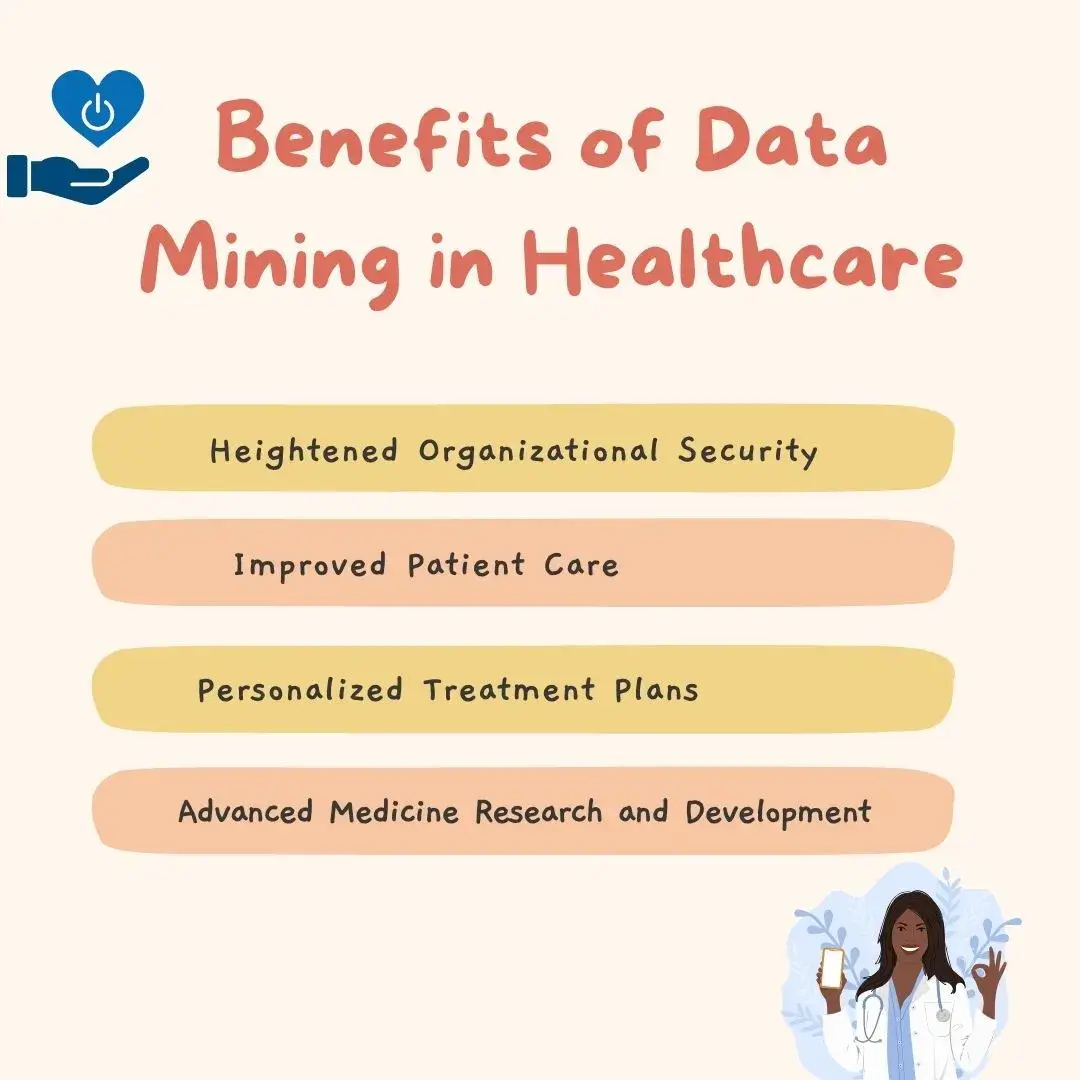
 1. Advanced Medicine Research and Development
Data mining projects in healthcare enable researchers to analyze large datasets from sources like clinical trials, patient records, and medical studies. Using these analyses and reliable IoT development platforms, healthcare professionals can perform many tasks through data mining, such as speeding up drug discovery by identifying the most effective compounds, understanding how diseases change in different populations, and more.
2. Heightened Organizational Security
Healthcare organizations are responsible for handling the most sensitive personal data, which means that security is a top priority. Data mining can help hospitals detect and flag unusual access patterns and potential data breaches before they escalate. Besides identifying threats, it strengthens compliance with regulations like HIPAA by continuously auditing data usage. Healthcare claim data mining can reveal billing anomalies and fraudulent activity across large provider networks.
3. Improved Patient Care
By analyzing historical patient data, healthcare providers are efficiently able to predict which patients are at risk of complications, readmission, or deteriorating condition. Medical data mining also helps optimize staffing, reduce wait time, and allocate resources more effectively.
4. Personalized Treatment Plans
As data mining becomes more popular, the one-size-fits-all approach to patient care is becoming outdated. Hospitals can leverage data mining and healthcare app development to create a platform that analyzes a patient’s medical history, genetics, lifestyle, and responses to past treatments. This enables clinicians to recommend the most effective treatments for each individual.
Applications: How is Data Mining Used in Healthcare?
Many data mining applications enhance the healthcare industry. They address operational inefficiencies and provide better treatments and experiences for patients. These applications are innovative and will continue to grow.
1. Pattern Recognition in Medical Imaging
Computer vision can analyze X-rays, MRIs, and CT scans to detect anomalies that the human eye might overlook. This helps reduce misdiagnosis and promotes earlier diagnosis and more advanced treatment.
2. Clinical Pathway Analysis
Sometimes, patients with similar diagnoses can follow different treatment paths. Clinical data mining involves analyzing the treatment steps of a large group of patients who achieve the same recovery outcome to help providers identify the “optimal” sequence of care.
3. Supply Chain Optimization
Data mining can lead to more efficient inventory practices. It can help predict when surgical supplies and medications will run out and expire. This allows healthcare organizations like hospitals to avoid being overstocked, which can lower inventory costs.
4. Fraudulent Claim Detection
Hospitals and other healthcare centers can identify unusual billing patterns using anomaly detection. For instance, a doctor billing for 300 procedures in a week would raise alarms, and this billing activity would be flagged because it significantly exceeds the volume of similar clinics in the area.
5. Identity Theft Prevention
One of the biggest considerations in healthcare, especially with the rise of digital healthcare, is identity theft. It is becoming increasingly important to prioritize security in telemedicine app development. When integrated properly, healthcare providers can monitor access logs to Electronic Health Records (EHRs) and detect unusual login patterns. Logging this activity can help prevent data breaches or unauthorized access to sensitive patient files.
Popular Data Mining Tools in Healthcare
As data mining gains popularity in healthcare, numerous clinical data software options are available to help hospitals and other healthcare organizations incorporate data mining into their daily activities.
| Tool | HIPAA Compliance | Primary Use in Healthcare | Pricing |
| IBM SPSS Modeler | Yes (configurable) |
|
|
| SAS Health Analytics | Yes (built-in) |
|
|
| Python | Configurable and must be set up by a developer |
|
|
| Tableau | Yes. Tableau Cloud is HIPAA compliant |
|
|
| Azure ML | Yes. Azure ML is HIPAA compliant and has BAA available |
|
|
| Weka | No built-in HIPAA compliance |
|
|
Best Data Mining Techniques in Healthcare
The most impactful data mining projects in healthcare use the most up-to-date and efficient techniques. Below is a breakdown of the methods used for efficient data mining today.
1. Decision trees
Decision trees are visual, branch-like diagrams that show decisions and their possible outcomes. They are easy to interpret and explain to non-technical staff, making them one of the most popular techniques in clinical decision-making.
Example: Hospitals can use decision trees to determine whether an incoming ER patient should be admitted, treated, and released, or referred to a specialist based on age, symptoms, vitals, and medical history.
2. Clustering
Clustering happens when patients are grouped based on shared traits within specific categories. Healthcare organizations can then identify patient segments and tailor care accordingly.
Example: A hospital clusters its patient population and discovers a previously unidentified group of middle-aged patients with overlapping symptoms of fatigue, weight gain, and high cholesterol. This data leads to screenings for underdiagnosed thyroid conditions across that group.
3. Genetic Algorithm and Survival Analysis
Survival analysis predicts how long until a specific event, like disease relapse or death, occurs. Genetic algorithms are used to optimize complex treatment challenges.
Example: Oncologists use survival analysis on cancer patient data to predict which patients are most likely to experience remission after a specific chemotherapy protocol. This helps tailor treatment plans based on proven outcomes for patients with similar profiles.
4. Natural Language Processing
Natural language processing is a technique that enables machines to read, interpret, and extract meaning from human language, such as physician notes, patient feedback, and medical literature.
Example: An NLP system is designed to analyze millions of physician progress notes across a hospital network and identify patients whose notes mention side effect symptoms that were not officially added to their diagnosis records.
Real-Life Examples of Data Mining in Healthcare
Over the past few years, many major hospitals have launched extensive and high-impact data mining examples in healthcare. As a result, they have made a difference in how data in integrated into the medical industry.
1. Cleveland Clinic: Scheduling, Cancer Treatment & Patient Outcomes
The Cleveland Clinic has implemented an AI scheduling system that cuts patient wait times by 20%, improves resource use, and speeds access to care. It also secured a patent for a machine learning decision support system that personalizes radiotherapy doses, enhancing cancer treatment precision. Since 2007, the clinic has collected patient-reported outcomes from over 720,500 visits, creating a database of about 13 million responses for research on effectiveness and quality.
The primary data mining techniques employed in this project were classification, clustering, and decision trees. The tools used included Epic EHR, PathAI, and Microsoft.
2. Johns Hopkins: Adverse Drug Reaction Prevention
Johns Hopkins used machine learning to predict adverse drug reactions in high-risk patients. The system identified adverse drug reactions 65% earlier, decreased serious adverse events related to medications by 48%, and reduced medication-related emergency department visits by 35%.
The data mining techniques used were predictive modeling and NLP. Johns Hopkins employed a custom ML platform to develop the drug reaction system and integrated 14 biological data streams. Overall, Johns Hopkins’ project proves that machine learning solutions are integral in data mining operations.
3. Lombardia Hospitals, Italy: Fraud Detection Across 183 Hospitals
Across 183 hospitals in Lombardia, scientists studied and analyzed patterns of fraudulent behaviors. The team identified groups of hospitals with similar procedures for heart failure treatment to make it easier to find outliers. Human auditors cross-validated the results, and the team was able to identify two hospitals whose patterns indicated possible fraud.
The data mining techniques and tools used in this project were K-means clustering, anomaly detection, and custom research models.
What are the Challenges of Data Mining in Healthcare?
If your organization is considering data mining, understanding the benefits is only part of the picture. Recognizing the challenges ahead helps with smarter planning, better investments, and avoiding mistakes that have caused issues for even the most well-equipped health systems.
1. Data Privacy and Security
Healthcare organizations hold some of the most sensitive personal information. Big data and data mining in healthcare must adhere to strict regulations like HIPAA, GDPR, and others depending on the patient’s location. Data mining requires access to large amounts of detailed patient data, which conflicts with the need to keep that data protected.
During data mining, there is a risk of data breaches during collection, storage, and transfer. It can also be difficult to anonymize data without losing significant analytical value. Patients are often unaware that their data is being used for mining, and non-compliance penalties, such as HIPAA violations, can cost up to $2 million per year. Learning about healthcare app development in 2026 can help improve data security.
2. Data Quality and Inconsistency
Healthcare data comes from many sources such as EHRs, lab systems, billing platforms, wearables, and pharmacy records. Each source is formatted and interpreted differently, which can lead to inconsistency. Incomplete or inaccurate data can produce misleading results that may directly harm patient care.
Missing or incomplete patient records can affect data quality, along with duplicate patient records across systems, human errors in manual data entry, and unstructured data in physicians’ notes that can be hard to automatically process.
3. Resistance from Clinical Staff
Clinical adoption remains one of the biggest barriers to success in data mining. The most powerful data mining systems won’t be effective if doctors and nurses don’t know how to use them or lack trust in them.
One of the most prominent issues with data mining is poor user interface design. It is important to develop an intuitive mobile app design that can be easily navigated by staff. Many clinicians are skeptical of AI-driven recommendations and the accuracy of its insights. However, when paired with human knowledge, data mining insights can provide a good outcome.
4. High Implementation Costs
Building a high-level infrastructure for data mining in healthcare is expensive. Many factors go into making the full ecosystem work properly, such as licensing costs, hardware and infrastructure costs, data preparation and cleaning costs, and human capital cost.
Some key considerations here are the ongoing costs of cloud computing, storage, and maintenance. Staying informed about the various factors influencing mobile app development costs in 2026 will help healthcare providers remain current.
5. Scalability Issues
Technologies and techniques that work in one hospital program might not always scale across an entire health system or nationwide network. The most significant issues affecting scalability are infrastructure that can’t handle large patient volumes, maintaining model accuracy over time as populations and disease patterns evolve, and updating and retraining models, which require significant ongoing investment.
What is the Future of Data Mining in Healthcare?
Data mining for healthcare has already advanced significantly, but even more innovations are on the horizon that will serve as a catalyst for a more revolutionary data mining process. The applications are already very diverse, and the benefits far outweigh the challenges. For businesses aiming to develop platforms that support data mining in healthcare, partnering with a company that offers reliable IoT app development services is a smart first step.
The hospitals and health systems leading the way in data mining are not only those with large budgets or the most advanced equipment. They are the ones that have recognized data as one of their most valuable assets and have made a conscious decision to mine it intelligently.
Conclusion
Data mining in healthcare continues to change how providers work with data and deliver care. What was once a manual industry driven by intuition is now one of the most data-savvy sectors worldwide. Every patient record, lab result, and clinical decision has the potential to contribute to something more than just a diagnosis.
For healthcare organizations still hesitant, it is crucial to understand that the cost of not engaging in data mining exceeds the investment required. Without a comprehensive data strategy, there will be missed diagnoses, operational inefficiencies, and preventable patient harm.
Harness the Power of Data Mining in Healthcare with AppsChopper
At AppsChopper, we assist healthcare organizations in unlocking the full potential of their data. Our skilled development team creates HIPAA-compliant, scalable data mining solutions, ranging from predictive analytics platforms to custom IoT integrations, tailored to meet the complexities of the healthcare industry. We don’t just write code; we develop tools that enhance patient outcomes, cut costs, and future-proof your organization. Ready to get started? Let’s turn your data into your most valuable clinical asset.
Frequently Asked Questions
1. How much does it cost to implement data mining in healthcare?
Costs of implementing healthcare data mining range from $500,000–$1.5M for small hospitals to $10M–$50M+ for large networks, depending on infrastructure, software, staffing, and compliance requirements.
2. Is healthcare data mining compliant with HIPAA and other regulations?
Yes, when properly implemented. Tools like SAS, Azure ML, and Tableau offer built-in HIPAA compliance, but organizations must sign Business Associate Agreements with every vendor.
3. How long does it take to integrate data mining solutions in healthcare?
Small implementations take 6–12 months. Enterprise-wide deployments typically take 2–4 years, depending on data quality, system complexity, staff training, and regulatory approvals.
4. How does big data enhance data mining applications in healthcare?
Big data provides larger, richer datasets that improve model accuracy, enable real-time analysis, uncover deeper patterns, and support more precise predictions across larger patient populations.
5. Is data mining suitable for small clinics and hospitals?
Yes. Cloud-based tools like Azure ML and open-source options like Python make data mining applications in healthcare accessible and affordable for smaller organizations without requiring massive upfront infrastructure investment.